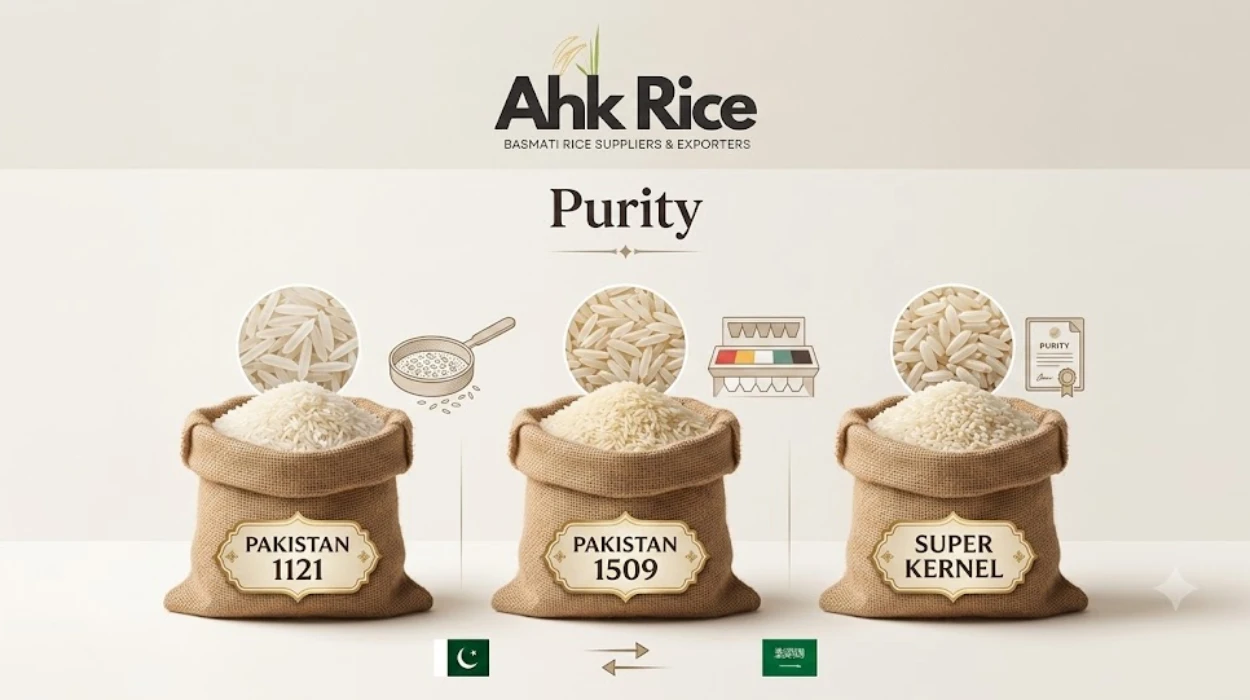
Purity Comparison Between Pakistan 1121, 1509, and Super Kernel Rice for Saudi Arabia
Pakistan 1121 Basmati rice offers the highest grain purity for premium Saudi Arabian retail and hospitality markets, while 1509 provides a balance between purity and affordability, and Super Kernel remains a preferred option for traditional buyers seeking authentic aroma with competitive pricing. Choosing the correct variety depends on the target market, packaging segment, and buyer specifications rather than grain length alone.
Saudi Arabia remains one of the largest importers of Pakistani Basmati rice in 2026. Importers now evaluate rice beyond aroma and grain length. Purity percentage has become a major purchasing specification because it directly affects cooking consistency, packaging claims, customer satisfaction, and retail brand reputation. Saudi food regulations and private-label retailers increasingly require consistent quality across every shipment.
Before comparing varieties, it helps to understand how Saudi importers evaluate rice purity throughout the supply chain, from harvesting to export inspection. This broader overview is explained in our educational guide:
Why premium Saudi brands carefully examine grain purity before selecting Pakistani Basmati rice,” before moving into detailed variety comparisons.
The three major Pakistani export varieties 1121 Basmati, 1509 Basmati, and Super Kernel Basmati—each have different physical characteristics, milling behavior, and purity performance. When sourced from experienced exporters such as AHK Rice, these varieties undergo controlled processing, optical sorting, grading, metal detection, moisture testing, and multiple quality inspections before export to Saudi Arabia.
What does purity mean when comparing Pakistan 1121, 1509, and Super Kernel rice?
Purity refers to the percentage of genuine rice grains belonging to one specific variety without contamination from broken grains, foreign matter, immature kernels, chalky grains, damaged kernels, red grains, or other rice varieties. Higher purity delivers better cooking consistency, stronger consumer confidence, and improved retail brand value.
Rice purity is not simply cleanliness.
It is a measurable quality specification used during export inspection.
Modern rice mills measure purity after several processing stages.
Typical inspection includes:
- Variety identity
- Foreign matter
- Broken percentage
- Damaged kernels
- Chalky grains
- Paddy presence
- Red grains
- Immature grains
- Discolored kernels
Saudi importers usually request purity certificates before shipment approval because purity directly affects customer complaints, cooking performance, and product positioning.
Premium private-label brands often require purity above 95–98%, while foodservice distributors may accept slightly lower specifications depending on price targets.
How do Pakistan 1121, 1509, and Super Kernel compare in export specifications?
Although all three varieties satisfy Saudi import requirements, 1121 consistently achieves the highest export-grade purity because of its long grain structure and advanced optical sorting efficiency. 1509 follows closely, while Super Kernel maintains excellent traditional quality despite naturally shorter grain dimensions.
Export Specification Comparison (2026)
| Specification | 1121 Basmati | 1509 Basmati | Super Kernel |
|---|---|---|---|
| Average Grain Length | 8.3–8.5 mm | 8.2–8.4 mm | 7.2–7.5 mm |
| Typical Export Purity | 98–99% | 97–98% | 96–98% |
| Broken Rice | 1–2% | 2–3% | 2–4% |
| Foreign Matter | Below 0.1% | Below 0.1% | Below 0.1% |
| Average Moisture | 12–13% | 12–13% | 12–13% |
| Cooking Elongation | Very High | High | Medium-High |
| Saudi Premium Market Suitability | Excellent | Very Good | Very Good |
The higher grain length of 1121 allows optical sorting machines to distinguish defective grains more accurately.
1509 performs similarly but is harvested earlier, making careful drying and grading essential.
Super Kernel remains highly valued because of its traditional aroma and established market acceptance despite its shorter grain profile.
What processing methods improve rice purity before export?
Multiple processing stages remove defects progressively instead of relying on one machine. Combining cleaning, grading, optical sorting, polishing, and final inspection produces significantly higher purity than single-stage processing and creates consistent export quality suitable for Saudi import standards.
Modern export mills use several technologies.
The sequence usually includes:
- Pre-cleaning
- Destoning
- Paddy separation
- Length grading
- Thickness grading
- Optical color sorting
- Metal detection
- Final manual inspection
- Laboratory testing
- Export packaging
Each stage removes different defects.
Optical sorters identify color variations.
Length graders separate mixed varieties.
Gravity separators remove immature kernels.
Laboratory verification confirms the final purity percentage before container loading.
AHK Rice follows this multi-stage export process to ensure consistency across commercial shipments destined for Saudi Arabia and other international markets.
Which rice variety is best for different Saudi Arabian market segments?
No single variety serves every buyer equally. Premium retailers typically choose 1121, mid-range distributors often prefer 1509, while traditional wholesalers and foodservice businesses continue selecting Super Kernel because each variety matches different pricing, branding, and consumer expectations.
Saudi Arabia contains multiple market segments.
Each segment values different purchasing factors.
Retail Premium Brands
Preferred Grade:
- 1121 Extra Long Grain
Reasons:
- Premium appearance
- Maximum elongation
- Excellent purity
- Luxury packaging
Supermarkets
Preferred Grades:
- 1121
- 1509
Reasons:
- Consistent cooking
- Attractive pricing
- Reliable shelf presentation
Foodservice Companies
Preferred Grades:
- 1509
- Super Kernel
Reasons:
- Volume purchasing
- Stable cooking
- Better budget management
Traditional Wholesale Markets
Preferred Grade:
- Super Kernel
Reasons:
- Consumer familiarity
- Traditional aroma
- Competitive pricing
Selecting the correct variety depends on the final consumer rather than selecting the highest specification available.
How do Saudi market preferences differ between the three rice varieties?
Saudi demand differs across retail, hospitality, wholesale, and private-label sectors. Premium brands prioritize appearance and purity, whereas institutional buyers balance purity with pricing, supply continuity, and cooking performance over large purchasing volumes.
Saudi Arabia Market Comparison (2026)
| Market Region | Preferred Variety | Main Buying Priority |
|---|---|---|
| Premium Retail | 1121 | Maximum purity and appearance |
| Hypermarkets | 1121 / 1509 | Consistent quality and pricing |
| Hotels & Restaurants | 1509 | Cost-performance balance |
| Wholesale Distribution | Super Kernel | Traditional demand |
| Private Label Brands | 1121 | Premium branding |
Consumer expectations influence purchasing decisions more than production costs.
Premium supermarket shelves prioritize visual quality.
Institutional kitchens prioritize cooking consistency.
Wholesale markets emphasize dependable supply.
How do prices and shelf life compare among Pakistan 1121, 1509, and Super Kernel?
Higher purity generally increases export pricing because additional sorting and grading require greater processing investment. However, shelf life remains similar across properly processed varieties when moisture content stays within internationally accepted export specifications.
Price and Storage Comparison (2026)
| Comparison Factor | 1121 | 1509 | Super Kernel |
|---|---|---|---|
| Typical Export Price | $1,250–$1,500/MT | $1,050–$1,250/MT | $950–$1,150/MT |
| Premium Processing Cost | Highest | Medium | Medium |
| Typical Shelf Life | 24 months | 24 months | 24 months |
| Best Storage Moisture | 12–13% | 12–13% | 12–13% |
| Packaging Options | Premium Retail | Retail & Foodservice | Wholesale & Retail |
Actual pricing changes according to harvest conditions, freight costs, packaging, and contract volume.
Proper warehouse conditions remain more important than variety for preserving long shelf life.
What are the advantages and disadvantages of each rice variety?
Every variety provides unique commercial benefits. Buyers achieve better purchasing outcomes by matching product characteristics with their target customers instead of assuming the highest purity automatically delivers the greatest commercial value.
Pakistan 1121
Advantages
- Highest purity potential
- Longest grain
- Premium retail appearance
- Excellent elongation
- Strong private-label value
Disadvantages
- Highest export price
- Greater sensitivity to improper storage
Example
Luxury Saudi supermarkets commonly package 1121 under premium private-label brands.
Pakistan 1509
Advantages
- Competitive pricing
- High purity
- Early harvest availability
- Strong cooking performance
Disadvantages
- Slightly shorter grain than 1121
- Lower luxury positioning
Example
Large restaurant suppliers frequently select 1509 because it balances quality with operating costs.
Super Kernel
Advantages
- Traditional aroma
- Stable consumer demand
- Competitive pricing
- Reliable availability
Disadvantages
- Shorter grain
- Less premium shelf appearance
Example
Traditional wholesale distributors continue purchasing Super Kernel because existing consumers recognize and trust the variety.
Which factors should buyers evaluate before selecting a rice variety?
Successful purchasing decisions combine purity, market positioning, pricing, cooking characteristics, storage conditions, packaging requirements, and supplier quality management. Evaluating every factor together reduces commercial risk and improves long-term customer satisfaction.
Buyer Decision Framework
| Decision Factor | 1121 | 1509 | Super Kernel |
|---|---|---|---|
| Premium Branding | Excellent | Good | Moderate |
| Budget Efficiency | Moderate | Excellent | Excellent |
| Luxury Retail Sales | Excellent | Good | Moderate |
| Foodservice Supply | Good | Excellent | Very Good |
| Traditional Market Demand | Good | Good | Excellent |
Before placing an order, buyers should verify:
- Purity certificate
- Laboratory analysis
- Moisture report
- Variety authenticity
- Packaging specification
- Inspection reports
- Container loading procedure
- Traceability documentation
These documents reduce quality disputes after arrival in Saudi Arabia.
What is the best approach for choosing the right Pakistan Basmati rice for Saudi Arabia?
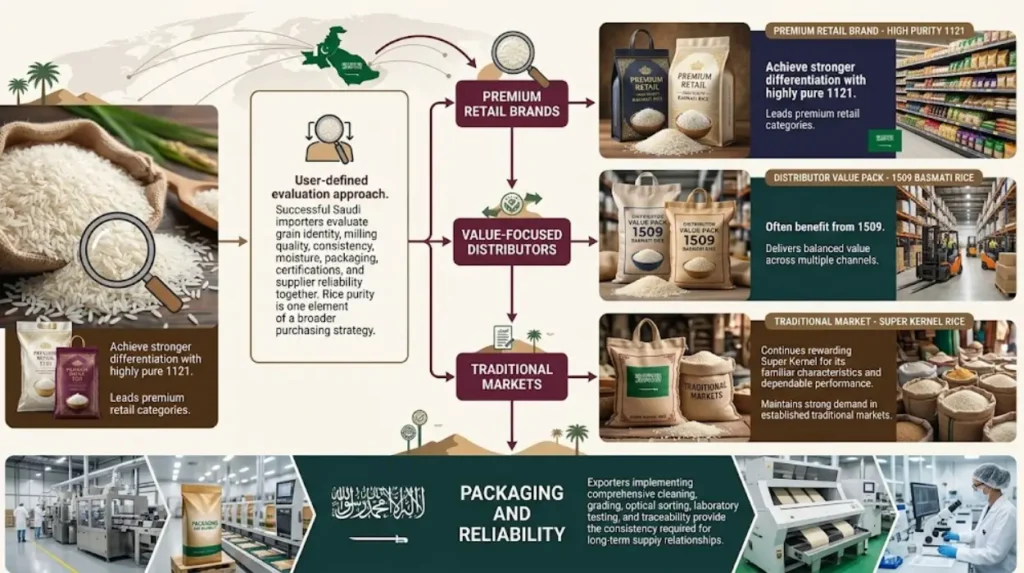
The most effective approach begins with understanding the final customer rather than selecting the highest specification automatically. Premium retail brands achieve stronger differentiation with highly pure 1121, value-focused distributors often benefit from 1509, and traditional markets continue rewarding Super Kernel for its familiar characteristics and dependable performance.
Rice purity is one element of a broader purchasing strategy.
Successful Saudi importers evaluate grain identity, milling quality, consistency, moisture, packaging, certifications, and supplier reliability together.
Each variety serves a distinct commercial purpose.
1121 leads premium retail categories.
1509 delivers balanced value across multiple channels.
Super Kernel maintains strong demand in established traditional markets.
Exporters that implement comprehensive cleaning, grading, optical sorting, laboratory testing, and traceability provide the consistency required for long-term supply relationships. AHK Rice applies these integrated quality-control practices throughout its processing and export operations, helping international buyers receive uniform shipments that align with modern Saudi import expectations.
For buyers ready to move from comparing varieties to evaluating supplier capabilities, certifications, and private-label export solutions, the next step guide on:
Frequently Asked Questions
Which Pakistan Basmati rice variety has the highest purity for Saudi Arabia?
Pakistan 1121 Basmati rice typically achieves the highest export purity, ranging from 98–99% after advanced optical sorting and grading. It is widely preferred by premium Saudi retailers and private-label brands.
Why is rice purity important for Saudi importers?
Rice purity ensures uniform cooking, reduces customer complaints, improves retail presentation, and helps importers meet Saudi quality standards for packaged and foodservice rice products.
How is rice purity tested before export?
Exporters test purity through laboratory analysis, optical sorting verification, grading inspections, and quality control checks that measure broken grains, foreign matter, damaged kernels, and varietal consistency.
Is 1509 Basmati rice suitable for the Saudi market?
Yes. Pakistan 1509 Basmati offers high purity, competitive pricing, and excellent cooking performance, making it popular among Saudi supermarkets, restaurants, and bulk food distributors.
What makes Super Kernel rice different from 1121 and 1509?
Super Kernel has a shorter grain than 1121 and 1509 but is valued for its traditional Basmati aroma, consistent cooking quality, and strong demand in Saudi wholesale and traditional retail markets.
Which rice variety offers the best value for money?
Pakistan 1509 Basmati is often considered the best value because it combines high purity, good grain length, competitive export pricing, and reliable cooking performance.
Does higher purity increase the export price?
Yes. Higher purity requires additional sorting and quality control, increasing processing costs and resulting in a higher export price, particularly for premium-grade 1121 Basmati rice.
What purity percentage do Saudi buyers usually require?
Most Saudi importers request rice purity between 95% and 99%, depending on whether the rice is intended for premium retail, private-label packaging, foodservice, or wholesale distribution.
How long can properly processed Pakistani Basmati rice be stored?
When stored at a moisture level of 12–13% in suitable packaging and warehouse conditions, Pakistani Basmati rice generally has a shelf life of up to 24 months.
Which Pakistan Basmati rice is best for Saudi private-label brands?
Pakistan 1121 Basmati is usually the preferred choice for Saudi private-label brands because of its extra-long grains, high purity, superior appearance, and premium market positioning.