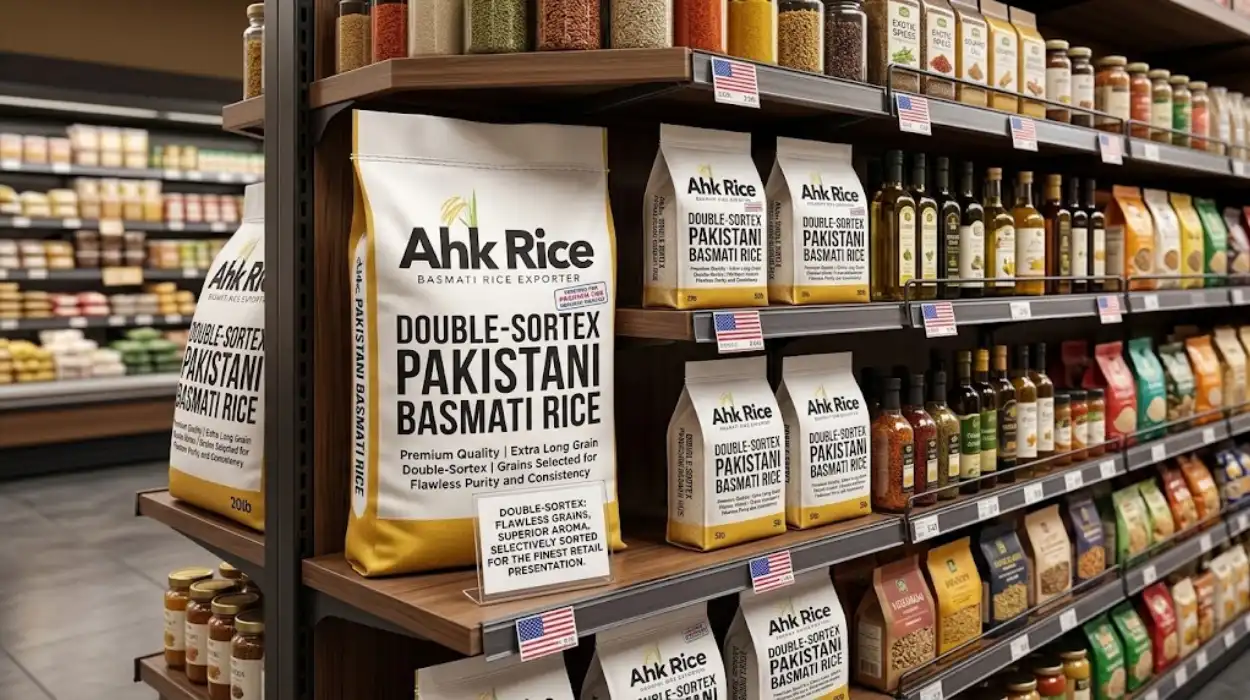
Buy Double-Sortex Pakistani Basmati Rice for Premium USA Grocery Shelves
Double-Sortex Pakistani Basmati rice is suitable for premium grocery shelves when importers require consistent grain appearance, controlled foreign-material levels, and clearly documented specifications. Buyers should approve a representative sample, confirm contractual tolerances, and verify the finished shipment before committing to commercial quantities.
Premium grocery customers expect rice to look consistent from one bag to another. Discoloured grains, visible foreign matter, excessive broken kernels, and inconsistent grain size can undermine product presentation and create complaints. Importers therefore need a defined quality specification rather than relying on descriptions such as premium or export quality.
Double-Sortex processing passes rice through optical colour-sorting equipment twice to identify and remove grains that differ from programmed colour parameters. Depending on the equipment and processing setup, this can improve the visual uniformity of the finished product. It does not automatically guarantee zero defects, a particular broken percentage, or compliance with every US import requirement.
For grocery programmes, buyers should specify the rice variety, processing style, grain length, moisture, broken percentage, colour tolerance, foreign-material limits, packaging, and inspection arrangements. These requirements should appear in the purchase specification and be confirmed before production.
Importers evaluating the processing method can read what Sortex colour sorting does for export Basmati rice. This educational guide explains why optical sorting matters when selecting rice for retail distribution.
Why Choose AHK Rice for Double-Sortex Basmati Rice?
AHK Rice supplies Pakistani Basmati rice from Punjab for international buyers seeking defined product specifications, processing coordination, and export shipment support. Importers can discuss double-Sortex requirements, sample approval, private-label packaging, and destination-specific documentation before confirming a commercial order.
AHK Rice works with established Pakistani Basmati varieties, including 1121, Super Kernel, and 1509. Each variety serves different retail and foodservice requirements. For a premium US grocery programme, 1121 can suit customers seeking long grains and an attractive cooked presentation, while Super Kernel offers traditional Pakistani Basmati characteristics.
Buyers can discuss their requirements directly through AHK Rice’s Basmati rice export service. The purchase specification should identify whether the order requires raw, steam, or parboiled rice, together with the required colour-sorting standard and packaging format.
The supplier and importer should agree on measurable acceptance criteria before processing begins. These can include minimum or average raw grain length, maximum moisture, broken percentage, milling quality, discoloured grains, foreign matter, and packaging weight tolerance. Any claimed specification must be verified against the actual lot and agreed inspection method.
Double-Sortex processing is a quality-control step, not a replacement for grading, laboratory testing, sanitation, or shipment inspection. A well-defined supply arrangement combines these controls with traceable lot identification and documentation.
How Does Double Sortex Compare with Single Sortex Rice?
Single-Sortex rice receives one optical colour-sorting pass, while double-Sortex rice receives two. The additional pass can improve the removal of remaining discoloured grains, depending on equipment settings and incoming quality. Buyers should compare verified samples, defect tolerances, and total landed costs.
Single-Sortex processing may satisfy buyers selling value-oriented Basmati or supplying markets with less demanding appearance specifications. Double-Sortex processing adds another opportunity to remove visually defective grains and may be appropriate for premium retail packs, private-label ranges, and distributors targeting consistent shelf presentation.
However, two passes do not guarantee that every defect is removed. Sorting performance depends on the incoming paddy or milled rice condition, machine calibration, throughput, lighting, defect recognition, and quality-control procedures. The final result must be assessed against the agreed specification.
US importers comparing processing options should review single vs double-Sortex Basmati rice for purity, appearance, and price. The comparison supports purchasing decisions based on the intended retail segment rather than the number of sorting passes alone.
| Purchasing factor | Single Sortex | Double Sortex |
|---|---|---|
| Optical sorting | One pass | Two passes |
| Visual uniformity | Depends on incoming quality and settings | May improve with an effective second pass |
| Processing cost | Usually lower | May be higher |
| Premium retail suitability | Depends on final sample | Useful when tighter appearance control is required |
| Acceptance criteria | Must be specified | Must be specified and verified |
The commercial decision should depend on the quality difference demonstrated by representative samples. If the second pass produces a meaningful improvement for the target shelf segment, the additional processing cost may be justified.
Which Specifications Should USA Grocery Buyers Confirm?
USA grocery buyers should approve a written specification covering variety, processing style, grain length, moisture, broken percentage, colour defects, foreign matter, packaging, and lot identification. The supplier should confirm achievable tolerances before production and provide agreed quality documents for the shipment.
For premium retail, 1121 Basmati is often considered where long grain appearance and cooked elongation are important. Super Kernel can suit retailers targeting traditional Pakistani Basmati aroma and eating quality. The correct selection depends on the price point, cooking expectations, and positioning of the grocery brand.
A purchase specification can include the following targets, subject to supplier confirmation and pre-shipment verification:
- Variety: 1121, Super Kernel, or another agreed Pakistani Basmati variety.
- Processing: Double-Sortex, with raw, steam, or parboiled processing clearly identified.
- Moisture: A contractual maximum, commonly targeted at 12–13% for suitable export-grade rice.
- Broken grains: An agreed maximum percentage appropriate to the grade.
- Appearance: Defined limits for discoloured grains and visible foreign material.
- Packaging: Approved bag material, net weight, label artwork, and batch identification.
- Documentation: Commercial invoice, packing list, transport documents, and applicable export and food-safety records.
These are purchasing considerations, not a universal guarantee of a particular lot. The importer should also confirm applicable US Food and Drug Administration requirements, facility and importer responsibilities, prior notice, and any relevant customs or phytosanitary requirements with qualified import and customs professionals.
What Results Can Buyers Expect?
A properly specified double-Sortex order can deliver more consistent visual presentation and a clearer basis for supplier acceptance. Results depend on incoming grain quality, machine performance, agreed tolerances, and inspection. Buyers should assess the sample before approving production and verify the commercial lot before shipment.
For example, a grocery distributor launching a five-kilogram premium 1121 Basmati pack may prioritise long, clean-looking grains and a low visible-defect level. A wholesaler supplying restaurants may place greater emphasis on cooking performance, broken percentage, and price per kilogram.
In both cases, double-Sortex processing should support a broader quality programme. It does not independently prove aroma, grain length, cooking elongation, food safety, or freedom from chemical residues. Those attributes require suitable specifications, tests, and evidence.
AHK Rice can discuss the requested processing and packaging requirements with the buyer before the order is finalised. The buyer should approve the sample, retain the agreed reference where practical, and establish a written process for resolving discrepancies between the approved sample and the delivered goods.
What Affects Double-Sortex Basmati Rice Pricing?
Double-Sortex pricing depends on rice variety, grade, crop and market conditions, incoming grain quality, sorting losses, processing requirements, order volume, packaging, inspection, and delivery terms. Request an itemised quotation so the buyer can compare product cost, freight, insurance, and destination charges accurately.
The second sorting pass can increase processing costs. Lower recovery rates can also affect the quantity of saleable rice produced from a given input. Premium 1121 grades, specialised steam or parboiled processing, retail-ready packaging, and tighter defect tolerances may add further costs.
Pricing also differs according to whether the contract uses FOB or CIF terms. FOB generally places the main ocean freight and insurance arrangements with the buyer after loading, subject to the agreed Incoterms. CIF includes cost, insurance, and freight to the named destination port, but does not automatically cover all destination charges or final delivery.
No fixed price should be assumed without a current written offer. Buyers should request a quote specifying the variety, grade, double-Sortex requirement, packaging, quantity, loading port, destination port, Incoterm, and quote validity.
How Much Does the Sample Process Cost?
Commercial samples allow importers to evaluate appearance, cooking quality, and suitability before placing a bulk order. Sample costs depend on quantity, preparation, courier destination, documentation, and applicable inspection or phytosanitary charges. Agree on all charges and responsibilities before dispatch.
A practical sampling workflow is:
- Submit requirements: Provide the variety, processing type, desired grade, packaging concept, destination, and intended order volume.
- Confirm the sample: Agree on sample weight, whether it represents the requested double-Sortex specification, and any sample-preparation fee.
- Arrange dispatch: Confirm the courier service, shipping charge, delivery address, and required paperwork.
- Complete evaluation: Check grain appearance, cooking performance, aroma, texture, and other agreed criteria.
- Approve the commercial specification: Record the accepted grade, packaging, tolerances, price basis, and inspection conditions before production.
For budgeting, the buyer should request a separate breakdown for the sample itself, courier shipping, and any applicable phytosanitary or documentation charges. These amounts vary by destination and shipment arrangement, so they must be confirmed rather than treated as fixed fees.
Where a sampling offer covers up to 20 kg of Super Kernel Basmati, the buyer should verify current eligibility and whether courier shipping and applicable phytosanitary charges remain payable. A sample of Super Kernel should not be treated as proof that a different 1121 or double-Sortex commercial lot will meet the same specification.
How Many Days Does Shipping to the USA Take?
Shipping schedules depend on the loading port, carrier service, transshipment, destination terminal, customs clearance, and inland delivery. Buyers should distinguish ocean transit from total door-to-door lead time and obtain a current carrier schedule before confirming retail launch dates.
For shipments from Pakistan to the United States, planning estimates can be used for initial discussions, but they are not guaranteed transit times:
| Destination market | Indicative ocean transit planning range |
|---|---|
| US East Coast | Approximately 25–40 days |
| US West Coast | Approximately 30–45 days |
| US Gulf Coast | Approximately 30–45 days |
Actual transit can fall outside these ranges. Routing, vessel availability, transshipment, congestion, seasonal demand, and carrier schedules all affect delivery. The time required for production, export clearance, vessel booking, US customs processing, and inland trucking must be added separately.
Importers should confirm the current route and estimated arrival date with their freight forwarder. Retail launch plans should include contingency time for inspections, documentation corrections, port delays, and warehouse receiving.
How Can Importers Start an Order with AHK Rice?
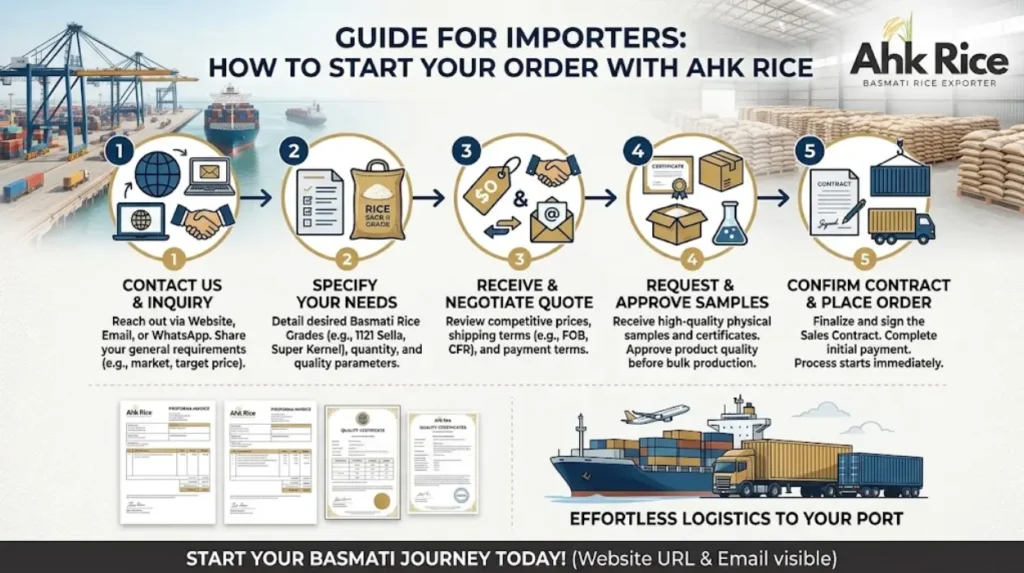
Start by defining the retail specification, requesting a sample, and agreeing on the commercial terms. Confirm the final grade, double-Sortex requirement, packaging artwork, inspection arrangements, shipping schedule, and import documentation before authorising production or shipment.
AHK Rice can discuss product selection, processing requirements, export packaging, and shipment planning with interested importers. Buyers should provide their destination port, expected volume, preferred variety, bag sizes, and target arrival window to support an accurate quotation.
The order process should proceed from written requirements to sample approval, quotation, contract confirmation, production, quality verification, export documentation, and shipment. Payment terms and responsibilities should be recorded in the contract.
Before dispatch, the importer should ensure that the product description and labels match the actual rice and intended market. US food import requirements should be reviewed with the importer of record and relevant compliance professionals.
For a premium grocery programme, the purchasing decision should be based on verified product quality and total landed cost, not the double-Sortex label alone. Buyers can discuss their required specifications and shipment plans with AHK Rice and request a quotation.
Frequently Asked Questions
What is double-Sortex Pakistani Basmati rice?
Double-Sortex Basmati rice passes through optical colour-sorting equipment twice. The process identifies and removes grains that differ from the programmed colour criteria. Its effectiveness depends on the incoming rice and equipment settings. Buyers should verify the finished sample against written defect tolerances.
Is double-Sortex rice better for premium USA grocery shelves?
It can be suitable when a retailer requires more consistent visual appearance. The second pass may remove additional discoloured grains. However, it does not guarantee zero defects or food safety. Importers should compare approved samples and confirmed specifications before purchasing.
Which Pakistani Basmati variety should US importers choose?
1121 suits programmes prioritising long-grain presentation and cooked elongation. Super Kernel can suit retailers seeking traditional Pakistani Basmati characteristics. The final selection depends on consumer expectations, cooking performance, price, and target shelf position. Buyers should test the actual variety before placing an order.
How much does a double-Sortex Basmati sample cost?
The cost depends on sample quantity, preparation, courier charges, and applicable documentation or phytosanitary fees. Some offers may cover the rice sample but exclude delivery expenses. Request a written cost breakdown before dispatch. Confirm that the sample matches the intended commercial specification.
How long does Pakistani Basmati rice take to reach the USA?
Ocean transit may take roughly 25–45 days, depending on the US destination and shipping route. Production, port handling, customs clearance, and inland delivery add time. These figures are planning estimates, not guaranteed schedules. Obtain a current freight quotation and vessel schedule before setting a retail launch date.