Super Kernel White Rice Price Trends Between Pakistan Exporters and UAE Importers
Pakistan remains one of the largest suppliers of Super Kernel White Rice to the UAE because of its consistent grain quality, competitive export pricing, established shipping routes, and year-round milling capacity. Export prices change according to paddy availability, milling costs, freight rates, exchange rates, seasonal demand, and government trade policies. Understanding these price drivers helps importers evaluate quotations and plan purchases with greater accuracy.
What are Super Kernel White Rice price trends between Pakistan exporters and UAE importers?
Super Kernel White Rice price trends between Pakistan exporters and UAE importers reflect continuous changes in export costs, freight expenses, currency exchange rates, seasonal harvest volumes, processing quality, and regional demand. Tracking these factors enables buyers to compare offers accurately and understand why identical products receive different quotations throughout the year.
Super Kernel White Rice is a long-grain aromatic rice variety grown mainly in Punjab, Pakistan. It resembles traditional Basmati in grain appearance but is generally offered at a lower export price than premium Basmati varieties.
The UAE imports large quantities of Pakistani rice to serve supermarkets, wholesale distributors, restaurants, catering businesses, and food processors. Dubai also acts as a regional redistribution hub, supplying neighbouring Gulf countries.
Rice prices between Pakistan and the UAE are normally discussed using FOB and CIF trade terms.
- FOB (Free on Board) represents the export price at the Pakistani port before ocean freight.
- CIF (Cost, Insurance and Freight) includes freight and insurance until arrival at the UAE destination port.
Anyone comparing supplier quotations should understand these pricing structures before evaluating offers.
Readers who want to understand how FOB prices convert into final landed costs can continue with the detailed guide on:
Comparing FOB export prices with delivered UAE import costs.
How is Super Kernel White Rice grown and processed before export?
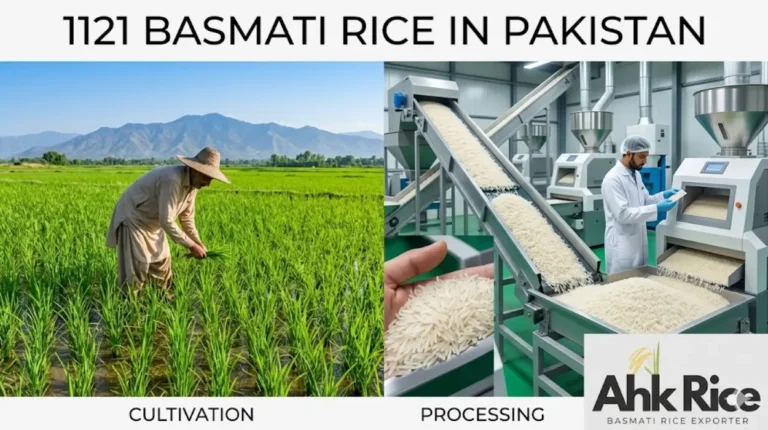
Super Kernel White Rice follows a structured production process that starts with certified seed selection, continues through cultivation, harvesting, drying, milling, grading, polishing, quality inspection, packaging, and export documentation before international shipment from Pakistan to overseas markets including the UAE.
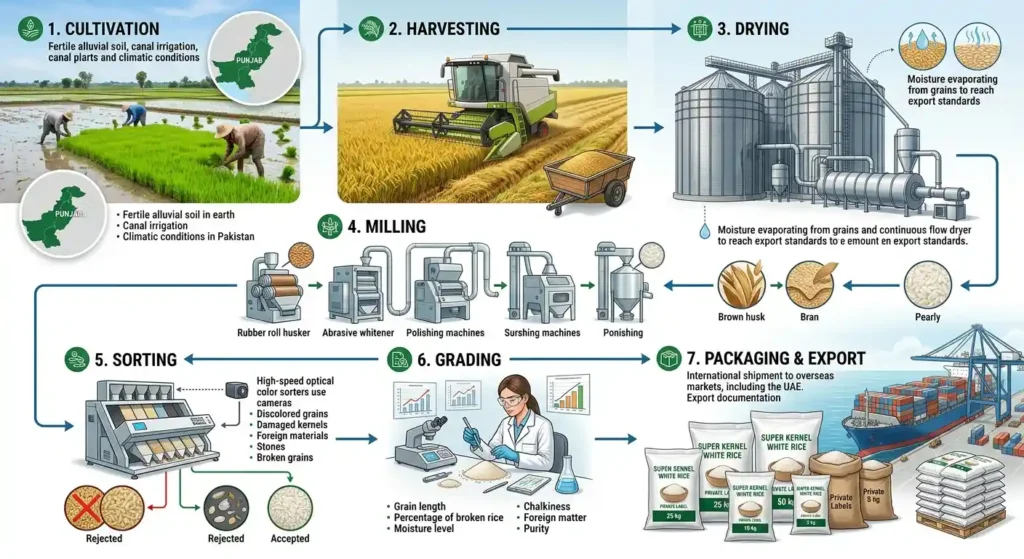
Punjab produces most of Pakistan’s export-quality Super Kernel White Rice because of its fertile alluvial soil, canal irrigation system, and suitable climatic conditions.
Cultivation
Farmers prepare the fields before transplanting rice seedlings.
The crop develops over several months under controlled irrigation.
Proper water management supports grain development and improves milling recovery.
Harvesting
Harvesting begins once the grains reach the required maturity level.
Mechanical harvesters reduce grain damage and improve efficiency.
Freshly harvested paddy contains high moisture.
Drying
Drying lowers moisture to export standards.
Controlled drying protects grain integrity and reduces breakage during milling.
Milling
The milling process removes:
- Husk
- Bran layer
- Surface impurities
The rice then passes through polishing machines to produce a clean white appearance.
Sorting
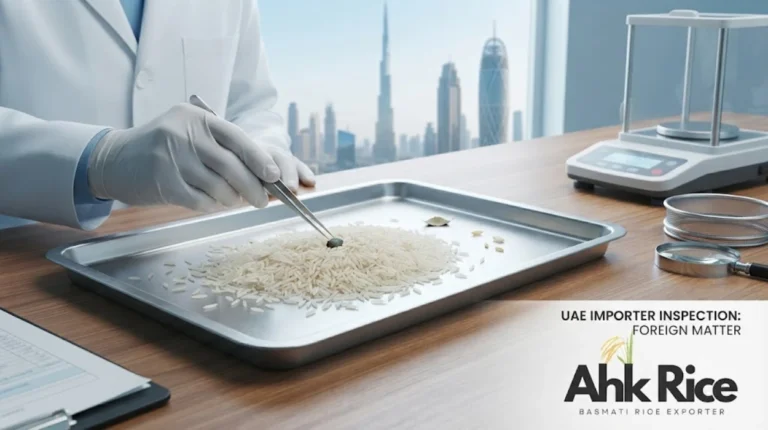
Modern optical colour sorters remove:
- Discoloured grains
- Damaged kernels
- Foreign materials
- Stones
- Broken grains
Grading
Each export lot is graded according to buyer specifications.
Typical grading factors include:
- Grain length
- Percentage of broken rice
- Moisture level
- Chalkiness
- Foreign matter
- Purity
Packaging
Rice is packed in different sizes including:
- 1 kg
- 2 kg
- 5 kg
- 10 kg
- 20 kg
- 25 kg
- 40 kg
- 50 kg
Private-label packaging is also widely used for Gulf retailers.
Which factors influence Super Kernel White Rice prices in Pakistan and the UAE?
Rice prices change because production costs, export demand, freight charges, exchange rates, harvest timing, packaging specifications, and quality grades all influence the total transaction value from Pakistani suppliers to UAE importers throughout the trading year.
Several measurable factors determine export quotations.
Paddy prices
Raw paddy prices establish the base production cost.
Higher farm-gate prices increase milling costs.
Harvest season
Fresh harvest supplies generally increase market availability.
Higher supply stabilises export prices.
Lower inventories later in the marketing season often increase quotations.
Ocean freight
Container shipping costs remain a significant component of UAE import pricing.
Changes in global shipping markets directly affect CIF prices.
Currency exchange
Rice exports are generally traded in US dollars.
Changes in the Pakistani Rupee influence exporter pricing calculations.
Energy costs
Electricity and fuel affect:
- Milling
- Drying
- Warehousing
- Inland transportation
Higher operating expenses increase export quotations.
Packaging
Different packaging formats have different costs.
Examples include:
- Retail consumer bags
- Woven polypropylene bags
- BOPP laminated bags
- Jumbo bulk bags
Custom branding also affects total pricing.
What quality specifications affect export prices?
Quality specifications determine export value because buyers pay according to measurable characteristics including grain length, broken percentage, moisture content, purity, colour consistency, milling quality, and packaging standards that directly influence commercial acceptance in international markets.
Every shipment is inspected against agreed specifications.
Common export parameters include:
| Quality Factor | Typical Export Importance |
|---|---|
| Grain Length | Premium appearance |
| Broken Percentage | Lower percentages command higher prices |
| Moisture Content | Longer storage stability |
| Purity | Higher commercial value |
| Colour Uniformity | Better retail presentation |
| Foreign Matter | Export compliance |
| Milling Quality | Higher customer acceptance |
Lower broken percentages generally receive higher market prices.
Higher polishing consistency also improves buyer acceptance.
Which grades of Super Kernel White Rice are commonly exported?
Super Kernel White Rice is exported in several commercial grades that satisfy different wholesale, retail, food service, and institutional requirements through varying specifications for grain length, broken percentage, polishing level, and packaging configuration.
Export grades generally include:
Sortex Super Kernel White Rice
This grade undergoes advanced optical sorting.
It offers high visual consistency.
Double Polished Grade
Additional polishing creates a brighter grain appearance.
Retail markets often prefer this finish.
Single Polished Grade
This grade retains a more natural surface.
Many wholesalers purchase this specification.
Different Broken Levels
Commercial contracts commonly specify:
- 1% broken
- 2% broken
- 5% broken
- 10% broken
Lower broken percentages generally receive higher export quotations.
Which countries import Pakistani Super Kernel White Rice?
Pakistani Super Kernel White Rice reaches international buyers across the Middle East, Africa, Europe, North America, and Asia because its quality, competitive pricing, and reliable export infrastructure support diverse commercial food markets and retail sectors.
The UAE remains one of Pakistan’s largest rice trading partners.
Other importing markets include:
- Saudi Arabia
- Oman
- Qatar
- Kuwait
- Bahrain
- Iraq
- Yemen
- United Kingdom
- Germany
- Canada
- Australia
- South Africa
- Kenya
- Tanzania
- Malaysia
Each destination specifies different packaging sizes and quality requirements.
Retail markets usually demand premium presentation.
Food service buyers often prioritise competitive pricing and consistent cooking performance.
Which certifications support Super Kernel White Rice exports?
International certifications verify food safety, traceability, hygiene, and regulatory compliance across farming, milling, storage, packaging, and export operations, helping overseas buyers assess supplier capability using recognised international quality management systems.
Common export certifications include:
- ISO 22000 Food Safety Management
- HACCP
- FSSC 22000
- BRCGS Food Safety
- Halal Certification
- Phytosanitary Certificate
- Certificate of Origin
- Fumigation Certificate when required
- SGS or third-party inspection upon buyer request
Import requirements differ by destination country.
Export contracts normally specify all required documentation before shipment.
What benefits do buyers gain by understanding rice price trends?

Understanding price trends enables importers to compare quotations objectively, calculate total purchasing costs, schedule procurement efficiently, evaluate supplier offers accurately, and improve inventory planning across changing international market conditions.
Price trend analysis improves purchasing decisions.
Buyers can identify:
- Seasonal pricing patterns
- Freight cost movements
- Currency impacts
- Packaging cost differences
- Quality-related price variations
Historical market analysis also supports annual procurement planning.
Businesses purchasing multiple containers each year often compare quotations over several months rather than relying on one-day pricing.
What are the common misconceptions about Super Kernel White Rice pricing?
Many buyers incorrectly assume that all exporters offer identical products, FOB prices always represent total import costs, lower quotations indicate better value, and identical rice grades perform equally after shipment, although measurable quality differences significantly affect commercial pricing.
Several misconceptions continue to influence purchasing decisions.
Lowest price always means best value
Lower quotations sometimes reflect:
- Higher broken percentages
- Lower milling quality
- Reduced sorting standards
- Different packaging
- Different payment terms
Price alone does not define commercial value.
FOB and CIF are identical
These pricing methods represent different cost structures.
Freight and insurance significantly influence final landed cost.
Every Super Kernel shipment has identical quality
Quality varies according to:
- Paddy selection
- Milling technology
- Sorting equipment
- Storage conditions
- Export specifications
Professional buyers compare complete specifications rather than headline prices.
How are Super Kernel White Rice price trends expected to evolve in 2026?
Current 2026 market conditions indicate that export pricing continues responding to harvest volumes, freight markets, global food demand, production costs, and exchange rate movements while Pakistan maintains a strong competitive position in supplying Super Kernel White Rice to UAE buyers.
The Pakistan–UAE rice trade continues to benefit from established logistics networks and strong commercial relationships.
Exporters increasingly invest in automated sorting, food safety systems, and customised packaging to meet evolving buyer requirements.
Importers increasingly compare total procurement costs instead of focusing solely on FOB quotations.
Evaluating product specifications, logistics expenses, documentation requirements, and delivery schedules together provides a clearer understanding of overall purchasing costs than comparing headline export prices alone.
Frequently Asked Questions
What affects Super Kernel White Rice prices between Pakistan and the UAE?
Super Kernel White Rice prices are influenced by paddy costs, milling expenses, freight rates, exchange rates, packaging requirements, export demand, and seasonal harvest supply.
How often do Super Kernel White Rice export prices change?
Export prices can change weekly or monthly depending on market demand, harvest availability, shipping costs, currency movements, and global trade conditions.
Is Super Kernel White Rice cheaper than premium Basmati rice?
Yes. Super Kernel White Rice is generally priced lower than premium Basmati varieties while still offering long grains, pleasant aroma, and good cooking quality.
What is the difference between FOB and CIF rice prices?
FOB covers the cost until the rice is loaded at the Pakistani port, while CIF includes freight and insurance costs to the destination port in the UAE.
Which Pakistani region produces most Super Kernel White Rice?
Punjab is the main rice-growing region for Super Kernel White Rice because of its fertile soil, irrigation system, and favourable climate.
Which quality specifications influence export prices?
Key specifications include grain length, broken percentage, moisture content, purity, polishing level, colour consistency, and packaging requirements.
Which countries import Pakistani Super Kernel White Rice?
Major importers include the UAE, Saudi Arabia, Oman, Qatar, Kuwait, Bahrain, Iraq, the United Kingdom, Germany, Canada, and several African countries.
What certifications are commonly required for Super Kernel White Rice exports?
Common certifications include ISO 22000, HACCP, Halal Certification, Phytosanitary Certificate, Certificate of Origin, and other buyer-specific inspection documents.