What Makes Pakistan 1509 Basmati Rice Suitable for Indonesian Foodservice Buyers?
Pakistan 1509 Basmati Rice suits Indonesian foodservice buyers through long grain appearance, strong cooking yield, soft texture, moderate aroma, and competitive procurement economics. Here is why: 1509 combines commercial cooking performance with scalable supply for restaurants, hotels, catering companies, and foodservice distributors.
What is Pakistan 1509 Basmati Rice?
Pakistan 1509 Basmati Rice is an extra-long aromatic rice variety cultivated in Pakistan, especially Punjab, then milled and graded for export. Its raw grain commonly measures around 8.1–8.5 mm. Its cooked grain becomes longer and remains separate.
Pakistan 1509 Basmati belongs to the Basmati rice category. Farmers cultivate the variety in Pakistan’s rice-growing regions, with Punjab forming the main production base. The variety has gained commercial importance through early maturity, long grains, and efficient agricultural productivity.
Raw grain length directly affects visual presentation. A typical export specification places 1509 around 8.10–8.50 mm. Some commercial specifications use 8.4 mm or higher. The exact value depends on the contracted grade and quality specification.
Cooked grain performance matters more in foodservice kitchens. 1509 produces elongated, fluffy grains with a soft texture. Restaurants use these characteristics for biryani, pulao, pilaf, rice platters, and buffet service.
Indonesia classifies Basmati as special rice rather than ordinary consumption rice. Indonesian authorities stated that special rice imports include Basmati, while general consumption rice remains subject to separate controls. (source: Badan Pangan Nasional, December 2025)
The product definition establishes the variety, origin, and culinary role. The next question is how Pakistan produces 1509 for export.
How is Pakistan 1509 Basmati Rice cultivated and processed?
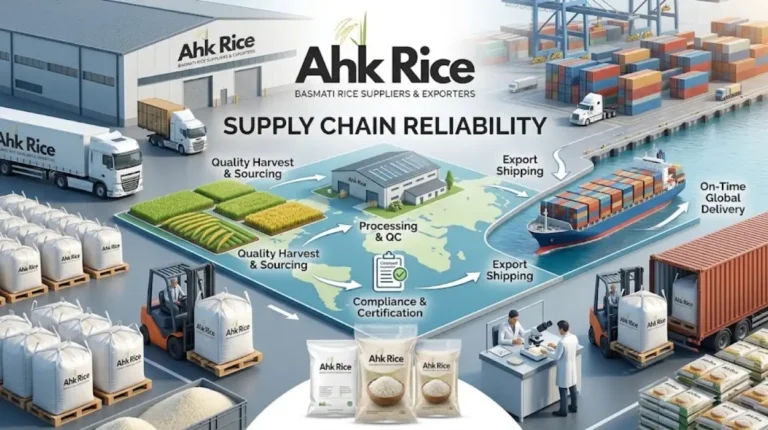
Pakistan 1509 Basmati moves from cultivated paddy through harvesting, milling, sorting, grading, testing, packaging, and export preparation before reaching commercial kitchens. Each stage controls a specific quality attribute.
How is 1509 Basmati cultivated?
Farmers cultivate 1509 Basmati in suitable rice-growing areas of Pakistan. The variety has an early-maturing profile compared with traditional Basmati varieties. Early maturity supports faster crop cycles and efficient farm planning.
Harvest timing affects grain quality. Farmers harvest mature paddy before excessive field exposure damages grain structure. Harvested paddy then enters controlled post-harvest handling.
How is 1509 Basmati processed?
Export processing follows a defined sequence:
- Clean the paddy to remove field debris and unwanted material.
- De-husk the grain to remove the outer husk.
- Polish the rice according to the contracted appearance specification.
- Sort by length to separate grains by dimensional requirements.
- Sort by colour to remove discoloured and defective grains.
- Grade the rice according to broken percentage and quality parameters.
- Test the rice for moisture, purity, grain dimensions, and applicable safety parameters.
- Pack the rice into food-grade export packaging.
- Prepare the shipment with commercial and phytosanitary documentation.
Steam processing adds controlled steaming before drying and final milling. The treatment strengthens the grain and supports more uniform cooking. Parboiling uses hydrothermal treatment and creates a firmer grain structure.
These processing stages explain how raw paddy becomes a consistent foodservice ingredient. The next question focuses on the grades available to Indonesian buyers.
Which 1509 Basmati grades are available for foodservice use?
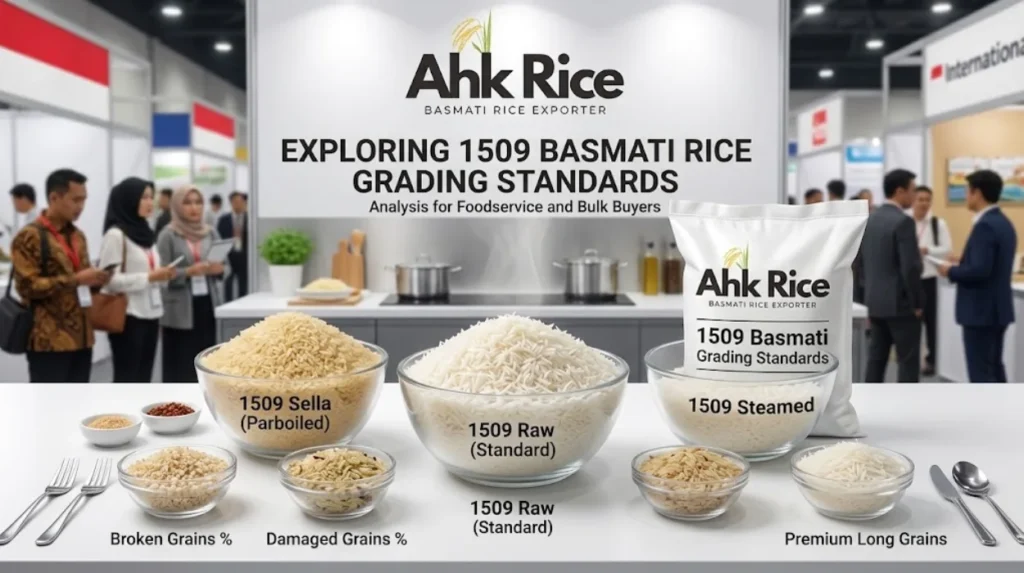
The main 1509 processing grades include White, Steam, Golden Sella, Creamy Sella, Parboiled, and Brown rice. Each grade creates different texture, appearance, cooking behavior, and storage characteristics for commercial kitchens.
What is 1509 White Basmati?
1509 White Basmati is conventionally milled and polished for a clean white appearance. The grain provides soft texture and separate cooked grains. Foodservice kitchens use it for everyday rice dishes and standard restaurant menus.
What is 1509 Steam Basmati?
1509 Steam Basmati undergoes controlled steaming during processing. The treatment improves grain strength and cooking uniformity. Indonesian foodservice buyers use Steam grades for dishes requiring consistent grains across large cooking batches.
What is 1509 Golden Sella?
1509 Golden Sella is parboiled and dried to produce a golden appearance. Parboiling strengthens the grain and improves resistance during cooking. The grade suits catering operations that require firm grains during extended holding.
What is 1509 Creamy Sella?
1509 Creamy Sella is a parboiled grade with a creamy-white appearance. Its processing creates a firmer grain structure than conventional White rice. Foodservice operators use it for bulk preparation and dishes requiring strong grain integrity.
What is 1509 Brown Basmati?
1509 Brown Basmati retains the bran layer after milling. The grain has a darker appearance and different cooking behavior. Restaurants use Brown Basmati for health-focused menus and specialty food offerings.
A commercial supplier specification can also include moisture, broken percentage, foreign matter, grain length, polishing level, and packaging requirements. One Pakistani 1509 export listing specifies extra-extra-long grain, moisture below 15%, and broken grains below 5%. (source: Pakistan Trade Portal)
Grade selection therefore depends on the kitchen’s cooking method. The next question explains why those specifications matter in Indonesian foodservice.
Why does 1509 Basmati suit Indonesian foodservice buyers?
1509 Basmati suits Indonesian foodservice because it balances grain appearance, cooking yield, texture, aroma, procurement economics, and supply scalability across restaurants, hotels, catering, and distribution. These factors directly influence kitchen cost and plate consistency.
Does grain length matter?
Grain length matters because long grains create stronger plate presentation. 1509 commonly measures around 8.10–8.50 mm before cooking. Cooked grains elongate substantially under controlled preparation.
Long separate grains work well for biryani and rice platters. Commercial kitchens also benefit from consistent grain dimensions because batch cooking becomes easier to standardize.
Does aroma matter?
1509 provides natural Basmati aroma with a generally milder profile than premium 1121. This balance suits dishes where rice fragrance supports spices without dominating the finished plate.
Does cooking yield matter?
Cooking yield affects food cost per serving. Higher cooked volume from each kilogram improves portion economics. 1509’s elongation and separate grain structure support efficient bulk cooking.
Does price matter?
Price matters strongly in foodservice because rice forms part of recurring ingredient expenditure. 1509 generally occupies a lower-cost position than 1121 while retaining long-grain Basmati characteristics.
Indonesian market analysis identifies 1509 Steam as a strong option for wholesale and horeca channels because it combines moderate pricing with long grain appearance and cooking performance. (source: AHK Rice Indonesian wholesale analysis, 2026)
These attributes connect directly to kitchen economics. The next question identifies the Indonesian operations that use this rice profile.
Where can Indonesian foodservice operators use 1509 Basmati?
Indonesian restaurants, hotels, catering companies, institutional kitchens, and food manufacturers can use 1509 Basmati for high-volume rice preparation. The grade supports dishes requiring long, separate, visually consistent grains.
Which restaurant dishes use 1509?
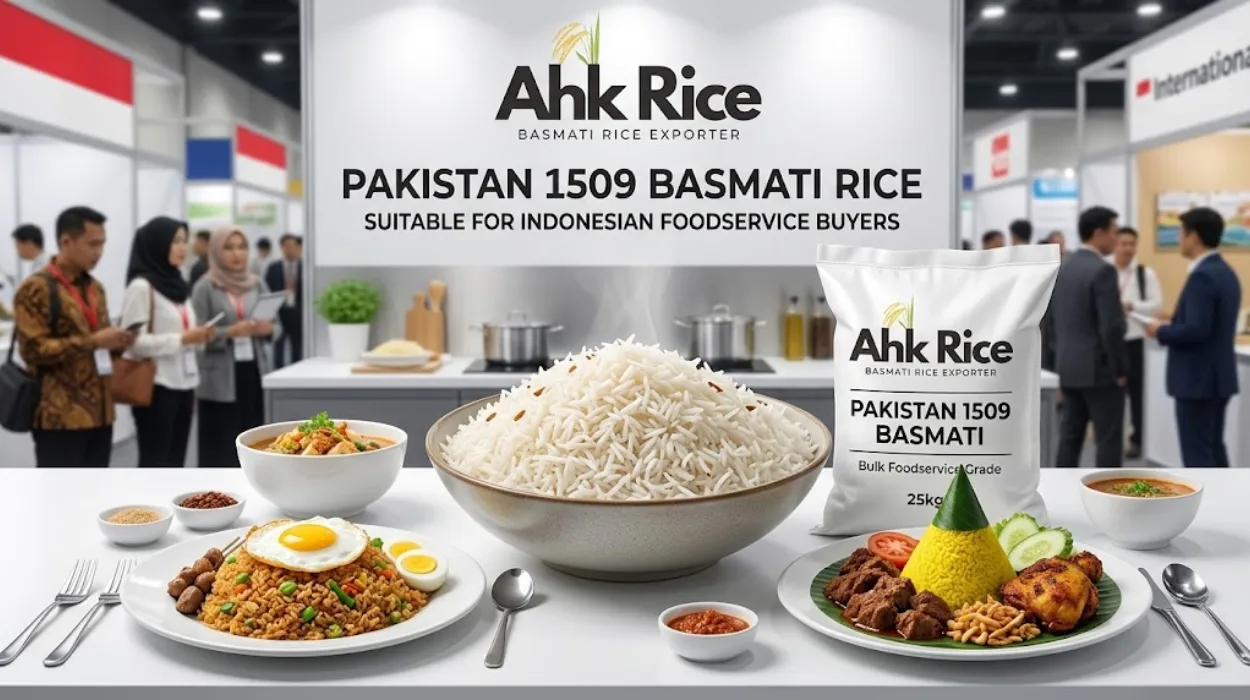
Restaurants use 1509 for biryani, pilaf, pulao, rice bowls, and mixed rice dishes. Long cooked grains create a recognizable premium presentation on individual plates and shared serving trays.
Which hospitality operations use 1509?
Hotels use 1509 for breakfast buffets, banquet service, and large catered events. Consistent cooking performance helps kitchen teams produce repeated batches throughout service periods.
Which catering operations use 1509?
Catering companies use 1509 for weddings, corporate events, institutional meals, and large gatherings. Steam and Sella grades provide stronger grain integrity during bulk cooking and holding.
Which Indonesian regions have relevant demand?
Jakarta supports premium imported rice demand across retail and hospitality channels. Bandung and Surabaya support price-performance segments. Bali hospitality buyers emphasize aroma, texture, presentation, and consistent supply.
Indonesian import controls also distinguish special rice from ordinary consumption rice. Import procedures therefore require buyers to verify the permitted product category before shipment planning. (source: Badan Pangan Nasional; Directorate General of Foreign Trade)
Market applications show where 1509 fits. The next question addresses certifications and import documentation.
Which certifications and documents apply to Pakistan 1509 Basmati exports?
Export shipments require product testing, phytosanitary documentation, commercial documents, and destination-specific compliance checks. The exact certification set depends on Indonesian import rules, product classification, importer status, and contracted specifications.
What quality certifications apply?
Foodservice buyers commonly evaluate food safety systems such as HACCP and ISO 22000. These systems demonstrate controlled food safety processes. Buyers also review laboratory testing, residue compliance, moisture results, and product specifications.
Certifications must match the shipment and facility. A certificate name alone does not prove compliance with Indonesian import requirements.
What export documents support shipment clearance?
Common export documentation includes:
- Commercial Invoice for transaction value and product details.
- Packing List for package counts, weights, and shipment configuration.
- Certificate of Origin for declared country of origin.
- Phytosanitary Certificate for plant-health requirements.
- Fumigation Certificate where treatment applies.
- Bill of Lading for maritime transport.
- Quality Inspection Report for contracted product specifications.
Indonesia’s plant quarantine authority requires imported plant commodities to undergo quarantine measures before entry. These measures verify plant-health requirements and freedom from regulated pests. (source: Badan Karantina Indonesia)
Indonesia also maintains an official plant-quarantine system with import requirement resources and prior-notice services. (source: Badan Karantina Indonesia)
Compliance therefore starts before loading the container. The final issue is understanding common misconceptions about 1509 Basmati.
What are the common misconceptions about Pakistan 1509 Basmati?
1509 is not simply a cheaper 1121 substitute, and grain length alone does not determine foodservice suitability. Grade, processing, moisture, broken percentage, cooking method, aroma, and purchase economics determine operational performance.
Is 1509 lower quality because it costs less?
Lower procurement cost does not automatically indicate lower quality. 1509 achieves competitive economics through its agricultural productivity and commercial availability. Product quality still depends on the contracted specification and processing controls.
Is 1509 identical to 1121?
1509 and 1121 are separate Basmati varieties. 1121 generally provides a longer grain profile and stronger premium positioning. 1509 provides strong elongation with a different price-performance balance.
For Indonesian buyers comparing both grades, the comparison should include raw length, cooked length, aroma, processing method, broken percentage, moisture, and landed cost. A detailed comparison of these specifications appears in [how Pakistan 1509 Steam compares with 1121 Steam rice in Indonesia].
Does every 1509 grade cook the same way?
Different processing grades produce different cooking behavior. Steam, White, Golden Sella, Creamy Sella, and Brown rice require different preparation methods and create different textures.
The correct specification therefore depends on the menu, cooking equipment, holding period, and customer positioning. Foodservice procurement should evaluate the complete specification rather than the variety name alone.
What should Indonesian foodservice buyers remember about 1509 Basmati?
Pakistan 1509 Basmati provides a practical combination of long grain appearance, cooking yield, soft texture, moderate aroma, and commercial procurement value. Its White, Steam, Sella, and Brown grades serve different foodservice requirements.
1509 begins with cultivated Basmati paddy from Pakistan. Milling removes unwanted material and prepares the grain for international trade. Sorting and grading establish the contracted physical specifications.
Steam and parboiled processing create different grain characteristics. White rice provides conventional appearance. Sella grades provide stronger grain integrity. Brown rice serves specialty menus.
Indonesian foodservice buyers must also verify import classification and destination compliance. Indonesia treats Basmati as special rice, making regulatory verification an essential part of procurement planning. (source: Badan Pangan Nasional)
The product therefore fits Indonesian foodservice through measurable performance rather than branding alone. Grain length, cooking yield, processing grade, safety documentation, and commercial economics define its suitability.
Frequently Asked Questions
What is 1509 Basmati Rice?
1509 Basmati is a long-grain aromatic rice variety cultivated in Pakistan. Its raw grain commonly measures around 8.1–8.5 mm.
Is 1509 Basmati suitable for Indonesian restaurants?
Yes. Its long cooked grains, soft texture, cooking yield, and moderate aroma suit restaurants, hotels, catering operations, and commercial kitchens.
What is 1509 Steam Basmati?
1509 Steam is processed through controlled steaming before final preparation. The process strengthens grain structure and supports uniform cooking.
What grades of 1509 Basmati are available?
Common grades include White, Steam, Golden Sella, Creamy Sella, Parboiled, and Brown rice.
Is 1509 cheaper than 1121 Basmati?
1509 generally occupies a lower procurement position than 1121. Actual pricing depends on crop, specification, packaging, order volume, freight, and destination.
What documents are required for Indonesian rice imports?
Common documents include commercial invoice, packing list, certificate of origin, phytosanitary certificate, fumigation certificate where applicable, bill of lading, and quality documentation.