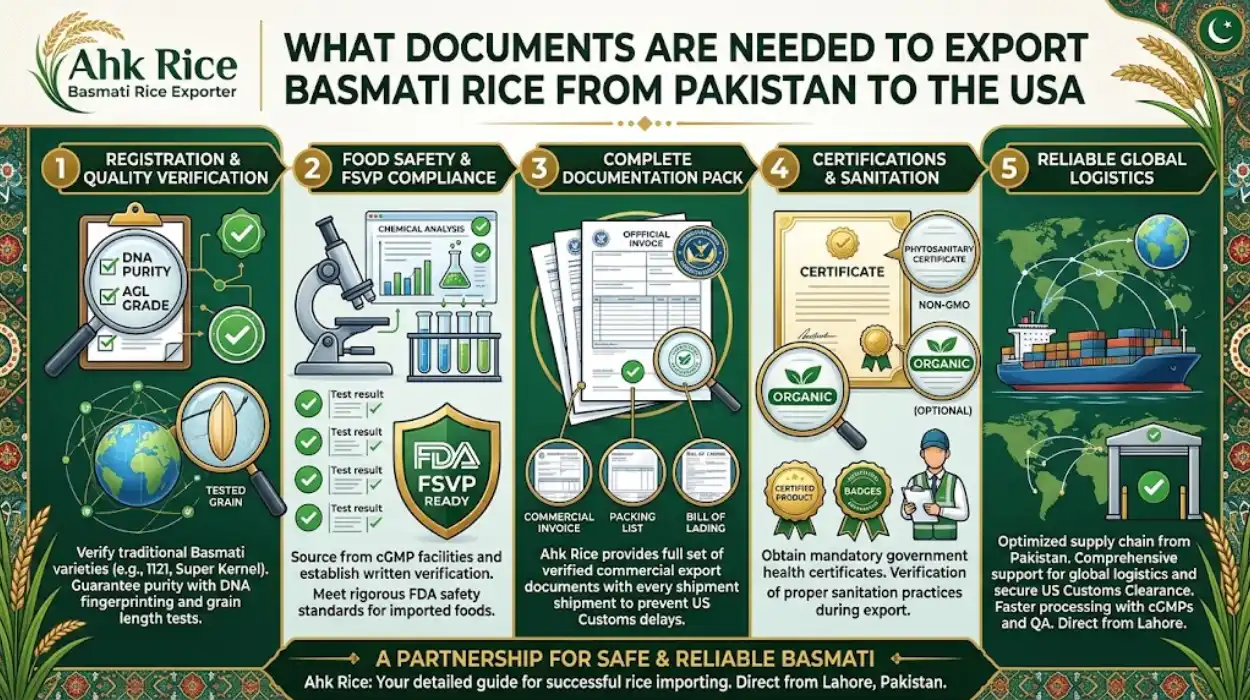
What Documents Are Needed to Export Basmati Rice from Pakistan to the USA?
Exporting Basmati rice from Pakistan to the USA requires commercial shipping documents, customs declarations, food safety compliance records, and applicable plant health certificates. The main documents include a commercial invoice, packing list, bill of lading, certificate of origin, and phytosanitary certificate when required by the applicable import conditions.
Pakistani Basmati rice exporters must coordinate with the US importer, customs broker, shipping agent, and relevant Pakistani authorities before dispatch. The importer must also meet applicable US Food and Drug Administration (FDA) requirements, including food facility registration, prior notice, and Foreign Supplier Verification Program (FSVP) obligations. The exact documentation depends on the rice product, shipment, and applicable regulations.
What Documents Are Needed to Export Pakistani Basmati Rice to the USA?
Exporting Basmati rice to the USA requires commercial, customs, and food compliance documentation. The standard shipment file includes a commercial invoice, packing list, bill of lading, certificate of origin, and applicable phytosanitary documentation. FDA prior notice, facility registration details, and FSVP records address additional US food import requirements.
Each document serves a different purpose during international trade.
1. Commercial Invoice
A commercial invoice records the sale between the Pakistani exporter and the American buyer. It identifies the seller, importer, rice variety, quantity, unit price, total value, currency, and agreed Incoterm.
For example, an invoice for 25 metric tonnes of 1121 Steam Basmati rice must accurately state the product description, price per metric tonne, packaging, and total shipment value. US Customs and Border Protection (CBP) uses invoice information to assess the imported merchandise. The invoice must also contain the appropriate tariff classification information required for entry.
2. Packing List
A packing list describes how the rice shipment is packed. It records the number of bags, net weight, gross weight, packaging type, and container details where applicable.
For example, 25 metric tonnes packed in 1,000 bags of 25 kg should show the correct bag count and net weight. The figures must match the commercial invoice and shipping instructions. Accurate packing information helps customs officials and warehouse teams verify the cargo.
3. Bill of Lading
A bill of lading is a transport document issued by the carrier or its agent. It serves as a receipt for the cargo and evidence of the contract of carriage. Depending on its form, it also serves a document-of-title function.
It identifies the shipper, consignee, cargo description, package count, weight, and transport route. For containerized Basmati rice shipped by sea from Karachi to a US port, the bill of lading connects the physical shipment with the transport record.
4. Certificate of Origin
A certificate of origin identifies the country where the exported product originates. For Pakistani Basmati rice, it supports the declaration that the goods originate in Pakistan.
Exporters obtain the certificate through the applicable authorized issuing process. The buyer or customs broker uses it to support origin declarations and any relevant trade requirements. A certificate of origin does not replace the commercial invoice or customs entry.
5. Phytosanitary Certificate
A phytosanitary certificate is an official plant health document issued by the competent authority of the exporting country when required under the importing country’s plant health conditions. It addresses specified pest and plant health requirements.
Exporters must confirm the applicable US Department of Agriculture Animal and Plant Health Inspection Service (USDA APHIS) conditions for the exact rice commodity and processing status before shipment. Requirements differ according to the commodity and its intended use. A phytosanitary certificate is not automatically a universal requirement for every processed rice shipment.
6. Additional Supporting Documents
Some shipments require additional documents based on the product, buyer’s contract, inspection arrangements, or destination requirements. Examples include a laboratory analysis report, fumigation or treatment certificate when applicable, insurance certificate, and inspection certificate.
These records support quality verification, contractual compliance, and cargo clearance. They do not replace mandatory government documentation.
How Does the Basmati Rice Export Process Work from Pakistan to the USA?
The export process begins with product specifications and buyer requirements, followed by processing, inspection, documentation, customs clearance, and shipment. The exporter and US importer coordinate their responsibilities before loading. Completing regulatory checks before dispatch reduces documentation discrepancies, avoidable delays, and cargo clearance problems.
Step 1: Confirm the Product and Import Requirements
The buyer selects a rice variety, grade, processing type, packaging format, and quantity. The importer and customs broker confirm the tariff classification and applicable US food and plant health requirements.
A specification sheet should define grain length, broken percentage, moisture, crop year, packing weight, and quality tolerances. These details guide procurement, processing, inspection, and the final invoice.
Step 2: Process and Grade the Rice
Pakistani Basmati rice commonly originates in Punjab, including growing areas around Hafizabad, Gujranwala, Sheikhupura, Narowal, and Sialkot.
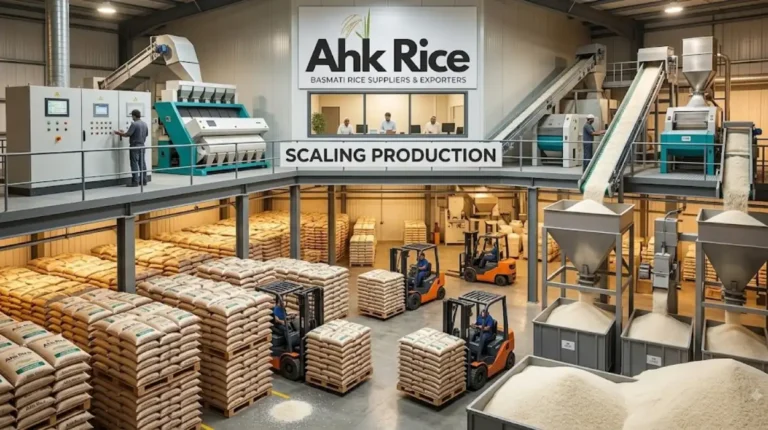
The processing chain begins with paddy intake and cleaning. The mill removes foreign material, mills or husks the grain as appropriate, and separates rice by size and quality. Optical Sortex machines identify and remove discoloured or defective grains. Grading controls broken percentages and helps achieve the agreed specification.
Processing methods include raw white rice, Steam Basmati, and parboiled rice sold as Sella. Golden Sella and Creamy Sella differ in their processing and final appearance. Each finished product requires a specification that accurately describes the grade supplied.
Step 3: Conduct Quality Checks
The exporter checks the finished rice against the buyer’s specification. Relevant measurements include grain dimensions, moisture, broken percentage, foreign matter, and appearance. Laboratory testing addresses food safety parameters specified by the buyer or applicable regulations.
For example, an importer selling premium 1121 Basmati rice requires the delivered product to match the agreed grain and quality profile. A laboratory report supports verification but does not guarantee US regulatory acceptance by itself.
Step 4: Prepare Export Documentation
The exporter prepares the commercial invoice, packing list, and other shipment documents. The exporter also arranges the certificate of origin and any applicable plant health or treatment documentation.
The shipping agent prepares the transport documentation using the confirmed cargo details. The exporter checks the consignee, product description, package count, weights, and destination across the documents before finalization.
Step 5: Complete US Import Compliance and Ship the Cargo
The US importer or its authorized representative coordinates customs entry and applicable FDA requirements. FDA must receive prior notice for covered food shipments before arrival, and the importer must meet applicable FSVP obligations.
The carrier transports the cargo after the exporter completes the required dispatch formalities. At arrival, CBP and other relevant authorities review the entry and admissibility information. Release depends on compliance with the requirements that apply to the shipment.
What FDA and USDA Requirements Apply to Basmati Rice Imports?
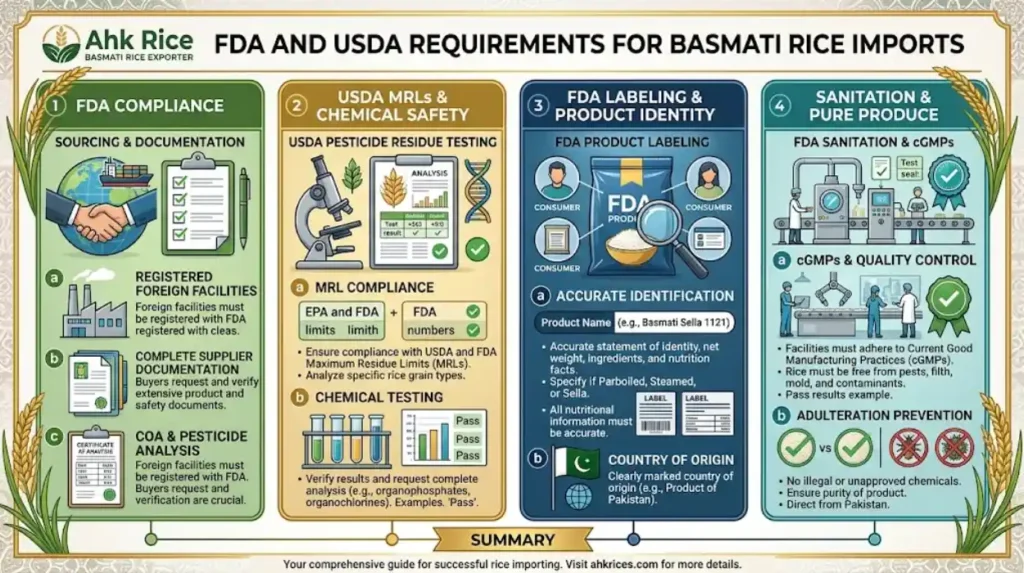
US food imports must comply with applicable FDA safety, registration, prior notice, and importer verification rules. USDA APHIS plant health requirements apply where relevant to the specific rice commodity. The importer and broker must confirm each obligation rather than treating one certificate as approval for the entire shipment.
FDA Food Facility Registration
Foreign facilities that manufacture, process, pack, or hold food for US consumption generally require FDA registration unless an exemption applies. The relevant facility must maintain registration in accordance with applicable requirements, including renewal requirements.
Registration does not mean FDA has approved the facility, product, or shipment. FDA states that imported foods must meet US requirements even when they originate overseas.
FDA Prior Notice
Prior notice informs FDA about an incoming food shipment before it arrives in the United States. The submission includes information about the food, manufacturer, shipper, and shipment, as applicable.
The importer, exporter, broker, or another eligible party can submit prior notice through an authorized electronic system. The submission must be completed within the applicable time limits for the mode of transportation. Failure to provide adequate prior notice can result in refusal or detention.
Foreign Supplier Verification Program
The FSVP rule generally requires the US importer to verify that its foreign food supplier and the imported food meet applicable US food safety requirements. The importer maintains risk-based supplier verification records and performs the activities required for its circumstances.
The Pakistani exporter supports this process by supplying accurate specifications, supplier information, relevant hazard-control records, and available test results. The US importer remains responsible for its own FSVP obligations.
USDA APHIS Plant Health Requirements
USDA APHIS regulates the importation of plants and plant products to manage plant pest risks. Import conditions depend on the commodity’s identity, origin, processing, and intended use.
Before loading, the importer or broker should verify the current requirements for the exact Pakistani rice product. This check establishes whether a permit, phytosanitary certificate, treatment, or other plant health condition applies. Do not assume that all rice varieties follow identical import conditions.
Which Basmati Rice Varieties and Grades Can Be Exported to the USA?
Pakistani exporters supply several Basmati varieties and processing grades to US importers. The suitable option depends on grain characteristics, aroma, cooking performance, target retail price, and foodservice needs. The selected variety and grade must appear consistently in the purchase contract, product specification, invoice, and packing records.
1121 Basmati Rice
1121 Basmati is known for its long grain and cooked elongation. Raw, Steam, Golden Sella, Creamy Sella, and Brown forms serve different market preferences.
Premium grocery retailers, specialty distributors, and foodservice buyers select grades according to cooking performance and price positioning. The contract should specify the exact processing type rather than using only the general term “1121 Basmati.”
Super Kernel Basmati Rice
Super Kernel is a traditional aromatic Pakistani Basmati variety associated with Punjab. Buyers value its aroma, grain appearance, and cooking characteristics.
It serves ethnic grocery retailers, distributors, and restaurants that require a recognisable Pakistani Basmati profile. Specifications should identify grain length, moisture, broken percentage, and processing method.
1509 Basmati Rice
1509 is a shorter-duration Basmati variety often selected for yield efficiency and competitive bulk sourcing. Its white and parboiled forms suit different commercial requirements.
Importers compare 1509 with 1121 and Super Kernel based on grain specifications, cooking needs, and cost. The selected grade must match the buyer’s intended use and declared product description.
What Are the Benefits of Accurate Rice Export Documentation?
Accurate export documents support customs processing, cargo identification, origin declarations, food compliance, and payment administration. Consistent records help exporters and importers resolve questions about shipment quantities, product grades, and transport details. They also provide a traceable documentary record for commercial transactions and quality disputes.
Faster Document Verification
When the invoice, packing list, and bill of lading contain matching cargo information, brokers can verify the shipment more efficiently. Consistent descriptions reduce avoidable corrections.
Better Traceability
Batch references, processing records, and laboratory reports help connect finished rice with its production and inspection history. This information supports supplier verification and investigations into quality complaints.
Clearer Commercial Responsibilities
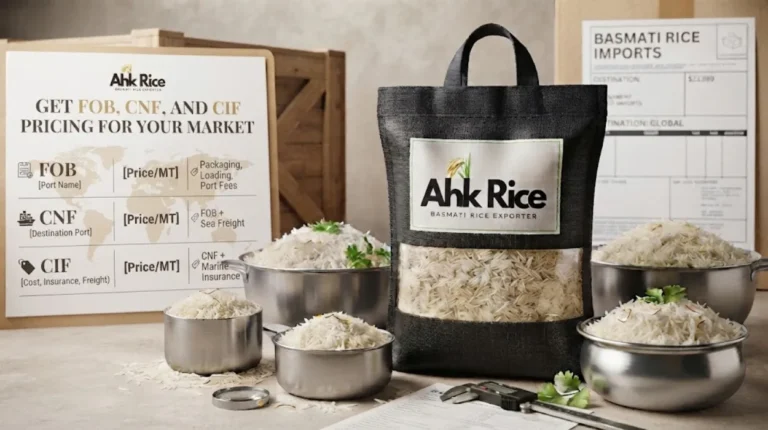
The purchase contract defines product specifications, payment terms, delivery conditions, and inspection arrangements. The agreed Incoterm identifies which party handles particular transport costs, risks, and formalities. Clear allocation helps both parties prepare their respective documents on time.
What Common Mistakes Delay Basmati Rice Shipments to the USA?
Common problems include inconsistent weights, incorrect product descriptions, missing prior notice, unresolved plant health requirements, and incomplete importer verification records. These issues create avoidable clearance risks. Exporters and importers should compare the full document set against the contract and current regulatory requirements before the shipment leaves Pakistan.
Incorrect or Inconsistent Cargo Details
A packing list showing 1,000 bags must agree with the invoice and shipping record. Differences in net weight, gross weight, consignee details, or rice grade require correction before documents are finalized.
Confusing Certificates with Regulatory Approval
A certificate of origin establishes origin, while a phytosanitary certificate addresses applicable plant health conditions. Neither document replaces FDA prior notice, food facility registration, FSVP compliance, or customs entry requirements.
Treating Every Rice Shipment the Same
Requirements depend on the product, processing status, intended use, and current regulations. Brown rice, milled white rice, and other plant products do not automatically share identical plant health conditions.
Leaving Compliance Checks Until Loading
Late verification creates pressure to amend documents after cargo dispatch. The importer, exporter, and customs broker should confirm requirements before shipment booking and final packing.
For a deeper explanation of the roles played by the phytosanitary certificate, certificate of origin, bill of lading, and commercial invoice, consult the related guide, Phytosanitary Certificate, Certificate of Origin, Bill of Lading and Commercial Invoice Explained. Understanding these documents separately helps buyers distinguish commercial records from government compliance requirements.
Exporting Basmati rice from Pakistan to the USA requires coordinated commercial documentation, customs preparation, and applicable food and plant health compliance. The commercial invoice, packing list, bill of lading, and certificate of origin establish the shipment’s commercial and transport details. A phytosanitary certificate or other plant health documentation is required when the applicable import conditions specify it.
FDA facility registration, prior notice, and FSVP responsibilities must also be addressed where applicable. The exporter and US importer should verify current requirements for the exact product before loading. Accurate specifications and consistent documents support a more organised import process and reduce preventable clearance problems.
Frequently Asked Questions
What documents are required to export Basmati rice from Pakistan to the USA?
Common documents include a commercial invoice, packing list, bill of lading, and certificate of origin. A phytosanitary certificate and other supporting documents are required when applicable. US food import requirements also include FDA prior notice and relevant facility registration and FSVP compliance.
Is a phytosanitary certificate mandatory for Pakistani Basmati rice exports to the USA?
The requirement depends on the exact rice commodity and applicable USDA APHIS import conditions. Exporters should verify the current requirements for the product’s processing status before shipment rather than assuming every rice shipment requires the same certificate.
Who issues the certificate of origin for Pakistani rice?
The certificate of origin is obtained through the applicable authorized issuing process in Pakistan. It identifies the declared country of origin and supports the importer’s origin documentation.
Does Pakistani Basmati rice require FDA approval before entering the USA?
FDA does not routinely approve individual food shipments before import. However, imported rice must meet applicable US food safety requirements. Relevant foreign facilities must be registered unless exempt, prior notice must be submitted, and the importer must meet applicable FSVP requirements.
What is the difference between a commercial invoice and a packing list?
A commercial invoice records the sale, including the product description, quantity, and value. A packing list explains how the cargo is packed, including package counts, weights, and packaging details. Both documents should contain consistent shipment information.