Which Food Safety Certifications Should a Basmati Rice Exporter Have?
Food safety certifications help Basmati rice exporters demonstrate that their facilities control biological, chemical, and physical hazards during processing, storage, and packing. The relevant certifications depend on the destination market, buyer requirements, food safety risks, and the exporter’s supply chain.
Pakistani Basmati rice exporters supply several varieties, including 1121, Super Kernel, and 1509 Basmati rice. These varieties pass through harvesting, milling, grading, sorting, and packaging before shipment. Each stage requires controls that protect product quality and food safety.
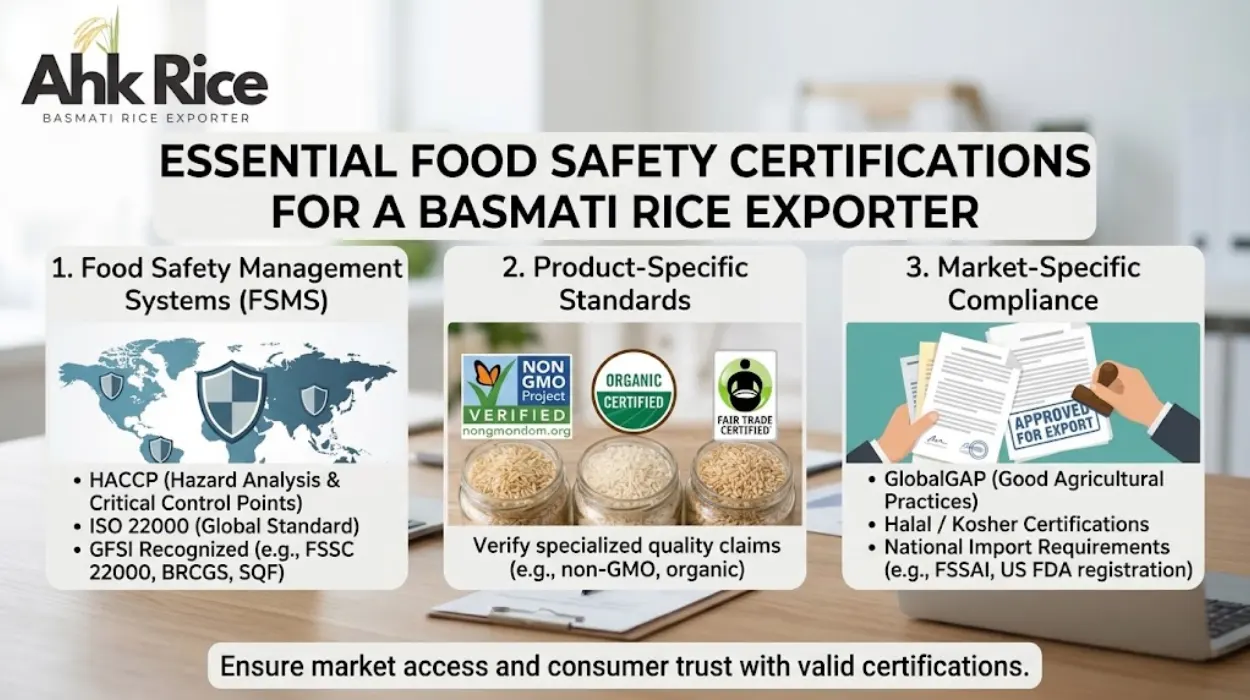
ISO 22000, HACCP, BRCGS, and SQF are important food safety standards for international rice trade. They serve different purposes. HACCP identifies and controls food safety hazards, ISO 22000 establishes a food safety management system, BRCGS provides a recognized framework for food safety and quality at manufacturing sites, and SQF combines food safety requirements with applicable quality controls.
What Are Food Safety Certifications for Basmati Rice Exporters?
Food safety certifications verify that a rice processing or packing operation follows defined requirements for managing food safety risks. They provide evidence of documented procedures, hazard controls, sanitation, traceability, and verification activities relevant to the certified facility and its scope.
A certification is not simply a statement that rice is clean. It concerns the systems used to produce, handle, process, and package food safely. The certificate identifies the certified organization, site, applicable standard, scope, and validity period.
Four widely discussed frameworks are:
- HACCP: Hazard Analysis and Critical Control Points, a systematic method for identifying and controlling food safety hazards.
- ISO 22000: An international standard specifying requirements for a food safety management system.
- BRCGS: Brand Reputation through Compliance Global Standards, including a Global Standard for Food Safety used by food manufacturers and suppliers.
- SQF: Safe Quality Food, a certification program covering food safety and, under relevant codes, quality management.
These frameworks are not interchangeable. HACCP principles form part of food safety management, while ISO 22000, BRCGS, and SQF establish broader certification frameworks with distinct requirements.
A rice exporter also needs to distinguish facility certification from product testing. Laboratory results, inspection reports, certificates of origin, phytosanitary documents, and shipment records serve separate purposes.
How Does Food Safety Certification Work in Rice Processing?
Food safety certification follows a structured process that identifies hazards, establishes preventive controls, documents operating procedures, verifies implementation, and subjects the applicable system to an assessment. The process connects farm sourcing, milling, storage, packaging, and shipment documentation.
1. Raw rice sourcing and receiving
The exporter identifies suppliers, checks incoming paddy or milled rice, and records the source and received lot. Purchasing specifications address grain variety, moisture, foreign material, and relevant chemical contamination risks.
2. Cleaning and milling
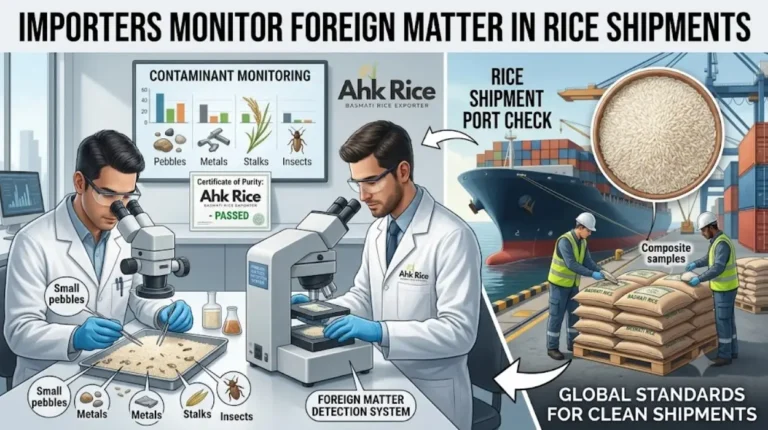
Rice passes through cleaning equipment that removes stones, dust, straw, and other foreign materials. Milling removes husks and, depending on the product, bran layers. Equipment maintenance and cleaning procedures help prevent contamination.
3. Grading and sorting
Processing lines separate rice by grain dimensions, appearance, and quality specifications. Optical color sorters remove selected discolored or defective grains. Metal detection and other foreign-material controls are applied according to the facility’s hazard assessment and process design.
4. Parboiling or steaming
Some rice varieties receive additional processing. Parboiled rice undergoes soaking, heat treatment, drying, and milling. Steam-treated rice follows a different process designed to influence grain characteristics. Each operation requires controls for water quality, temperatures, drying, and moisture.
5. Storage and packaging
The facility stores finished rice under conditions that protect it from moisture, pests, and contamination. Packaging materials must be suitable for food contact. Lot codes connect finished packs with production records and incoming materials.
6. Verification and shipment
The exporter reviews records, checks product specifications, and arranges required laboratory testing or third-party inspection. Shipment documentation must match the product, quantity, lot identification, destination requirements, and contractual specifications.
Certification assessments evaluate the applicable management system. They do not replace every legal import requirement or guarantee that every individual shipment is free from hazards.
What Are the Main Components of a Rice Food Safety System?
An effective rice food safety system combines hazard analysis, prerequisite programs, operational controls, traceability, corrective action, and verification. These components establish how a facility prevents contamination, identifies deviations, investigates problems, and demonstrates compliance through controlled records.
The principal components include:
- Hazard analysis: Assessment of biological hazards, chemical contaminants, and physical hazards such as metal fragments.
- Prerequisite programs: Foundational controls covering sanitation, pest management, employee hygiene, maintenance, and supplier approval.
- Critical control points: Process stages where control is essential to prevent, eliminate, or reduce a significant food safety hazard to an acceptable level.
- Monitoring: Recorded observations or measurements that confirm controls operate as intended.
- Corrective action: Procedures for responding to a failed control, affected product, or other deviation.
- Traceability: Records linking suppliers, production lots, packaging batches, and shipments.
- Verification and validation: Activities that establish whether the system is correctly designed and operating effectively.
Rice exporters also evaluate hazards associated with pesticide residues, mycotoxins, heavy metals such as arsenic, and pest infestation. The relevant hazards and testing frequency depend on sourcing conditions, the product, applicable regulations, and the documented risk assessment.
Traceability is especially important when a buyer reports a problem. A lot-based system allows the exporter to identify affected stock, review processing records, and support a targeted withdrawal or recall when necessary.
Which Certifications Should Rice Exporters Understand?
HACCP, ISO 22000, BRCGS, and SQF address food safety through different frameworks. The appropriate option depends on customer specifications, retail supply-chain requirements, facility activities, certification scope, and the destination market rather than on the rice variety alone.
HACCP
HACCP provides a systematic method for analyzing hazards and establishing controls at relevant process stages. It relies on prerequisite programs, documented hazard analysis, monitoring, corrective action, verification, and recordkeeping.
For rice processing, the hazard analysis considers risks such as foreign material, chemical contamination, and unsafe storage conditions. HACCP is a methodology, so the phrase “HACCP certified” does not identify one universal international certification scheme. Buyers should confirm the standard, certification provider, and scope behind any claimed certification.
ISO 22000
ISO 22000:2018 specifies requirements for a food safety management system for organizations involved in the food chain. It integrates hazard-control principles with management responsibilities, communication, operational planning, and continual improvement.
A rice mill or packing facility uses this framework to coordinate food safety procedures across receiving, processing, storage, and dispatch. ISO 22000 certification demonstrates that the assessed system conforms to the standard within the certificate’s stated scope.
BRCGS Food Safety
BRCGS Global Standard Food Safety establishes requirements for food manufacturing operations supplying customers that recognize the scheme. Its framework addresses management commitment, hazard analysis, food safety systems, site standards, product controls, process controls, and personnel.
A rice processor supplying a supermarket’s private-label range encounters customer requirements that differ from those of a bulk commodity buyer. BRCGS certification is relevant when the retailer or importer specifies the standard and the certified site and product scope match the intended supply.
SQF
SQF is a food safety and quality certification program with codes designed for different sectors of the food supply chain. Applicable requirements depend on the selected code and the activities conducted at the facility.
An exporter supplying a US food distributor should confirm whether the buyer requires SQF, BRCGS, another Global Food Safety Initiative-recognized certification program, or a different documented assurance system. Certification does not automatically establish compliance with every US import law.
What Benefits Do Food Safety Certifications Provide?
Food safety certifications provide structured evidence of risk management, documented procedures, traceability, and independent assessment. They help exporters demonstrate their operating controls to buyers, support supplier approval, and improve the consistency of food safety practices across production and packing.
The main benefits include:
- Buyer confidence: Importers can review a defined standard, certified site, and assessment scope.
- Improved traceability: Lot records help connect raw materials with finished goods and shipments.
- Consistent processes: Documented procedures establish repeatable controls for cleaning, grading, storage, and packaging.
- Problem investigation: Monitoring records help identify deviations and support corrective action.
- Supplier qualification: Certification helps meet buyer requirements when the relevant scheme and scope are accepted.
- Risk management: Hazard analysis directs attention to contamination risks and control measures.
- Operational discipline: Internal audits and management reviews help identify weaknesses and improve the system.
Certification alone does not guarantee premium prices, customs clearance, or acceptance by every importer. Buyers evaluate product specifications, test results, documentation, supply reliability, and commercial terms alongside food safety credentials.
Which Food Safety Requirements Apply to Rice Exported to the USA?
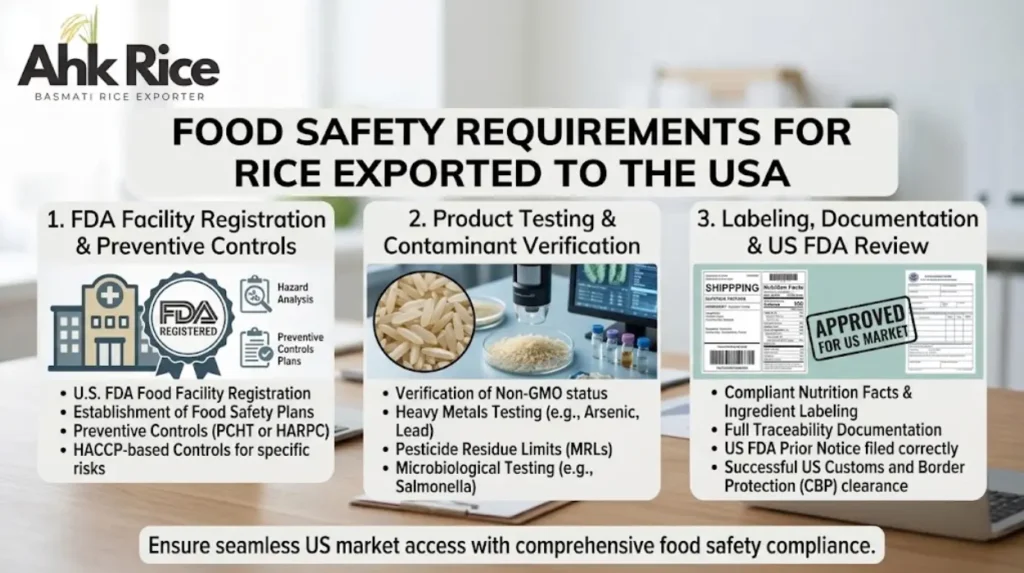
Rice entering the United States must meet applicable federal food safety and import requirements, regardless of whether the exporter holds a voluntary certification. Importers and exporters need to identify the responsible parties, facility obligations, preventive controls, documentation, and product-specific requirements before shipment.
The US Food and Drug Administration regulates most food imports, including rice. Applicable obligations depend on the business’s role and activities. Relevant requirements include food facility registration where required, prior notice of imported food, and compliance with applicable preventive-control regulations.
The Foreign Supplier Verification Programs rule generally requires covered US importers to conduct risk-based verification of foreign suppliers. The importer evaluates whether the supplier produces food in a manner that provides the level of public health protection required under applicable US law. Specific exemptions and modified requirements apply to certain situations.
ISO 22000, BRCGS, or SQF certification can support a buyer’s supplier assessment. None automatically replaces the importer’s legal FSVP responsibilities.
US buyers also evaluate product specifications, country-of-origin information, contaminant risks, packaging suitability, and shipment documentation. Testing and records must reflect applicable regulatory limits and contractual requirements.
For a structured comparison of the major certification schemes and their relevance to American importers, consult the guide explaining [ISO 22000, HACCP, BRCGS, and SQF for USA rice buyers]([Insert Link to MOFU Article]).
What Common Certification Problems Should Rice Exporters Avoid?
The most common certification problems involve confusing voluntary standards with legal requirements, relying on expired certificates, overlooking certificate scope, and treating certification as a substitute for product testing. Exporters reduce these risks by verifying documents, checking buyer requirements, and maintaining current operational records.
A certificate does not necessarily cover every facility operated by the same company. Buyers should check the site’s name and address, certified activities, standard version, certification body, validity dates, and applicable product scope.
Another misconception is that every food safety certification has identical requirements. ISO 22000, BRCGS, and SQF use different frameworks, assessment criteria, and certification arrangements. Buyers should confirm their exact acceptance criteria before selecting a supplier.
Exporters also need to separate food safety certification from laboratory analysis. A certificate does not replace testing for pesticide residues, arsenic, or other contaminants when testing is required by law, a risk assessment, or a purchase contract.
Finally, certification does not remove the need for accurate shipping documents, suitable packaging, pest control, and effective lot traceability. These controls must remain operational between audits.
How Should an Exporter Choose the Right Certification?
An exporter should select a certification by comparing destination-market obligations, buyer specifications, processing activities, and the scope of each recognized scheme. The decision begins with the target customer and ends with verification that the certified facility meets the actual purchasing and regulatory requirements.
A practical selection process includes five steps.
- Identify target markets, such as the United States, United Kingdom, United Arab Emirates, or Malaysia.
- Ask prospective importers and retailers which standards they accept or require.
- Map the processing activities covered by the certification, including milling, parboiling, storage, and packing.
- Verify the certification body’s credentials and confirm the certificate’s validity and scope.
- Maintain food safety records, conduct internal reviews, and reassess requirements when products, processes, or markets change.
For a Pakistani Basmati exporter, the central objective is a documented, risk-based food safety system that matches the facility’s operations and the destination’s requirements. HACCP principles provide a foundation for hazard control, while ISO 22000, BRCGS, and SQF offer distinct routes for demonstrating a managed system.
The strongest supplier qualification combines appropriate certification with accurate product specifications, reliable testing, traceability, and compliant export documentation.