How Is Basmati Rice Purity Verified Before International Export?
Basmati rice purity is verified through laboratory testing, physical grain inspection, DNA-based varietal verification, moisture analysis, colour sorting, and export certification. Here is why: international buyers require proof that rice matches the contracted variety, meets food safety standards, and complies with import regulations before shipment.
Importers purchasing Pakistani Basmati rice need more than a supplier declaration. They need documented evidence showing varietal authenticity, grain consistency, contamination control, and export compliance. Basmati rice exports exceeded billions in value during recent trade cycles, making quality verification a critical part of international trade (source: Pakistan Bureau of Statistics, FY2024-25).
Buyers researching rice quality systems often begin with educational resources explaining rice specifications and grading standards. For a broader understanding of rice quality parameters, readers can explore our guide on understanding Basmati rice grading, processing, and export specifications. AHK Rice, a trusted Pakistani exporter, manages verification processes across 1121, Super Kernel, and 1509 Basmati varieties through integrated milling, grading, testing, and export procedures.
What Methods Are Used to Verify Basmati Rice Purity Before Export?
The most reliable purity verification methods include laboratory testing, grain dimension analysis, moisture testing, colour sorting, varietal identification, and government certification. Together, these methods verify authenticity, reduce contamination risks, and confirm compliance with international import requirements.
Purity verification begins with varietal identification. A rice variety is a genetically distinct grain type cultivated for specific characteristics. Basmati varieties possess unique grain length, aroma compounds, cooking behaviour, and elongation properties.
Exporters inspect harvested paddy before milling. Inspection identifies varietal mixing, damaged kernels, foreign matter, and immature grains. Early detection prevents quality issues later in the processing chain.
Modern rice mills use multiple verification stages.
The 9-Step Purity Verification Process
- Clean the paddy.
- De-husk the grain.
- Dry the rice.
- Polish the kernels.
- Grade by size.
- Sort by length.
- Sort by colour.
- Test in laboratories.
- Certify before shipment.
Each step removes impurities and improves consistency.
Common Purity Tests Used by Exporters
| Verification Method | Purpose | Typical Outcome |
|---|---|---|
| Grain Length Analysis | Verify varietal characteristics | Confirms specification compliance |
| Moisture Testing | Prevent spoilage | Confirms storage stability |
| Foreign Matter Testing | Detect contamination | Ensures cleanliness |
| Broken Grain Analysis | Verify grade | Confirms contract quality |
| Colour Sorting | Remove discoloured grains | Improves appearance |
| Aroma Evaluation | Confirm Basmati traits | Supports varietal identity |
| DNA Verification | Confirm genetic purity | Highest authenticity assurance |
DNA testing offers the strongest proof of varietal authenticity. Physical testing remains the most common method because it provides fast commercial verification.
With the verification methods established, the next question is how individual approaches compare in accuracy and practical use.
How Do Different Purity Verification Approaches Compare?
DNA verification delivers the highest accuracy, laboratory analysis provides comprehensive quality assessment, and physical inspection offers the most cost-effective routine verification. The best approach combines all three methods.
Different verification systems solve different problems.
Specification Comparison Table
| Attribute | Physical Inspection | Laboratory Testing | DNA Verification |
|---|---|---|---|
| Accuracy | High | Very High | Highest |
| Speed | Fast | Moderate | Slowest |
| Cost | Lowest | Medium | Highest |
| Detects Foreign Matter | Yes | Yes | No |
| Detects Moisture Issues | No | Yes | No |
| Confirms Variety | Partial | Strong | Definitive |
| Export Acceptance | Standard | Required | Premium Assurance |
Physical inspection identifies visible issues quickly. Inspectors examine grain size, colour, shape, and uniformity.
Laboratory testing measures measurable quality parameters. Laboratories test moisture, purity percentages, broken grains, and contamination levels.
DNA verification confirms the genetic identity of the rice variety. Premium buyers increasingly request DNA reports for high-value contracts.
European importers often require stricter documentation than regional markets. Gulf importers frequently focus on grain consistency and visual appearance. Each market prioritises different verification requirements.
Having compared the methods, the next question becomes which verification approach suits specific importing regions and buyer requirements.
Which Purity Verification Method Works Best for Different Markets?
European markets prefer laboratory and DNA-supported verification, while Gulf and African markets prioritise laboratory testing, grading reports, and visual consistency verification. Market requirements determine the ideal testing strategy.
Different regions purchase different Basmati grades.
UK and European Market Preferences
European importers typically prefer:
- 1121 Steam Basmati
- 1121 White Basmati
- Premium aged Basmati
- Certified traceable lots
European buyers focus heavily on traceability, food safety, and varietal authenticity.
DNA verification adds value in retail supply chains. Supermarket suppliers often require detailed documentation supporting product claims.
Gulf Market Preferences
Gulf importers commonly prefer:
- 1121 Golden Sella
- Super Kernel Basmati
- Catering-grade Basmati
- Long shelf-life specifications
Golden Sella performs better in high-temperature storage conditions. In UAE warehouses reaching 40°C, Golden Sella often maintains quality for approximately 18 months. Steam rice generally performs best within 12 months under similar conditions.
Price Per MT Comparison
| Grade | Typical Export Position |
|---|---|
| 1121 White Basmati | Premium |
| 1121 Steam Basmati | Premium-Mid |
| 1121 Golden Sella | Premium |
| Super Kernel Basmati | Mid-Premium |
| 1509 Basmati | Mid-Range |
Prices fluctuate according to harvest conditions, demand, and destination markets. Premium grades command higher values because purity requirements are stricter and buyer expectations are higher.
Market requirements influence testing intensity, leading naturally to an evaluation of each verification solution’s strengths and limitations.
What Are the Pros and Cons of Each Purity Verification Solution?
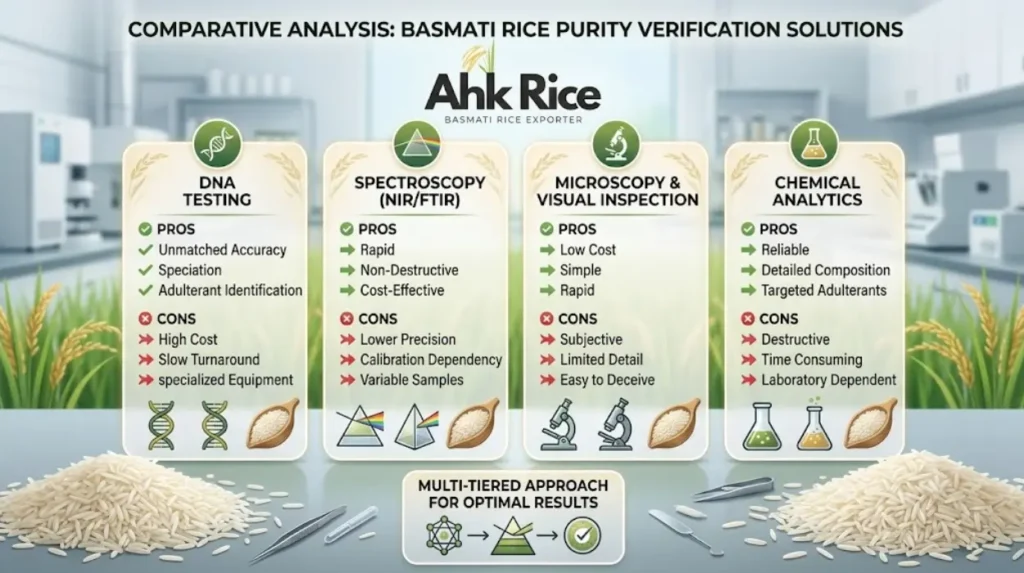
Physical inspection offers speed, laboratory testing delivers broad quality validation, and DNA testing provides maximum authenticity assurance. Each method contributes unique advantages and limitations within export supply chains.
Physical Inspection
Advantages
- Fast verification
- Low operational cost
- Immediate results
- Effective contamination detection
Limitations
- Cannot guarantee genetic purity
- Depends on inspector expertise
- Limited scientific evidence
Example: Grain mixing between similar long-grain varieties may escape visual detection.
Laboratory Testing
Advantages
- Objective measurements
- International acceptance
- Comprehensive reporting
- Supports export documentation
Limitations
- Higher cost than inspection
- Requires specialist facilities
- Longer processing time
Example: Laboratory analysis accurately measures moisture content before container loading.
DNA Verification
Advantages
- Genetic confirmation
- Highest authenticity assurance
- Supports premium contracts
- Strengthens buyer confidence
Limitations
- Highest testing cost
- Longer turnaround times
- Not required for every shipment
Example: Premium retail programmes in Europe may require DNA verification to support origin claims.
Each solution offers distinct benefits. Combining them produces the strongest quality assurance framework.
With strengths and weaknesses identified, the next step is determining how importers should select the right verification strategy.
What Factors Should Importers Consider When Evaluating Purity Verification?
Buyer requirements, destination regulations, product positioning, storage duration, and risk tolerance determine the most appropriate verification strategy. Strong verification aligns testing intensity with commercial objectives.
Importers should evaluate the intended sales channel first.
Retail distribution demands stronger documentation than wholesale commodity trading. Consumer-facing brands face greater scrutiny regarding authenticity claims.
Destination regulations also influence verification requirements.
European regulations often require extensive documentation. Gulf markets commonly prioritise consistency, appearance, and cooking performance.
Storage duration affects quality risks.
Longer storage periods increase the importance of moisture control and contamination prevention. Moisture levels above specification can reduce shelf life significantly.
Shelf Life Comparison
| Product Type | Typical Shelf Life |
|---|---|
| 1121 Golden Sella | 18–24 months |
| 1121 Steam Basmati | 12–18 months |
| 1121 White Basmati | 12–18 months |
| Super Kernel Basmati | 12–18 months |
Proper storage conditions remain essential for all grades.
Decision Framework for Importers
| Decision Factor | Recommended Focus |
|---|---|
| Retail Sales | DNA + Laboratory Testing |
| Foodservice Distribution | Laboratory Testing |
| Wholesale Trading | Inspection + Laboratory Testing |
| Premium Branding | DNA Verification |
| High-Temperature Markets | Moisture & Shelf-Life Testing |
Importers benefit most when verification methods match business objectives rather than applying identical testing to every shipment.
With decision criteria established, the final question is how exporters implement these standards consistently before international dispatch.
How Do Exporters Maintain Purity Standards Throughout the Export Process?
Consistent purity standards require controlled sourcing, dedicated processing lines, laboratory verification, documented traceability, and final shipment certification. Systematic controls reduce quality variation and improve buyer confidence.
Quality assurance begins before harvesting. Farmers cultivate specific Basmati varieties under controlled agricultural practices.
Rice mills maintain segregation procedures throughout processing. Separate storage areas reduce cross-variety contamination.
Quality teams inspect and test rice during multiple processing stages. Continuous verification identifies issues before final packaging.
Export documentation supports product claims through:
- Phytosanitary Certificates
- Certificate of Origin
- Fumigation Certificates
- Quality Inspection Reports
- Laboratory Analysis Reports
These documents help buyers verify compliance before customs clearance.
Importers evaluating suppliers often review the complete verification framework rather than a single test report. Comprehensive systems provide stronger assurance than isolated inspections.
Basmati rice purity verification depends on a combination of physical inspection, laboratory testing, DNA verification, grading systems, and export certification. No single method provides complete assurance. The strongest export programmes integrate multiple verification stages from harvesting through shipment.
International buyers should align verification requirements with destination markets, product positioning, and regulatory expectations. European retail channels often require deeper verification than wholesale distribution markets. Gulf buyers frequently prioritise consistency, cooking performance, and shelf-life stability.
For importers ready to evaluate sourcing options, our detailed guide on selecting high-purity Pakistani Basmati rice for UK retail and wholesale distribution provides practical buying considerations and supplier evaluation criteria.
Frequently Asked Questions
How is Basmati rice purity measured?
Purity is measured through grain analysis, moisture testing, foreign matter assessment, broken grain percentages, laboratory testing, and varietal verification procedures.
Is DNA testing mandatory for Basmati exports?
No. DNA testing is generally optional. Premium retail programmes and specialised import contracts are the most common users.
What purity percentage do importers typically expect?
Premium Basmati contracts commonly require very high varietal consistency and strict limits on foreign matter, broken grains, and contamination.
Why is moisture testing important?
Moisture testing helps prevent mould growth, spoilage, insect activity, and quality deterioration during shipping and storage.
Which market requires the strictest verification?
European retail supply chains generally require the most comprehensive documentation, traceability, and quality verification procedures.
Can visual inspection alone verify Basmati purity?
No. Visual inspection identifies many quality issues but cannot conclusively confirm genetic varietal authenticity.