Source Residue-Tested Pakistani Basmati Rice That Meets USA Import Standards
Importing Pakistani Basmati rice into the USA requires more than competitive pricing and premium grain quality. Importers must evaluate pesticide residue compliance, supplier documentation, food safety controls, and shipment traceability before approving a commercial order. AHK Rice helps US importers source Pakistani Basmati rice with agreed specifications, residue-testing coordination, and export documentation that supports import compliance.
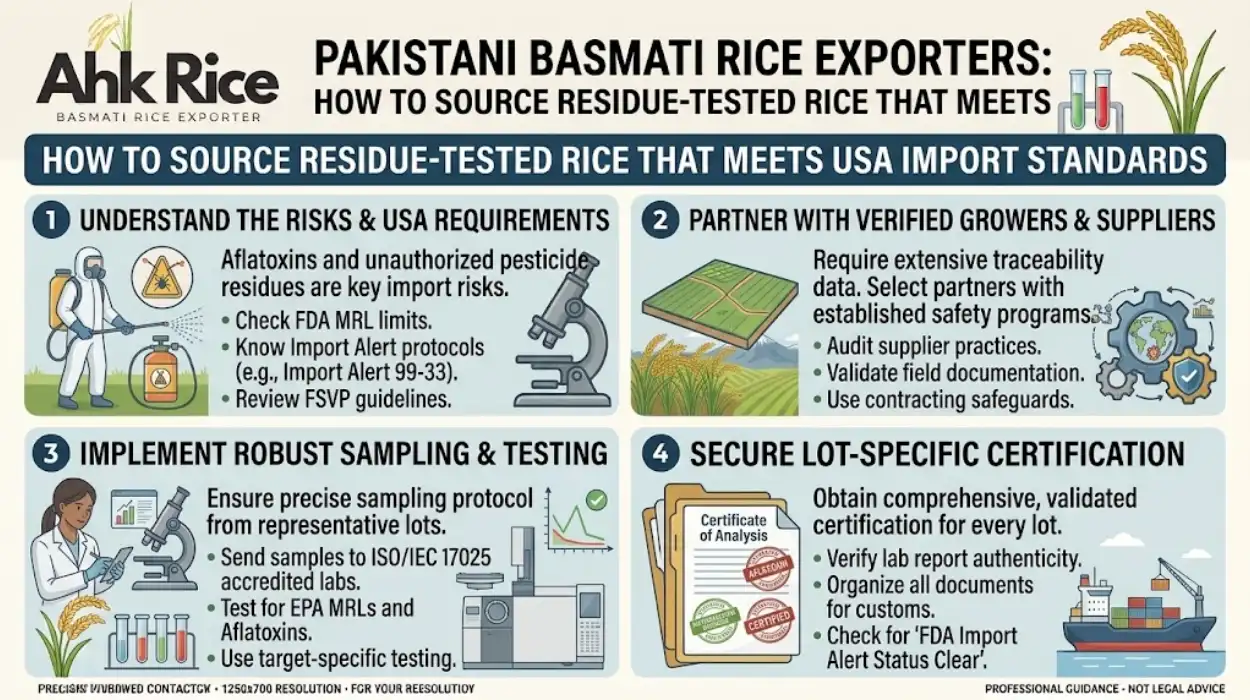
Before selecting a supplier, buyers should understand what pesticide residue limits apply to rice imported into the USA. This knowledge helps importers establish purchasing specifications, identify testing requirements, and reduce the risk of receiving consignments that fail regulatory checks. A reliable sourcing process connects laboratory evidence, product specifications, and shipment documents before the rice leaves Pakistan.
What Is the Best Solution for Sourcing Residue-Tested Pakistani Basmati Rice?
The best solution is to purchase Pakistani Basmati rice against written pesticide residue specifications, supported by appropriate laboratory testing and traceable shipment documentation. Importers should confirm applicable US Environmental Protection Agency tolerances, agree on sampling procedures, and review test results before authorizing shipment.
Pesticide residue compliance depends on the active ingredient and its applicable tolerance, not simply on whether a laboratory report labels a product safe. The US Environmental Protection Agency (EPA) establishes pesticide residue tolerances for food, while the Food and Drug Administration (FDA) monitors pesticide residues in most domestic and imported foods.
Rice exporters should therefore avoid relying on generic statements such as pesticide-free, chemical-free, or fully compliant without supporting evidence. A valid assessment must identify the substances tested, analytical methods, reporting limits, and results against the applicable requirements.
Importers should also understand that laboratory testing does not guarantee automatic entry into the United States. The FDA can examine imported food, request documentation, collect samples, and take regulatory action when applicable requirements are not met.
AHK Rice can work with buyers to define product specifications, coordinate testing arrangements where agreed, and prepare relevant export documentation. Buyers should approve the testing scope before production or shipment so the report addresses their actual purchasing and compliance requirements.
Why Should US Importers Choose AHK Rice?
US importers should select a supplier that combines consistent Pakistani Basmati quality with documented specifications, traceability, and a clearly agreed testing process. AHK Rice supports commercial sourcing decisions by coordinating product requirements, packaging specifications, inspection arrangements, and export documentation with buyers.
Through its Pakistani Basmati rice export and sourcing service, AHK Rice supplies buyers seeking varieties such as 1121, Super Kernel, and 1509 Basmati rice. Each variety serves different market requirements, from premium retail shelves to wholesale distribution and foodservice operations.
The supplier selection process should establish measurable acceptance criteria before the purchase order is confirmed.
These criteria should cover grain variety, processing type, moisture content, broken percentage, packing format, and pesticide residue testing requirements. Buyers should also identify the production lot or shipment batch associated with the laboratory report.
AHK Rice can discuss testing requirements and documentation with prospective buyers before an order is finalized. The specific laboratory, test panel, sample collection method, and inspection arrangements should be confirmed in writing because availability and costs depend on the order.
This approach gives importers a clearer basis for comparing suppliers. Instead of evaluating quotations on price alone, purchasing teams can assess product specifications, evidence quality, and the supplier’s ability to meet agreed shipment requirements.
Which Pesticide Residue Tests Should Buyers Require?
Buyers should select a pesticide residue panel based on applicable US tolerances, the product’s supply-chain risk assessment, and the intended shipment specifications. The laboratory report should identify tested compounds, analytical methods, detection limits, and measured concentrations for meaningful compliance review.
A multi-residue screening panel can test for numerous pesticide compounds in one laboratory procedure. However, no single panel necessarily detects every pesticide or addresses every analytical requirement. Buyers should confirm that the selected panel covers the substances relevant to their sourcing risk assessment.
The testing plan should consider the following requirements:
- Applicable tolerances: Verify the relevant EPA tolerance for each pesticide and food commodity, including any applicable exemptions or other legal provisions.
- Analytical coverage: Confirm that the selected method can measure the target compounds at suitable reporting limits.
- Laboratory credentials: Evaluate the laboratory’s accreditation scope, such as ISO/IEC 17025 accreditation for the relevant tests.
- Sampling procedures: Establish how samples will represent the production lot and whether independent inspection is required.
- Report identification: Ensure the report identifies the product, sample, testing dates, methods, and results.
A report showing no detected residues does not necessarily mean that every pesticide is absent. It means the tested substances were not detected at or above the relevant method’s reporting threshold.
Importers should review results against applicable legal limits rather than applying one universal threshold to all pesticides. If a result exceeds an applicable tolerance, the buyer should investigate the finding and obtain qualified regulatory advice before proceeding with shipment.
How Does AHK Rice Support Testing and Shipment Documentation?
A documented sourcing process connects the approved rice specification with the tested sample, production lot, and final shipment. Importers should establish these links before dispatch and verify that the documents accurately describe the goods being purchased.
AHK Rice can discuss the documentation required for an order and coordinate agreed requirements with relevant suppliers, laboratories, and inspection providers. The exact documents depend on the shipment, buyer instructions, applicable regulations, and contractual terms.
A practical document package may include:
| Document or record | Purpose |
|---|---|
| Commercial invoice | Records the goods, quantities, and transaction value |
| Packing list | Identifies package counts, net weight, and gross weight |
| Certificate of Origin | Documents the declared country of origin |
| Bill of lading | Records shipment and carriage details |
| Laboratory residue report | Provides analytical results for the identified sample |
| Product specification | Defines variety, grade, moisture, broken percentage, and packaging |
| Additional compliance records | Supports applicable food safety, traceability, and importer requirements |
A pesticide residue report is evidence of analytical testing, not a substitute for all US import obligations. US importers must assess applicable FDA requirements, including facility registration where required, prior notice, and Foreign Supplier Verification Program (FSVP) responsibilities.
Under FSVP, the US importer generally must verify that its foreign supplier produces food in compliance with applicable US food safety requirements. The importer should determine the appropriate verification activities and retain the required records.
AHK Rice and the US buyer should agree on document responsibilities before the order is placed. This reduces confusion about who arranges testing, who reviews results, and which records must accompany or precede shipment.
What Results Can Importers Expect From a Residue-Testing Process?
A well-defined testing process gives importers measurable evidence for supplier approval, purchasing decisions, and shipment review. Results depend on the sample, laboratory method, substances tested, and actual residue concentrations; testing cannot guarantee regulatory clearance or eliminate every import risk.
For example, a US distributor ordering 1121 Basmati rice for premium grocery stores may require a multi-residue laboratory report, a defined moisture specification, and traceability to the production lot. The buyer can review the results and approve the shipment against the purchase contract before dispatch.
A foodservice importer purchasing 1509 Basmati rice may prioritize consistent cooking performance, bulk packaging, and predictable supply. The same buyer can specify pesticide residue testing while separately defining grain quality and packaging acceptance criteria.
These examples demonstrate why quality and compliance should be assessed together. A residue report does not establish grain length, cooking performance, aroma, or packaging quality. Each requirement needs its own appropriate evidence.
AHK Rice can help buyers define these requirements before shipment planning begins. The expected commercial benefit is a clearer approval process, fewer specification misunderstandings, and better visibility into supplier performance.
Importers should still allow time for laboratory analysis, document review, and any additional inspections. If a result is inconclusive or fails the agreed specification, shipment approval should wait until the issue has been investigated and resolved.
How Much Does Residue Testing and Export Sourcing Cost?
The total cost depends on the pesticide panel, laboratory, sample collection method, inspection requirements, rice grade, order quantity, packaging, and shipping terms. Importers should request an itemized quotation that separates product costs, testing charges, inspection fees, freight, and destination expenses.
Laboratory charges vary according to the number of compounds tested, analytical complexity, sample quantity, turnaround time, and laboratory location. Independent sampling or third-party inspection may add costs when required by the purchase contract.
There is no single reliable testing fee for every Pakistani Basmati shipment. A narrow test panel and a broad multi-residue analysis can have different costs, so buyers should compare the scope of each quotation rather than the headline price.
Before confirming an order with AHK Rice, buyers should clarify:
- Whether laboratory testing is included in the rice quotation or charged separately.
- Which pesticide compounds the laboratory will test.
- Whether sample collection and courier charges are included.
- Whether independent inspection or additional food safety analysis is required.
- Whether freight is quoted under FOB, CFR, or CIF terms.
- Which party pays for repeat testing if a result is inconclusive or disputed.
Importers should also account for destination handling, customs brokerage, duties where applicable, and other charges that are not necessarily included in the exporter’s quotation.
A written cost breakdown helps procurement teams compare suppliers on a consistent basis. It also prevents disputes about testing responsibilities after production has started.
How Long Does Shipping Take From Pakistan to the USA?
Transit time depends on the Pakistani port, US destination, carrier schedule, transshipment arrangements, and port congestion. Importers should obtain a current shipping schedule and treat estimated transit days separately from production, laboratory testing, customs clearance, and final delivery.
For planning purposes, ocean freight from Pakistan to major US ports may take approximately 25–40 days, although some routes require longer. Actual transit can vary significantly by destination and carrier, so this range is an estimate rather than a guaranteed delivery commitment.
Buyers shipping to the East Coast, Gulf Coast, or West Coast should request a route-specific estimate before confirming delivery dates. Transshipment, vessel availability, and seasonal congestion can change the schedule.
The complete order timeline also includes specification approval, production, testing, document preparation, and destination clearance. Laboratory turnaround should be confirmed directly with the selected laboratory and scheduled early enough to avoid unnecessary shipment delays.
AHK Rice can discuss the intended destination, shipment quantity, and agreed testing arrangements during quotation. The buyer should approve the schedule only after receiving current freight information and a clear allocation of compliance responsibilities.
How Can Buyers Request Samples Before Placing a Commercial Order?
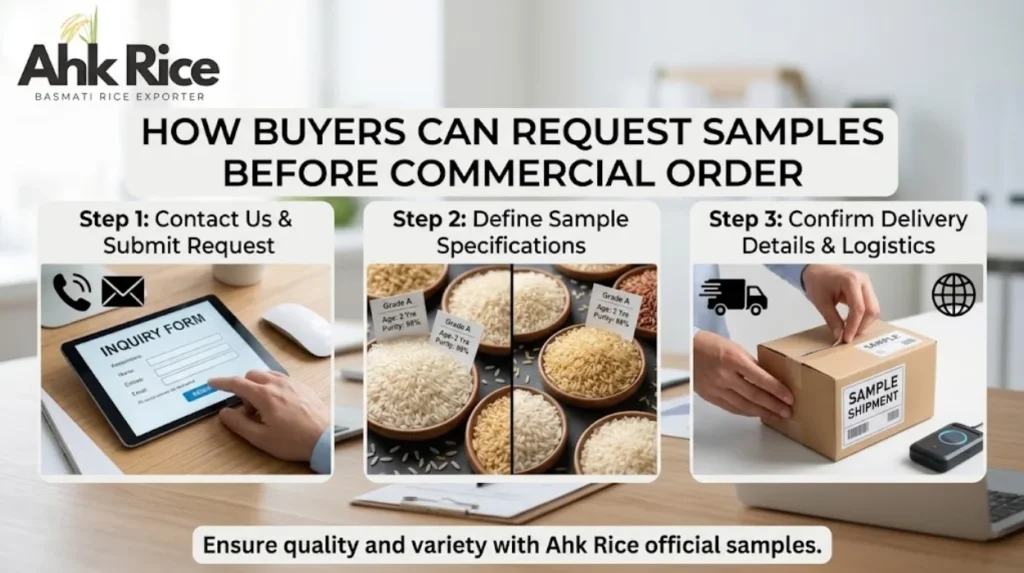
Buyers should approve a representative rice sample, agree on testing requirements, and confirm all associated charges before committing to a full shipment. Sample evaluation should cover both commercial quality and any laboratory testing needed for the buyer’s supplier approval process.
AHK Rice can discuss sample availability for varieties such as 1121, Super Kernel, and 1509, subject to confirmation. A practical sample-to-order process follows these steps:
- Submit requirements: Specify the rice variety, processing type, target grade, destination, intended quantity, and packaging needs.
- Confirm sample availability: Agree on the sample weight, dispatch schedule, and whether the sample represents the proposed commercial specification.
- Arrange courier delivery: Confirm the courier fee, destination charges, and any applicable documentation or handling costs before dispatch.
- Agree on laboratory testing: Decide whether the buyer requires a residue-tested sample, who selects the laboratory, and who pays for analysis.
- Review the results: Evaluate the laboratory report against applicable tolerances and the agreed specification. Conduct cooking and grain-quality tests separately where required.
- Approve the purchase order: Confirm commercial specifications, final pricing, packaging, shipment terms, testing responsibilities, and documentation requirements.
Sample costs should be quoted individually because courier rates, destination, sample weight, and laboratory requirements differ. Where AHK Rice offers a sample arrangement, the buyer should confirm whether the rice is free and whether courier, testing, and applicable handling charges are payable separately.
A sample test also does not automatically establish that a later commercial shipment complies. Buyers should agree on how the production lot will be sampled and whether the commercial consignment requires separate testing.
How Can US Importers Start an Order With AHK Rice?
Start by submitting the target variety, required quantity, destination port, residue-testing panel, and preferred shipping terms. AHK Rice can then discuss product availability, specification approval, testing arrangements, packaging, documentation, and a quotation based on the buyer’s requirements.
Before placing the purchase order, confirm the following decision points:
- The rice variety and measurable quality specifications.
- The applicable pesticide tolerances and required laboratory panel.
- The laboratory’s accreditation and reporting limits.
- The sample approval and commercial lot sampling procedure.
- The export documentation and US importer responsibilities.
- The total cost, payment terms, and estimated shipping schedule.
Buyers should also review the comparison of EPA tolerances, MRL testing and aflatoxin checks for Pakistani Basmati exports to distinguish pesticide residue compliance from other food safety checks. Pesticide residues and aflatoxins are separate hazards requiring different analytical methods and compliance assessments.
AHK Rice supports Pakistani Basmati sourcing for buyers who need defined specifications and a clear export process. The most reliable purchasing decision combines documented product requirements, suitable laboratory evidence, transparent commercial terms, and a shipment plan that accounts for US import obligations.
To discuss your required variety, testing panel, sample arrangements, and destination-specific quotation, request a quote from AHK Rice.
Frequently Asked Questions
1. Does Pakistani Basmati rice need pesticide residue testing for US import?
Testing requirements depend on applicable regulations, buyer specifications, and the shipment’s risk assessment. Importers should verify relevant EPA tolerances and determine appropriate testing before dispatch.
2. Does a laboratory report guarantee FDA clearance?
No. A laboratory report provides evidence about the tested sample and substances. FDA admissibility also depends on applicable regulations, documentation, inspection findings, and other import requirements.
3. How much does pesticide residue testing cost?
Costs vary by laboratory, test panel, sample collection, and turnaround time. Request an itemized quotation specifying the compounds tested and any additional inspection or courier charges.
4. Can AHK Rice provide residue-tested 1121 and 1509 Basmati rice?
AHK Rice can discuss testing arrangements for 1121, 1509, and other Pakistani Basmati varieties. Buyers should confirm the specific laboratory, test panel, sample traceability, and available reports before ordering.
5. How long does shipping Pakistani Basmati rice to the USA take?
Ocean transit may take approximately 25–40 days on some routes, but actual schedules vary. Confirm current transit estimates and allow additional time for production, laboratory testing, documentation, and customs clearance.
SEO Metadata
Meta Title: Residue-Tested Pakistani Basmati Rice for USA
Meta Description: Source Pakistani Basmati rice for the USA with agreed pesticide residue testing, traceable specifications, export documentation, and shipment planning from AHK Rice.
Primary Keyword: Residue-tested Pakistani Basmati rice for USA
Secondary Keywords:
- Pakistani Basmati rice exporter USA
- Pesticide residue testing for rice imports
- EPA pesticide tolerances for imported rice
- US rice import compliance
- Basmati rice laboratory testing
- 1121 Basmati rice supplier USA
- 1509 Basmati rice exporter
- Pakistani rice export documentation
- FDA import requirements for rice
- FSVP compliance for rice importers