What Is California Prop 65 and Does It Affect Imported Rice?
California Proposition 65, commonly called Prop 65, is a state law that requires businesses to provide warnings about significant exposures to chemicals identified as causing cancer, birth defects, or other reproductive harm. For imported rice, the law becomes relevant when a product creates an exposure that meets California’s warning requirements.
Rice is a staple food imported into the United States from countries including Pakistan, India, Thailand, and Vietnam. California retailers, distributors, food manufacturers, and importers need to understand how Prop 65 applies to rice containing detectable levels of listed chemicals.
Understanding California’s rice warning, heavy metal testing, and compliance requirements helps food businesses distinguish between chemical detection, legally significant exposure, and the need for a consumer warning.
What Is California Proposition 65?
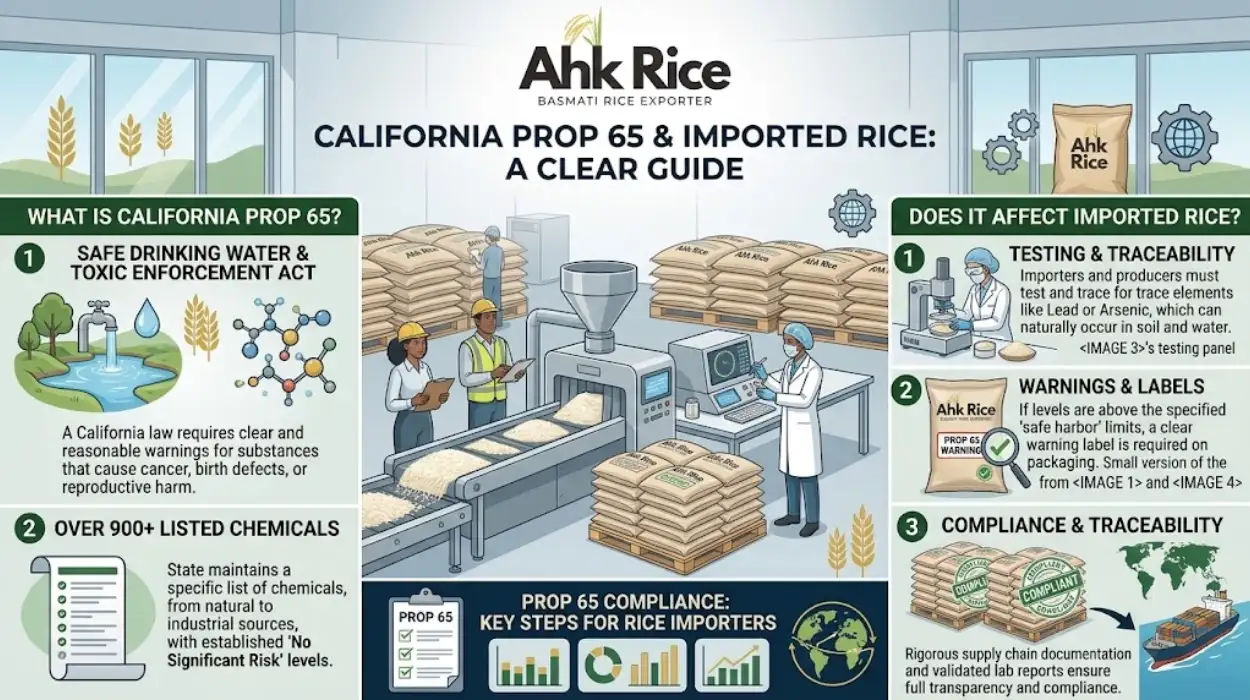
California Proposition 65 is a state law requiring warnings about significant exposures to chemicals listed by California as causing cancer, birth defects, or reproductive harm. It applies to businesses operating in California, including food sellers, when their products create exposures covered by the law.
Approved by California voters in 1986, Proposition 65 is formally known as the Safe Drinking Water and Toxic Enforcement Act of 1986. The law is administered primarily by the California Office of Environmental Health Hazard Assessment (OEHHA).
OEHHA maintains the list of chemicals covered by Prop 65. The list includes substances such as inorganic arsenic, cadmium, lead, and other chemicals associated with cancer or reproductive harm.
Prop 65 does not automatically prohibit products containing listed chemicals. Instead, it generally requires a warning before a person is exposed to a listed chemical above the applicable safe-harbor level, unless an exemption or other legal basis applies.
Food businesses must assess the chemical, the exposure level, the route of exposure, and the relevant regulatory requirements. A laboratory result showing a chemical’s presence does not, by itself, establish that a warning is legally required.
Does California Prop 65 Apply to Imported Rice?
Yes, California Prop 65 can apply to imported rice sold in California. The law focuses on consumer exposure to listed chemicals rather than the country of origin. Importers, distributors, manufacturers, and retailers must assess applicable exposure requirements.
Imported Pakistani Basmati rice is not automatically exempt because it originates outside the United States. The same principle applies to Indian Basmati, Thai Jasmine rice, and other imported rice varieties.
Responsibility depends on the business’s role, contractual arrangements, available exemptions, and applicable legal requirements. Manufacturers, importers, distributors, and retailers should establish who evaluates chemical exposure and provides any required warning.
Prop 65 operates separately from federal food safety requirements. The U.S. Food and Drug Administration (FDA) regulates food safety under federal law, while California applies its own warning requirements to qualifying exposures.
Compliance with federal import rules does not automatically establish Prop 65 compliance. Businesses need to evaluate both regulatory frameworks when importing rice for California consumers.
How Does Prop 65 Work for Rice Products?
Prop 65 compliance for rice starts with identifying listed chemicals, testing representative samples, estimating consumer exposure, and comparing exposure with applicable safe-harbor levels. Businesses then determine whether a warning, exemption, or additional assessment applies.
The process involves four main steps.
1. Identify relevant chemicals
Rice can contain trace elements absorbed from soil and water during cultivation. Arsenic, cadmium, and lead are important examples for food safety assessment.
The chemical’s form matters. Inorganic arsenic, for example, is specifically relevant to cancer and reproductive-harm assessments under California’s chemical listing framework.
2. Test representative rice samples
Importers and suppliers use qualified laboratories to measure relevant contaminants. Sampling plans should reflect the rice variety, production lot, processing method, and intended market.
A result from one bag does not necessarily represent an entire shipment. Documented sampling procedures improve the reliability of decisions.
3. Assess consumer exposure
Exposure assessment considers the concentration of a chemical in rice, the amount consumed, consumption frequency, and other factors relevant to the applicable chemical and route of exposure.
The concentration measured in milligrams per kilogram or parts per billion is not the same as a consumer’s daily exposure. Businesses need a scientifically appropriate calculation before making a compliance decision.
4. Determine the warning requirement
The assessed exposure is compared with applicable Prop 65 safe-harbor levels, including a No Significant Risk Level (NSRL) for cancer and a Maximum Allowable Dose Level (MADL) for reproductive toxicity, where established and applicable.
If the legal requirements for a warning are met and no exemption applies, the responsible business must provide a compliant warning before exposure. Qualified regulatory counsel can help interpret complex cases.
Which Chemicals in Rice Are Relevant to Prop 65?
The chemicals relevant to rice depend on agricultural conditions, contaminant levels, and California’s current chemical list. Inorganic arsenic, cadmium, and lead deserve attention during food safety assessments, but each chemical requires its own evaluation.
Inorganic arsenic
Arsenic occurs naturally in soil and water. Rice plants absorb arsenic through their roots, and growing conditions influence the amount present in harvested grain.
Inorganic arsenic is a Prop 65-listed chemical associated with cancer and reproductive harm. Total arsenic testing alone does not always establish the inorganic arsenic concentration, so laboratories should use methods suited to the assessment.
Cadmium
Cadmium is a naturally occurring metal that also enters agricultural environments through certain human activities. Plants absorb varying amounts depending on soil properties and growing conditions.
Cadmium has Prop 65-listed health classifications. Its presence in rice requires interpretation based on the relevant chemical form, exposure route, and applicable warning requirements.
Lead
Lead can enter the environment through contaminated soil, dust, water, or other sources. Food testing helps identify concentrations that require investigation.
Lead is associated with serious health effects, particularly for children and developing fetuses. Businesses must evaluate results using applicable food safety standards and California’s exposure-based legal framework.
The detection of any one of these chemicals does not automatically mean a rice product violates Prop 65. The result must be interpreted against the appropriate regulatory criteria.
What Are the Key Components of Rice Prop 65 Compliance?
Rice Prop 65 compliance involves chemical identification, representative laboratory testing, exposure assessment, accurate records, and appropriate warning decisions. Importers need evidence linking the tested product and production lot to the rice sold in California.
The main components are:
- Chemical identification: Determine which listed substances are relevant to the product and its expected exposure.
- Laboratory analysis: Use a qualified laboratory with validated methods and suitable detection limits.
- Lot traceability: Connect test results to the production batch, shipment, supplier, and packaging records.
- Exposure assessment: Calculate exposure using relevant concentration and consumption data.
- Warning review: Determine whether a warning is required and ensure the wording and presentation comply with applicable rules.
- Documentation: Retain laboratory reports, sampling records, supplier specifications, assessments, and warning decisions.
These components support consistent decisions across different rice varieties, including 1121 Basmati, Super Kernel, 1509 Basmati, and non-Basmati rice.
A certificate of analysis (COA) records laboratory findings for a specified sample or lot. It supports quality control, but it does not automatically prove Prop 65 compliance unless the testing and assessment address the relevant legal requirements.
What Are the Benefits of Prop 65 Testing for Rice Importers?
Appropriate testing helps rice importers understand contaminant levels, document supplier controls, assess consumer exposure, and make informed warning decisions. It also improves traceability and supports communication between overseas suppliers and California distributors.
Testing provides evidence for risk assessment rather than relying on assumptions about a country, supplier, or rice variety.
Importers can use results to compare production lots, investigate unusual findings, and improve supplier specifications. Consistent records also help businesses answer questions from retailers, auditors, and regulatory professionals.
Testing does not guarantee that a product is free from every contaminant. Its value depends on representative sampling, suitable laboratory methods, and correct interpretation of results.
Which Imported Rice Products Need Prop 65 Assessment?
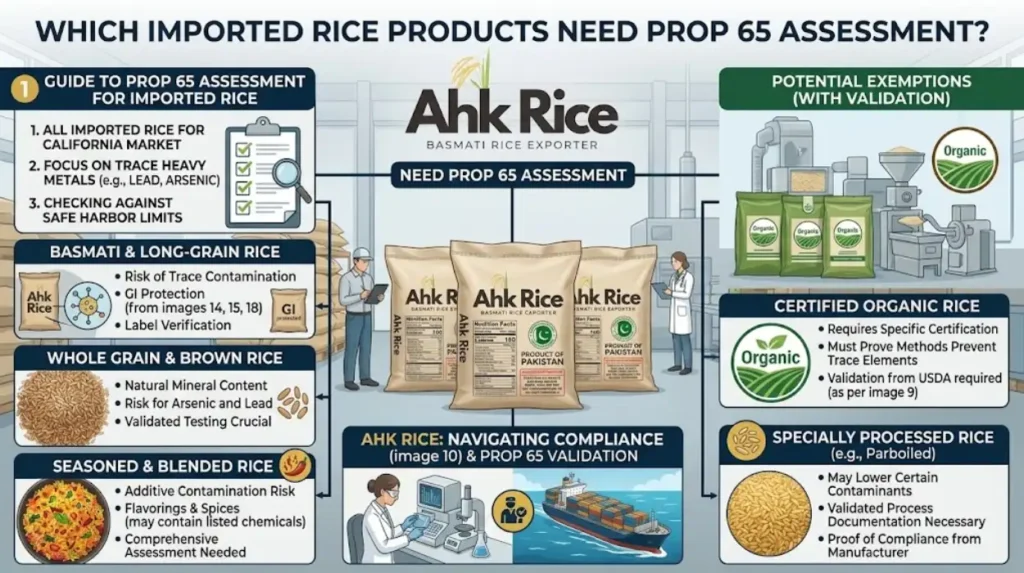
Prop 65 assessment depends on the product’s chemical exposure and intended sale in California, not simply its rice variety. White, brown, parboiled, and specialty rice products all require evaluation when relevant listed chemicals create potential exposure.
Common examples include:
- White Basmati rice: Milled rice sold in retail bags or bulk shipments.
- Brown rice: Rice retaining its bran layer, which has a different composition from fully milled white rice.
- Parboiled rice: Rice treated with water and heat before milling, including Golden Sella and Creamy Sella varieties.
- Food-service rice: Bulk rice supplied to restaurants, caterers, and institutional kitchens.
- Private-label rice: Products packed under a retailer’s or distributor’s brand.
Processing method, agricultural origin, and product specifications influence quality characteristics. They do not independently establish whether a warning is necessary.
Importers should assess the product as sold and consumed. A result for one variety or lot should not automatically be applied to every product from the same supplier.
What Are Common Prop 65 Misconceptions About Imported Rice?
The most common misconceptions are that any detectable chemical requires a warning, imported rice is exempt, and a laboratory certificate guarantees compliance. In reality, Prop 65 decisions depend on applicable exposure thresholds, legal responsibilities, exemptions, and reliable supporting evidence.
Misconception 1: Any detectable arsenic requires a warning. Detection alone does not establish the warning requirement. The relevant exposure assessment and legal criteria determine the outcome.
Misconception 2: Imported food is exempt. Products sold in California are not generally exempt solely because they were produced overseas.
Misconception 3: FDA compliance automatically satisfies Prop 65. Federal food requirements and California’s warning law have different legal purposes. Businesses need to evaluate both.
Misconception 4: One COA covers every shipment. A COA relates to the sample and lot it identifies. New production lots and changed suppliers require appropriate review.
Misconception 5: A Prop 65 warning means a product is banned. A warning communicates qualifying chemical exposure. It is not, by itself, a determination that the food is prohibited or unsafe at every level of consumption.
How Can Rice Importers Prepare for California Market Requirements?
Rice importers can prepare by selecting traceable suppliers, defining contaminant specifications, arranging appropriate laboratory testing, maintaining lot-specific records, and reviewing California warning obligations before distribution. These controls support informed decisions throughout purchasing, shipment, and retail sale.
Start with supplier documentation covering origin, processing, product grade, lot identification, and available contaminant results. Confirm that laboratory reports identify the tested sample, analytical method, units, and reporting limits.
Establish a risk-based testing schedule and review results before shipping or distributing products when the commercial and regulatory process requires it. Testing frequency should reflect supplier history, product risk, and the intended market.
Importers should also define contractual responsibilities for testing, corrective actions, documentation, and warnings. Legal review is important when exposure calculations, safe-harbor levels, or warning obligations are uncertain.
California Prop 65 is an exposure-based warning law, not a blanket ban on imported rice. Understanding the distinction between chemical detection and legally significant exposure helps businesses make evidence-based decisions and maintain responsible food distribution practices.
Frequently Asked Questions
Does California Prop 65 apply to Pakistani Basmati rice?
Yes. Pakistani Basmati rice sold in California falls within the law’s potential scope. Importers must evaluate exposure to relevant listed chemicals and determine whether a warning is required.
Does rice containing arsenic automatically require a Prop 65 warning?
No. Detecting arsenic does not automatically establish a warning obligation. Businesses must evaluate the relevant chemical form, consumer exposure, applicable safe-harbor levels, and legal requirements.
Which heavy metals should rice importers test for?
Importers commonly assess inorganic arsenic, cadmium, and lead. The appropriate testing panel depends on the product, agricultural risks, applicable food safety requirements, and intended market.
Is FDA compliance enough to satisfy California Prop 65?
No. Federal food safety requirements and California’s Prop 65 warning requirements are separate legal frameworks. Importers must assess the requirements applicable to their products and distribution channels.
Does a certificate of analysis guarantee Prop 65 compliance?
No. A certificate of analysis documents results for a specified sample or lot. Compliance also depends on representative sampling, appropriate analytical methods, exposure assessment, and the applicable legal requirements.