Prop 65 Warnings, Heavy Metal Testing and Compliance for Basmati Rice Sold in California
For California Basmati rice retailers, the strongest compliance strategy combines risk-based heavy metal testing, traceable sourcing, batch-specific laboratory reports, and an evidence-based Proposition 65 exposure assessment. Testing identifies contamination levels, while exposure calculations determine whether a warning is necessary. Neither premium grain quality nor a supplier’s general food safety certification establishes Proposition 65 compliance.
California retailers importing Pakistani Basmati rice must evaluate chemical exposure alongside grain specifications, packaging requirements, and supplier documentation. Understanding how heavy metals and food safety risks affect Basmati rice sourcing helps buyers distinguish routine quality checks from California-specific compliance decisions. The distinction matters because rice can absorb inorganic arsenic from its growing environment, and a product’s chemical concentration alone does not establish the exposure a consumer receives.
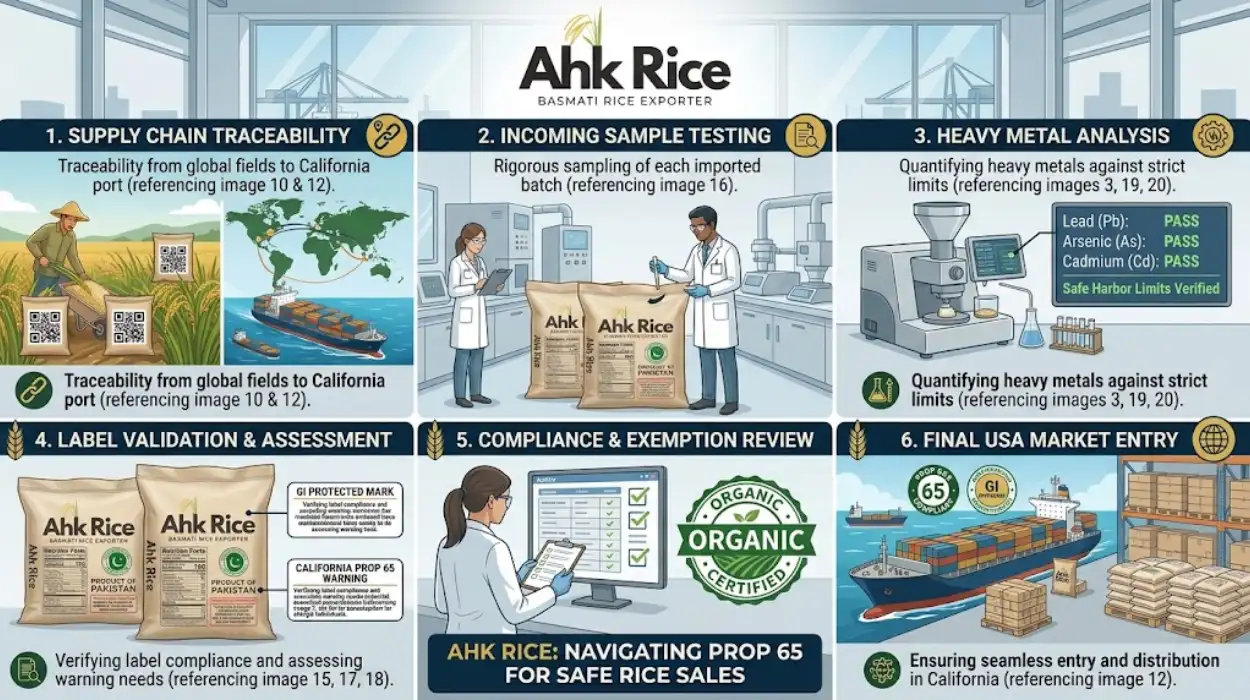
For importers, distributors, private-label brands, and grocery chains, the practical objective is to establish a documented process before shipping rice into California. This process includes selecting the right testing panel, evaluating results against applicable standards, assessing serving-based exposure, reviewing warning obligations, and retaining records that connect each finished product to its source and production batch.
What does California Proposition 65 require from Basmati rice sellers?
California Proposition 65 requires businesses to provide clear and reasonable warnings before exposing people to listed chemicals at levels that trigger the law, unless an applicable exemption or defensible exposure determination applies. Rice sellers must evaluate their products and cannot assume that every product containing a listed chemical requires a warning.
Proposition 65, formally called the Safe Drinking Water and Toxic Enforcement Act of 1986, is a California law addressing exposures to chemicals identified as causing cancer or reproductive harm. The Office of Environmental Health Hazard Assessment (OEHHA) maintains the list of covered chemicals and publishes guidance on warning requirements.
Inorganic arsenic is a form of arsenic that occurs naturally in the environment and can enter rice through soil and irrigation water. Lead is another metal that may require evaluation depending on the product and its contamination profile. Both appear on California’s Proposition 65 list. Their presence must be assessed in the context of the relevant chemical, exposure route, and applicable legal threshold.
The law focuses on exposure rather than simply detecting a chemical in a laboratory sample. For chemicals associated with cancer, businesses assess exposure against an applicable No Significant Risk Level (NSRL). For chemicals associated with reproductive harm, they assess exposure against an applicable Maximum Allowable Dose Level (MADL). These are legal risk-assessment benchmarks, not universal limits for the concentration of a metal in every food.
A laboratory result showing arsenic in rice therefore does not automatically establish that a warning is required. Equally, a result below a general food safety limit does not automatically establish that a Proposition 65 warning is unnecessary. Businesses must evaluate the applicable requirements and their product’s actual or reasonably anticipated exposure.
What heavy metals should importers test for in Pakistani Basmati rice?
Importers should establish a risk-based testing panel covering inorganic arsenic and lead, with cadmium and total arsenic included where the product risk assessment or buyer specification warrants them. The laboratory method must distinguish inorganic arsenic when that chemical-specific result is necessary for the compliance decision.
Rice accumulates contaminants differently depending on growing conditions, soil characteristics, irrigation water, and agricultural practices. Testing only one shipment or relying on a supplier’s general certificate does not establish the composition of every subsequent batch.
The main testing considerations are:
- Inorganic arsenic: Measures the arsenic form relevant to major rice-related exposure concerns. Total arsenic alone does not reveal the precise inorganic fraction.
- Lead: Measures a listed chemical that requires evaluation against the relevant Proposition 65 exposure criteria.
- Cadmium: Provides additional information about contamination where growing conditions, supplier history, or customer specifications justify its inclusion.
- Total arsenic: Measures arsenic in all forms. It provides useful screening information but cannot replace inorganic arsenic analysis when a decision depends on the inorganic fraction.
Buyers should request laboratory reports that identify the product, batch or lot number, sampling date, analytical method, reporting units, detection or quantification limits, and measured results. A report expressed in parts per billion (ppb) must be interpreted consistently with any specification expressed in micrograms per kilogram (µg/kg). For mass concentrations, 1 ppb in a solid food corresponds to 1 µg/kg.
A defensible testing program also defines how samples are collected. A single grab sample may not represent an entire shipment if contamination varies between bags, lots, or production runs. Representative sampling and documented chain of custody help connect laboratory findings to the actual product being sold.
What are the available solutions for managing Proposition 65 risk?
Four approaches help manage Proposition 65 risk: supplier screening, independent laboratory testing, exposure assessment, and legally reviewed warning or risk-reduction measures. The strongest program combines them because each addresses a different question, from contaminant detection to consumer exposure and final labeling decisions.
1. Supplier screening and traceability
Supplier screening starts before a purchase order is confirmed. Buyers evaluate the production location, sourcing controls, food safety procedures, previous laboratory results, and ability to identify individual lots. Traceability records connect the finished retail pack to the underlying rice batch and processing date.
This approach helps exclude suppliers that cannot provide reliable documentation. However, traceability does not measure metal concentrations and cannot independently prove compliance.
2. Independent laboratory testing
An accredited laboratory can analyze representative rice samples using validated analytical methods. Independent testing provides measurable evidence of chemical concentrations and supports comparisons between suppliers, varieties, and batches.
The laboratory’s accreditation scope should cover the relevant analytes and methods. Buyers should also confirm whether testing measures total arsenic or inorganic arsenic, since the distinction affects interpretation.
Testing alone does not determine the need for a Proposition 65 warning. That decision requires an exposure assessment and review of applicable legal requirements.
3. Exposure assessment
An exposure assessment translates a laboratory concentration into an estimate of consumer exposure. The calculation considers the measured concentration, the amount of rice consumed, the consumption frequency where relevant, and the applicable exposure assumptions.
For example, a concentration reported in µg/kg can be converted into an estimated daily intake by multiplying it by the quantity of rice consumed in kilograms per day. The result is expressed in µg/day. A qualified toxicologist or other appropriate specialist can determine whether the assumptions and calculations fit the relevant Proposition 65 requirements.
4. Warning review and preventive controls
When an exposure assessment establishes that a warning is required, the responsible business must determine the appropriate warning method and wording. Where the evidence supports a conclusion that exposure does not trigger the warning requirement, the business should retain the scientific and legal basis for that conclusion.
Preventive controls may include reviewing growing regions, tightening supplier specifications, improving lot selection, or rejecting batches that fail purchasing requirements. These actions can reduce risk, but they must be supported by actual results rather than general claims about origin or processing.
OEHHA explains that testing is not expressly required by Proposition 65. Businesses remain responsible for determining whether warnings are necessary, and testing or expert assessment can support that decision.
How do heavy metal testing and Proposition 65 compliance approaches compare?
Supplier documentation offers a low-cost starting point, independent testing measures chemical concentrations, and exposure assessment connects those results to legal warning thresholds. A combined program provides stronger evidence than any single method because it addresses sourcing, measurement, and regulatory interpretation.
| Comparison attribute | Supplier documentation | Independent laboratory testing | Exposure assessment |
|---|---|---|---|
| Primary purpose | Verify sourcing and process controls | Measure chemical concentrations | Evaluate consumer exposure |
| Main evidence | Traceability records and supplier declarations | Batch-specific analytical report | Documented exposure calculation |
| Arsenic evaluation | Depends on existing supplier data | Measures total or inorganic arsenic as specified | Uses the relevant measured concentration |
| Lead evaluation | Depends on existing supplier data | Measures lead concentration | Compares estimated exposure with the applicable benchmark |
| Relative cost | Generally low | Moderate; varies by panel and sample count | Varies by complexity and specialist fees |
| Main limitation | Does not independently verify contaminants | Does not automatically determine warning obligations | Depends on reliable data and appropriate assumptions |
| Best application | Initial supplier qualification | Batch verification and ongoing monitoring | California warning and risk decisions |
The methods serve different purposes. Supplier documentation helps establish control over the supply chain, but it cannot replace analytical evidence when measured concentrations are needed. Laboratory testing supplies that evidence, but it does not automatically resolve the legal question. Exposure assessment interprets the findings in context and helps the responsible business document its decision.
A further distinction is necessary when comparing Proposition 65 with federal food safety requirements. The US Food and Drug Administration (FDA) publishes guidance on inorganic arsenic in infant rice cereals, including an action level of 100 ppb for that specific product category. That action level does not establish a universal Proposition 65 threshold for ordinary retail Basmati rice. Buyers must identify the exact standard applicable to their product and intended use.
Which compliance method works best for different California rice buyers?
Retailers with established suppliers should combine routine supplier qualification with risk-based batch testing and a documented exposure assessment. New importers should establish all three controls before launch, while private-label brands need additional coordination between testing, packaging artwork, legal review, and lot traceability.
A small importer purchasing one shipment has different operational needs from a supermarket chain buying multiple containers each month. The underlying compliance responsibilities still require a defensible product assessment.
An importer entering California for the first time should prioritize a representative sample, an appropriate heavy metal panel, and an exposure assessment before approving final retail packaging. This creates a documented baseline against which later shipments can be evaluated.
A distributor with repeat purchases can establish supplier approval criteria and a testing schedule based on historical results, product variability, and the consequences of non-compliance. Each shipment should remain traceable to its relevant records, even when the supplier and variety remain unchanged.
A private-label retailer should integrate these controls into its product approval process. The importer, brand owner, laboratory, packaging team, and legal adviser need to agree on who reviews results, who approves label claims, and who determines whether a warning is required.
For all three buyer types, the preferred method is a risk-based program rather than a blanket claim that a particular Basmati variety, country of origin, or processing technique guarantees compliance.
How do California and other US markets differ in rice compliance requirements?
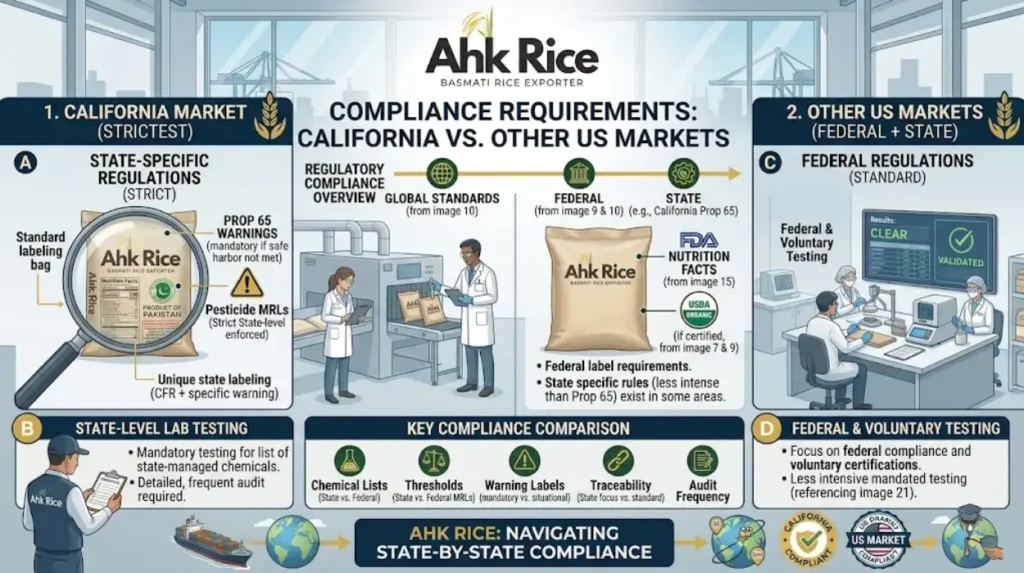
California-bound rice requires a specific Proposition 65 review in addition to applicable federal food safety and import requirements. Other US markets follow the relevant federal and state rules, but California’s chemical exposure warning framework makes documented exposure assessment particularly important for businesses selling into that state.
For sourcing purposes, buyers should compare the regulatory requirements of their destination markets rather than assume that one laboratory report or retail label automatically satisfies every jurisdiction.
| Purchasing factor | California retail market | Other US retail markets |
|---|---|---|
| Regulatory review | Federal requirements plus applicable California rules | Applicable federal, state, and local requirements |
| Heavy metal testing | Risk-based panel with California exposure assessment | Risk-based panel aligned with product and buyer requirements |
| Preferred grades | 1121, Super Kernel, and 1509 according to retail positioning | 1121, Super Kernel, and 1509 according to retail positioning |
| Documentation | Lot traceability, test results, and Proposition 65 assessment records | Lot traceability, test results, and applicable compliance records |
| Packaging approval | Review consumer warnings and applicable label requirements | Review federal and destination-specific label requirements |
| Procurement cost per MT | Depends on grade, testing, packaging, and compliance services | Depends on grade, testing, packaging, and destination requirements |
Which Basmati grades suit different retail strategies?
1121 Basmati suits premium retail positioning where long grains, cooked elongation, and an established premium identity matter. Retailers should evaluate its actual laboratory results rather than assume that long grain length predicts lower heavy metal concentrations.
Super Kernel Basmati serves buyers seeking traditional Pakistani Basmati aroma and a premium everyday product. Its suitability depends on the agreed grain specifications, cooking performance, price, and documented quality controls.
1509 Basmati suits buyers prioritizing commercial value, consistent supply, and a competitive price position. Its shorter growing cycle can support a different sourcing strategy, but growing duration alone does not establish a lower contaminant concentration.
AHK Rice supplies Pakistani Basmati varieties from Punjab to international buyers. Retailers can use its Basmati rice sourcing and export services to discuss variety selection, processing specifications, packaging requirements, and shipment documentation. Product-specific testing and Proposition 65 exposure decisions should remain tied to the actual lot and intended retail use.
How should buyers compare price per metric tonne?
A meaningful price comparison must include the rice grade, shipment volume, testing scope, packaging, freight terms, and destination. California-bound rice may incur additional testing and compliance assessment costs, but there is no universal California compliance premium that applies to every shipment.
The following framework helps buyers compare quotations without treating unverified market prices as established benchmarks.
| Cost component | California-bound shipment | Other US shipment |
|---|---|---|
| Rice price per MT | Based on grade and agreed specifications | Based on grade and agreed specifications |
| Laboratory testing | Panel and sampling costs depend on scope | Panel and sampling costs depend on scope |
| Exposure assessment | Include when needed for Proposition 65 decisions | Include when required by the applicable risk assessment |
| Packaging | Include approved retail artwork and required warnings, where applicable | Include destination-appropriate retail artwork |
| Freight and import costs | Calculate using the agreed Incoterm and destination | Calculate using the agreed Incoterm and destination |
Request quotations using the same grade, broken percentage, moisture specification, packaging format, and shipment volume. Then compare the complete delivered cost per metric tonne. Ask suppliers to itemize testing, packaging changes, and specialist assessment fees rather than burying these costs in a general product price.
How does shelf life affect compliance planning?
Shelf life depends on rice condition, moisture, packaging integrity, storage conditions, and the product’s validated quality specifications. Proposition 65 does not establish a universal shelf life for Basmati rice, and a longer shelf life does not prove that a product meets heavy metal exposure requirements.
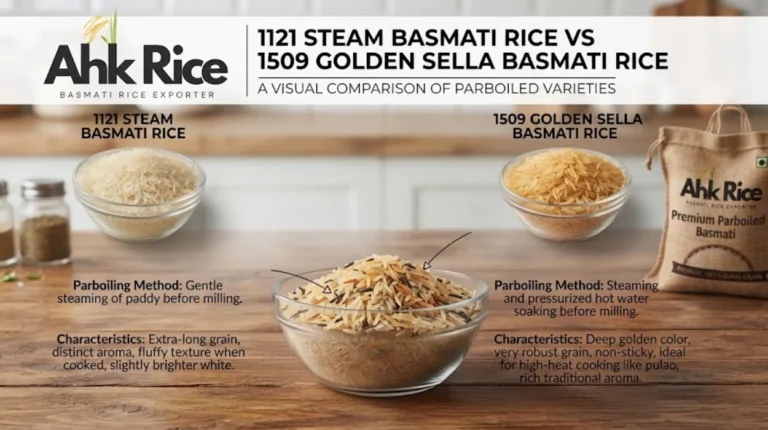
White, Steam, and Sella Basmati products can have different processing and storage characteristics. Buyers should request a documented shelf-life specification for the exact product and packaging format, supported by appropriate product information.
Packaging should protect rice from moisture and physical contamination throughout distribution. Lot codes should remain legible and connect retail packs to laboratory reports and production records. If a product is repacked or its formulation changes, the responsible business should determine whether existing test results and exposure assumptions still represent the finished product.
For both California and other US markets, retain product identity, production dates, lot codes, storage requirements, and the evidence supporting the stated shelf life. Keep these records separate from Proposition 65 exposure conclusions so that quality assurance and legal compliance remain independently verifiable.
What are the advantages and disadvantages of each compliance strategy?
Supplier screening reduces avoidable sourcing risks, laboratory testing supplies measurable evidence, and exposure assessment supports a defensible warning decision. Their limitations differ, so importers should combine the methods instead of relying on a supplier certificate, a single test result, or a generic warning statement.
Supplier screening: advantages and limitations. Reviewing traceability and supplier controls before placing an order helps buyers identify gaps early. It can reduce unnecessary testing of unsuitable suppliers and establish consistent purchasing requirements. Its main limitation is that supplier declarations cannot independently establish the contaminant levels in a specific shipment.
Independent laboratory testing: advantages and limitations. Testing provides quantitative evidence that can support supplier comparisons and lot acceptance decisions. A representative sample also helps buyers identify batches requiring further investigation. However, results apply to the tested sample and analytes, not automatically to every future shipment. Testing costs increase when buyers require multiple analytes, repeated sampling, or additional confirmation.
Exposure assessment: advantages and limitations. An assessment connects laboratory concentrations with consumption assumptions and the relevant legal benchmarks. It helps explain why a warning is required or why the available evidence supports a different conclusion. Its reliability depends on the quality of the underlying data and the suitability of its assumptions. A poorly designed assessment can produce an unreliable compliance decision even when the laboratory analysis is accurate.
Preventive sourcing and process controls: advantages and limitations. Reviewing growing regions, irrigation information, supplier performance, and lot history can help reduce the likelihood of purchasing unsuitable rice. Yet country of origin, grain variety, parboiling, steam processing, or optical sorting does not independently establish low heavy metal levels. Any claim about contaminant reduction needs evidence appropriate to the specific process and product.
The practical approach is to establish written specifications, test according to risk, investigate unusual results, and document the final decision. This produces a repeatable process for purchasing teams and gives retailers a clearer basis for supplier approval.
What factors should buyers use when selecting a compliance strategy?
The best compliance strategy depends on the destination, supplier reliability, product variability, testing evidence, and retail packaging requirements. Buyers should evaluate these factors before confirming a purchase order so that quality approval, exposure assessment, and label decisions follow a documented process.
Use this five-factor decision framework to compare supplier options.
| Decision factor | What buyers should evaluate | Recommended action |
|---|---|---|
| Supplier reliability | Traceability, quality procedures, and previous test results | Approve suppliers with verifiable records |
| Chemical testing | Inorganic arsenic, lead, and other relevant analytes | Specify suitable methods and representative sampling |
| Exposure assessment | Consumption assumptions and applicable legal benchmarks | Obtain a documented assessment where needed |
| Packaging and labeling | Product identity, lot codes, and applicable warnings | Approve artwork after regulatory review |
| Shipment consistency | Batch variation, storage conditions, and documentation | Maintain lot-level records and a risk-based monitoring plan |
Before signing a supply agreement, buyers should define acceptance criteria and responsibilities in writing. The agreement should specify who arranges testing, who pays for additional analysis, how failed results are handled, and whether the buyer must approve laboratory reports before dispatch.
For private-label shipments, the agreement should also establish who approves the final label and who maintains the supporting compliance records. These responsibilities should be explicit because the exporter, importer, distributor, and retailer may have different roles in the supply chain.
How can AHK Rice support California-focused Basmati rice sourcing?
AHK Rice supports international Basmati buyers through product selection, processing coordination, custom packaging, and export documentation. California-focused buyers should communicate their heavy metal testing specifications and documentation requirements before production so the proposed shipment can be evaluated against their purchasing and compliance criteria.
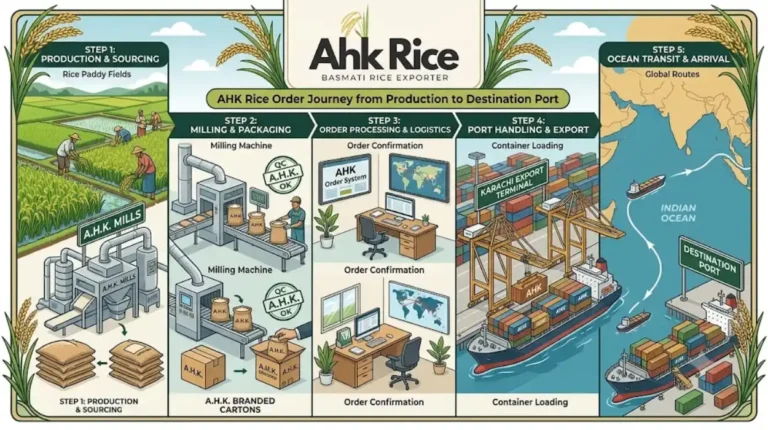
A practical procurement process begins by selecting the required grade and defining the product specification. Buyers should confirm grain length, broken percentage, moisture, processing type, packing format, and shipment quantity. They should then identify the laboratory panel and documentation needed for the intended US market.
The next step is to establish a batch-specific testing plan. The buyer and supplier should agree on sampling arrangements, laboratory qualifications, reporting units, and acceptance criteria before shipment. Where results require interpretation under Proposition 65, the responsible business should arrange an appropriate exposure assessment and obtain legal advice when necessary.
Finally, the importer should approve the packaging and supporting documentation before the product enters retail distribution. This process connects the commercial purchase decision with the evidence required for product quality, traceability, and regulatory review.
For buyers evaluating a commercial order, the next step is to supply Prop 65-ready Basmati rice to California retailers with AHK Rice. The exact testing scope, label requirements, and exposure assessment should be confirmed for the intended product and market. No exporter can guarantee Proposition 65 compliance solely through a variety specification, country-of-origin statement, or general quality certificate.
Frequently asked questions
Does every Basmati rice product sold in California need a Proposition 65 warning?
No. A warning is not automatically required simply because rice contains a listed chemical. The responsible business must evaluate the exposure and applicable requirements. A warning may be necessary when exposure exceeds the relevant threshold and no applicable exemption or other basis removes the obligation.
Does heavy metal testing guarantee Proposition 65 compliance?
No. Testing measures the concentrations of the chemicals included in the analytical panel. Proposition 65 decisions may require an additional exposure assessment using consumption assumptions and applicable legal benchmarks. The business must evaluate the evidence before deciding whether a warning is necessary.
Is inorganic arsenic testing more useful than total arsenic testing for rice?
For decisions specifically concerning inorganic arsenic exposure, testing that measures inorganic arsenic provides more directly relevant information. Total arsenic measures all arsenic forms combined and does not independently establish the inorganic concentration.
Does FDA compliance mean that Basmati rice meets Proposition 65 requirements?
Not automatically. Federal food safety requirements and California Proposition 65 address different regulatory questions. FDA guidance for infant rice cereals, for example, includes a 100 ppb inorganic arsenic action level for that specific category. It is not a universal Proposition 65 limit for all Basmati rice.
How often should importers test Basmati rice for heavy metals?
The testing schedule should reflect supplier history, growing conditions, product variability, previous results, and buyer requirements. New suppliers and products with limited testing history generally need stronger initial verification. Established suppliers can use documented risk assessments to determine appropriate ongoing monitoring.
Can parboiling or Sortex processing remove heavy metals from rice?
Neither process independently guarantees the removal of heavy metals. Parboiling changes rice processing characteristics, while Sortex equipment primarily separates grains based on optical differences. Buyers should require analytical evidence before making claims about contaminant reduction.
What documents should a California rice importer request?
The documentation package should include product specifications, lot identification, relevant laboratory reports, supplier traceability records, and applicable food safety and import documents. Where Proposition 65 exposure requires evaluation, the responsible business should also retain the supporting assessment and warning decision.
Can Pakistani Basmati rice exporters prepare packaging for California retailers?
Exporters can coordinate custom packaging and provide product information for retailer review. However, the importer or other responsible business must confirm the applicable US and California labeling requirements. Final artwork should receive appropriate regulatory review before printing and distribution.