How Is Basmati Rice Processed Step by Step from Paddy to Export Grain?
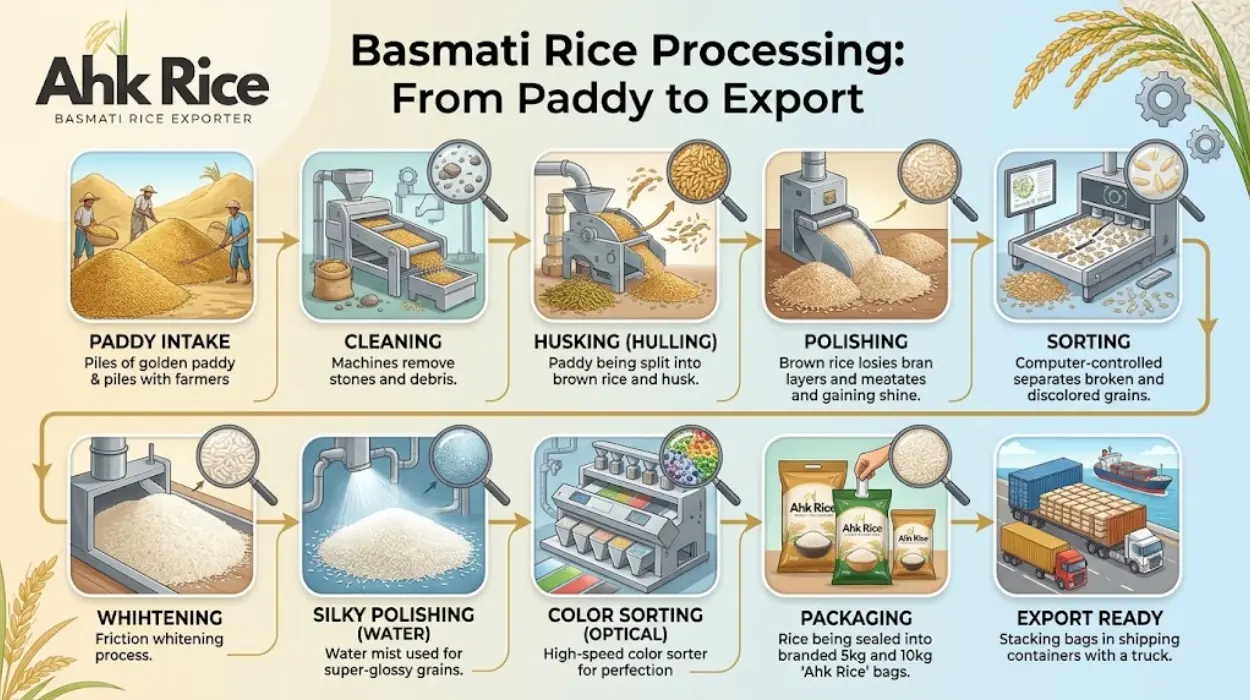
Basmati rice processing transforms harvested paddy into clean, graded, polished, and export-ready rice through controlled milling operations. The process includes paddy inspection, cleaning, drying, dehusking, whitening, polishing, Sortex sorting, grading, quality testing, packaging, and export preparation.
Basmati rice originates primarily from the Punjab regions of Pakistan and India. Pakistani Basmati is cultivated across Punjab districts, including Gujranwala, Hafizabad, Sheikhupura, Narowal, and Sialkot. Its characteristic aroma, slender grain structure, and cooking elongation make it an important agricultural export.
Understanding how Basmati moves from paddy to finished grain helps importers, distributors, wholesalers, and food manufacturers evaluate rice quality. Pakistani exporters such as AHK Rice process 1121, Super Kernel, and 1509 Basmati rice varieties for international markets through controlled milling and export preparation.
What Is Basmati Rice Processing?
Basmati rice processing is the controlled conversion of harvested paddy into market-ready rice through cleaning, drying, dehusking, whitening, polishing, sorting, and grading. Each operation removes unwanted material, protects grain quality, and prepares rice for domestic consumption or international export.
Paddy is the harvested rice crop with its outer husk intact. It contains the rice grain, bran layers, and husk. A rice mill separates these components through mechanical operations while maintaining the physical characteristics of the grain.
The finished product is available in different forms, including raw white rice, steamed rice, and parboiled Sella rice. Each form follows specific processing conditions that influence colour, texture, cooking performance, and storage characteristics.
Basmati processing also preserves commercially important characteristics such as:
- Grain length and slenderness.
- Natural aroma and varietal identity.
- Moisture percentage.
- Broken grain percentage.
- Colour consistency and cleanliness.
- Cooking elongation and texture.
Where Is Basmati Rice Grown Before Processing?
Pakistani Basmati rice is cultivated mainly in Punjab, where suitable soil, irrigation, seasonal temperatures, and agricultural practices support aromatic grain production. Harvested paddy moves from farms to rice mills for inspection, cleaning, drying, and subsequent processing.
Pakistan’s traditional Basmati-growing areas include Gujranwala, Hafizabad, Sheikhupura, Narowal, and Sialkot. These districts form important agricultural zones for aromatic rice cultivation.
Farmers grow different varieties according to seed characteristics, maturity periods, yield potential, and market requirements.
Three important Pakistani commercial varieties include:
- 1121 Basmati: Known for extra-long slender grains, strong aroma, and significant cooked-grain elongation.
- Super Kernel Basmati: A traditional aromatic variety valued for its characteristic fragrance and cooking quality.
- 1509 Basmati: A high-yielding, shorter-duration variety with long grains and strong commercial demand.
The harvesting stage determines the starting condition of paddy. Harvest timing, grain maturity, moisture, and handling influence milling recovery and finished rice quality.
How Is Basmati Rice Processed Step by Step?
Basmati rice passes through a sequence of mechanical and quality-control operations. Rice mills inspect incoming paddy, remove impurities, adjust moisture, separate husks, whiten kernels, polish surfaces, sort defects, classify grades, and prepare finished rice for export.
1. Paddy Reception and Quality Inspection
Rice processing begins when harvested paddy arrives at the mill. Workers collect representative samples and examine the incoming crop before unloading or processing.
Initial inspection measures moisture content, foreign material, immature grains, damaged kernels, and varietal identity. Paddy moisture commonly requires controlled drying before milling, with approximately 13–14% serving as a general milling reference rather than a universal specification.
2. Pre-Cleaning and Removal of Impurities
Cleaning removes unwanted materials from harvested paddy before mechanical processing. Screens separate larger materials, while aspiration systems remove lightweight particles.
Destoners remove heavier impurities, including small stones and soil particles. Magnetic separators capture ferrous metal fragments.
These operations protect milling machinery and reduce contamination risks.
3. Paddy Drying and Moisture Control
Drying reduces excessive moisture to improve storage stability and milling performance. Industrial rice mills use controlled dryers or suitable natural drying systems to achieve the required moisture level.
Uneven drying increases fissures and grain breakage during milling. Controlled drying preserves kernel integrity and supports better head-rice recovery.
4. Dehusking or Hulling
Dehusking removes the outer protective husk from paddy. Rubber-roll huskers use two rotating rollers operating at different speeds to separate the husk without excessive kernel damage.
The resulting product is brown rice, which retains its bran layers and germ. Separated husk moves into another collection system for disposal or other industrial uses.
5. Paddy Separation
Paddy separators distinguish unhusked grains from brown rice through differences in density and physical movement.
Unhusked paddy returns to the husking machine for another pass. Brown rice advances to the whitening stage.
This separation reduces unnecessary husking and protects the finished grain from excessive mechanical handling.
6. Whitening and Milling
Whitening removes the bran layers and germ from brown rice to produce white rice. Abrasive or friction-based milling machines remove these outer layers through controlled mechanical action.
The degree of whitening determines the appearance and remaining surface characteristics of the grain. Excessive milling increases broken grains and reduces total rice recovery.
7. Polishing
Polishing improves the surface appearance of milled rice by removing residual bran particles and creating a more uniform finish.
Rice mills use friction or mist-polishing systems depending on the required finish. Proper polishing produces cleaner-looking kernels without unnecessary grain abrasion.
8. Length Grading and Sortex Sorting
Grading separates kernels according to physical characteristics such as length, thickness, and broken percentage. Length graders classify whole kernels and shorter fragments into different categories.
Sortex machines use optical sensors and air-ejection systems to identify and remove discoloured grains, foreign particles, and visible defects.
These operations improve product uniformity and support consistent commercial specifications.
9. Final Inspection and Quality Testing
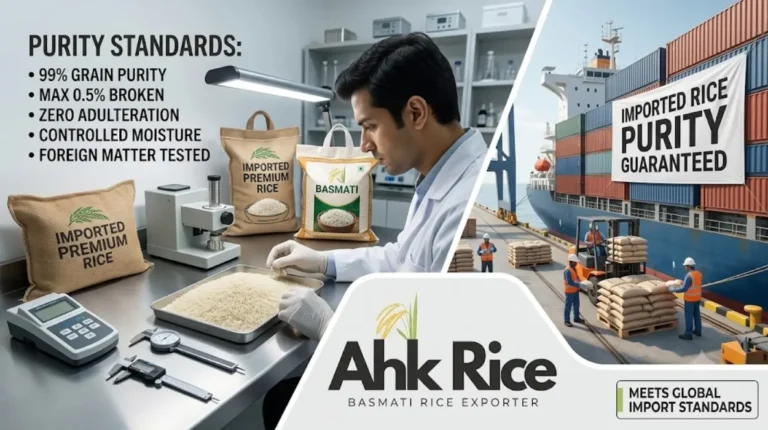
Finished rice undergoes laboratory and physical inspection before packaging. Quality teams check moisture, grain length, broken percentage, foreign matter, colour, and varietal consistency.
Representative samples support laboratory testing and Certificate of Analysis (COA) preparation. The approved specification provides a reference for the finished shipment.
10. Packaging and Export Preparation
The final stage places graded rice into suitable packaging according to buyer specifications. Export packaging includes 5 kg, 10 kg, 25 kg, and 50 kg bags, depending on the destination and distribution requirements.
Rice mills use woven polypropylene bags, laminated bags, and custom retail packaging. Finished consignments undergo weight verification, lot identification, documentation, and container-loading preparation.
What Are the Key Components of a Basmati Rice Mill?
A Basmati rice mill combines mechanical equipment, optical technology, moisture-control systems, and inspection facilities. Each component performs a defined operation, from removing impurities and separating husks to producing uniform grain grades and maintaining finished-product quality.
Important milling equipment includes:
- Pre-cleaners: Remove straw, dust, and large impurities.
- Destoners: Separate stones and heavier particles.
- Dryers: Control paddy moisture before milling.
- Rubber-roll huskers: Remove outer husks.
- Paddy separators: Separate brown rice from unhusked paddy.
- Whitening machines: Remove bran layers.
- Polishers: Improve grain surface appearance.
- Length graders: Separate whole grains and broken fractions.
- Sortex machines: Remove visually defective kernels.
- Weighing and packing machines: Prepare accurately measured export bags.
Laboratory equipment also supports moisture measurement, grain-length analysis, and broken-percentage testing.
What Are the Main Grades and Types of Processed Basmati Rice?
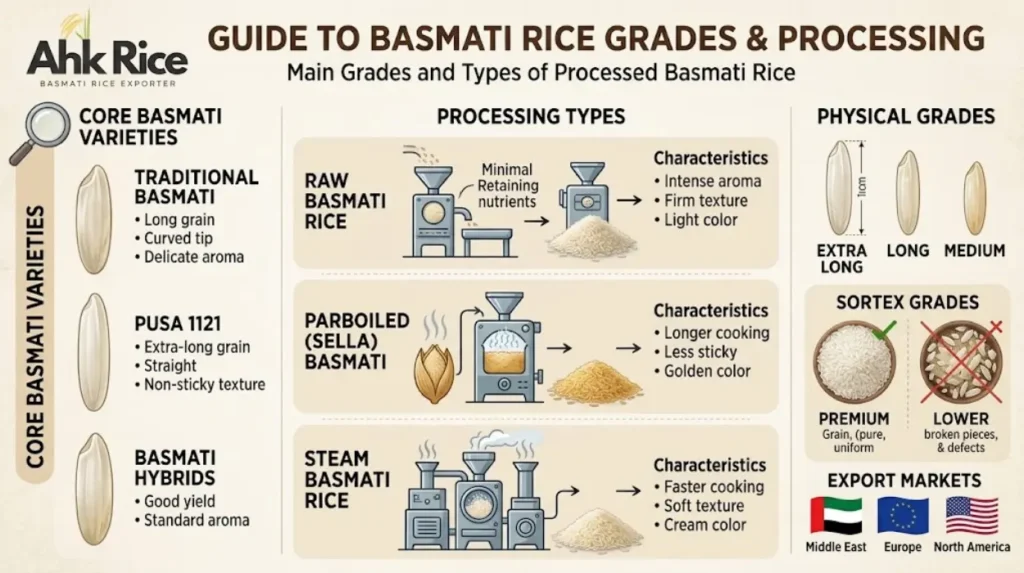
Processed Basmati rice is classified by variety, grain condition, milling treatment, and commercial quality. Major categories include 1121, Super Kernel, and 1509, while finished forms include white, brown, Steam, Golden Sella, and Creamy Sella rice.
Varieties identify the agricultural type of rice. Processing forms describe how the grain is treated after harvesting.
Common commercial categories include:
- 1121 White: Extra-long milled grains for premium retail and foodservice.
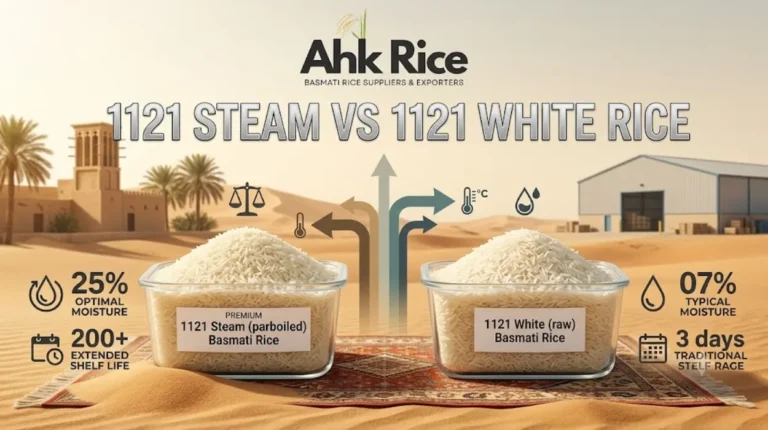
- 1121 Steam: Steam-treated grains with a distinct cooking texture.
- 1121 Golden Sella: Parboiled grains with a golden appearance.
- 1121 Creamy Sella: Parboiled grains with a lighter creamy colour.
- Super Kernel White: Aromatic white rice for traditional rice dishes.
- 1509 White: Long-grain white rice for wholesale and retail distribution.
- 1509 Steam: Steam-processed rice for commercial kitchens.
- 1509 Golden Sella: Parboiled rice for catering and institutional foodservice.
- Brown Basmati: Rice retaining its bran layers and germ.
- Broken Basmati: Broken kernels separated during milling and grading.
The final grade depends on grain dimensions, broken percentage, moisture, whiteness, purity, and buyer specifications. These parameters determine the commercial suitability of each consignment.
What Are the Benefits of Proper Basmati Rice Processing?
Proper processing improves grain cleanliness, physical uniformity, storage stability, and commercial consistency. Controlled milling reduces unwanted impurities, limits avoidable breakage, separates defective kernels, and produces rice that meets defined specifications for retailers, wholesalers, restaurants, and international importers.
The main benefits include:
- Improved cleanliness: Cleaning and destoning remove unwanted materials before milling.
- Better grain appearance: Whitening and polishing produce a consistent finished surface.
- Reduced defects: Sortex technology removes visually defective kernels.
- Controlled moisture: Drying and inspection support suitable storage conditions.
- Consistent grading: Length grading separates whole grains and broken rice.
- Improved market suitability: Packaging and specifications support different distribution channels.
Processing also improves traceability when mills maintain records of paddy batches, milling dates, laboratory results, and packaging lots.
Which Markets Import Processed Pakistani Basmati Rice?
Processed Pakistani Basmati rice serves international retail, wholesale, foodservice, and institutional markets. Important importing destinations include the United Arab Emirates, Saudi Arabia, the United Kingdom, the United States, Malaysia, Iraq, and other markets with demand for aromatic rice.
Different destinations have different preferences for rice varieties, processing forms, and packaging.
- UAE: Imports aromatic Basmati for supermarkets, wholesalers, restaurants, and re-export businesses.
- Saudi Arabia: Uses Basmati in household consumption, catering, restaurants, and institutional foodservice.
- United Kingdom: Supplies South Asian grocery stores, supermarkets, restaurants, and private-label brands.
- United States: Serves ethnic retailers, premium grocery chains, foodservice distributors, and private-label businesses.
- Malaysia: Imports aromatic rice for retail distribution and commercial food preparation.
- Iraq: Uses long-grain rice in wholesale distribution, retail channels, and foodservice operations.
Importers evaluate grain length, aroma, broken percentage, packaging, price, and destination-specific compliance before purchasing.
Which Certifications and Documents Apply to Basmati Rice Exports?
Basmati rice export compliance combines food-safety management, destination-specific requirements, product testing, and shipment documentation. Applicable certifications and documents depend on importing-country regulations, buyer contracts, product claims, and the processing facility’s approved management systems.
Common food-safety certifications and standards include:
- HACCP: Identifies and controls food-safety hazards during processing.
- ISO 22000: Establishes a food-safety management system.
- BRCGS: Provides a recognised framework for food manufacturing and supplier assurance.
- Halal certification: Verifies compliance with applicable Halal requirements.
- Kosher certification: Confirms compliance with relevant Jewish dietary requirements.
- Organic certification: Applies when rice is produced and handled under an approved organic certification system.
Common export documents include:
- Commercial invoice.
- Packing list.
- Certificate of Origin.
- Phytosanitary Certificate.
- Fumigation Certificate, where required.
- Bill of Lading.
- Certificate of Analysis.
Additional requirements depend on the destination. For example, United States imports involve applicable FDA facility registration, Prior Notice, and Foreign Supplier Verification Program responsibilities. Importers also check pesticide residue limits and other relevant food-safety requirements.
A certification is not interchangeable with an export document. Each serves a separate regulatory or commercial purpose.
What Are the Common Problems and Misconceptions in Basmati Rice Processing?
Common processing problems include excessive grain breakage, uneven moisture, incomplete dehusking, inconsistent whitening, poor sorting, and inadequate storage. Misunderstanding varieties, milling grades, and parboiled forms also leads to incorrect purchasing decisions and inconsistent product specifications.
Several misconceptions affect rice quality assessments.
1. All long-grain rice is not Basmati. Grain length alone does not establish varietal identity. Aroma, grain characteristics, origin, and applicable authenticity requirements also matter.
2. More whitening does not always mean better quality. Excessive whitening removes additional grain material and increases milling losses.
3. Sortex sorting does not replace laboratory testing. Optical machines identify visible defects, while laboratory testing evaluates parameters such as moisture and chemical residues.
4. Steam and Sella are not identical. Steam processing and parboiling involve different treatments and produce different grain characteristics.
5. Low moisture does not guarantee complete quality. Grain integrity, cleanliness, broken percentage, purity, and storage conditions also influence finished rice quality.
6. Packaging does not correct processing defects. Proper bags protect finished rice during storage and transportation, but they cannot restore damaged or incorrectly graded kernels.
Understanding these differences helps buyers evaluate rice using measurable specifications rather than appearance alone.
Basmati rice processing is a sequence of agricultural handling, mechanical milling, optical sorting, grading, and quality-control operations. Each stage contributes to the transformation of harvested paddy into a finished product suitable for international distribution.
From 1121 and Super Kernel to 1509, Pakistani Basmati varieties undergo controlled processing to achieve defined grain characteristics and commercial grades. Proper moisture management, dehusking, whitening, polishing, Sortex sorting, inspection, and packaging determine the consistency of export-ready rice.
AHK Rice is a Pakistani Basmati rice exporter based in Punjab, supplying 1121, Super Kernel, and 1509 varieties to more than 15 countries through end-to-end processing, custom packaging, and export coordination.
Frequently asked questions
How is Basmati rice processed from paddy to finished rice?
Basmati rice is processed through paddy inspection, cleaning, drying, dehusking, paddy separation, whitening, polishing, grading, Sortex sorting, quality testing, and packaging.
What is the first step in Basmati rice processing?
The first step is paddy reception and inspection. The mill checks moisture, grain condition, impurities, and varietal identity before cleaning.
What is the difference between dehusking and whitening?
Dehusking removes the outer protective husk from paddy to produce brown rice. Whitening removes the bran layers and germ to produce white rice.
What is Sortex sorting in rice processing?
Sortex sorting uses optical sensors and air-ejection systems to identify and remove discoloured grains, defective kernels, and visible foreign materials.
What are the main types of processed Basmati rice?
Common types include White Basmati, Brown Basmati, Steam Basmati, Golden Sella, and Creamy Sella. These represent different processing forms rather than separate agricultural varieties.