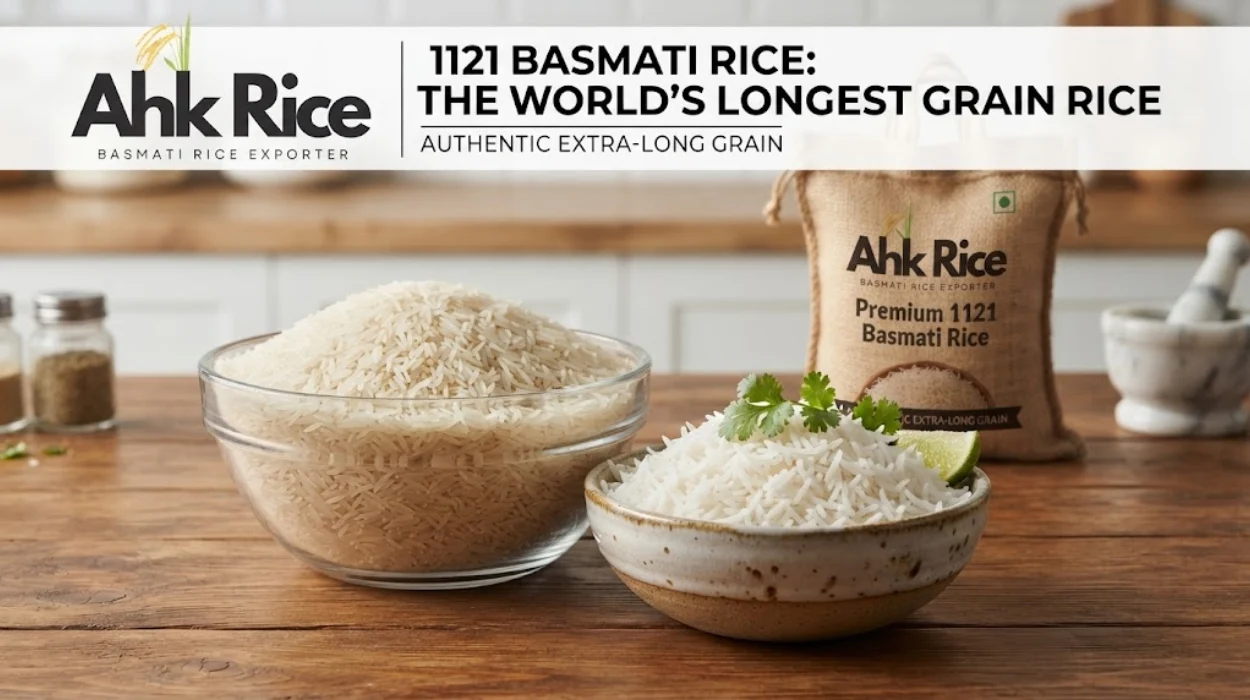
Why 1121 Basmati Rice Is the World’s Longest Grain Rice
1121 Basmati Rice is recognized as the longest-grain commercial Basmati variety, with raw grains around 8.20–8.40 mm and cooked grains reaching about 22 mm or more. Here is why: its genetic grain structure delivers exceptional length, elongation, aroma, and separation after cooking.
1121 Basmati Rice belongs to the long-grain Basmati category cultivated in the Punjab region. Pakistan is a major source of this variety for international markets. Export records show Pakistani 1121 shipments reaching dozens of importing countries, including the United States, United Kingdom, Saudi Arabia, Oman, Italy, UAE, Germany, Netherlands, Canada, and Belgium.
The defining feature is grain length. A raw 1121 grain commonly measures about 8.20–8.40 mm. After cooking, the grain expands lengthwise rather than becoming excessively swollen. Commercial specifications commonly report cooked lengths above 22 mm.
What Is 1121 Basmati Rice?
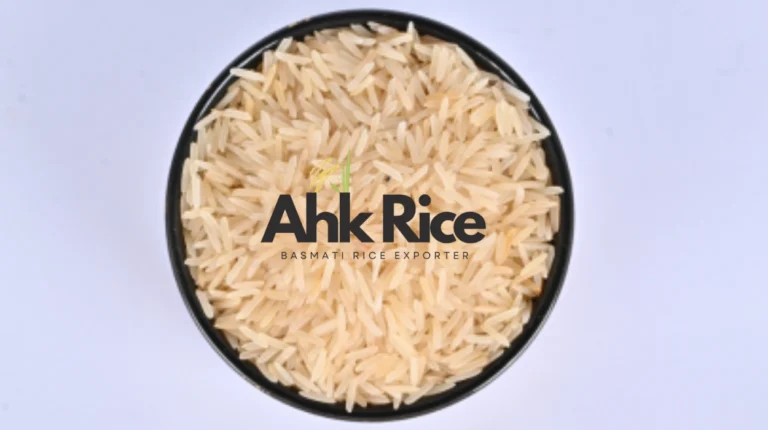
1121 Basmati Rice is an extra-long Basmati variety with approximately 8.30 mm raw grain length, strong cooking elongation, natural aroma, and a firm, separate texture after cooking. Its unusual length makes it highly identifiable in premium rice markets.
1121 refers to a specific Basmati variety rather than a processing method. The same variety can be processed into different commercial forms. These forms include White, Steam, Sella, and Golden Sella.
Raw 1121 Basmati
Raw 1121 is milled without steam treatment or parboiling. The grain retains its natural white appearance and Basmati aroma. Buyers use this form for traditional rice dishes, including biryani and pulao.
1121 Steam
Steam processing exposes paddy to controlled heat before milling. This treatment strengthens the grain and improves resistance to cracking during cooking and cooling. Commercial specifications commonly place the raw grain around 8.20–8.40 mm.
1121 Sella
Sella means parboiled rice. The paddy undergoes soaking, steaming, drying, and milling. This process changes the grain structure and produces a firmer cooked texture with strong grain separation.
1121 Golden Sella
Golden Sella receives parboiling that produces a stronger golden or amber appearance. The processing creates firm grains that remain separate during cooking. Golden Sella is widely used for rice dishes requiring visual length and structural stability.
With the variety defined, the next step is understanding how cultivation and processing create its distinctive grain.
How Is 1121 Basmati Rice Cultivated and Processed?
1121 Basmati Rice develops its long grain through cultivation and then passes through cleaning, dehusking, polishing, grading, sorting, and optional steaming or parboiling before export. Each stage controls cleanliness, appearance, grain integrity, and cooking performance.
How Does Cultivation Produce the Grain?
1121 Basmati is cultivated in suitable rice-growing areas of Punjab. Farmers manage irrigation, field preparation, crop nutrition, and harvesting to protect grain development. Harvest timing also affects moisture and milling performance.
How Is the Paddy Processed?
The commercial process follows a defined sequence:
- Clean the paddy to remove stones, soil, straw, and other field materials.
- De-husk the grain to remove the outer husk while protecting the rice kernel.
- Polish the grain to achieve the required surface appearance.
- Grade the grain according to length, broken percentage, and other specifications.
- Sort the grain using mechanical and optical systems to remove unwanted kernels.
- Steam the paddy for Steam-grade production before final milling.
- Parboil the paddy for Sella and Golden Sella production.
- Dry the grain to reach the required moisture specification.
- Inspect the rice for broken grains, foreign matter, damaged kernels, and visual uniformity.
Processing therefore determines the commercial grade while the underlying variety remains 1121.
Why Does 1121 Basmati Rice Become So Long After Cooking?
1121 Basmati Rice reaches exceptional cooked length because its grain structure supports strong longitudinal expansion, with commercial examples exceeding 22 mm from roughly 8.30 mm raw grain length. This creates the visual appearance associated with extra-long Basmati rice.
What Is Grain Elongation?
Grain elongation describes the increase in rice length during cooking. It differs from simple swelling because the grain extends substantially along its original axis.
An 8.30 mm raw grain reaching more than 22 mm after cooking represents roughly 2.65 times its original length. Actual results depend on processing, rice age, cooking method, water ratio, and grain quality.
Why Does Grain Separation Matter?
Grain separation describes how individual cooked grains remain distinct instead of forming a sticky mass. Properly processed 1121 Basmati supports separate grains in dishes such as biryani, pulao, kabsa, and mandi.
The combination of length and separation gives 1121 its recognizable appearance on a serving plate. These characteristics also explain why different processing grades serve different food applications.
What Are the Main Grades of 1121 Basmati Rice?
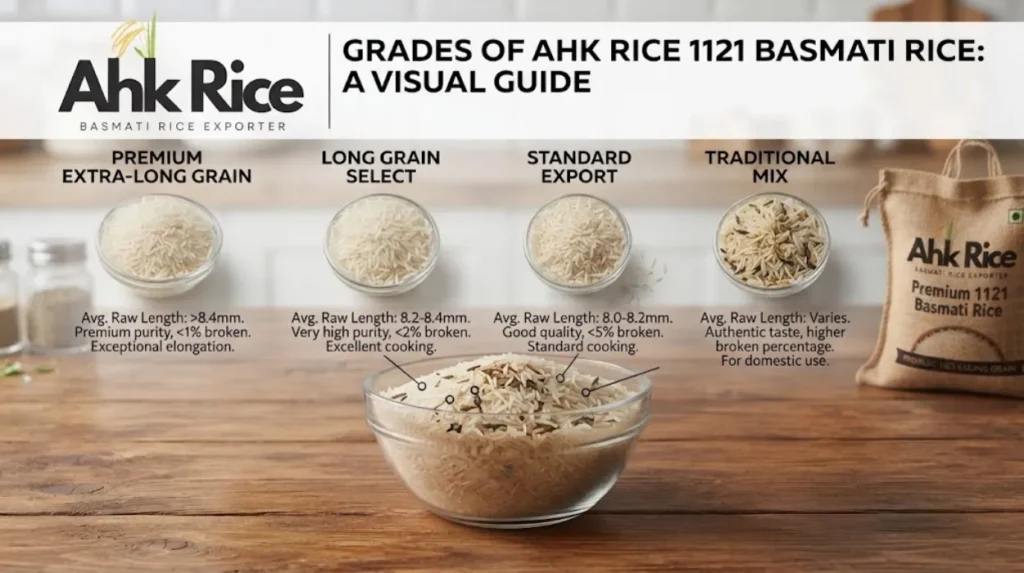
The main commercial forms are White, Steam, Sella, and Golden Sella, while export specifications also classify rice by broken percentage, polishing, sorting, purity, and customized buyer requirements. Processing changes cooking behavior without changing the underlying 1121 variety.
| Grade | Processing | Typical appearance | Main characteristic |
|---|---|---|---|
| 1121 White | Milled | White | Natural aroma and long grain |
| 1121 Steam | Steam-treated | White to creamy | Firm grain structure |
| 1121 Sella | Parboiled | Pale to golden | Strong separation |
| 1121 Golden Sella | Parboiled | Golden to amber | Firm texture and visual color |
Commercial specifications vary by supplier. Examples include maximum moisture around 12–13.5%, broken grains around 0–2%, and foreign matter around 0.1% in specific export specifications. Buyers therefore need a written specification rather than relying only on the grade name.
The processing difference becomes important when buyers compare cooking performance, appearance, and distribution requirements.
Where Is 1121 Basmati Rice Used and Imported?
1121 Basmati Rice serves premium retail, restaurants, catering, foodservice, wholesale, and institutional channels across international markets, with documented demand in the United States, United Kingdom, Gulf countries, Europe, and other regions.
Which Markets Import 1121?
Recent shipment data identifies the United States, United Kingdom, Saudi Arabia, Oman, Italy, UAE, Germany, Netherlands, Canada, and Belgium among significant destination markets for 1121 Basmati shipments.
Middle Eastern markets use 1121 in dishes such as kabsa, mandi, and biryani. European and North American markets use it across retail, restaurant, and ethnic-food channels.
Which Applications Need Extra-Long Grain?
Premium restaurants use long grains for plate presentation. Retail brands use the visual length as a product attribute. Catering operators use firm grades for large-batch cooking.
Golden Sella and Sella also suit applications requiring stronger grain separation. Steam grades suit buyers seeking a white appearance with firm cooking performance.
The market applications explain why 1121 has multiple processing forms rather than one universal commercial grade.
What Quality Specifications Should Buyers Check?
Buyers should verify grain length, moisture, broken percentage, foreign matter, damaged kernels, milling quality, crop year, processing type, and inspection requirements before approving 1121 Basmati Rice. These specifications establish measurable quality instead of relying on appearance alone.
A practical specification sheet should identify the variety as 1121 and state the processing grade. It should also define average grain length and acceptable broken percentage.
Moisture affects storage stability and milling behavior. Foreign matter measures unwanted material. Broken percentage measures kernels that lose their full-grain form during processing.
Color sorting removes visually different kernels. Double polishing controls surface appearance. Laboratory testing verifies measurable parameters before dispatch.
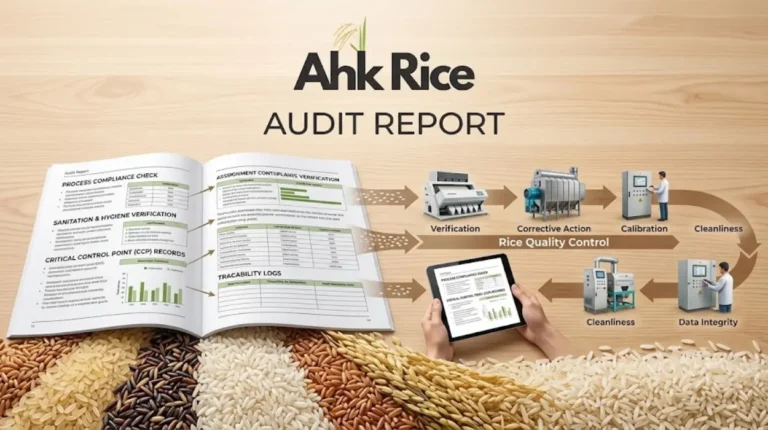
Certification requirements depend on the destination market and buyer specification. Common food-safety systems in commercial rice supply chains include HACCP and ISO 22000. Individual exporters can hold additional certifications depending on their facilities and target markets.
Buyers should also verify certificates, laboratory reports, phytosanitary documents, packing details, and inspection records required for the destination country.
What Are the Common Misconceptions About 1121 Basmati Rice?
1121 is not a single processing grade, and its 8.30 mm raw length does not mean every 1121 shipment performs identically after cooking. Processing type, moisture, crop condition, milling, storage, and cooking method directly influence final performance.
One misconception is that 1121 always means Golden Sella. The variety and processing grade are separate concepts. A shipment can contain 1121 White, Steam, Sella, or Golden Sella.
Another misconception is that raw grain length alone determines quality. Broken percentage, moisture, foreign matter, damaged kernels, milling quality, and sorting also affect commercial value.
A third misconception is that every 1121 grain reaches exactly the same cooked length. Cooking conditions influence elongation. Water ratio, cooking temperature, soaking, and rice age affect the final result.
The final misconception is that the longest grain automatically fits every buyer. Foodservice operations, retailers, wholesalers, and restaurants require different processing characteristics.
The distinction between Steam and Golden Sella becomes especially important when cooking performance and end-use requirements drive procurement decisions.
Which 1121 Processing Grade Should Buyers Compare Next?
Steam and Golden Sella represent two distinct processing approaches: Steam emphasizes a white appearance and firm cooking behavior, while Golden Sella emphasizes parboiled strength, grain separation, and golden color. The appropriate specification depends on the intended application.
For buyers comparing these grades, the next useful step is a direct specification comparison covering processing, appearance, texture, cooking performance, storage requirements, and commercial applications.
Frequently Asked Questions
Is 1121 Basmati Rice the longest-grain Basmati rice?
Yes. 1121 is widely marketed as the longest-grain commercial Basmati variety. Raw grains commonly measure around 8.20–8.40 mm. Cooked grains can exceed 22 mm.
How long is 1121 Basmati Rice after cooking?
Commercial specifications commonly report cooked grain lengths above 22 mm. An 8.30 mm raw grain reaching 22 mm represents roughly 2.65 times its original length.
What are the main types of 1121 Basmati Rice?
The main commercial processing forms are White, Steam, Sella, and Golden Sella. White remains unsteamed, Steam receives heat treatment, while Sella and Golden Sella are parboiled.
Is 1121 Sella the same as Golden Sella?
No. Both are parboiled forms of 1121, but their processing intensity and resulting color differ. Golden Sella develops a deeper golden appearance and firm grain structure.
Which countries import 1121 Basmati Rice?
Major documented destination markets include the United States, United Kingdom, Saudi Arabia, Oman, Italy, UAE, Germany, Netherlands, Canada, and Belgium.
What certifications apply to 1121 Basmati Rice?
Certification depends on the exporter and destination. Food-safety systems such as HACCP and ISO 22000 are used within commercial rice processing. Import markets can also require phytosanitary and other compliance documents.