1121 Steam vs 1121 White Rice: Moisture Levels and Storage Performance in Saudi Arabia
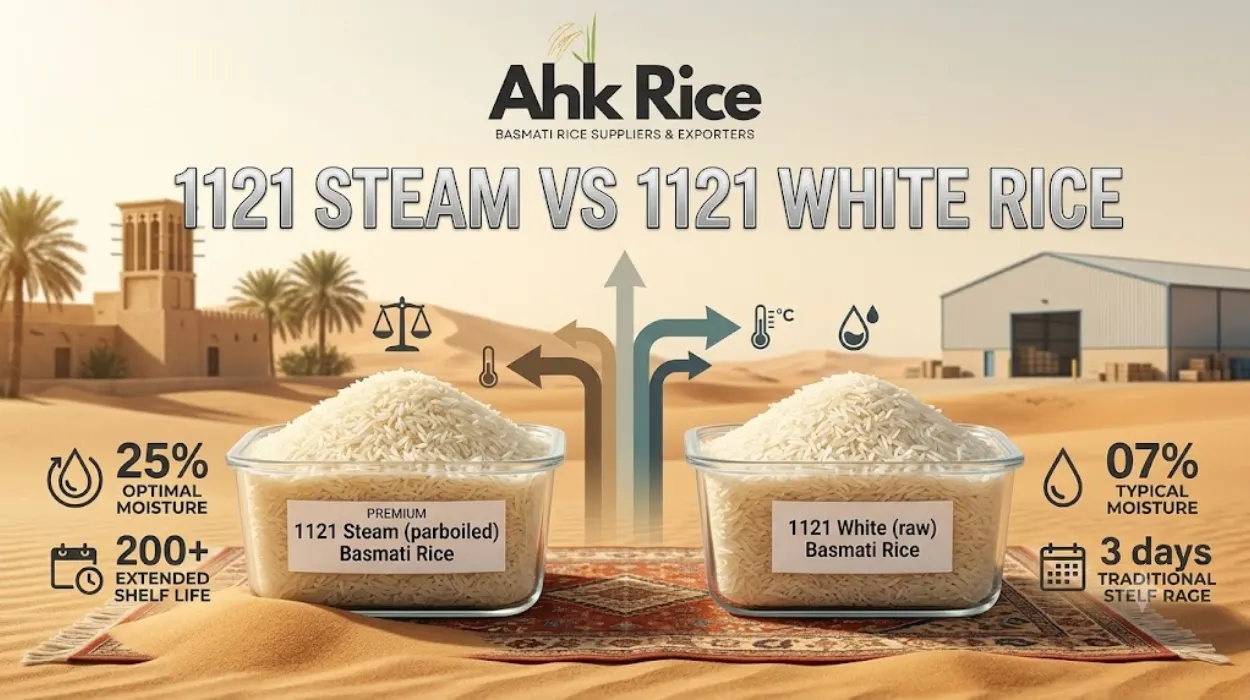
Saudi Arabian importers achieve better storage stability with 1121 Steam Basmati Rice than 1121 White Basmati Rice because the steaming process creates a stronger grain structure, improves moisture tolerance, and reduces breakage during long-distance transportation and warehouse storage.
Pakistan remains one of the largest suppliers of premium 1121 Basmati rice to Saudi Arabia. Importers, wholesalers, distributors, and retail brands choose between steam and white processing depending on warehouse conditions, customer preferences, shelf-life expectations, and distribution channels. Understanding the moisture behavior of both products allows buyers to reduce storage losses and maintain consistent quality throughout the supply chain.
AHK Rice is a Pakistani Basmati exporter based in Punjab, supplying 1121, Super Kernel, and 1509 rice varieties with complete processing, quality inspection, custom packaging, and export documentation for more than 15 countries. Before comparing processing methods, it is useful to understand why export moisture specifications matter. Readers unfamiliar with Saudi import standards should first explore our guide explaining:
Ideal Moisture Content for Pakistan 1121 Basmati Rice Exported to Saudi Arabia?
Why Does Steam Rice Store Better Than White Rice?
Before comparing both products, every importer should understand what each processing method means.
1121 White Basmati Rice is produced after milling removes the husk and bran while keeping the grain untreated by steam. The grain retains its natural white appearance, slender shape, and delicate texture.
1121 Steam Basmati Rice undergoes controlled steam treatment before milling. Heat allows starch molecules inside the grain to stabilize. After drying and milling, the rice becomes slightly cream-colored with a firmer structure.
Although both products originate from the same paddy, their post-processing characteristics differ significantly.
Specification Comparison
| Specification | 1121 Steam Rice | 1121 White Rice |
|---|---|---|
| Processing Method | Hydrothermal steam treatment before milling | Conventional milling only |
| Typical Export Moisture | 12–13% | 12–13% |
| Grain Strength | Very High | High |
| Breakage Resistance | Excellent | Moderate |
| Storage Stability | Excellent | Good |
| Color | Cream to golden white | Bright white |
| Preferred Distribution | Long-term wholesale & retail | Premium retail & foodservice |
The moisture percentage remains similar because reputable exporters ship both products within internationally accepted limits. The difference lies in how each grain responds when exposed to changing humidity during storage.
Why Does Steam Rice Perform Better in Saudi Warehouses?
Saudi Arabia presents one of the most demanding environments for imported food products.
Summer temperatures frequently exceed 45°C in several regions. Warehouses therefore rely on insulation, ventilation, pallet systems, and humidity management to preserve food quality.
Steam rice offers several storage advantages.
The hydrothermal process hardens the grain. Reduced internal stress lowers the risk of cracking during transportation from Karachi Port to Jeddah Islamic Port or King Abdulaziz Port in Dammam.
White rice remains highly attractive because consumers appreciate its bright appearance. However, distributors must maintain more consistent warehouse conditions to preserve grain integrity over extended storage periods.
For importers serving nationwide retail chains, this distinction becomes economically important because reduced breakage directly improves marketable yield.
Which Rice Suits Different Saudi Market Segments?

There is no universal solution for every buyer.
The correct choice depends on the intended market.
Retail Supermarkets
Consumers generally value appearance.
White rice often receives preference for premium retail packaging due to its clean white color.
Wholesale Distribution
Steam rice performs exceptionally well because distributors may store inventory for several months before resale.
Hotels and Restaurants
Hospitality businesses focus on cooking consistency.
Steam rice maintains grain separation after cooking and withstands bulk preparation better than white rice.
Food Manufacturers
Processors prioritize stable quality over appearance.
Steam rice generally reduces production losses caused by broken grains.
How Do Steam and White Rice Compare?
Three common options exist for Saudi Arabian importers.
Option 1: 1121 White Rice
Best suited for:
- Premium retail shelves
- Fast inventory turnover
- Luxury consumer packaging
- Short warehouse duration
Advantages include bright appearance, premium presentation, and excellent consumer recognition.
Limitations include greater sensitivity to handling damage during repeated loading and unloading.
Option 2: 1121 Steam Rice
Best suited for:
- Wholesale markets
- Large distributors
- Long-distance logistics
- Extended warehouse storage
Advantages include stronger grains, better moisture stability, lower breakage, and consistent cooking performance.
The slightly cream-colored appearance may not match the visual expectations of every premium retail customer.
Option 3: Customized Moisture-Controlled Shipments
Some exporters offer customized moisture specifications within buyer-approved contractual ranges.
Combined with appropriate packaging and container loading, this approach improves storage consistency without changing the rice variety itself.
Central Saudi Arabia (Riyadh Region)
Preferred Grades:
- 1121 Steam
- Premium White
- Extra Long Grain
Large wholesalers and institutional buyers frequently prioritize storage performance because inventory moves through regional distribution centers.
Western Saudi Arabia (Jeddah, Makkah, Madinah)
Preferred Grades:
- Premium White Rice
- Steam Rice
- Retail Pack Grades
Retail demand remains particularly strong due to high population density, tourism, hospitality, and foodservice businesses.
Price per Metric Ton Comparison (2026)
Actual prices vary according to crop quality, freight rates, exchange rates, packaging, order quantity, and contract timing.
| Grade | Typical FOB Pakistan Range (USD/MT) |
|---|---|
| 1121 White Basmati | $970–1,090 |
| 1121 Steam Basmati | $990–1,130 |
Steam rice generally commands a modest premium because additional processing increases production costs while improving durability.
Shelf Life Comparison
| Storage Condition | Steam Rice | White Rice |
|---|---|---|
| Cool, dry warehouse | Up to 24 months | Up to 24 months |
| High humidity exposure | Better stability | Greater quality decline risk |
| Repeated handling | Lower breakage | Higher breakage |
| Long-distance distribution | Excellent | Good |
Shelf life depends primarily on maintaining proper storage conditions, food-safe packaging, and export moisture specifications.
Pros and cons become clearer when evaluated through practical importing scenarios
Example 1
A Riyadh distributor imports twenty containers every quarter.
Inventory remains in storage for four months.
Steam rice reduces broken grain losses during warehouse handling.
Example 2
A premium supermarket imports branded consumer packs.
Products reach store shelves quickly.
White rice provides stronger visual appeal for consumers purchasing premium packaging.
Example 3
A catering company serves thousands of meals daily.
Steam rice delivers better grain separation after cooking and maintains texture during large-scale preparation.
Example 4
An importer supplying multiple cities experiences repeated transportation cycles.
Steam rice tolerates multiple loading operations more effectively.
Pros of 1121 Steam Rice
- Stronger grain structure
- Lower breakage
- Better warehouse stability
- Excellent cooking consistency
- Suitable for long logistics chains
Cons of 1121 Steam Rice
- Slightly cream-colored appearance
- Slightly higher purchase price
Pros of 1121 White Rice
- Bright premium appearance
- Excellent consumer recognition
- Attractive retail presentation
- Preferred for luxury packaging
Cons of 1121 White Rice
- More sensitive to handling damage
- Requires stricter warehouse management
Selecting the right processing method
Depends on operational priorities because purchasing decisions should align with storage duration, customer expectations, logistics complexity, and inventory turnover rather than focusing solely on product appearance or initial procurement cost.
The following framework simplifies the selection process.
| Decision Factor | Best Choice |
|---|---|
| Long warehouse storage | 1121 Steam |
| Premium retail shelves | 1121 White |
| Bulk foodservice | 1121 Steam |
| Luxury consumer packaging | 1121 White |
| Nationwide wholesale distribution | 1121 Steam |
Each decision should also consider:
- Expected inventory turnover
- Warehouse temperature
- Relative humidity control
- Packaging specification
- Container transit duration
- Target customer segment
- Distribution distance
Importers who evaluate all seven factors generally experience lower product losses and better customer satisfaction.
Which method works best for different cases?
Neither product is universally superior because each serves different commercial objectives. Steam rice performs best for extended storage, wholesale distribution, and foodservice operations, while white rice remains ideal for premium retail presentation where visual appearance strongly influences purchasing decisions.
For businesses prioritizing operational efficiency, reduced breakage, and long storage cycles, 1121 Steam Basmati Rice is the more practical solution. Its hydrothermal processing enhances grain durability, making it well suited to Saudi Arabia’s climate and large-scale distribution networks.
For brands focused on premium supermarket shelves, consumer appeal, and fast inventory turnover, 1121 White Basmati Rice offers the visual brightness many retail customers expect. When stored under proper temperature and humidity conditions, it also delivers excellent cooking quality and shelf life.
Ultimately, the best choice depends on matching the rice specification to the intended sales channel, warehouse conditions, and customer expectations rather than selecting a product based solely on appearance or initial cost. Importers ready to compare supplier specifications, moisture controls, packaging options, and export services can naturally continue to the:
Buy Pakistan 1121 Basmati Rice with Controlled Moisture for Saudi Arabian Distribution” in this concluding paragraph, preferably on the phrase “compare supplier specifications and moisture-controlled sourcing options.”
Frequently Asked Questions
Which has better storage performance in Saudi Arabia: 1121 Steam or 1121 White Rice?
1121 Steam Basmati Rice generally offers better storage performance because the steam treatment strengthens the grain, reduces breakage, and improves resistance to moisture fluctuations during transportation and warehousing.
What is the ideal moisture level for exporting 1121 Basmati Rice to Saudi Arabia?
The recommended export moisture content is typically between 12% and 13%. This range helps maintain grain quality, minimizes spoilage risk, and supports a longer shelf life during shipping and storage.
Why do Saudi importers often choose 1121 Steam Rice?
Many Saudi importers prefer 1121 Steam Rice for wholesale distribution and long-term storage because it has stronger grains, lower breakage rates, and more consistent cooking performance.
Is 1121 White Rice better for retail markets?
Yes. 1121 White Basmati Rice is widely preferred for premium retail packaging because of its bright white appearance, attractive presentation, and strong consumer appeal.
Does steam processing affect the taste of 1121 Basmati Rice?
Steam processing mainly improves grain strength and cooking stability. It has little impact on the characteristic aroma and flavor of premium 1121 Basmati Rice when processed correctly.
How long can 1121 Steam and White Rice be stored?
When stored in cool, dry, and hygienic warehouse conditions, both varieties can maintain quality for up to 24 months, provided the moisture level and packaging remain within export standards.
Which rice is more resistant to breakage during transportation?
1121 Steam Rice is more resistant to breakage because hydrothermal processing strengthens the grain, making it better suited for long shipping routes and repeated handling.
How does Saudi Arabia’s climate affect rice storage?
High temperatures and humidity variations can increase the risk of quality deterioration. Proper moisture control, food-grade packaging, palletized storage, and warehouse ventilation help preserve rice quality.
Is 1121 Steam Rice more expensive than 1121 White Rice?
Generally, yes. Steam Rice usually costs slightly more due to the additional hydrothermal processing required, but many buyers consider the improved storage performance worth the higher price.
Which type of 1121 Basmati Rice is best for my business?
The best choice depends on your market. 1121 Steam Rice is ideal for wholesalers, distributors, and foodservice businesses, while 1121 White Rice is better suited for premium retail brands focused on appearance.