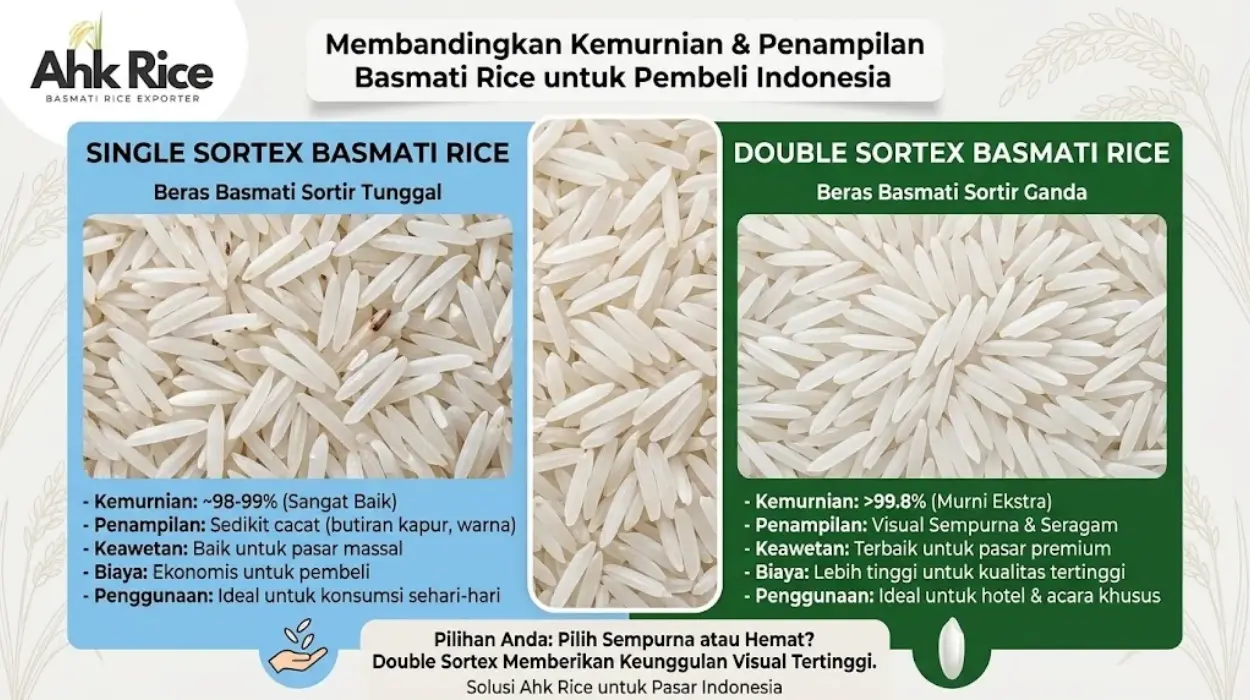
Single vs Double Sortex Basmati Rice: Purity and Appearance Compared for Indonesian Buyers
Indonesian importers should choose double Sortex Basmati rice when premium retail appearance, stricter visual consistency, and lower visible foreign-material levels are priorities, while single Sortex rice suits cost-conscious wholesale and foodservice buyers with less demanding presentation requirements.
Pakistani Basmati rice is available in different varieties, including 1121, Super Kernel, and 1509, with different grain lengths, aromas, cooking characteristics, and commercial applications. Understanding how Sortex color sorting works and why it matters for export Basmati rice helps Indonesian importers evaluate the difference between processing methods before placing bulk orders. AHK Rice, a Pakistani Basmati exporter based in Punjab, supplies these varieties through processing, grading, custom packaging, and export operations.
The main purchasing decision is not simply whether one sorting method is better than another. Importers must evaluate the relationship between grain purity, visual consistency, broken percentage, processing costs, shelf life, and the requirements of their distribution channels. Single and double Sortex processing address different quality expectations, so the right choice depends on the intended market.
What are the available solutions for Sortex Basmati rice?
Indonesian buyers can select single Sortex, double Sortex, or additional quality-controlled processing according to their required grain appearance and purity. Each approach uses optical sorting technology, but the number of sorting passes and inspection stages determines the level of visual refinement.
Sortex is an optical color-sorting process used in rice mills to identify and remove grains that differ from the accepted visual characteristics. The machine uses cameras, sensors, and controlled air ejection to separate defective grains and foreign particles from acceptable rice.
The main processing options include:
1. Single Sortex Basmati rice
Single Sortex rice passes through an optical sorting machine once. The equipment detects discolored grains, damaged kernels, and visible foreign materials according to programmed sorting parameters.
This method improves the appearance of conventionally milled rice without adding a second optical sorting pass. It suits importers purchasing commercial Basmati for wholesale distribution, restaurants, and price-sensitive grocery channels.
For example, an Indonesian foodservice distributor purchasing Super Kernel Basmati for restaurants can select single Sortex rice when cooking performance, aroma, grain length, and competitive purchasing costs matter more than an exceptionally uniform retail appearance.
2. Double Sortex Basmati rice
Double Sortex rice passes through two optical sorting stages. The second pass provides another opportunity to identify and remove visually defective grains that remain after the first sorting stage.
This additional inspection improves the consistency of the finished batch. It supports premium retail packaging, private-label products, and distributors serving customers who expect cleaner-looking rice.
For instance, an Indonesian supermarket brand selling 5 kg and 10 kg Pakistani Basmati bags benefits from double Sortex processing because customers can directly inspect the grain appearance through transparent packaging.
3. Sortex combined with additional quality control
Optical sorting works alongside other milling and inspection operations. Destoning removes heavier foreign materials, while grading separates grains according to size and thickness. Laboratory testing evaluates moisture, broken percentage, and other contractual specifications.
These processes serve different purposes. Double Sortex does not automatically replace destoning, grading, or laboratory inspection.
How do single and double Sortex approaches compare?
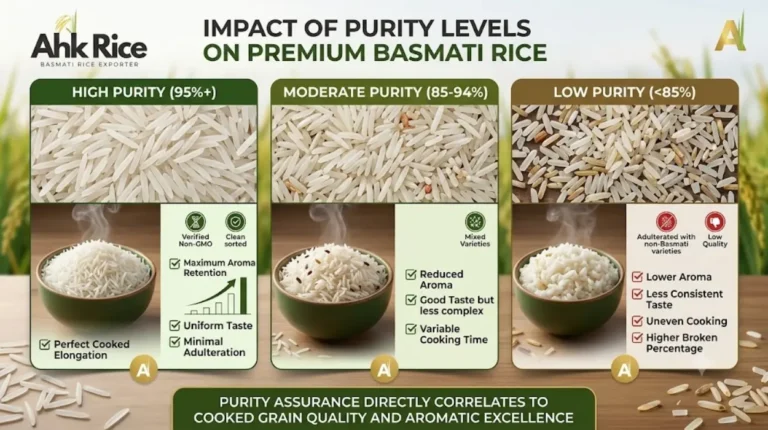
Double Sortex generally delivers more consistent visual purity than single Sortex because the second pass provides another opportunity to remove defective grains. Single Sortex offers a lower processing requirement while maintaining acceptable appearance for many wholesale and foodservice applications.
The following table compares the two methods across seven purchasing attributes.
Single Sortex vs Double Sortex specification comparison
| Specification | Single Sortex | Double Sortex |
|---|---|---|
| Sorting passes | One optical sorting pass | Two optical sorting passes |
| Discolored grains | Removes detected defects in one pass | Provides an additional removal opportunity |
| Visual uniformity | Commercially acceptable consistency | Higher potential visual consistency |
| Foreign material | Removes detectable visual contaminants | Additional optical screening |
| Broken grains | Requires separate grading controls | Requires separate grading controls |
| Processing cost | Generally lower | Generally higher |
| Best application | Wholesale and foodservice | Premium retail and private label |
The comparison demonstrates that double Sortex focuses on improving visual consistency rather than changing the underlying rice variety. Both methods can process 1121, Super Kernel, and 1509 Basmati rice.
An importer should also distinguish optical sorting from grain grading. Sortex identifies visual defects, while grading establishes measurable specifications such as grain length, broken percentage, and thickness.
For example, 1121 Basmati can maintain its varietal grain-length characteristics after either sorting method. Double Sortex does not make a shorter grain longer or convert a lower-grade variety into premium 1121.
Does double Sortex guarantee 100% purity?
No. Double Sortex provides an additional optical inspection stage, but it does not guarantee the complete removal of every contaminant or defective grain.
Actual performance depends on machine calibration, product feeding speed, camera sensitivity, defect definitions, and the quality of incoming rice. Buyers should establish acceptable defect limits and require representative pre-shipment samples.
A documented specification and independent inspection provide stronger quality assurance than relying on the term double Sortex alone.
Which Sortex method suits Indonesian importers?
Single Sortex suits Indonesian bulk wholesalers and commercial kitchens prioritizing procurement costs, while double Sortex suits premium grocery retailers, private-label brands, and distributors requiring consistent visual presentation across packaged Basmati products.
Indonesia has several rice purchasing channels. Importers supply wholesale markets, supermarkets, specialist food retailers, restaurants, catering companies, and institutional kitchens. Each channel evaluates rice according to different commercial requirements.
1. Indonesia: Wholesale and foodservice market
Wholesale distributors and foodservice operators generally prioritize competitive landed costs, consistent cooking performance, and reliable bulk availability.
Single Sortex Super Kernel and 1121 Basmati can serve these requirements when the incoming batch meets agreed specifications for broken percentage, moisture, grain length, aroma, and visible defects.
Restaurants purchasing 25 kg or 50 kg bags benefit from consistent cooking results and manageable procurement costs. Their customers usually experience the rice through prepared meals rather than inspecting uncooked grains in retail packaging.
Single Sortex therefore provides a practical purchasing option for commercial distribution when the agreed appearance specification does not require an additional optical sorting pass.
2. Indonesia: Premium retail and private-label market
Premium retail buyers place greater importance on packaging presentation, grain uniformity, and perceived product quality.
Double Sortex 1121 Basmati and Super Kernel Basmati suit this channel because the additional sorting stage improves the opportunity to remove discolored grains and produce a visually consistent batch.
Retailers selling 1 kg, 5 kg, and 10 kg packages can use transparent windows or product photography to communicate grain quality. Consistent appearance supports premium positioning and helps maintain a uniform brand presentation across different production lots.
For this channel, buyers should request double Sortex processing alongside measurable grain specifications rather than treating the sorting method as the only quality requirement.
Grade preferences across Indonesian purchasing channels
| Market channel | Suitable variety | Preferred sorting | Main priority |
|---|---|---|---|
| Wholesale distribution | Super Kernel | Single Sortex | Competitive cost |
| Restaurant supply | Super Kernel / 1121 | Single Sortex | Cooking consistency |
| Premium supermarkets | 1121 Basmati | Double Sortex | Grain appearance |
| Private-label brands | 1121 / Super Kernel | Double Sortex | Batch uniformity |
| Specialist rice retailers | 1121 / 1509 | Double Sortex | Product presentation |
These are purchasing recommendations based on channel requirements, not mandatory Indonesian import standards. Final grade selection depends on buyer specifications, customer demand, and applicable import requirements.
How do single and double Sortex rice prices compare per MT?
Single Sortex generally has a lower processing cost than double Sortex because it requires fewer optical sorting operations. However, exporters do not publish one universal premium per metric ton for the second pass, so buyers must compare quotations against identical rice specifications.
The following benchmark provides a reference for Indonesian importers evaluating Pakistani Basmati procurement.
A published September 2026 market benchmark places Pakistan Super Kernel Basmati with 2% broken at approximately US$1,094 per metric ton FOB. This is a variety and grade benchmark, not a separate confirmed price for single or double Sortex rice. rice.ag
Indicative price comparison
| Pricing factor | Single Sortex | Double Sortex |
|---|---|---|
| Base Super Kernel benchmark | $1,094/MT | $1,094/MT |
| Additional sorting pass | Not required | Required |
| Processing cost | Lower | Higher |
| Final export quotation | Supplier-confirmed | Supplier-confirmed |
| Freight to Indonesia | Quoted separately | Quoted separately |
Reference benchmark: September 2026 FOB export price. Figures are not guaranteed AHK Rice offers or confirmed Indonesian landed prices.
The equal base figure is used only to isolate the processing difference. It does not mean both finished products have the same contractual price.
The final difference depends on rice variety, crop year, raw grain quality, broken percentage, moisture, machine operating costs, processing yield, packaging, and order quantity.
Indonesian importers must also distinguish FOB Karachi from CFR or CIF destination pricing. FOB excludes ocean freight and insurance, while destination pricing incorporates the agreed shipping and insurance costs.
A practical quotation should identify the sorting method, accepted defect limits, variety, packing, quantity, inspection requirements, and Incoterm.
How does shelf life compare between single and double Sortex rice?
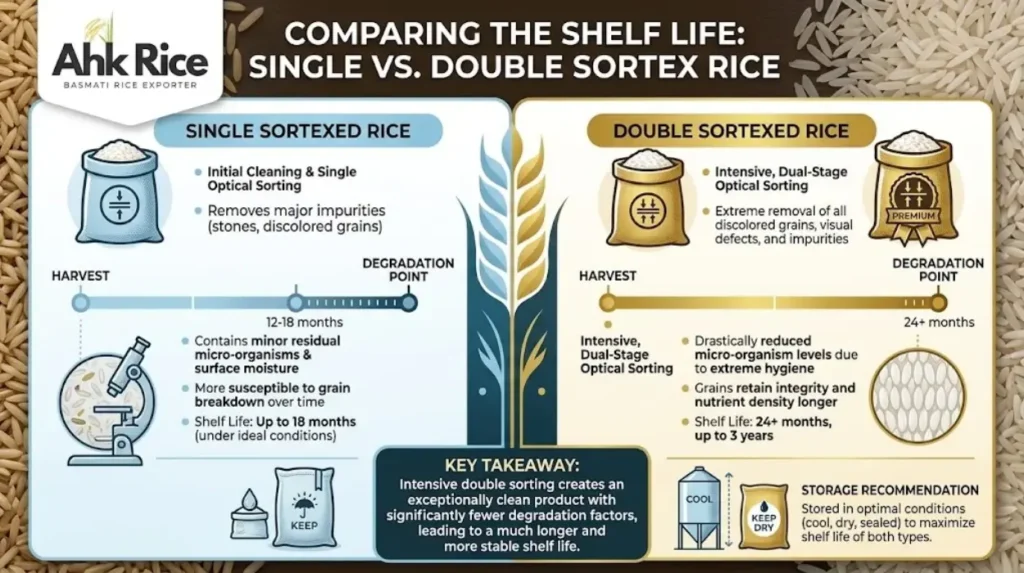
Single and double Sortex Basmati rice have no inherent shelf-life difference because optical sorting does not determine the product’s storage stability. Moisture, packaging, warehouse conditions, processing hygiene, and stock rotation have a greater influence on commercial shelf life.
Both products remain dry milled rice after optical sorting. The additional sorting pass does not automatically extend the storage period or improve resistance to moisture and pests.
Importers should assess the following storage factors:
- Moisture: Controlled moisture reduces the risk of deterioration during storage.
- Packaging: Properly sealed food-grade packaging protects rice from moisture exposure and contamination.
- Warehouse conditions: Clean, dry, ventilated storage protects product quality.
- Pest management: Appropriate pest-control procedures protect stored rice from infestation.
- Stock rotation: First-in, first-out inventory management prevents unnecessary prolonged storage.
Shelf-life comparison
| Attribute | Single Sortex | Double Sortex |
|---|---|---|
| Storage stability | Depends on storage controls | Depends on storage controls |
| Moisture requirement | Contractually specified | Contractually specified |
| Packaging requirement | Suitable food-grade packaging | Suitable food-grade packaging |
| Pest protection | Required | Required |
| Shelf-life advantage | No automatic disadvantage | No automatic advantage |
For Indonesian buyers, the appropriate shelf-life specification should be agreed with the exporter and supported by product documentation. Storage conditions in warehouses across Jakarta, Surabaya, and other distribution centres remain important throughout the product’s commercial life.
What are the advantages and disadvantages of single and double Sortex?
Single Sortex offers a cost-efficient solution for commercial rice distribution, while double Sortex provides stronger visual refinement for premium retail. Neither method replaces varietal grading, laboratory testing, or independent shipment inspection.
Advantages of single Sortex
- Lower processing requirements reduce additional sorting costs.
- Suitable for wholesale and restaurant supply.
- Maintains the original variety’s grain characteristics.
- Supports commercial quality specifications when incoming rice is suitable.
Example: A Jakarta restaurant distributor purchasing 20 tonnes of Super Kernel Basmati can prioritize aroma, grain length, cooking performance, and broken percentage over premium retail appearance.
Disadvantages of single Sortex
- One sorting pass provides fewer opportunities to detect remaining visual defects.
- Batch appearance depends heavily on incoming raw material quality.
- It may not meet the visual expectations of demanding premium retail customers.
Advantages of double Sortex
- Provides a second opportunity to remove discolored grains.
- Supports more consistent visual presentation.
- Suits premium supermarket packaging and private-label products.
- Helps exporters meet demanding appearance specifications.
Example: An Indonesian retailer introducing a premium 1121 Basmati product can specify double Sortex processing to achieve a more uniform appearance across its packaged inventory.
Disadvantages of double Sortex
- Additional processing increases manufacturing costs.
- Incorrect machine settings can cause unnecessary rejection of acceptable grains.
- It does not automatically reduce broken percentage.
- It cannot guarantee zero foreign material or eliminate the need for laboratory inspection.
The important distinction is that processing intensity should match the commercial specification. Paying for additional sorting without a corresponding buyer requirement increases procurement costs without necessarily creating additional market value.
What factors should Indonesian buyers evaluate before choosing a method?
Indonesian importers should evaluate five purchasing factors: distribution channel, varietal specifications, acceptable visual defects, total procurement cost, and shipment quality verification. These factors connect the processing method with the actual requirements of the intended customer.
Five-row purchasing decision framework
| Decision factor | Single Sortex choice | Double Sortex choice |
|---|---|---|
| Distribution channel | Wholesale and restaurants | Premium retail |
| Visual requirements | Standard commercial appearance | Higher visual uniformity |
| Budget | Lower processing expenditure | Higher processing expenditure |
| Brand positioning | Value-oriented products | Premium packaged products |
| Quality verification | Agreed inspection specifications | Stricter appearance specifications |
1. Distribution channel
Identify whether rice will enter wholesale distribution, restaurant supply, institutional procurement, or premium retail. A foodservice importer should prioritize cooking performance and reliable supply, while a supermarket buyer should consider appearance and packaging presentation.
2. Rice variety and grain specifications
Choose the Basmati variety before selecting the sorting method.
- 1121 Basmati: Premium extra-long grain characteristics and suitability for premium retail and biryani applications.
- Super Kernel Basmati: Recognizable aroma and grain characteristics for wholesale, retail, and foodservice.
- 1509 Basmati: A commercially relevant long-grain option for buyers evaluating yield, procurement economics, and foodservice requirements.
The sorting method should preserve the agreed characteristics of the selected variety.
3. Visual defect tolerance
Buyers should define acceptable limits for yellow grains, damaged kernels, foreign materials, and other visible defects. A numerical specification makes single and double Sortex quotations easier to compare.
4. Total procurement cost
Compare the complete FOB or CIF quotation rather than evaluating the optical sorting charge independently. Include packaging, inspection, freight, insurance, documentation, and destination-related costs where applicable.
5. Pre-shipment quality verification
Request a representative commercial sample and approve the final specification before shipment. Confirm grain length, moisture, broken percentage, appearance, and packaging. The approved sample should correspond to the agreed shipment specification.
How can Indonesian importers source the right Sortex Basmati from Pakistan?
Indonesian importers should select an exporter capable of matching the approved sample, processing method, varietal specifications, packaging, and shipment documentation. A documented sample-to-order process reduces quality disputes and improves consistency across commercial shipments.
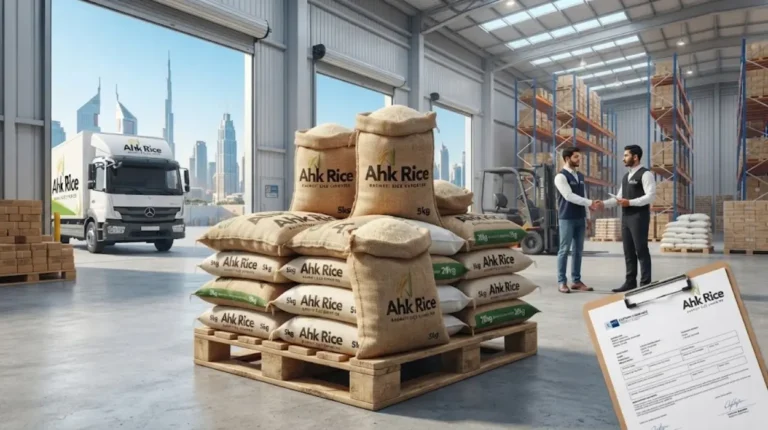
AHK Rice operates from Punjab, Pakistan, and supplies 1121, Super Kernel, and 1509 Basmati rice to international buyers. Its export operations cover sourcing, grading, milling, sorting, custom packaging, and shipment coordination.
For Indonesian buyers, the procurement process should follow five stages:
- Product selection: Identify the required Basmati variety, processing type, grain length, and broken percentage.
- Sorting specification: Select single or double Sortex according to the agreed appearance requirements.
- Sample approval: Evaluate a commercial sample through visual inspection and cooking tests.
- Quotation and packaging: Confirm quantity, bag size, private-label requirements, FOB or CIF terms, and payment arrangements.
- Shipment approval: Confirm the final specification, inspection requirements, export documents, and shipment schedule.
Importers should also verify applicable Indonesian import licensing, food safety, labelling, phytosanitary, and customs requirements before shipment. The required documentation depends on the product classification and current import rules.
This process creates a clear connection between the buyer’s original requirements and the rice delivered at the destination.
Which Sortex method delivers better value for Indonesian buyers?
Double Sortex delivers stronger value when visual presentation directly affects retail positioning and customer expectations. Single Sortex provides better procurement efficiency when commercial buyers prioritize cooking performance, varietal quality, and competitive wholesale pricing.
The final selection depends on the intended market rather than the number of sorting passes alone.
A wholesale importer purchasing bulk Super Kernel Basmati should evaluate single Sortex against agreed commercial defect limits. A premium supermarket sourcing 1121 Basmati should evaluate double Sortex against its retail appearance requirements.
For both purchasing strategies, the strongest quality decision combines optical sorting, grain grading, moisture control, laboratory testing, and representative sample approval.
AHK Rice provides Indonesian importers with access to Pakistani Basmati varieties and processing options that can be evaluated against their commercial requirements. Buyers should compare finished specifications and verified samples before committing to container quantities.
Frequently Asked Questions
What is the difference between single and double Sortex Basmati rice?
Single Sortex rice passes through one optical sorting stage, while double Sortex rice passes through two. Double sorting provides another opportunity to remove discolored grains and improve visual consistency.
Is double Sortex Basmati rice better for Indonesian supermarkets?
Yes, double Sortex is generally more suitable for premium supermarket products because visual uniformity supports retail presentation. Buyers should still verify the finished product against their own defect and grain specifications.
Does double Sortex increase Basmati rice prices per MT?
Yes, the additional sorting operation generally increases processing costs. The actual price difference depends on the rice variety, incoming quality, processing yield, order quantity, and export specifications.
Does double Sortex improve Basmati rice shelf life?
No. Double Sortex does not automatically extend shelf life. Moisture management, suitable packaging, hygienic handling, warehouse conditions, and stock rotation determine storage stability.
Which Pakistani Basmati variety is suitable for premium Indonesian retail?
1121 Basmati and Super Kernel Basmati are suitable options. The final choice depends on grain length, aroma, cooking characteristics, customer preferences, and the retail price position.