Buy Double-Sortex Pakistani Basmati Rice for Premium Indonesian Retail
Indonesian rice importers, supermarket distributors, and private-label brands need consistent Basmati rice appearance to maintain premium shelf presentation and buyer confidence. Double-Sortex Pakistani Basmati rice provides an additional optical sorting stage to remove detectable discolored grains and improve visual uniformity before export. Buyers can evaluate the sorting process, approve a commercial sample, and establish shipment specifications before confirming a bulk order. Understanding what Sortex color sorting means for export Basmati rice helps Indonesian importers assess the quality benefits before purchasing.
What Is the Best Solution for Indonesian Retailers Buying Premium Basmati Rice?
Double-Sortex Pakistani Basmati rice is a suitable solution for Indonesian retailers requiring consistent grain appearance, reduced visible defects, and controlled product specifications. Two optical sorting passes provide additional opportunities to remove discolored kernels and certain foreign particles. The final quality still depends on incoming grain condition, machine calibration, and inspection procedures.
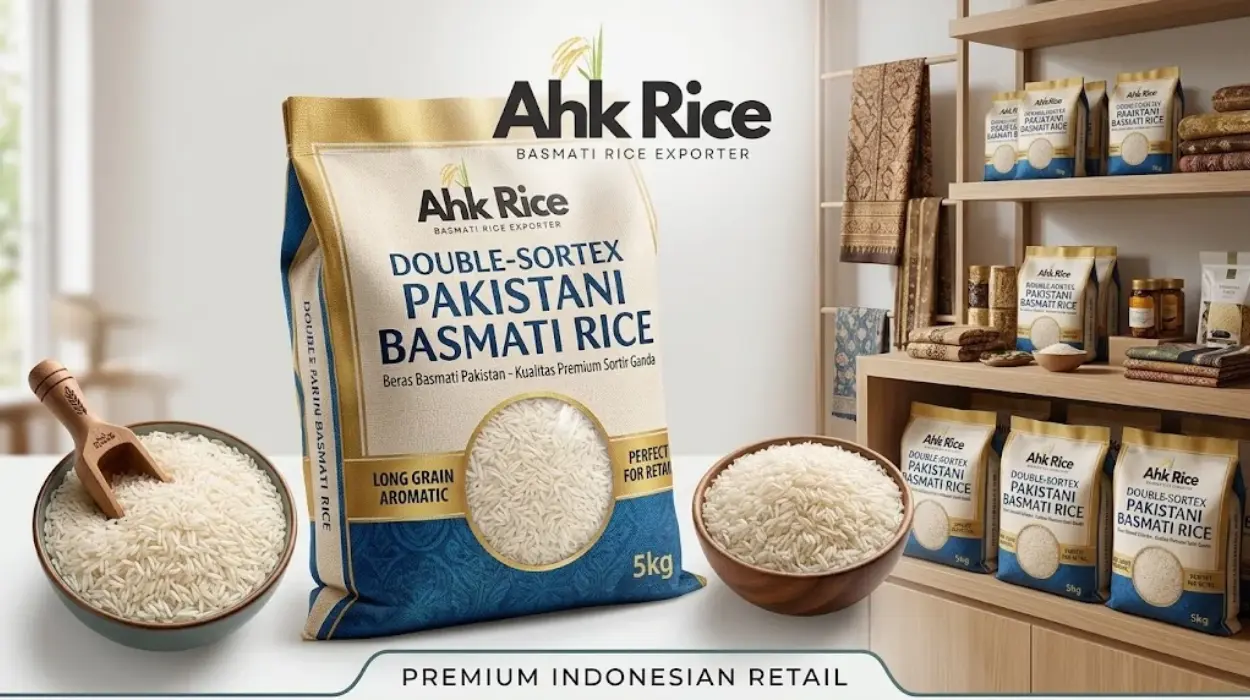
Premium Indonesian supermarkets require rice that maintains a consistent appearance across retail packaging. Importers supplying five-kilogram, ten-kilogram, or twenty-five-kilogram packs need uniform grain presentation to support their product positioning.
Pakistani Basmati varieties offer different commercial advantages:
- 1121 Basmati: Suitable for premium retail customers seeking long, slender grains and attractive cooked presentation.
- Super Kernel Basmati: Offers traditional Pakistani Basmati aroma and cooking characteristics for premium ethnic grocery distribution.
- 1509 Basmati: Provides a commercial option for distributors balancing grain appearance, purchasing costs, and bulk supply requirements.
Double-Sortex processing adds another inspection opportunity after the first sorting stage. It helps reduce detectable visual defects that can affect the appearance of packaged rice.
Indonesian buyers should evaluate the finished product rather than purchasing solely on the Double-Sortex label. Grain length, broken percentage, moisture, variety authenticity, and cooking performance require separate specifications.
Why Choose AHK Rice for Double-Sortex Pakistani Basmati Rice?
AHK Rice supplies Pakistani Basmati varieties from Punjab with processing coordination, quality specifications, custom packaging, and export shipment support. Indonesian importers can discuss Double-Sortex requirements, approve samples, establish packaging specifications, and coordinate commercial shipments through one export supply arrangement.
AHK Rice focuses on established Pakistani varieties, including 1121, Super Kernel, and 1509 Basmati rice. Buyers can select the variety and processing style according to their retail positioning and customer requirements.
The AHK Rice Basmati export service supports international buyers requiring product sourcing, grading, processing, packaging, and export coordination.
The purchasing process should establish measurable requirements before production begins.
These include:
- Rice variety and processing type.
- Required raw grain length.
- Maximum broken percentage.
- Moisture specification.
- Acceptable visible-defect tolerance.
- Double-Sortex processing requirement.
- Retail packaging material and bag weights.
- Batch identification and export documentation.
AHK Rice can coordinate the requested product specifications with the buyer before commercial production. The importer should receive a representative sample and confirm the agreed quality parameters before authorising shipment.
For premium Indonesian retail, this specification-based approach helps reduce misunderstandings between the supplier and importer.
What Results Can Indonesian Importers Expect?

Importers can expect improved visual uniformity, fewer detectable discolored kernels, and a more consistent retail presentation when Double-Sortex processing is properly calibrated. Actual results depend on incoming rice quality, sorting settings, inspection procedures, and the written acceptance criteria agreed between the buyer and supplier.
The main commercial outcomes include:
1. Improved retail appearance
The second optical sorting pass provides another opportunity to remove remaining discolored grains. This supports consistent presentation in transparent and printed retail packaging.
2. Better batch consistency
Controlled sorting and final inspection help maintain similar visual characteristics across production batches. Importers can establish reference samples for repeat purchasing.
3. More controlled product specifications
Buyers can define moisture, grain length, broken percentage, and visible-defect limits before production. These measurements provide a clearer basis for quality acceptance.
4. Better private-label positioning
Indonesian distributors developing premium rice brands can specify bag sizes, product descriptions, batch information, and packaging requirements before confirming orders.
5. More predictable procurement
An approved sample and documented specification provide a reference for future purchases. Buyers can compare subsequent shipments against the original commercial agreement.
Double-Sortex processing does not guarantee zero defects or independently establish food safety. Laboratory testing, food-safety controls, and applicable Indonesian import requirements remain separate responsibilities.
How Much Does Double-Sortex Basmati Rice Cost?
The export price depends on the Basmati variety, grade, sorting requirements, order quantity, packaging, and shipping terms. Double-Sortex processing generally adds operating costs because it requires another sorting pass. A written quotation should identify the product specification and distinguish FOB pricing from CIF delivery costs.
The principal pricing factors include:
| Pricing factor | Commercial impact |
|---|---|
| Rice variety | 1121, Super Kernel, and 1509 have different market values. |
| Sorting process | Double-Sortex processing adds equipment and processing costs. |
| Grain specifications | Length, broken percentage, and defect limits affect pricing. |
| Moisture requirements | Controlled moisture specifications influence processing and storage. |
| Order quantity | Larger commercial orders can affect per-tonne costs. |
| Packaging | Retail bags require different materials and printing costs. |
| Shipping terms | FOB and CIF quotations include different freight responsibilities. |
Indonesian buyers should request quotations in USD per metric tonne with the following information:
- FOB Karachi price.
- CIF Jakarta or another nominated Indonesian port price.
- Product grade and processing method.
- Packaging and total quantity.
- Ocean freight and insurance where applicable.
- Quote validity and payment conditions.
A fixed export price should not be assumed without confirming the current crop, specifications, freight rates, and order quantity.
How Many Days Does Shipping Take From Pakistan to Indonesia?
Sea freight from Karachi to Indonesian ports generally requires approximately 24–40 days for planning, depending on the destination, carrier, routing, and transshipment arrangements. Jakarta, Surabaya, Semarang, and Belawan have different shipping schedules, so importers should confirm the actual vessel itinerary before committing to retail delivery dates.
Indicative planning estimates are:
| Indonesian destination | Estimated sea transit |
|---|---|
| Jakarta / Tanjung Priok | 24–40 days |
| Surabaya | 24–40 days |
| Semarang | 24–40 days |
| Belawan / Medan | 24–40 days |
These are planning estimates, not guaranteed AHK Rice delivery schedules. Published route estimates vary considerably by carrier and routing. <Cite refs={[“turn100539search4″,”turn100539search6″,”turn100539search0”]}/>
The overall procurement timeline also includes production, inspection, export documentation, vessel cut-off, customs clearance, and final delivery.
Importers should therefore coordinate purchase orders with their Indonesian warehouse receiving schedules. A confirmed shipping quotation should specify the loading port, destination port, expected departure, estimated arrival, and applicable destination charges.
What Is the Complete Sample Approval Process and Its Cost?
The sample process allows Indonesian buyers to inspect rice appearance, conduct cooking tests, and approve product specifications before placing a bulk order. Buyers should agree on the sample variety, sorting requirement, quantity, delivery address, and courier charges before dispatch.
AHK Rice can coordinate the following sample-to-order workflow:
Step 1: Submit product requirements
The importer identifies the required variety, such as 1121, Super Kernel, or 1509. The buyer also specifies Double-Sortex processing, grain specifications, and intended retail packaging.
Step 2: Confirm sample availability
AHK Rice confirms the available grade and sample quantity. The buyer and supplier establish whether the sample represents the proposed commercial specification.
Step 3: Confirm sample charges
Where the applicable sampling offer covers the requested product, the rice sample can be supplied without a product charge. The buyer remains responsible for actual international courier charges and applicable phytosanitary charges.
The previously offered Super Kernel sampling programme covers up to 20 kg, subject to confirmation of eligibility for the requested grade and processing specification. Double-Sortex Indonesian retail samples should be confirmed separately.
Step 4: Arrange courier dispatch
The supplier coordinates sample preparation and dispatch after confirming the destination, courier service, and applicable charges. Courier costs depend on weight, destination, service level, and documentation requirements.
Step 5: Conduct buyer inspection
The importer checks grain appearance, visible defects, aroma, cooking performance, and other agreed characteristics. Retail buyers can also assess packaging and product presentation.
Step 6: Approve the commercial specification
Both parties confirm the final specification, packaging, quantity, price, payment terms, and inspection requirements.
Step 7: Confirm the bulk order
After approval, AHK Rice coordinates production, final quality checks, export documentation, container loading, and shipment arrangements.
The sample approval stage establishes the reference standard for commercial purchasing. Buyers should retain the approved sample and document the acceptance criteria before authorising bulk production.
How Can Indonesian Importers Start Their First Order?
Indonesian importers can begin by submitting their variety, quantity, packaging, sorting, and destination requirements for a commercial quotation. The supplier then coordinates sample availability, specification approval, pricing, production arrangements, and export shipment planning.
A practical purchasing sequence includes:
- Select 1121, Super Kernel, or 1509 Basmati rice.
- Specify Double-Sortex processing and acceptable defect limits.
- Confirm the sample quantity and courier arrangements.
- Approve the sample and written product specification.
- Request FOB Karachi or CIF Indonesian port pricing.
- Agree on packaging, payment, inspection, and documentation.
- Confirm the purchase order and shipment schedule.
AHK Rice supports international buyers through sourcing, processing coordination, custom packaging, and export documentation. A clear purchase specification helps establish accountability before the shipment leaves Pakistan.
For a more detailed purchasing comparison, Indonesian buyers can also review Single vs Double Sortex Basmati Rice: Purity, Appearance and Price for US Buyers. The comparison explains the additional sorting stage, visual quality considerations, and processing cost differences.
Premium retail procurement requires more than selecting a rice variety. Importers need an approved sample, documented specifications, appropriate quality checks, and a reliable export schedule.
Start your Indonesian retail procurement programme by submitting your product specifications and requesting a commercial quotation from AHK Rice through the Request a Quote page.
Frequently Asked Questions
Why should Indonesian retailers buy Double-Sortex Pakistani Basmati rice?
Double-Sortex processing provides an additional optical sorting stage. It helps remove detectable discolored grains and certain foreign particles. This improves visual uniformity for premium retail packaging. Buyers should separately verify grain length, moisture, and broken percentage. The final shipment must match the approved commercial specification.
Which Pakistani Basmati variety is suitable for Indonesian premium retail?
1121 Basmati suits retailers targeting premium long-grain rice customers. Super Kernel provides traditional Pakistani Basmati aroma and cooking characteristics. 1509 offers another commercial option for distributors. The right variety depends on customer demand and retail positioning. Importers should evaluate samples before selecting a grade.
How long does shipping take from Pakistan to Indonesia?
Sea freight generally requires approximately 24–40 days for planning. Jakarta, Surabaya, Semarang, and Belawan have different vessel schedules. Transshipment and port congestion can affect arrival dates. Buyers should confirm the shipping line’s estimated transit time. Customs clearance and final delivery require additional time.
Does AHK Rice provide free Basmati rice samples?
Sample availability depends on the variety and requested specification. An existing offer covers up to 20 kg of Super Kernel Basmati, subject to eligibility confirmation. The buyer pays applicable international courier and phytosanitary charges. Double-Sortex sample availability should be confirmed before dispatch. Commercial samples allow importers to evaluate quality before bulk purchasing.
What determines the price of Double-Sortex Pakistani Basmati rice?
The variety and grade influence the base export price. Double-Sortex processing adds another processing stage. Packaging, order quantity, and quality specifications also affect cost. FOB and CIF quotations include different shipping responsibilities. Importers should request a current written quotation for their destination.