What is the best solution for scheduled Basmati rice deliveries to Indonesia?
The best solution is a planned supply cycle that connects specification approval, sampling, production, documentation, container loading and vessel booking before each shipment. This gives Indonesian buyers predictable dispatch dates, clearer landed-cost planning and repeatable quality control.
Indonesian rice buyers need more than a competitive per-tonne quotation. A shipment must arrive within the commercial window agreed with distributors, retailers, foodservice operators or import partners. A delayed container can affect inventory planning, promotional commitments and customer supply.
AHK Rice handles the export workflow as a connected process. Buyers can define the Basmati variety, grade, moisture, broken percentage, packaging, quantity and destination before production starts. The same specification becomes the reference for sampling, quality approval and shipment preparation.
For buyers comparing transit expectations, the guide How Long Does Basmati Rice Take to Ship from Karachi to Indonesia? provides the educational foundation. The commercial decision is then based on the actual shipment plan rather than a generic transit estimate.
For Indonesia, Jakarta and Surabaya are practical destination points for shipment planning. The exact schedule depends on vessel availability, port congestion, documentation readiness, customs procedures and the selected shipping route.
Why choose AHK Rice for Indonesia supply?
AHK Rice provides an end-to-end export process covering product sourcing, grading, processing, packaging, quality approval, export documentation and container-ready shipment preparation, allowing Indonesian buyers to manage repeat orders through one defined commercial workflow.
The first decision is product specification. A buyer can select 1121 Basmati, Super Kernel or 1509 according to market positioning and required cooking characteristics.
The second decision is grade control. Specifications should define grain length, broken percentage, moisture, purity, foreign matter and packaging before commercial production. This prevents a price discussion from becoming a quality dispute later.
The third decision is shipment planning. A buyer should establish the target delivery window before production begins. AHK Rice can then coordinate the stages leading toward container loading and vessel departure.
AHK Rice also supports custom packaging for buyers developing their own retail or distribution programs. Packaging can be aligned with the agreed commercial specification and shipment quantity.
This approach is particularly useful for importers ordering repeatedly. Instead of negotiating every shipment from zero, the buyer can establish a repeat specification and use the same quality-control framework for subsequent orders.
How does the AHK Rice sample process work before an Indonesian order?
The sample process starts with product selection and specification confirmation, followed by sample preparation, courier dispatch, cooking evaluation, commercial approval and production authorization, so Indonesian buyers can validate grain quality before committing to a full container shipment.
The process begins with the buyer identifying the required variety and grade. AHK Rice then confirms the specification, packaging requirement, quantity and destination.
For Super Kernel sampling, AHK Rice has offered up to 20 kg for sampling, while the buyer covers courier shipping and applicable phytosanitary charges. The exact sample arrangement should be confirmed before dispatch.
The buyer receives the sample and conducts a practical evaluation. This can include appearance, aroma, grain uniformity, cooking behavior, elongation and texture. For retail or foodservice buyers, the cooking test is often more useful than relying only on a laboratory specification.
After approval, the buyer confirms the commercial specification. Production then follows the approved parameters.
For larger commercial programs, the sample should represent the specification that will be used for the shipment. The buyer should retain the approved sample or specification reference for comparison during subsequent orders.
This creates a clear sequence:
Specification → Sample → Cooking test → Approval → Production → Quality inspection → Packing → Documentation → Container loading → Shipment.
How many days does Basmati rice take to reach Indonesia?
A practical shipment plan separates production and export preparation from ocean transit, with the total schedule commonly requiring several weeks from order confirmation to arrival; the final number depends on production readiness, vessel schedules, ports, customs and destination handling.
For a scheduled Indonesian order, buyers should not calculate delivery from vessel sailing time alone. The commercial timeline begins when specifications and payment conditions are confirmed.
A typical planning framework can be structured as follows:
| Stage | Typical planning window |
|---|---|
| Specification and commercial confirmation | 1–3 days |
| Sample approval, where required | 3–10+ days |
| Production and processing | 7–14 days |
| Packing and export preparation | 2–5 days |
| Container loading and port handling | 2–5 days |
| Ocean transit | Route and vessel dependent |
| Destination clearance and delivery | Importer and port dependent |
For Jakarta, the buyer should build the schedule around the nominated Indonesian port, vessel departure and destination clearance process.
For Surabaya, the same principle applies, but the final delivery window depends on the selected sailing and inland distribution arrangement.
The safest commercial approach is to agree on a target delivery window rather than promising one fixed arrival date before vessel booking.
AHK Rice can prepare the shipment around the buyer’s required delivery cycle. Repeat buyers can also plan future orders before existing inventory reaches its minimum stock level.
What affects the price of Basmati rice delivered to Indonesia?
The final price depends on the selected Basmati variety, grade, grain length, broken percentage, moisture, packaging, order quantity, destination, freight, insurance where applicable, port costs and the agreed Incoterm such as FOB or CIF.
A low FOB price does not automatically represent the lowest landed cost in Indonesia. Freight, insurance, destination charges, clearance costs and inland delivery can change the commercial result.
The product specification is the first major price variable. Premium long-grain Basmati normally carries a different commercial value from a higher-yield, price-oriented specification.
Quantity also affects the quotation. Full-container orders generally provide a clearer freight and packaging calculation than small-volume shipments.
Packaging creates another variable. Standard export bags and custom private-label packaging have different preparation requirements.
The destination also matters. A quotation for Karachi FOB is structurally different from a CIF quotation to Jakarta or another Indonesian destination.
For buyers evaluating a repeat supply program, it is better to compare landed cost per metric tonne and quality consistency than to compare FOB prices alone.
The commercial specification should therefore be written before requesting a final quotation. It should state variety, grade, grain length, broken percentage, moisture, packing, quantity, destination and Incoterm.
What results can Indonesian buyers expect from scheduled supply?

A properly scheduled program gives buyers greater control over inventory replenishment, consistent product specifications, shipment timing and purchasing decisions, while reducing uncertainty between commercial approval and container dispatch.
Consider an Indonesian distributor supplying several retail outlets. A single urgent order creates pressure on production and freight. A scheduled supply cycle allows the buyer to forecast stock requirements before inventory becomes critical.
The same principle applies to restaurants and foodservice distributors. If the buyer knows the expected replenishment window, procurement becomes easier to coordinate with customer demand.
Private-label buyers gain another advantage. Once packaging, product specification and quality requirements are established, repeat orders can follow a defined process.
AHK Rice supports this model through sourcing, grading, processing, packaging and export preparation. The objective is not simply to ship one container. It is to create a repeatable export workflow.
For buyers comparing production stages and payment timing in greater detail, the advance-payment-to-discharge production and shipping timeline provides useful context for planning the commercial cycle.
How should an Indonesian buyer decide between FOB and CIF?
Choose FOB when the buyer has strong control over freight and wants to manage the ocean shipment; choose CIF when the buyer prefers the exporter to arrange freight and insurance to the named destination, subject to the agreed commercial terms.
FOB can suit established importers with negotiated freight contracts or preferred shipping agents. It gives the buyer more control over the ocean transportation component.
CIF can simplify purchasing for buyers who prefer one export-side quotation covering the cargo value, freight and insurance to the agreed destination.
Neither term should be selected only because its headline price looks lower. The buyer should compare the complete cost structure.
The quotation should clearly identify the destination port, currency, quantity, packaging, product specification, freight basis and validity period.
For repeat Indonesian orders, the same Incoterm can also simplify comparison between shipment cycles.
How can buyers get started with AHK Rice?
Start by sending the required Basmati variety, specification, quantity, destination port, packaging preference and target delivery window; AHK Rice can then structure the sample, quotation, production and shipment workflow around those commercial requirements.
The buyer should provide the variety first. The next step is to define grade and quality parameters.
The buyer should then specify the required quantity and destination, such as Jakarta or Surabaya. Packaging requirements should also be stated, particularly for private-label programs.
If a sample is required, the buyer should request it before commercial production. The cooking test can then establish whether the grain meets the buyer’s market requirements.
After approval, commercial terms can be finalized. Payment conditions, Incoterm, production schedule and shipment target should be recorded in the order documentation.
AHK Rice then coordinates the export preparation. The process includes processing, packing, quality checks, export paperwork and container loading.
A scheduled program becomes stronger when the next order is planned before the current shipment reaches the buyer’s minimum inventory level. This converts rice purchasing from reactive ordering into structured supply management.
What should be included in an Indonesia Basmati rice quotation?
A useful quotation should identify the exact rice variety and grade, quality specifications, packing, quantity, Incoterm, destination, shipment window, payment terms, documentation and quotation validity so the Indonesian buyer can compare offers on an equivalent basis.
The quotation should include:
- Basmati variety and grade
- Grain-length specification
- Maximum broken percentage
- Moisture specification
- Packing format and weight
- Total quantity
- FOB or CIF basis
- Named destination port
- Production and shipment window
- Payment terms
- Required export documents
- Quality approval procedure
- Quotation validity
This information prevents two suppliers from appearing comparable when their specifications are different.
AHK Rice can also structure custom packaging for buyers requiring retail-ready or private-label shipments. The packaging requirement should be confirmed before production because it affects preparation time and commercial cost.
How should a buyer plan repeat deliveries?
Repeat deliveries should be scheduled from inventory demand rather than waiting for the current container to arrive, with the next specification, quantity and shipment window prepared early enough to absorb production, vessel and destination delays.
A distributor can establish a monthly, quarterly or demand-based purchasing cycle. The frequency depends on sales volume and available storage.
The buyer should monitor three points: current stock, confirmed inbound quantity and expected customer demand.
When available inventory reaches the predetermined reorder level, the next commercial order can enter the sample or production workflow.
This system gives AHK Rice a clear target for preparing future shipments. It also gives the Indonesian buyer a more predictable procurement process.
The strongest decision is therefore not simply choosing the lowest rice price. It is choosing a supplier and workflow that can consistently meet the required product specification, shipment window and commercial terms.
FAQs
How long does Basmati rice take to ship from Karachi to Indonesia?
Ocean transit depends on the selected vessel route and destination port.
Production and export preparation add time before sailing.
Jakarta and Surabaya schedules vary by vessel and port conditions.
Destination customs clearance also affects final delivery.
Buyers should therefore plan using a complete door-to-port or port-to-door timeline.
Can AHK Rice provide Basmati rice samples for Indonesia?
Yes, samples can be arranged before commercial production.
Super Kernel sampling can be available up to 20 kg under the stated sampling arrangement.
The buyer covers courier shipping and applicable phytosanitary charges.
The buyer can conduct a cooking and quality evaluation.
Commercial production follows the approved specification.
What Basmati varieties can Indonesian buyers order?
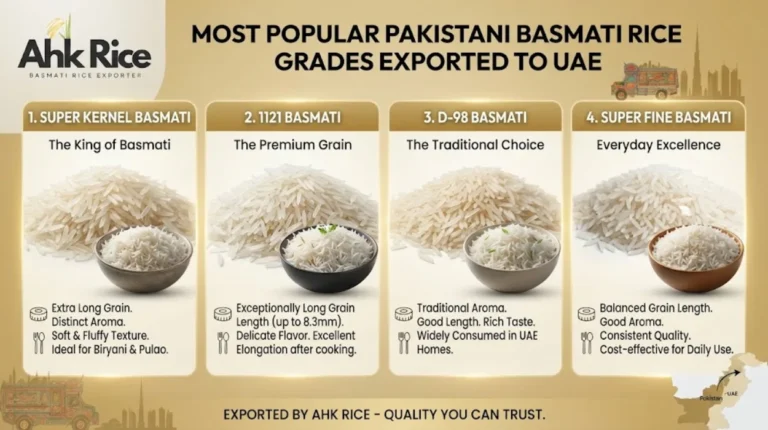
AHK Rice supplies Pakistani Basmati varieties including 1121, Super Kernel and 1509.
Each variety serves different commercial positioning and buyer requirements.
Grade, grain length, broken percentage and moisture should be confirmed before ordering.
Packaging can also be specified for retail or distribution programs.
The final quotation reflects the selected specification and quantity.
Should Indonesian buyers request FOB or CIF pricing?
FOB is useful when the buyer manages ocean freight directly.
CIF is useful when the buyer wants freight and insurance included to the named destination.
The two quotations should not be compared only by headline price.
Freight, destination charges and clearance affect landed cost.
The correct choice depends on the buyer’s logistics capability.
How can I request a scheduled shipment from AHK Rice?
Send the required variety, grade, quantity and destination port.
Include packaging requirements and the target delivery window.
Request a sample if product approval is required before production.
Confirm the agreed specification, Incoterm and payment terms.
Then request a Basmati rice quotation from AHK Rice for the scheduled Indonesia supply program.