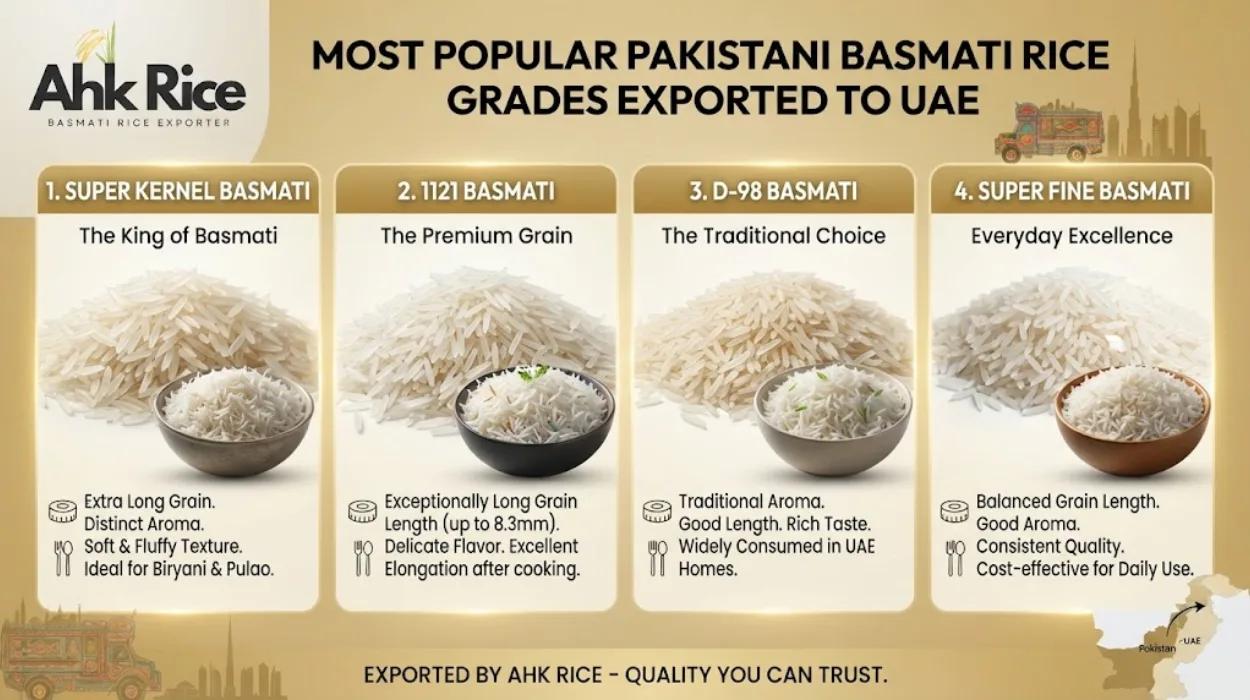
Most Popular Pakistani Basmati Rice Grades Exported to UAE in 2026
Pakistani 1121, Super Kernel, and 1509 Basmati rice serve different UAE retail and hospitality requirements, while Steam and Golden Sella processing grades address distinct cooking needs. Here is why: buyers compare grain length, aroma, cooking performance, broken percentage, shelf life, packaging, and landed cost before selecting an export specification.
The UAE rice market includes supermarkets, ethnic grocery stores, food distributors, restaurants, hotels, caterers, and wholesale importers. Each segment requires a different balance between product appearance, cooking consistency, retail price, and bulk purchasing costs. Understanding Pakistani Basmati rice varieties and export grades helps buyers distinguish rice varieties from processing grades before comparing supplier quotations.
AHK Rice is a Pakistani Basmati rice exporter based in Punjab, supplying 1121, Super Kernel, and 1509 Basmati rice varieties to more than 15 countries. Its export service covers sourcing, milling, grading, sorting, custom packaging, and shipment coordination. UAE importers can evaluate these varieties against their target customers, product specifications, and distribution requirements.
What are the most popular Pakistani Basmati rice grades exported to the UAE?
The principal varieties to compare are 1121, Super Kernel, and 1509, available in White, Steam, and Sella processing forms. Their commercial applications differ across premium retail, traditional rice distribution, restaurant kitchens, and institutional catering.
Pakistani Basmati rice is an aromatic long-grain rice cultivated primarily in Punjab. Its natural fragrance, elongated grains, and characteristic cooked texture distinguish it from many ordinary long-grain rice varieties. Export buyers select varieties according to their market positioning and cooking requirements.
1. 1121 Basmati Rice
1121 Basmati is an extra-long-grain variety known for substantial grain elongation during cooking. Exporters supply it as White, Steam, Creamy Sella, and Golden Sella rice. Buyers use these forms for biryani, pilaf, premium retail packs, and large hospitality kitchens.
The processing method changes the grain’s colour, texture, and cooking behaviour. White rice provides a familiar polished appearance, while Steam processing offers a different balance of firmness and grain separation. Sella rice undergoes parboiling before milling, producing a firmer grain suitable for many bulk-cooking applications.
2. Super Kernel Basmati Rice
Super Kernel is a traditional Pakistani Basmati variety valued for its characteristic aroma and familiar cooked texture. It serves ethnic grocery retailers, South Asian households, specialty rice distributors, and hospitality businesses seeking traditional Basmati characteristics.
Its commercial appeal depends on aroma, grain uniformity, purity, and consistent cooking results. Importers should request a defined specification for raw grain length, moisture, broken percentage, processing type, and crop year. These details help distinguish premium retail quality from more economical bulk grades.
3. 1509 Basmati Rice
1509 Basmati is a commercial variety associated with relatively short crop maturity and long grains. Buyers evaluate it for everyday retail, restaurant supply, catering, and price-sensitive distribution.
Its value depends on the contracted grain specification and the final landed cost. Steam and Sella forms offer different cooking characteristics, while White rice supports buyers seeking a conventional polished product. Importers should compare 1509 with 1121 using actual samples and matched specifications.
How do Pakistani Basmati rice varieties compare by specification?
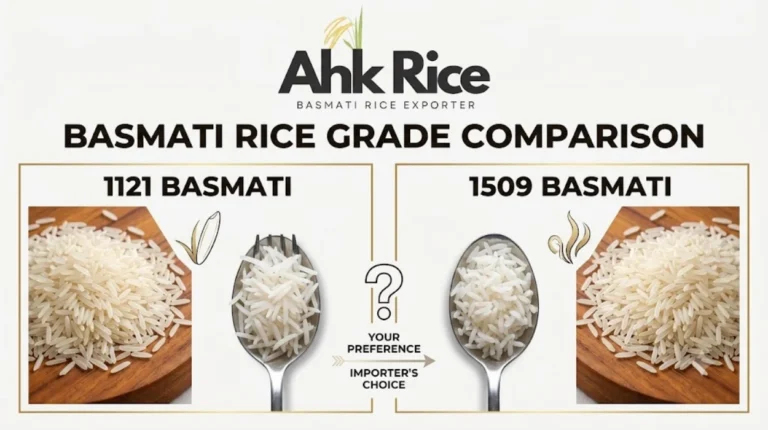
1121 prioritises extra-long grain presentation, Super Kernel emphasises traditional aroma, and 1509 addresses value-conscious commercial demand. A valid comparison must also account for processing method, moisture, broken percentage, packaging, and intended use.
| Attribute | 1121 Basmati | Super Kernel | 1509 Basmati |
|---|---|---|---|
| Main identity | Extra-long-grain variety | Traditional aromatic variety | Commercial long-grain variety |
| Key selling attribute | Grain elongation | Characteristic aroma | Value and commercial yield |
| White processing | Available | Available | Available |
| Steam processing | Available | Confirm with supplier | Available |
| Sella processing | Creamy and Golden Sella options | Confirm specific availability | Steam and Sella options depend on supplier |
| Typical applications | Premium biryani, retail, hospitality | Ethnic retail, traditional dishes | Everyday retail, catering, foodservice |
| Main purchasing factor | Grain length and cooked appearance | Aroma and traditional eating quality | Specification and landed cost |
Note: Availability depends on the supplier’s product range. Confirm processing options and commercial specifications in writing before placing an order.
Which specification should buyers request?
A product name alone does not establish export quality. Buyers should request the raw grain length, broken percentage, maximum moisture, foreign matter limit, processing method, crop year, and agreed packaging.
For example, AHK Rice’s documented 1509 specification includes an average raw grain length of 8.20–8.40 mm and maximum moisture of 13%. These are product-specific specifications, not universal standards for every 1509 shipment.
A purchase specification should also state the permitted variation in grain length, damaged kernels, chalky grains, and foreign matter. The agreed specification provides the basis for sample approval, inspection, and shipment acceptance.
Which Pakistani rice processing grades suit UAE retail and hospitality buyers?
White, Steam, Creamy Sella, and Golden Sella address different preferences for colour, texture, grain separation, and cooking performance. Buyers should select the processing grade according to the final dish and handling conditions, rather than variety name alone.
White Basmati Rice
White Basmati is milled and polished to produce a light-coloured grain. Retailers use it for conventional household rice packs, while restaurants select it for dishes requiring a clean white appearance and familiar Basmati flavour.
Its suitability depends on grain integrity and the kitchen’s cooking method. Importers should test absorption, aroma, softness, and grain separation before approving a shipment.
Steam Basmati Rice
Steam Basmati undergoes steaming as part of processing before the final milling stages. The resulting product suits buyers seeking a balance between grain firmness and the appearance of conventionally processed rice.
UAE restaurants and caterers can evaluate Steam grades for biryani, pulao, and large-volume meal preparation. A controlled cooking trial should measure grain breakage, consistency across batches, and the finished dish’s appearance.
Creamy Sella Basmati Rice
Creamy Sella is a parboiled rice grade with a relatively light golden or creamy colour. Parboiling involves soaking paddy, applying heat, drying it, and then milling the grain.
Its firmer texture suits kitchens that prioritise grain separation in bulk cooking. Buyers should compare its colour and cooked texture with the requirements of their restaurant menus and retail customers.
Golden Sella Basmati Rice
Golden Sella is a parboiled grade with a deeper golden colour. Processing conditions create the characteristic appearance and influence the grain’s cooking behaviour.
This grade suits buyers seeking firm grains for biryani, mandi-style dishes, banquets, and large catering operations. Its commercial suitability still depends on the specific variety, processing consistency, and cooking test results.
How do UAE market regions differ in grade preferences and purchasing requirements?
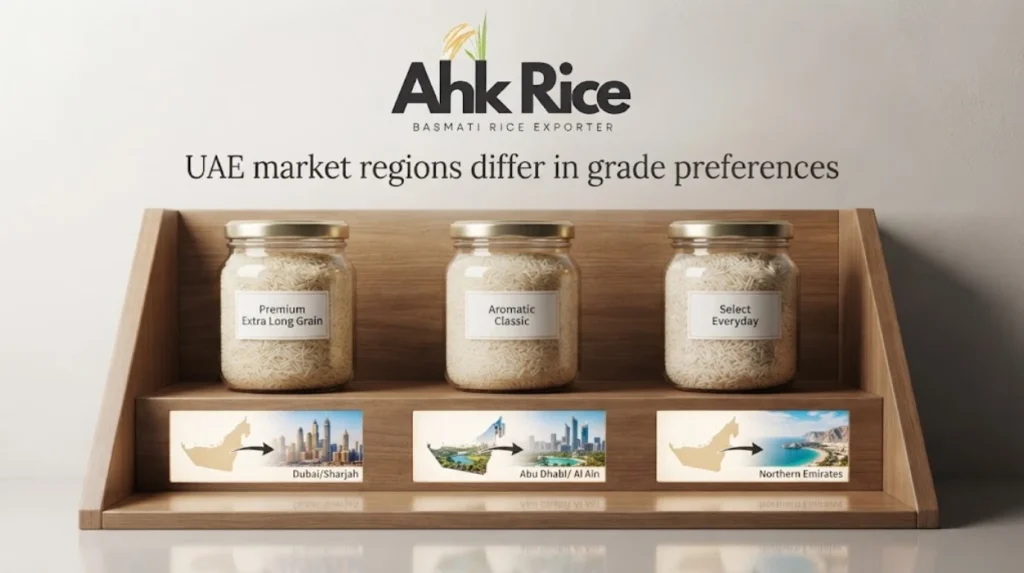
Dubai’s distribution and hospitality channels require clearly specified bulk products, while retail channels across the Emirates require packaging and quality suited to their target customers. These are buyer-segment distinctions, not claims that every emirate follows identical preferences.
Dubai and Northern Emirates: Wholesale and Hospitality
Dubai’s importers, food distributors, restaurant suppliers, and catering companies can compare 1121 Steam, 1121 Sella, Super Kernel, and 1509 against their menu requirements. Extra-long grain presentation matters for premium biryani, while consistent cooking performance matters for high-volume kitchens.
Northern Emirates buyers can apply the same specification-based approach across wholesale distribution, foodservice, and ethnic retail. Larger bags may suit commercial kitchens, while distributors supplying smaller retailers may require several pack sizes.
Buyers in these markets should prioritise consistent batches, clear labelling, agreed moisture limits, and reliable documentation. Jebel Ali is an important logistics gateway, but the destination port and delivery arrangement must match the buyer’s actual shipping plan.
Abu Dhabi and Other Consumer Markets: Retail and Distribution
Supermarkets, grocery distributors, and specialist food retailers require products that match their customers’ cooking preferences and spending levels. Super Kernel can address demand for traditional Basmati aroma, while 1121 can serve premium long-grain positioning.
1509 provides another option for distributors seeking a defined commercial specification at a competitive purchase cost. Retailers should test consumer-facing pack sizes, label requirements, grain appearance, and cooking results before committing to a large order.
Across all Emirates, importers should verify the applicable UAE food-import requirements with their importer or customs broker. Requirements depend on the product, shipment documents, origin, and current regulatory rules.
How do Pakistani Basmati rice prices per metric ton compare in the UAE?
1121, Super Kernel, and 1509 should be compared using current quotations for equivalent specifications, quantities, and delivery terms. A variety name alone cannot establish a reliable price because processing, grain quality, packaging, freight, and inspection change the final cost.
FOB pricing covers the seller’s delivery obligations under the agreed Free On Board term. CIF pricing includes cost, insurance, and freight to the named destination port, subject to the applicable Incoterms rules. Neither figure should be compared with the other without accounting for the different cost coverage.
The following table provides a purchasing framework rather than unverified 2026 market prices.
| Price factor | Effect on quotation | Buyer action |
|---|---|---|
| Variety and grade | Changes the product specification and price | Compare the same variety and processing grade |
| Broken percentage | Lower permitted breakage can affect cost | Specify the maximum percentage |
| Grain length and purity | Influences grade selection and sorting requirements | Request a written specification |
| Packaging | Retail packs and custom printing change costs | Confirm bag material, weight, and printing |
| Freight and insurance | Change CIF landed cost | Request a destination-specific quotation |
A supplier listing published in September 2026 indicated FOB Karachi prices of approximately US$1,135–US$1,205 per metric ton for selected Pakistani rice offerings. These figures are indicative market references, not guaranteed prices for every variety or a direct three-way comparison.
Importers should obtain fresh quotations for the same shipment month, quantity, broken percentage, packaging, and delivery term. The comparison becomes meaningful only after those variables are aligned.
How should buyers compare shelf life across Basmati rice grades?
Shelf life depends on moisture, packaging integrity, storage temperature, humidity, pest control, and the product’s validated best-before period. Processing grade alone does not establish a universal shelf-life duration for rice stored in UAE warehouses.
Dry milled rice generally stores well under suitable conditions. Heat, moisture exposure, damaged bags, insects, and poor warehouse hygiene reduce quality and increase the risk of spoilage.
| Storage factor | Retail distribution | Hospitality and wholesale |
|---|---|---|
| Packaging | Sealed consumer packs | Intact food-grade bulk bags |
| Warehouse conditions | Dry, clean storage | Dry, ventilated, pest-controlled storage |
| Stock rotation | First-expiry-first-out | Batch and expiry tracking |
| Quality checks | Pack integrity and odour | Moisture, pests, odour, and grain condition |
| Shelf-life evidence | Manufacturer’s declared date | Supplier documentation and validated storage guidance |
Buyers should request the manufacturer’s shelf-life declaration for the specific product and packaging. They should also record the production or packing date, lot number, storage conditions, and best-before date.
Golden Sella should not automatically be assigned a longer shelf life than Steam or White rice without product-specific evidence. Storage performance depends on the actual processing specification and packaging system.
What are the advantages and disadvantages of each rice variety?
Each variety offers a different balance of aroma, grain presentation, cooking performance, and purchasing cost. Importers should evaluate these advantages against customer expectations, menu requirements, and expected sales volume.
| Variety | Advantages | Limitations | Example buyer |
|---|---|---|---|
| 1121 | Extra-long grain and premium presentation | Premium specifications can increase purchasing cost | Premium supermarket or biryani supplier |
| Super Kernel | Traditional aroma and familiar Basmati character | Aroma and grain uniformity require sample verification | Ethnic grocery distributor |
| 1509 | Commercial flexibility and value-oriented positioning | Actual quality varies by grade and specification | Bulk distributor or catering supplier |
| Steam | Useful balance of appearance and cooking firmness | Results depend on processing and cooking method | Restaurant kitchen |
| Golden Sella | Firm grain and distinctive golden colour | Colour may not suit every retail or menu preference | Banquet or catering operator |
These options are not interchangeable in every application. A premium retailer may prioritise aroma and appearance, while a catering operator may place more weight on batch consistency and cost per prepared serving.
The practical approach is to test each shortlisted specification under the intended cooking conditions. Record cooked yield, grain separation, flavour, breakage, and the cost per serving before selecting a supplier.
What factors should UAE importers use to choose a Pakistani rice supplier?
Buyers should assess specification compliance, sample performance, documentation, landed cost, packaging, and shipment coordination before approving a supplier. A documented purchasing process reduces misunderstandings between the approved sample and the delivered shipment.
| Decision factor | Question to ask | Evidence to request |
|---|---|---|
| Product specification | Does the rice meet the required grade? | Signed specification sheet |
| Sample quality | Does it perform in the intended dish? | Representative sample and cooking results |
| Food safety | Does the shipment meet applicable requirements? | Relevant test reports and certificates |
| Landed cost | Does the quotation cover the required delivery terms? | Itemised FOB or CIF quotation |
| Supply reliability | Can the supplier coordinate the agreed shipment? | Production schedule and shipping documents |
AHK Rice supports buyers through sourcing, milling, grading, sorting, custom packaging, and export coordination. Importers should confirm the exact services, inspection arrangements, certificates, and delivery schedule applicable to their order.
A suitable supplier should also confirm the final packing format, bag weight, labelling details, container loading plan, and agreed shipment documents. The buyer should approve the sample and specification before authorising bulk production.
For the final decision, match the rice variety to the customer segment, select the processing grade, approve the sample, and compare quotations on equivalent commercial terms. This approach creates a defensible basis for purchasing Pakistani Basmati rice in the UAE market.
FAQs About Pakistani Basmati Rice Grades Exported to the UAE
Which Pakistani Basmati rice variety is suitable for UAE retail buyers?
1121, Super Kernel, and 1509 serve different retail segments. 1121 supports premium long-grain positioning, Super Kernel appeals to traditional Basmati customers, and 1509 offers a commercial alternative for value-conscious shoppers.
Is 1121 Steam or Golden Sella better for UAE restaurants?
The choice depends on the menu and cooking process. Steam suits kitchens seeking a lighter-coloured product, while Golden Sella suits dishes requiring firm, separate grains and a golden appearance. A cooking trial should determine the final choice.
Is Super Kernel Basmati rice suitable for UAE supermarkets?
Yes, Super Kernel can serve supermarkets targeting customers who value traditional Pakistani Basmati aroma. Retailers should verify grain uniformity, aroma, broken percentage, packaging, and cooking performance before approving a private-label or branded product.
What is the difference between 1509 and 1121 Basmati rice?
1121 is associated with extra-long grain presentation, while 1509 offers an alternative for commercial and value-oriented applications. Buyers should compare the actual grain specifications, processing grade, cooking yield, and landed price rather than relying on variety names alone.
What documents should UAE importers request from Pakistani rice exporters?
Importers should request a commercial invoice, packing list, certificate of origin, applicable phytosanitary documentation, and relevant food-safety or inspection records. The precise requirements depend on the product and current UAE import rules. Buyers should confirm requirements with their customs broker and relevant authorities.