Planning Basmati Rice Imports for Ramadan, Eid al-Adha and Hajj Catering Season
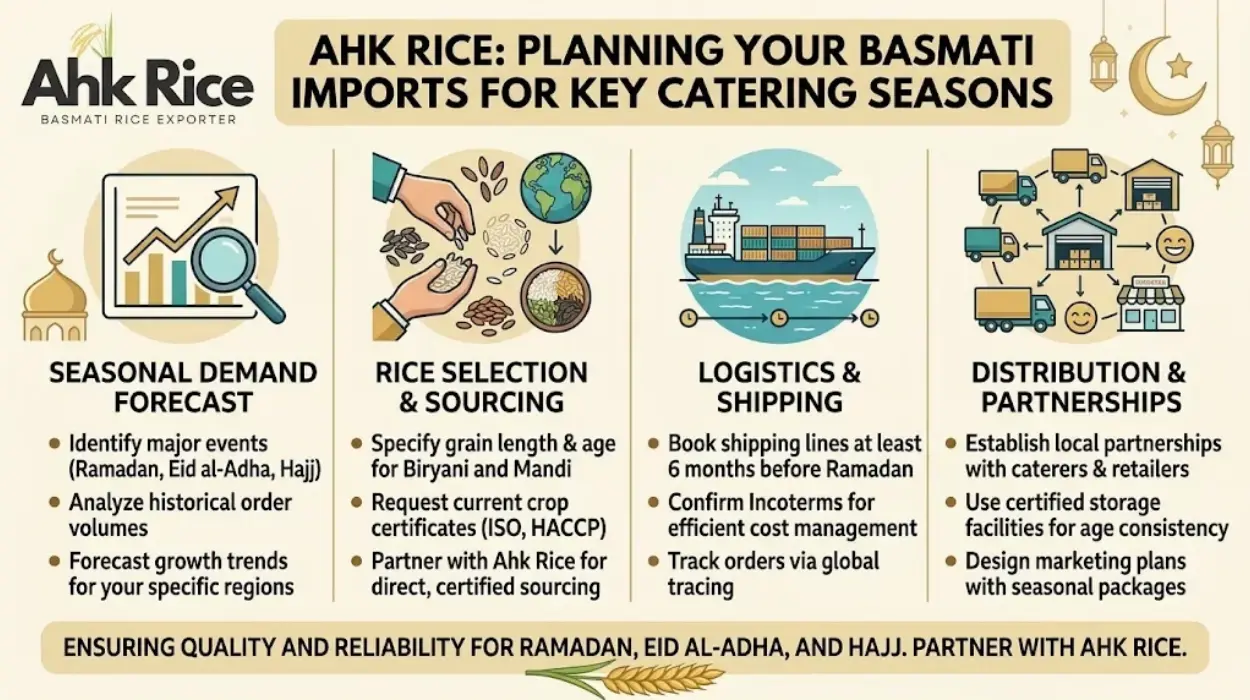
Ramadan, Eid al-Adha and Hajj catering require planned Basmati procurement because demand rises within defined periods. Importers can choose spot buying, pre-season contracting, aged inventory, or scheduled supply programs based on volume, price control, storage capacity, and planned delivery dates.
For Indonesian importers, seasonal rice planning is a procurement decision rather than a simple stock purchase. Ramadan increases household and foodservice consumption, while Eid al-Adha creates concentrated demand for biryani, rice meals, catering trays, restaurants and community events. Hajj-related catering adds another requirement: consistent supply during a period when foodservice operators cannot easily tolerate stock interruptions.
Before selecting a supplier, buyers should understand how seasonal demand affects Pakistani Basmati availability, processing schedules, shipment timing and inventory coverage. The educational guide How Does Ramadan and Eid Affect Basmati Rice Demand in Indonesia? provides the demand context before moving into procurement decisions.
What are the available solutions for seasonal Basmati rice imports?
Available solutions include spot procurement, pre-season contracts, aged Basmati inventory, and scheduled multi-shipment programs. Each method controls a commercial risk: spot buying maximizes flexibility, contracts improve availability, aged stock supports cooking stability, and scheduled shipments balance inventory with cash flow.
1. Spot procurement
Spot procurement means buying rice according to immediate stock requirements. An Indonesian distributor may purchase one or several containers after identifying current customer demand.
This model suits buyers with irregular sales patterns. It also works when the buyer has enough warehouse stock to absorb production and shipping lead times.
The disadvantage is reduced control over seasonal availability. A buyer waiting until Ramadan demand becomes visible may face tighter production schedules, fewer suitable grades or higher replacement costs.
2. Pre-season contracting
Pre-season contracting involves defining the rice specification and volume before peak seasonal demand.
The buyer specifies the variety, processing grade, grain length, moisture, broken percentage, packaging, quantity and delivery window. Production and shipment planning then follow the approved specification.
This approach provides stronger supply visibility than spot purchasing. It is particularly suitable for wholesalers, restaurant groups and catering companies with predictable Ramadan or Eid requirements.
3. Aged Basmati inventory
Aged Basmati is rice stored under controlled conditions after milling. Aging forms part of the commercial specification when the buyer requires established cooking characteristics and a defined storage profile.
This solution suits premium catering programs where cooking performance and grain behavior remain important across large-volume preparation.
Storage conditions still matter. Moisture, humidity, pest control, packaging integrity and warehouse temperature affect stock condition.
4. Scheduled seasonal supply
Scheduled supply divides the requirement into multiple shipments. Instead of purchasing the entire seasonal requirement at once, the importer establishes a supply schedule based on forecast consumption.
For example, an importer expecting 300 MT during a seasonal period can divide the requirement into production and shipment lots rather than placing the full requirement into one warehouse.
This reduces warehouse pressure and connects purchasing more closely with actual consumption.
How do different approaches compare?
Seasonal procurement methods differ mainly in price exposure, supply certainty, working-capital requirements, and inventory control. Spot buying provides maximum flexibility, while pre-season contracting provides stronger availability. Scheduled supply offers the best balance when demand and shipment timing are predictable.
The comparison should begin with the product specification. Comparing a 1121 Steam shipment with a 1509 Steam shipment only by price produces an incomplete purchasing decision.
A buyer must compare equivalent quality levels, processing grades, packing formats, quantities and Incoterms.
| Attribute | Spot Procurement | Pre-Season Contract | Aged Inventory | Scheduled Supply |
|---|---|---|---|---|
| Supply certainty | Medium | High | High | High |
| Price visibility | Low to medium | High | Medium | High |
| Working capital | Lower initial commitment | Higher commitment | Medium to high | Distributed |
| Seasonal availability | Less predictable | Strong | Strong | Strong |
| Warehouse requirement | Lower | Higher | Higher | Controlled |
| Demand flexibility | High | Medium | Medium | High |
| Best use | Irregular demand | Predictable seasonal demand | Premium foodservice | Recurring seasonal demand |
For Indonesian buyers, the most important comparison is not simply which method has the lowest FOB price. The correct method is the one that produces the lowest commercial risk for the required seasonal volume.
Pakistan-origin Basmati price references vary by variety and processing specification. Recent AHK Rice market material places comparable premium Basmati references around US$1,135–US$1,205 per MT FOB Karachi, with Super Kernel commonly positioned around US$1,165–US$1,205 per MT. These are origin reference levels rather than Indonesian landed prices. Freight, insurance, customs, taxes, destination charges, inspection and inland logistics remain separate costs.
Which method works best for different cases?
The strongest approach for seasonal catering is a specification-led supply program combining demand forecasting, approved samples, contracted volume, scheduled production, and staggered shipments. Buyers then match 1121, Super Kernel, or 1509 grades to customer segment, budget, cooking requirement, and storage capacity.
Premium catering and Hajj foodservice
1121 Basmati is suitable where long grain presentation and premium positioning matter. Its extra-long grain profile makes it relevant to biryani, festive meals, hotel kitchens and catering operations.
Golden Sella or other Sella processing can support foodservice programs where grain stability and holding performance are important.
Premium Indonesian retail
Super Kernel suits buyers targeting traditional Pakistani Basmati aroma and premium ethnic positioning. It can be used in retail packs and specialty foodservice.
The product should be evaluated through an approved sample because aroma, grain appearance, moisture and broken percentage affect the commercial result.
Value-focused seasonal distribution
1509 provides another option for buyers balancing long-grain presentation with price positioning. Its early-maturing production profile and competitive commercial positioning make it relevant to distributors managing larger seasonal volumes.
Large catering contracts
Large caterers should avoid relying entirely on spot purchases. A defined specification, approved sample, production reservation and shipment schedule create stronger continuity.
For recurring programs, the buyer can combine an initial seasonal stock position with scheduled replenishment.
What are the advantages and disadvantages of each approach?
Spot buying offers flexibility but exposes buyers to seasonal price and availability changes. Pre-season contracts improve supply certainty but require earlier commitment. Aged inventory supports cooking performance and storage planning, while scheduled shipments reduce warehouse pressure but require accurate forecasting.
Spot buying
Pros: Low initial commitment, flexibility and suitability for uncertain demand.
Cons: Lower control over future pricing, specification availability and shipment timing.
For example, a distributor serving several small retailers can use spot purchasing when monthly demand changes significantly.
Pre-season contracting
Pros: Better supply visibility, specification control and seasonal availability.
Cons: Requires earlier forecasting and stronger financial commitment.
This model works well for a caterer that already knows its expected Ramadan volume.
Aged inventory
Pros: Established cooking characteristics and useful storage coverage.
Cons: Requires controlled warehouse conditions and capital tied up in inventory.
A premium foodservice operator can use aged stock when cooking consistency has greater value than immediate purchase flexibility.
Scheduled supply
Pros: Better inventory rotation, controlled warehouse requirements and planned replenishment.
Cons: Requires reliable demand forecasting and coordination between buyer, exporter, production and shipping.
This is often the most practical structure for importers supplying several Indonesian regions.
Which Indonesian markets require different Basmati planning?
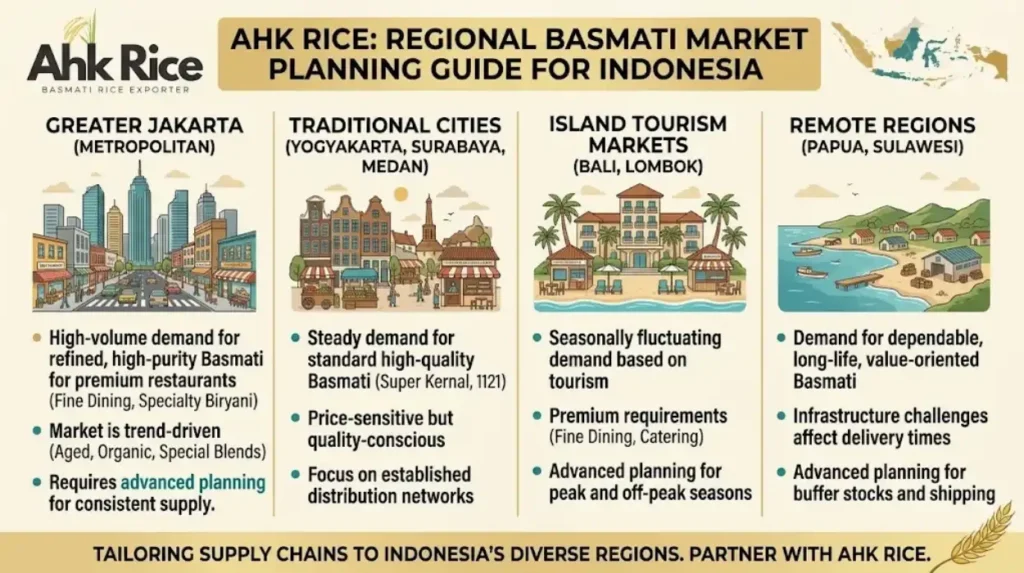
Western and Eastern Indonesia can require different inventory strategies because distribution patterns, warehouse positions and replenishment distances differ.
Western Indonesia, including major commercial markets around Jakarta and Java, generally supports more frequent replenishment. Buyers can prioritize 1121 White, 1121 Sella and Super Kernel when premium retail and foodservice demand is concentrated.
Eastern Indonesia benefits from stronger inventory coverage because additional domestic distribution can extend replenishment time. 1121 Sella, 1121 Steam and 1509 Steam can serve programs where cooking performance and scheduled availability are important. AHK Rice market planning data uses these regional preferences as a framework rather than as a universal rule.
| Market region | Typical grade preference | Reference FOB range | Shelf-life planning |
|---|---|---|---|
| Western Indonesia | 1121 White, 1121 Sella, Super Kernel | US$1,135–$1,205/MT | 12–24+ months depending on grade and storage |
| Eastern Indonesia | 1121 Sella, 1121 Steam, 1509 Steam | US$1,135–$1,205/MT for comparable premium grades | 12–24+ months depending on grade and storage |
The price range is a Pakistan-origin reference, not the final Indonesian wholesale price. A buyer must calculate landed cost using freight, insurance, port charges, import costs, taxes, inspection, customs clearance and domestic delivery.
Shelf life also requires specification-level planning. Rice does not have one universal commercial storage period. Packaging, moisture, warehouse conditions, pest management and processing grade affect practical inventory performance.
What decision factors should importers use before placing a seasonal order?
Decision factors include peak demand volume, required Basmati grade, target market, price per metric ton, shelf-life requirement, warehouse capacity, shipping lead time, import documentation, and cash-flow timing. Buyers should evaluate these factors together rather than selecting rice from price alone.
| Decision factor | Question for the buyer |
|---|---|
| Seasonal volume | How many MT are required during Ramadan, Eid and Hajj catering periods? |
| Grade | Does the market need 1121, Super Kernel or 1509? |
| Processing | Is White, Steam or Sella better for the intended application? |
| Inventory | How many days of stock must remain available before the next shipment? |
| Cost | Is the comparison based on equivalent FOB or landed specifications? |
A useful procurement model starts with expected consumption rather than supplier availability.
For example, a distributor can calculate average monthly consumption, expected Ramadan uplift, Eid demand, Hajj catering requirements and safety stock. The total requirement then becomes the basis for product allocation and shipment scheduling.
The next step is specification approval. A commercial sample should represent the intended bulk product. Buyers should compare grain length, broken percentage, moisture, appearance, aroma, cooking performance and packaging before confirming the production lot.
How should buyers structure a seasonal Basmati import plan?
A practical sequence is:
Demand forecast → grade selection → specification → sample approval → price comparison → contract → production reservation → inspection → container loading → shipment → Indonesian clearance → warehouse distribution.
This sequence separates purchasing decisions from emergency stock replacement.
AHK Rice supplies Pakistani Basmati varieties including 1121, Super Kernel, and 1509 Basmati rice and supports processing, grading, custom packaging and export documentation. For Indonesian buyers, its Indonesia export service provides a starting point for evaluating product specifications and the broader export process. AHK Rice Indonesia Basmati Rice Export Service
The key consideration is repeatability. A seasonal program should not only deliver one successful shipment. It should establish a specification that can be reproduced across subsequent orders.
For a catering operator, this means the rice used for the first major seasonal event should match the approved specification used for later replenishment. For a distributor, it means retail packaging, variety, grain characteristics and quality tolerances remain consistent across shipments.
How should buyers prepare before Ramadan, Eid al-Adha and Hajj demand peaks?
Seasonal planning should begin before warehouse stock reaches its minimum level. Buyers should calculate consumption first, then establish the required arrival date and work backward through production, inspection, container loading and ocean transport.
This is especially important when several buyers compete for similar grades during the same seasonal period.
Indonesian buyers should also separate Pakistan production lead time from ocean transit. A container cannot be booked at the same point at which the rice specification is first selected. Sample approval, quotation, contracting, production and export preparation occur before vessel departure.
For recurring Indonesian programs, shipment planning can also consider major destination ports such as Tanjung Priok, Tanjung Perak and Belawan, depending on the buyer’s warehouse and distribution network.
The result is a procurement calendar rather than an emergency purchase.
Planning Basmati rice for Ramadan, Eid al-Adha and Hajj catering requires coordination between demand, grade, price, storage and shipping. Spot purchasing works for uncertain demand, while pre-season contracts and scheduled supply programs provide stronger control for recurring seasonal requirements.
For Indonesian buyers, 1121, Super Kernel and 1509 should not be treated as interchangeable products. Each serves a different balance of grain length, aroma, cooking performance, customer positioning and price.
The strongest procurement structure connects the approved product specification with forecast volume, sample validation, production scheduling and planned shipments. This approach turns seasonal rice purchasing from an emergency stock decision into a repeatable supply program.
Frequently Asked Questions
When should Indonesian buyers start planning Basmati rice for Ramadan?
Buyers should start before seasonal demand reaches its peak. Early planning allows time for specification confirmation, sampling, quotation, production, inspection, packing, vessel booking, customs preparation and warehouse delivery.
Which Basmati variety is best for Ramadan catering?
1121 is suitable for premium catering where long-grain presentation is important. Super Kernel suits buyers prioritizing traditional Basmati aroma, while 1509 provides a competitive long-grain option for value-focused distribution.
Is aged Basmati better for Hajj catering?
Aged Basmati suits programs that prioritize established cooking characteristics and controlled storage. The decision should also consider the required processing grade, sample performance, warehouse conditions and catering preparation method.
How much Basmati rice should an importer stock before Ramadan?
The required quantity depends on historical consumption, expected seasonal growth, catering contracts, safety stock, warehouse capacity and replenishment lead time. Buyers should calculate seasonal demand rather than use a fixed percentage.
How should Indonesian buyers compare Basmati rice prices?
Compare equivalent varieties, processing grades, grain specifications, broken percentage, moisture, packaging, quantity and Incoterm. FOB Karachi provides an origin price comparison, while landed cost requires freight, insurance, import charges, taxes and domestic logistics.
Which processing grade suits catering?
Steam and Sella grades can serve foodservice programs, with the final choice depending on the required cooking texture, holding time, grain separation and menu application. Golden Sella is particularly relevant where grain stability and longer holding performance matter.
Can buyers combine several Basmati varieties in one seasonal program?
Yes. A distributor can allocate different varieties to different customer segments. For example, 1121 can serve premium catering, Super Kernel can serve aromatic premium retail, and 1509 can support value-oriented distribution.
What should a Basmati rice sample contain?
The commercial sample should represent the proposed bulk specification. Buyers should evaluate grain length, appearance, moisture, broken percentage, aroma, cooking performance, grain separation and consistency before approving production.
What is the biggest mistake in seasonal Basmati procurement?
Waiting until seasonal demand becomes urgent is the main procurement weakness. It reduces the time available for sample approval, production planning, shipping coordination and inventory replenishment.
How can importers reduce seasonal stockout risk?
Importers can combine demand forecasting, safety stock, approved specifications, pre-season contracting and scheduled shipments. This creates several control points instead of depending on one emergency purchase.