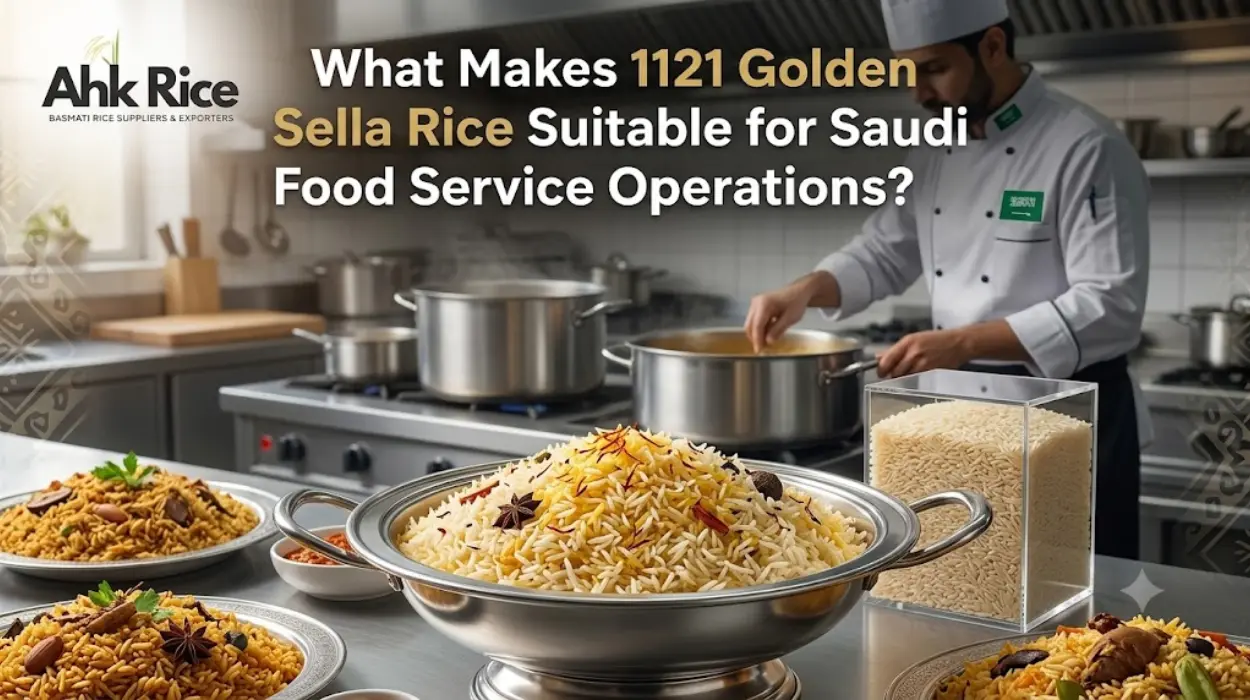
What Makes 1121 Golden Sella Rice Suitable for Saudi Food Service Operations?
1121 Golden Sella Rice suits Saudi food service operations because it delivers high cooked volume, long grain elongation, strong holding performance, low breakage, and consistency across large-scale catering environments. Here is why: Saudi restaurants, catering companies, hotel kitchens, institutional kitchens, and Hajj catering contractors require rice that maintains texture during batch cooking while controlling food costs through higher yield per kilogram.
1121 Golden Sella Rice is a parboiled Basmati rice variety cultivated primarily in Punjab, Pakistan. The variety belongs to the Basmati family and is recognized for its extra-long grain length, golden color after parboiling, and strong performance in commercial food preparation.
Saudi Arabia remains one of the largest import markets for Pakistani Basmati rice due to sustained demand from restaurants, catering services, hospitality groups, and large institutional kitchens (source: REAP export data, December 2025). Food service buyers prioritize consistency, storage stability, and cooking performance because daily production volumes often exceed hundreds or thousands of meals.
Understanding why 1121 Golden Sella performs well begins with understanding the rice itself.
What Is 1121 Golden Sella Rice?
1121 Golden Sella Rice combines extra-long Basmati grains, parboiled processing, grain lengths of approximately 8.30–8.40 mm, and strong cooking expansion that often reaches nearly twice the uncooked grain length.
1121 Golden Sella Rice is a parboiled version of the 1121 Basmati variety. Farmers cultivate the paddy in Punjab’s fertile agricultural regions. Millers process the harvested paddy through controlled parboiling before milling and grading.
Parboiling transfers nutrients from the outer layers into the grain kernel. This process creates the characteristic golden appearance. The treatment also strengthens the grain structure.
1121 Golden Sella differs from white rice because the grain undergoes heat and moisture treatment before milling. The process reduces grain breakage and improves handling during transportation and cooking.
Saudi food service operators prefer rice varieties that remain separate after cooking. 1121 Golden Sella achieves this requirement through its long grain structure and controlled moisture management.
Examples of food service operations include banquet catering companies, hotel buffets, airline catering kitchens, industrial cafeterias, and wedding catering contractors.
With the definition of 1121 Golden Sella established, the next question is how the processing method creates these performance advantages.
How Does 1121 Golden Sella Rice Processing Work?
Nine processing stages create the final product: soaking, steaming, drying, milling, de-husking, polishing, grading, color sorting, and packing.
Parboiling changes the internal structure of the rice grain. The process increases durability and improves cooking performance.
How Is 1121 Golden Sella Produced?
Food processors follow a structured sequence:
- Clean the harvested paddy.
- Soak the paddy in controlled-temperature water.
- Steam the soaked grain.
- Dry the parboiled paddy.
- De-husk the grain.
- Mill the rice.
- Polish the kernels.
- Grade and sort by size.
- Pack for export shipment.
Soaking allows moisture to penetrate the grain. Steaming gelatinizes the starch structure. Drying stabilizes the moisture level before milling begins.
De-husking removes the outer husk. Milling removes bran layers. Polishing creates a uniform appearance. Grading separates grains according to specification requirements.
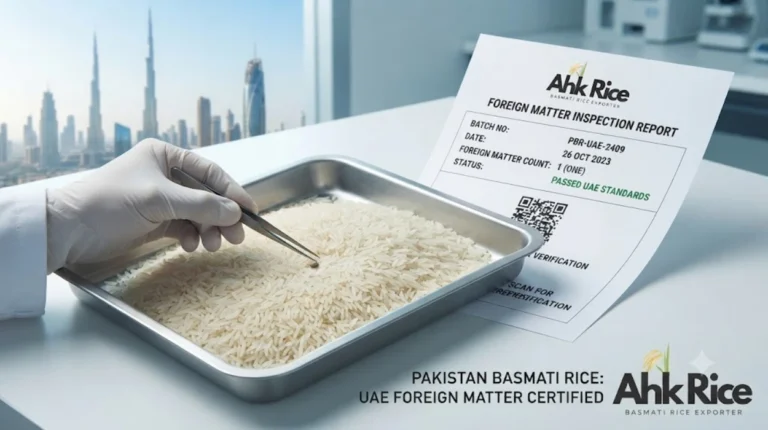
Export facilities inspect, test, and verify rice before shipment. Standard tests include moisture content, broken percentage, foreign matter levels, and grain length verification.
Saudi importers prefer uniform grades because kitchen operations require predictable cooking outcomes across multiple locations.
Processing explains the physical characteristics of the rice. The next step is understanding which specifications matter most to food service buyers.
What Key Components Make 1121 Golden Sella Suitable for Commercial Kitchens?
Extra-long grains, low breakage rates, high cooking yield, strong holding performance, extended shelf stability, and uniform grading create operational advantages for food service buyers.
Commercial kitchens evaluate rice using measurable specifications rather than appearance alone.
Grain Length
1121 Golden Sella typically measures 8.30–8.40 mm before cooking.
Long grains create premium plate presentation. Restaurants serving Kabsa, Mandi, Bukhari Rice, and Madghout depend on visible grain separation.
Grain Elongation
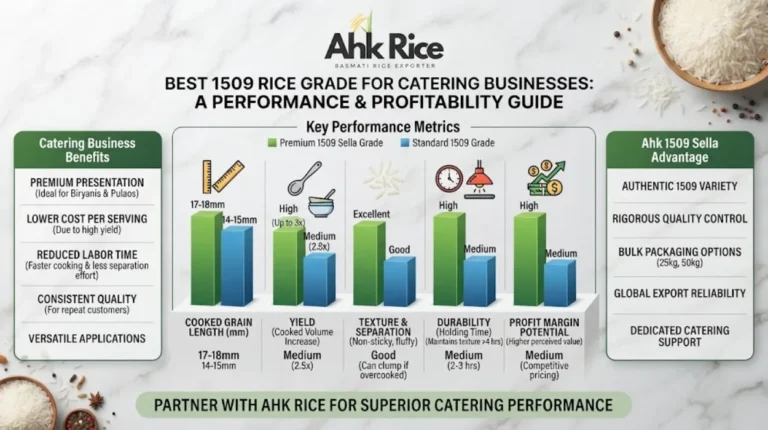
1121 Golden Sella commonly reaches 16–18 mm cooked length under correct cooking conditions.
Higher elongation improves visual appeal. Larger grain volume also increases perceived serving value.
Low Breakage
Food service grades commonly maintain 5% or lower broken rice percentages.
Lower breakage improves presentation quality. Uniform kernels cook more consistently during bulk preparation.
Moisture Control
Export specifications commonly target 12%–14% moisture content.
Controlled moisture supports storage stability. Stable moisture reduces quality deterioration during long-distance shipping.
Holding Performance
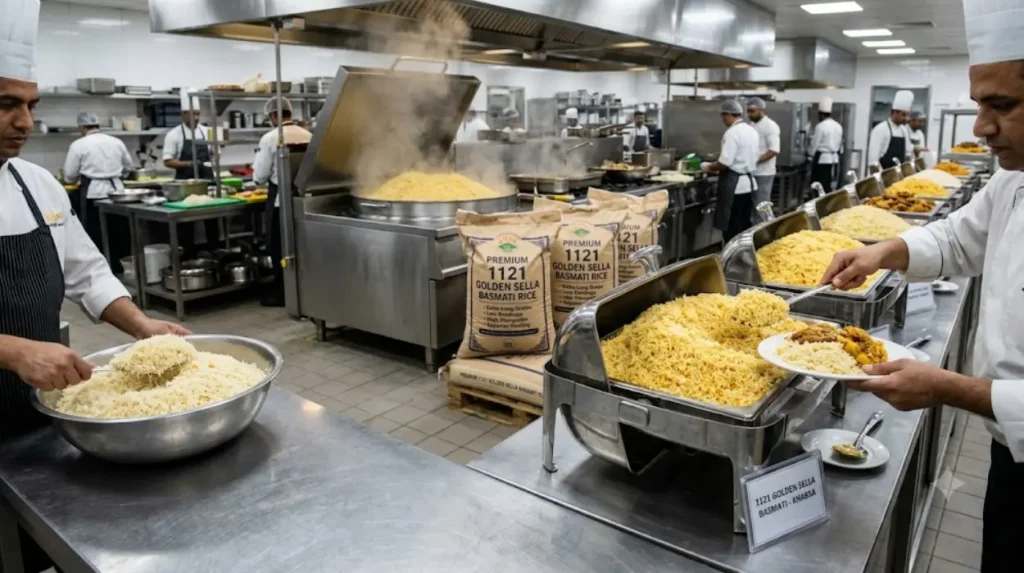
1121 Golden Sella maintains grain separation during buffet service and large catering operations.
Saudi catering environments often keep rice warm for extended service periods. Strong grain structure helps maintain texture during holding.
These technical components explain the product characteristics. The next question is how they translate into operational benefits.
What Benefits Does 1121 Golden Sella Rice Provide for Saudi Food Service Operations?
Higher cooked yield, lower waste, better presentation, extended storage stability, and consistent batch performance reduce operational costs while improving service quality.
Commercial kitchens evaluate ingredients according to cost and performance metrics.
Higher Cooked Volume
1121 Golden Sella absorbs water efficiently during cooking.
Higher expansion means more servings from the same quantity of raw rice. Large catering operations benefit directly from improved yield.
Better Plate Presentation
Long separated grains create a premium appearance.
Saudi consumers associate long-grain Basmati rice with quality dining experiences. Restaurants serving traditional Gulf dishes depend on this visual standard.
Reduced Cooking Loss
Parboiled grains resist breakage during washing, soaking, and cooking.
Lower cooking loss improves consistency between batches. Consistency supports portion control and purchasing forecasts.
Strong Storage Performance
Golden Sella rice remains stable during long storage cycles.
Golden Sella lasts longer than Steam Rice. In a 40°C Gulf warehouse environment, Golden Sella commonly supports storage periods of up to 18 months under proper conditions. Steam Rice generally performs best within 12 months. For Saudi catering companies maintaining inventory before Ramadan or Hajj seasons, Golden Sella aligns better with operational requirements.
Consistent Batch Results
Large commercial kitchens prepare hundreds of kilograms per cooking cycle.
Uniform grading supports predictable water absorption and cooking times. Predictability improves labor efficiency and service planning.
These benefits become more meaningful when viewed through real-world food service applications.
Which Saudi Food Service Sectors Use 1121 Golden Sella Rice?
Hotels, restaurants, catering contractors, institutional kitchens, airline caterers, and religious event food providers depend on 1121 Golden Sella Rice for large-volume meal production.
Different sectors use the rice for different operational reasons.
Hotel Buffets
Hotels require premium appearance and consistent serving quality.
1121 Golden Sella maintains grain separation during buffet service. This characteristic supports guest satisfaction and presentation standards.
Restaurant Operations
Saudi restaurants serving Kabsa and Bukhari rice require elongated grains and aromatic characteristics.
Long grains improve dish presentation. Consistent cooking supports menu standardization.
Industrial Catering
Industrial catering companies prepare thousands of meals daily.
Large-scale operations prioritize yield and consistency. Golden Sella supports both requirements.
Hajj and Umrah Catering
Religious event catering requires reliable performance at extremely high volumes.
Large kitchens benefit from rice that tolerates extended holding periods without significant texture deterioration.
Airline Catering
Airline food production requires uniformity and stability.
Parboiled rice performs well during preparation, packaging, transportation, and reheating cycles.
Understanding the use cases helps explain demand patterns. The next section addresses common misconceptions surrounding Golden Sella rice.
What Common Misconceptions Exist About 1121 Golden Sella Rice?
Buyers comparing processing styles often evaluate how Golden Sella performs against Creamy Sella in commercial kitchens. A detailed comparison of cooking yield, grain appearance, holding performance, and buyer preferences is available in our guide on choosing between Golden and Creamy Sella for Saudi catering operations.
Several misconceptions influence purchasing decisions.
Does the Golden Color Come From Additives?
No. The golden appearance develops during parboiling. Heat treatment changes the grain’s natural color.
Processors do not add color to create the Golden Sella appearance.
Is Golden Sella Lower Quality Than White Basmati?
No. Golden Sella and White Basmati represent different processing categories rather than quality levels.
White Basmati prioritizes bright appearance. Golden Sella prioritizes durability, shelf stability, and commercial cooking performance.
Does Longer Shelf Life Reduce Taste?
No. Controlled processing supports storage stability while preserving the characteristic Basmati profile.
Saudi buyers often select Golden Sella specifically because it balances flavor retention with operational durability.
Is All Golden Sella Rice the Same?
No. Different grades vary according to grain length, broken percentage, moisture level, and sorting quality.
Examples include premium export grades, standard catering grades, and economy grades.
Misconceptions often disappear once grading standards are understood. The final question focuses on certifications and import requirements.
What Certifications and Quality Standards Apply to 1121 Golden Sella Rice Exports?
Phytosanitary certification, quality inspection reports, fumigation compliance, food safety management systems, and destination-country import standards govern international shipments.
Exported rice passes through multiple verification stages before reaching Saudi Arabia.
Export Documentation
Required export documents commonly include:
- Phytosanitary Certificate
- Certificate of Origin
- Commercial Invoice
- Packing List
- Bill of Lading
- Fumigation Certificate
- Quality Inspection Report
Food Safety Certifications
Export facilities frequently maintain:
- ISO 22000
- HACCP
- GMP Compliance
- Halal Certification
Food safety systems establish standardized controls throughout processing operations.
Quality Testing Parameters
Inspectors verify:
- Grain length
- Moisture content
- Broken percentage
- Foreign matter
- Chalkiness levels
- Purity percentage
Saudi importers often define specification requirements before procurement contracts begin.
These standards ensure that 1121 Golden Sella Rice maintains consistency from cultivation in Punjab through final delivery to Saudi food service operations.
Conclusion
1121 Golden Sella Rice suits Saudi food service operations because it combines extra-long grains, high cooked yield, strong holding performance, low breakage, extended storage stability, and standardized export specifications. Punjab cultivation, controlled parboiling, rigorous grading, and international quality verification create a rice category designed for large-scale food production. These characteristics explain why hotels, restaurants, catering contractors, airline caterers, and institutional kitchens across Saudi Arabia continue to rely on 1121 Golden Sella Rice as a core menu ingredient.
Frequently Asked Questions
What is the difference between 1121 Golden Sella Rice and White Basmati Rice?
1121 Golden Sella Rice undergoes a parboiling process before milling, while White Basmati Rice does not. Golden Sella offers better grain strength, longer shelf life, and improved performance in large-scale catering operations. White Basmati provides a lighter color and softer texture after cooking.
Why do Saudi food service operators prefer 1121 Golden Sella Rice?
Saudi food service operators prefer 1121 Golden Sella Rice because it delivers high cooked yield, long grain elongation, and strong holding performance. The rice remains separate after cooking and maintains quality during buffet service, catering events, and institutional meal production.
How long can 1121 Golden Sella Rice be stored?
1121 Golden Sella Rice can typically be stored for up to 18 months when kept in dry, cool, and hygienic warehouse conditions. Proper moisture control and suitable packaging help maintain grain quality throughout the storage period.
Which dishes are commonly prepared with 1121 Golden Sella Rice in Saudi Arabia?
1121 Golden Sella Rice is widely used for Kabsa, Bukhari Rice, Mandi, Madghout, and large-scale catering meals. Its extra-long grains and excellent elongation make it suitable for traditional Saudi and Gulf rice dishes.
What certifications are commonly required for exporting 1121 Golden Sella Rice to Saudi Arabia?
Export shipments commonly require a Phytosanitary Certificate, Certificate of Origin, Commercial Invoice, Packing List, and Fumigation Certificate. Many rice processing facilities also maintain ISO 22000, HACCP, GMP, and Halal certifications to meet international food safety requirements.