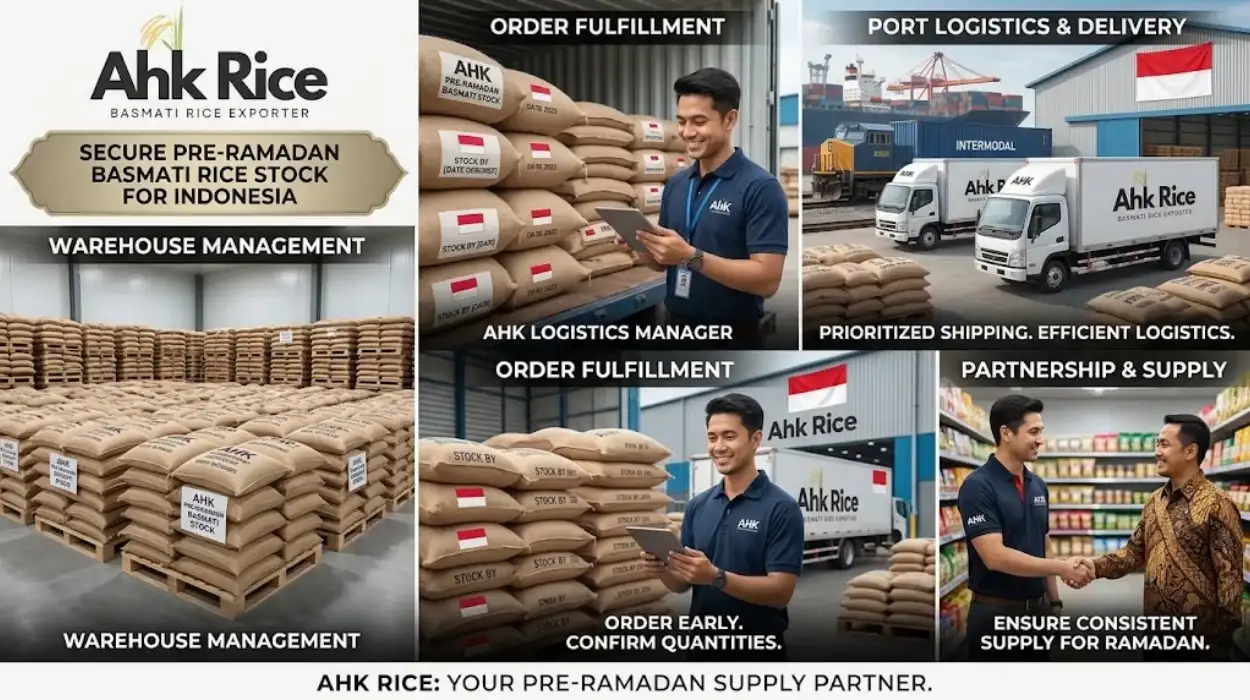
Secure Pre-Ramadan Basmati Rice Stock for Indonesia with AHK Rice
The best solution is to secure specification-approved Basmati rice before Ramadan demand accelerates, using confirmed quantities, packaging, documents, and shipment schedules. AHK Rice supports Indonesian importers with pre-shipment samples, quality approval, export processing, and container-ready Pakistani Basmati rice supply.
Ramadan creates a predictable increase in food consumption across Indonesia. Rice remains a core staple for household meals, restaurants, caterers, hotels, distributors, and Ramadan food programs. Importers therefore need stock planning before demand reaches its seasonal peak.
The purchasing decision should not start when Ramadan demand is already visible in the market. It should start with the required grade, quantity, packaging, destination port, and arrival window.
For buyers still assessing seasonal demand patterns, how Ramadan and Eid affect Basmati rice demand in Indonesia provides the market context needed before committing to volume.
The practical target is to have commercially approved rice moving early enough to avoid rushed purchasing. A pre-Ramadan program should cover product selection, sample approval, commercial terms, export documentation, production, loading, and sea transit.
For Indonesian buyers, the preferred approach is to approve the physical sample before confirming the full shipment. This reduces the risk of receiving a product that does not match the intended retail, foodservice, or catering specification.
AHK Rice supplies Pakistani Basmati varieties including 1121, Super Kernel, and 1509. Each variety serves a different purchasing objective. The buyer should therefore select the grade according to target customers rather than choosing solely on price.
Why should Indonesian importers choose AHK Rice for pre-Ramadan stock?
Indonesian importers choose AHK Rice when they need specification-based sourcing, pre-shipment sample approval, custom packaging, export documentation, and container-ready shipments from Pakistan. The process connects product selection with commercial approval and scheduled shipment planning for Ramadan inventory requirements.
The first advantage is specification control. A buyer can define grain length, variety, broken percentage, moisture, processing level, packaging format, quantity, and destination before commercial production.
AHK Rice manages the sourcing and processing sequence around those requirements. This creates a clearer connection between the approved sample and the shipment specification.
For premium Basmati positioning, 1121 and Super Kernel are strong options. 1121 focuses on long grain, aroma, cooked elongation, and premium presentation. Super Kernel provides Pakistani Basmati characteristics with strong suitability for ethnic retail and South Asian food distribution.
1509 provides another commercial option where buyers require long grain characteristics with a more efficiency-focused purchasing position. Steam and Sella processing can also be selected according to the intended market and cooking requirements.
The first product discussion should therefore begin with the AHK Rice Basmati rice export service, where product sourcing, processing, packaging, and export requirements can be aligned.
AHK Rice also supports custom packaging for importers building or expanding private-label programs. Packaging specifications should be confirmed before production because artwork, bag material, pack size, labeling requirements, and carton or pallet arrangements affect the export timeline.
The company’s end-to-end process covers sourcing, grading, processing, quality checks, packing, documentation, and container loading. This gives the buyer one coordinated export workflow rather than managing several disconnected suppliers.
For Indonesia, the buyer should also establish the required import documentation and destination requirements before the shipment is finalized. This is especially important when the rice will enter the market under a private label or retail brand.
How should buyers plan Ramadan Basmati rice shipments to Indonesia?
Buyers should work backward from the required Indonesian stock date, allowing time for specification approval, sample dispatch, commercial confirmation, production, documentation, container loading, port handling, and ocean transit. Early approval gives importers more control over seasonal inventory timing.
A practical shipment plan begins with the target arrival date.
For example, an importer targeting Ramadan retail sales should not calculate only the sea-transit period. The schedule must include the sample approval stage and export preparation before the container reaches the port.
A typical sequence is:
- Product and specification confirmation.
- Commercial sample preparation.
- Sample courier dispatch.
- Buyer cooking and quality evaluation.
- Final specification approval.
- Quantity and packaging confirmation.
- Production and processing.
- Export documentation.
- Container loading.
- Ocean shipment to Indonesia.
- Destination clearance and local distribution.
Shipping time depends on the selected Indonesian port, vessel schedule, transshipment requirements, and operating conditions. Jakarta and Surabaya should therefore be planned as separate logistics scenarios rather than assuming one fixed transit period.
For planning purposes, importers should allow a buffer beyond the expected ocean transit. A seasonal shipment that arrives only a few days before Ramadan leaves little room for customs, inspection, inland transport, or warehouse allocation.
The safer commercial strategy is to build inventory before the peak purchasing period. This also gives distributors and retailers time to position stock across multiple sales channels.
AHK Rice can structure the supply process around the buyer’s required shipment window instead of treating the order as a standard spot purchase.
What does the pre-Ramadan rice sample process cost?
The sample process normally begins with product selection, specification confirmation, commercial sample preparation, courier dispatch, buyer testing, and final approval. Sample courier and applicable destination charges are handled according to the agreed shipment arrangement before bulk production begins.
The cost of sampling depends on the requested variety, sample weight, courier destination, packaging, and any applicable phytosanitary or destination requirements.
For suitable sampling programs, AHK Rice can provide product samples for buyer evaluation. The buyer can then assess grain appearance, aroma, cooking performance, elongation, texture, and overall suitability.
A sample should not be treated as a formality. It is the buyer’s opportunity to verify whether the selected specification matches the intended Indonesian market.
The buyer should record the approved specifications after testing. These can include:
- Basmati variety
- Grain length
- Moisture level
- Broken percentage
- Processing type
- Packaging format
- Net weight
- Label requirements
- Quantity
- Destination port
- Required documentation
Once the commercial sample is approved, the same specification should become the reference point for the bulk shipment.
For higher-volume Ramadan programs, buyers should avoid repeatedly changing specifications after production begins. Changes can affect processing schedules, packaging, documentation, and shipment timing.
What affects the price of Pakistani Basmati rice delivered to Indonesia?
The final rice price depends on variety, grain specification, broken percentage, moisture, processing, packaging, order volume, shipment destination, freight conditions, and Incoterm. A comparable quotation must therefore use identical specifications before buyers compare suppliers.
FOB and CIF prices should not be compared as though they represent the same cost.
An FOB Karachi quotation generally covers the product and agreed export-side obligations up to the specified loading point. A CIF quotation incorporates ocean freight and insurance to the named destination port.
The buyer should request both when evaluating the total procurement cost.
The main cost factors include:
- Basmati variety and grade
- Grain length and purity
- Broken percentage
- Moisture specification
- Steam or Sella processing
- Sortex requirements
- Packaging material
- Private-label printing
- Order quantity
- Container configuration
- Port of destination
- Freight and insurance
- Export documentation
- Applicable destination charges
- Selected Incoterm
Packaging can also materially affect the final quotation. A standard bulk bag and a customized retail bag do not carry the same production requirements.
For Ramadan planning, quantity is another important factor. Larger confirmed volumes can create a different commercial structure from smaller trial orders.
Importers should therefore provide complete specifications when requesting a quotation from AHK Rice. A price without a defined grade and delivery basis is not a reliable procurement benchmark.
What results can Indonesian buyers expect from early stock planning?
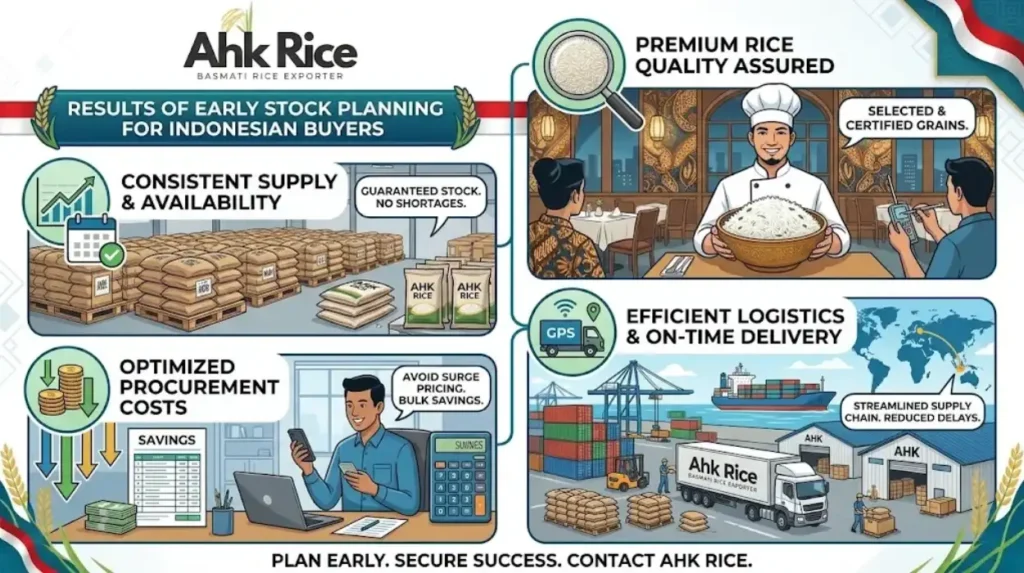
Early planning gives Indonesian importers greater control over product approval, shipment timing, packaging, inventory availability, and seasonal purchasing costs. It also reduces dependence on urgent spot purchases when Ramadan demand is already placing pressure on available supply.
The strongest outcome is operational control.
An importer that approves its sample early can move from product evaluation to commercial production without waiting for the seasonal market to tighten.
This creates a clearer procurement cycle. The buyer knows what product is being purchased, what packaging is being produced, what quantity is scheduled, and when the shipment is expected to move.
Consider a distributor supplying supermarkets and Ramadan foodservice customers. If the buyer waits until seasonal demand accelerates, the procurement team may need to prioritize immediate availability over preferred specifications.
An early purchase creates the opposite position. The buyer can select the variety based on customer demand and maintain the approved specification throughout the order.
AHK Rice also gives buyers the option of building a repeatable supply relationship. A successful Ramadan shipment can become the specification reference for future Eid, Hajj catering, institutional, wholesale, and retail programs.
For importers comparing supply models, planning Basmati rice imports for Ramadan, Eid al-Adha and Hajj catering season can help connect seasonal demand planning with longer-term procurement decisions.
How can an Indonesian importer start a Ramadan rice order with AHK Rice?
Start by sending the required variety, quantity, packaging, destination port, preferred Incoterm, and target arrival period. AHK Rice can then align the specification, sample process, quotation, production schedule, documentation, and shipment plan around the Indonesian buyer’s requirements.
The process should begin with a complete buying brief.
The buyer should provide the preferred Basmati variety and explain its intended application. Retail, wholesale, restaurant, catering, and private-label programs can require different specifications.
The second step is specification confirmation. This establishes the technical basis for sampling and quotation.
The third step is sample evaluation. The buyer receives the commercial sample and checks the rice against the intended cooking and market requirements.
The fourth step is commercial approval. Once the sample is accepted, the buyer confirms quantity, packaging, Incoterm, destination port, and shipment timing.
The fifth step is production and export preparation. AHK Rice coordinates processing, grading, packaging, documentation, and container loading according to the approved order.
The final step is shipment and destination handling.
For a Ramadan program, the most important decision is timing. The earlier the specification is approved, the more room the importer has to manage production and logistics without relying on last-minute purchasing.
AHK Rice is positioned for buyers that want Pakistani Basmati supply connected to a defined export process rather than a simple commodity transaction.
What should Indonesian buyers confirm before placing a Ramadan Basmati order?
Before placing an order, Indonesian buyers should confirm the exact Basmati variety, quality specification, sample approval, packaging, quantity, Incoterm, destination port, documentation, production schedule, and expected shipment window. These details create the commercial reference for the complete order.
Use this final checklist before approval:
- Confirm Basmati variety and grade.
- Approve the physical commercial sample.
- Confirm moisture and broken percentage.
- Confirm grain specification.
- Select Steam or Sella processing where required.
- Confirm Sortex and purity requirements.
- Approve packaging and labeling.
- Confirm order quantity.
- Select Jakarta, Surabaya, or another destination port.
- Compare FOB and CIF on the same specification.
- Confirm export documentation.
- Confirm production and loading schedule.
- Allow sufficient logistics buffer before Ramadan.
- Establish the final shipment specification in writing.
This approach turns Ramadan purchasing into a controlled procurement program.
For Indonesian importers, the objective is not simply to find Basmati rice before Ramadan. The objective is to secure the right specification, quantity, packaging, price basis, and arrival schedule before seasonal demand becomes difficult to manage.
With early sample approval and coordinated export preparation, AHK Rice can provide a practical route from Pakistani Basmati sourcing to container-ready supply for Indonesia.
To discuss the required grade, quantity, packaging, destination, and Ramadan shipment schedule, request a current quotation from AHK Rice.
Frequently Asked Questions
How early should Indonesian buyers order Basmati rice for Ramadan?
Buyers should begin before seasonal demand accelerates.
Sample approval should happen before bulk production.
Packaging and documentation also need lead time.
Ocean transit and destination clearance require additional buffer.
Early ordering gives importers better control over inventory timing.
Which Pakistani Basmati varieties can AHK Rice supply?
AHK Rice supplies Pakistani 1121 Basmati rice.
Super Kernel is another premium Pakistani Basmati option.
1509 provides a long-grain commercial alternative.
Steam and Sella processing can be selected where appropriate.
The final choice should match the buyer’s market and specification.
Can Indonesian buyers receive a rice sample before ordering?
Yes, buyers can request a commercial product sample.
The buyer evaluates grain appearance and cooking performance.
The sample can be checked against the required specification.
Courier and applicable destination charges depend on the arrangement.
Bulk production should follow the approved specification.
What determines the Basmati rice price for Indonesia?
Price depends on variety and quality specification.
Grain length, broken percentage and moisture affect the quotation.
Packaging and private-label requirements also influence cost.
Quantity, freight, destination and Incoterm affect delivered pricing.
FOB and CIF quotations should be compared on identical specifications.
Can AHK Rice provide custom packaging for Indonesian buyers?
Yes, custom packaging can be arranged for qualifying orders.
Buyers can define pack sizes and packaging requirements.
Private-label artwork should be confirmed before production.
Labeling requirements should be checked before final approval.
Packaging specifications become part of the commercial order reference.