Why 1121 Steam Basmati Rice Is Gaining Shelf Space in Vietnamese Supermarkets
1121 Steam Basmati rice is an extra-long-grain aromatic rice variety cultivated in the fertile alluvial plains of Punjab, Pakistan, measuring 8.30 mm to 8.35 mm raw and elongating up to 22 mm upon cooking after undergoing controlled pre-milling steam conditioning.
The 1121 cultivar belongs to the Oryza sativa species and carries the highest grain-length-to-width ratio among commercial aromatic rice varieties globally. Its signature floral aroma comes from 2-acetyl-1-pyrroline (2-AP), a volatile organic compound concentrated in the endosperm during grain maturation. Unlike standard raw white Basmati or fully parboiled Sella rice, 1121 Steam Basmati Rice receives a calibrated burst of hot steam while still inside the paddy husk before milling. This thermal treatment gelatinises surface starch molecules without turning the kernel amber or yellow, preserving a clean, creamy-white appearance while hardening the grain structure.
Geographic Origin in Punjab, Pakistan
Production of export-grade 1121 Basmati concentrates in Pakistan’s central and northern Punjab districts, specifically Gujranwala, Hafizabad, Sheikhupura, Sialkot, and Narowal. This zone sits within the Indus River basin, where mineral-rich clay-loam soils retain irrigation water from Himalayan snowmelt. During the October-to-November ripening window, daytime temperatures average 28°C to 32°C while nighttime temperatures drop to 14°C to 18°C. This 14°C diurnal temperature swing locks 2-AP aroma compounds inside the kernel and drives linear grain elongation rather than lateral swelling.
Why Vietnamese Supermarkets Stock Imported Basmati
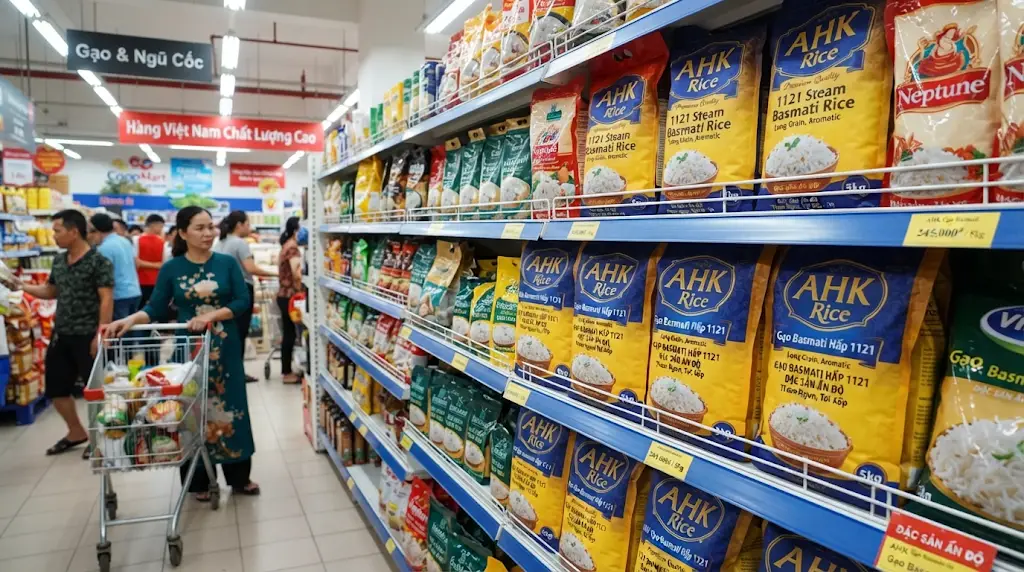
Vietnam ranks as the world’s third-largest rice exporter, producing millions of metric tons of domestic Japonica and Indica varieties such as ST25 and Jasmine rice. However, domestic Vietnamese cultivars contain higher amylopectin levels, yielding a soft, cohesive, and slightly sticky texture suited for chopsticks. In 2026, modern retail chains across Ho Chi Minh City, Hanoi, and Da Nang—including WinMart, AEON Vietnam, Co.opmart, and Lotte Mart—are expanding dedicated international grain aisles. Urban Vietnamese households, expatriate communities, and health-conscious shoppers seeking distinct, non-sticky long grains for pilafs, biryanis, and low-glycemic meal prep drive this shelf expansion.
How Does 1121 Steam Basmati Rice Processing Work Step by Step?
1121 Steam Basmati processing transforms harvested paddy into export-ready kernels through seven automated stages: pre-cleaning, controlled steam conditioning, precision drying, rubber-roll husking, abrasive whitening, silky water-jet polishing, and optical Sortex colour grading within 48 to 72 hours.
Modern export mills in Punjab, such as AHK Rice, execute end-to-end processing under strict moisture and temperature tolerances to eliminate kernel fissuring and maximise whole-grain recovery. Every batch follows a linear sequence from farm-gate procurement to container stuffing.
Stage 1: Paddy Reception and Pre-Cleaning
Freshly harvested 1121 paddy arrives at the mill with field moisture between 18% and 22%. Vibratory aspirators, magnetic separators, and rotary drum sieves strip away straw, dust, stones, and ferrous metal fragments before storage. Laboratory technicians test incoming paddy lots for varietal purity, ensuring contrast varieties remain below 5% to 7%.
Stage 2: Steam Conditioning and Fluidized-Bed Drying
Cleaned paddy enters stainless-steel steaming vessels where pressurised steam at 105°C to 115°C passes through the grain bed for 15 to 25 minutes. Unlike Sella parboiling, which requires 6 to 8 hours of hot-water soaking, steam conditioning omits soaking entirely. Immediately afterwards, continuous fluidised-bed dryers reduce grain moisture uniformly from 17% down to 11.5%–12.0%, locking the gelatinised outer starch layer in place.
Stage 3: Husking, Whitening, and Silky Polishing
Dried paddy passes through pneumatic rubber-roll huskers that strip the outer hull without scratching the bran layer, producing brown 1121 rice. Vertical abrasive whiteners remove the bran coat in three gentle passes to prevent thermal stress. Next, silky water-jet polishers apply a fine mist of purified water and friction to give each kernel a smooth, glossy finish.
Stage 4: Length Grading and Optical Sortex Cleaning
Rotary indented cylinders separate whole head rice from broken tips, retaining only kernels measuring 8.30 mm or longer. High-speed RGB and near-infrared (NIR) optical Sortex machines scan every individual grain at 10,000 frames per second, ejecting chalky, yellow, discoloured, or damaged kernels using compressed air jets to achieve 99.9% purity.
What Are the Key Components and Available Grades of 1121 Steam Basmati Rice?
Export-grade 1121 Steam Basmati rice is defined by five core physical parameters—8.35 mm average raw length, 12.0% maximum moisture, under 1.0% broken grains, zero foreign matter, and 95% varietal purity—and is supplied across four commercial milling grades.
International supermarket buyers evaluate Basmati shipments using standardised laboratory metrics rather than subjective visual checks. Understanding these exact specifications prevents shipment rejections at Vietnamese ports such as Cat Lai and Hai Phong.
Physical and Chemical Specifications
| Quality Parameter | Premium Retail Grade (2026 Export Standard) | Standard Foodservice Grade |
| Average Grain Length (Raw) | 8.35 mm minimum | 8.20 mm minimum |
| Cooked Grain Length | 20.0 mm – 22.0 mm | 18.5 mm – 20.0 mm |
| Moisture Content | 11.5% – 12.0% max | 12.5% – 13.0% max |
| Broken Grains | 0.5% – 1.0% max (Nil broken) | 2.0% – 5.0% max |
| Chalky Kernels | 0.0% – 1.0% max | 2.0% – 3.0% max |
| Damaged & Discolored | 0.5% max | 1.0% – 1.5% max |
| Admixture (Other Varieties) | 5.0% max | 7.0% max |
| Polishing & Cleaning | Double Silky Polished, 100% Sortex | Single/Double Polished, Sortex |
All Available Commercial Grades of 1121 Basmati
Pakistani exporters process 1121 paddy into four distinct commercial grades to match diverse retail and culinary segments:
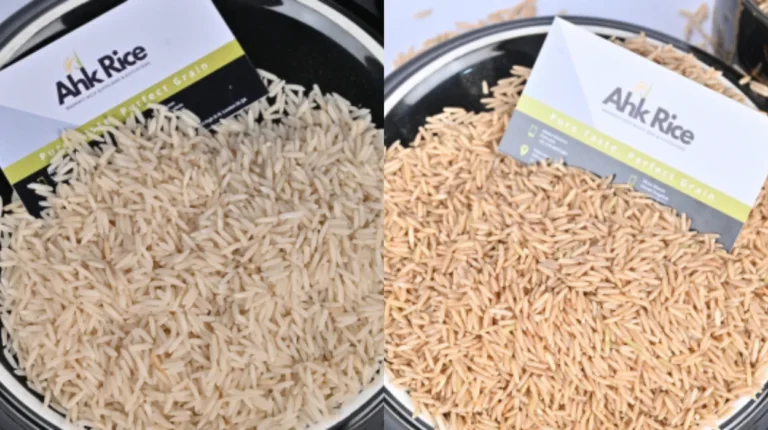
- 1121 Steam Basmati (Creamy White): Lightly steamed in the husk before milling, yielding a bright off-white kernel with high tensile strength, 2.4x elongation, and zero clumping.
- 1121 Raw White Basmati: Milled directly from aged raw paddy without thermal treatment, offering maximum natural 2-AP fragrance and a delicate, ultra-soft mouthfeel.
- 1121 Creamy Sella (Parboiled): Soaked, steamed, and dried before husking to produce a pale ivory kernel that withstands prolonged boiling and buffet holding times.
- 1121 Golden Sella (Parboiled): Subjected to extended hydrothermal parboiling for a rich amber-gold hue and maximum resistance to overcooking in commercial catering.
What Are the Benefits of 1121 Steam Basmati Rice for Retailers and Consumers?
1121 Steam Basmati rice delivers a 24-to-36-month shelf life without insect infestation, 30% higher cooked volume yield per kilogram, a medium-low glycemic index between 50 and 58, and zero grain breakage during household cooking.
For supermarket category managers in Vietnam, stocking 1121 Steam Basmati solves two operational challenges: inventory spoilage in tropical humidity and high gross-margin generation per linear meter of shelf space.
Retail Shelf Stability and Margin Economics
Because steam conditioning seals micro-cracks in the endosperm and reduces moisture below 12.0%, 1121 Steam Basmati resists weevil development and fungal mould in Vietnam’s 75% to 85% ambient relative humidity. Retail pouches in 1 kg, 2 kg, and 5 kg formats maintain peak aroma for up to 36 months when sealed in multi-layer barrier film. Furthermore, imported Basmati retails at 2.5x to 3.5x the per-kilogram price of standard domestic white rice, generating strong category margins.
Nutritional and Culinary Advantages for Shoppers
Steam treatment drives water-soluble B vitamins—including thiamine (B1) and niacin (B3)—from the outer bran layer into the starchy endosperm before milling. Consequently, 1121 Steam Basmati retains 40% more micronutrients than raw milled white rice while remaining completely gluten-free and low in fat. Its high amylose content (24% to 26%) slows enzymatic starch digestion, giving the rice a glycemic index of 50 to 58 compared to 70+ for short-grain white rice.
Which Markets Import 1121 Steam Basmati and What Are Its Primary Use Cases?
Over 65 countries import 1121 Steam Basmati rice—led by the UAE, Saudi Arabia, Iraq, the United Kingdom, the United States, and emerging Southeast Asian hubs like Vietnam—for modern supermarket retail, hospitality dining, and private-label health food lines.
Global demand for Pakistani 1121 Steam Basmati continues to expand in 2026 as importers shift away from raw white Basmati to reduce transit breakage. Major importing regions divide into distinct consumption tiers:
- Middle East & GCC (UAE, Saudi Arabia, Oman, Qatar, Iraq): Accounts for over 55% of global volume, supplying hypermarkets and restaurants preparing kabsa, mandi, and biryani.
- Europe & North America (UK, Germany, Netherlands, USA, Canada): Driven by ethnic grocery chains and mainstream supermarkets stocking 1 kg to 5 kg private-label pouches.
- Southeast Asia (Vietnam, Malaysia, Singapore): Rapidly growing retail demand fueled by rising disposable incomes, international tourism, and fusion culinary trends.
Vietnamese Retail and Culinary Use Cases
Within Vietnamese supermarkets, shoppers purchase 1121 Steam Basmati for four specific applications:
- Diabetic-Friendly and Fitness Meal Prep: Health-conscious consumers in Ho Chi Minh City and Hanoi substitute high-GI sticky rice with portion-controlled Basmati bowls paired with grilled chicken, seafood, and steamed vegetables.
- International and Fusion Home Cooking: Urban home cooks use extra-long separate grains for Indian curries, Middle Eastern spiced pilafs, Mediterranean grain salads, and fried rice dishes (cơm chiên) that require firm, non-clumping kernels.
- Expatriate and Diplomatic Household Staples: Growing populations of South Asian, European, and North American residents rely on modern supermarkets for authentic imported Basmati.
- HoReCa and Boutique Hotel Supply: Five-star resorts in Phu Quoc, Da Nang, and Nha Trang source 10 kg and 25 kg packs to serve international breakfast and dinner buffets where grains must stay fluffy for 3 to 4 hours under heat lamps.
When comparing shelf options, retail category managers frequently evaluate 1121 Steam Basmati vs Thai Hom Mali Rice for Premium Vietnamese Retail Shoppers to position both aromatic grains across distinct price tiers and culinary occasions.
What Certifications Apply and What Are Common Misconceptions About 1121 Steam Basmati?
Exporting 1121 Steam Basmati rice into Vietnam requires mandatory Phytosanitary Certificates, Certificates of Origin, ISO 22000, HACCP, and SGS pre-shipment quality inspection reports, while debunking three widespread myths regarding parboiling, ageing, and cooking behaviour.
Vietnamese customs and the Ministry of Agriculture and Rural Development enforce strict plant quarantine and food safety protocols on all imported cereal grains. Reputable Pakistani exporters maintain comprehensive compliance documentation to guarantee smooth port clearance.
Mandatory Export and Food Safety Certifications
- Phytosanitary Certificate: Issued by Pakistan’s Department of Plant Protection (DPP), verifying that the shipment is free from quarantine pests, live insects, and soil contaminants.
- ISO 22000 & HACCP Certification: Validates end-to-end food safety management across paddy storage, milling, Sortex cleaning, and automated packaging lines.
- Halal & GMP Certification: Confirms compliance with Good Manufacturing Practices and Halal standards required by international retail chains.
- SGS / Bureau Veritas Pre-Shipment Inspection: Independent third-party laboratory testing verifying grain length, moisture percentage, broken ratio, and aflatoxin limits (below 4 ppb) before vessel loading.
- Certificate of Origin (Form-A / Chambers of Commerce): Authenticates Pakistani Punjab provenance for customs tariff assessment.
Common Misconceptions About 1121 Steam Basmati
- Misconception 1: Steam Basmati is the same as Sella (parboiled) rice. Sella rice undergoes 6 to 8 hours of water soaking followed by heavy steaming, turning the grain yellow and giving it a chewy bite. Steam Basmati receives dry steam for under 25 minutes without soaking, retaining its natural white colour and delicate Basmati aroma.
- Misconception 2: Steam Basmati requires 12 to 24 months of warehouse ageing before cooking. While raw white Basmati must age in silos for at least 12 months to prevent mushiness, controlled steam conditioning stabilises the starch granules immediately. Buyers achieve identical 2.4x elongation and non-sticky separation from fresh-crop Steam Basmati without paying a $60 to $100 per metric ton storage premium.
- Misconception 3: Extra-long grains break easily during washing and boiling. Gelatinisation of the outer starch layer creates a protective barrier around the kernel. After a 20-minute cold-water soak and 10 to 12 minutes of boiling in a 1:1.75 rice-to-water ratio, 1121 Steam Basmati doubles in length with zero snapping or clumping.