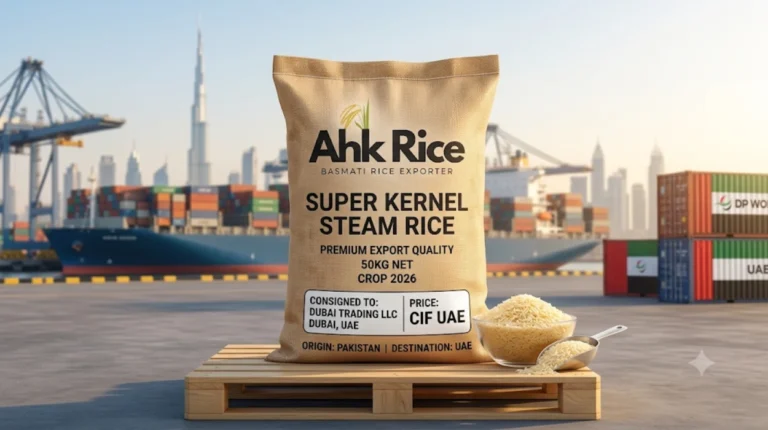
Why Are Moisture Levels Important for Imported Basmati Rice Quality?
Moisture levels determine imported Basmati rice quality. Here is why: a moisture range of 12%–14% preserves grain structure, aroma, cooking performance, and shelf life, while excess moisture causes spoilage, discoloration, insect activity, and broken grains during storage and transportation.
Imported Basmati rice travels thousands of kilometers before reaching wholesalers, retailers, restaurants, and consumers. Moisture content influences every stage of that journey. Basmati rice with controlled moisture retains its natural fragrance, elongates properly during cooking, and remains stable throughout shipping and storage. Moisture management starts in the field and continues through harvesting, drying, milling, grading, packaging, and export inspection.
Pakistan and India cultivate most of the world’s Basmati rice production. Pakistan exports significant quantities of 1121 Basmati, Super Kernel Basmati, and 1509 Basmati to markets including Saudi Arabia, UAE, Iraq, the United Kingdom, Canada, Australia, and European countries (source: REAP export data, December 2025). Understanding moisture levels helps buyers evaluate quality before importing rice.
What Are Moisture Levels in Basmati Rice?
Moisture content represents the percentage of water inside each rice grain. Imported Basmati rice performs best between 12% and 14% moisture content.
Moisture content measures the amount of water retained within a rice kernel after harvesting and processing. Laboratories determine this value through standardized moisture testing equipment. Exporters inspect moisture before packaging because water content directly affects quality stability.
Basmati rice naturally absorbs and releases moisture from surrounding air. Humid environments increase grain moisture. Dry environments reduce grain moisture. This constant exchange influences texture, weight, aroma retention, and storage behavior.
International buyers often specify maximum moisture requirements in purchase contracts. Common requirements include 13% moisture, 13.5% moisture, or 14% moisture, depending on destination market regulations and storage conditions.
With moisture content defined, the next question is how moisture influences rice quality throughout processing and distribution.
How Do Moisture Levels Affect Basmati Rice Quality?
Moisture levels influence grain strength, aroma preservation, cooking performance, appearance, and storage stability.
Basmati rice requires balanced moisture to maintain physical integrity. Low moisture causes grain brittleness. Brittle grains break during milling, handling, and transportation. Higher broken percentages reduce commercial value and consumer acceptance.
Basmati rice aroma depends on volatile compounds within the grain. Excess moisture accelerates chemical degradation. Reduced aromatic intensity lowers product quality, especially in premium varieties such as 1121 Basmati and Super Kernel Basmati.
Cooking performance also depends on moisture balance. Properly dried rice absorbs water uniformly during cooking. Uniform absorption produces longer grains, separate texture, and consistent appearance on the plate.
Rice appearance changes when moisture exceeds safe limits. Excess moisture encourages yellowing, discoloration, and fungal growth. Buyers reject shipments showing visible quality deterioration.
Storage performance depends heavily on moisture management. Rice maintained at controlled moisture remains stable for extended periods. Rice stored with excessive moisture deteriorates rapidly.
Understanding these quality effects leads directly to the processing methods used to control moisture.
How Is Moisture Controlled During Basmati Rice Processing?
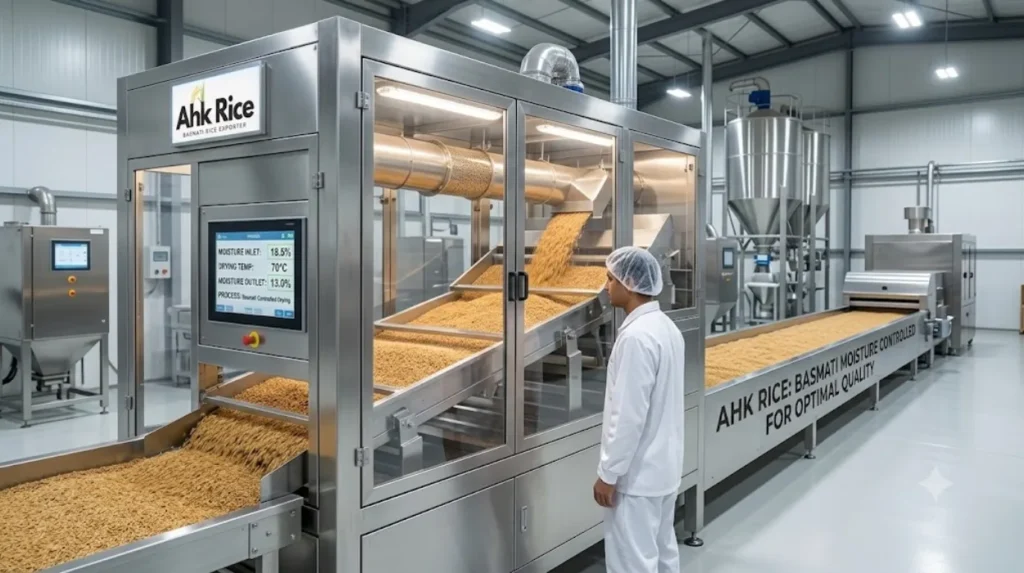
Moisture control requires harvesting, drying, milling, grading, testing, packaging, and storage procedures performed in sequence.
What Processing Steps Manage Moisture?
Rice processors follow several stages to achieve export-grade moisture levels:
- Clean the harvested paddy.
- Dry the paddy to target moisture.
- Store the paddy under controlled conditions.
- Dehusk the grain.
- Mill the rice kernels.
- Polish the rice surface.
- Sort by length and quality.
- Test moisture content.
- Package under controlled conditions.
Drying represents the most important moisture-control stage. Processors reduce moisture gradually to prevent grain stress and cracking. Controlled drying preserves grain strength and appearance.
Moisture testing occurs before export packaging. Laboratories verify moisture specifications through calibrated equipment. Export documentation often includes quality reports confirming compliance.
Packaging protects moisture levels after processing. Multi-layer bags, PP bags, BOPP bags, and vacuum packaging reduce moisture exchange during transportation.
With processing controls established, it becomes important to examine the major Basmati grades traded internationally.
Which Basmati Rice Grades Depend on Proper Moisture Control?
All commercial Basmati grades require moisture control, including 1121 Basmati, Super Kernel Basmati, and 1509 Basmati.
1121 Basmati Rice
1121 Basmati features extra-long grains measuring approximately 8.3 mm before cooking. Moisture control preserves grain length and reduces breakage during milling. Importers in Saudi Arabia, UAE, and Europe prefer this grade for premium retail products.
Super Kernel Basmati Rice
Super Kernel Basmati offers traditional aroma and long grain structure. Moisture management protects fragrance retention throughout storage. Importers in the Middle East and North America frequently source this variety.
1509 Basmati Rice
1509 Basmati matures earlier than traditional varieties. Moisture regulation helps maintain grain appearance and cooking consistency. Exporters supply this variety to price-sensitive and volume-oriented markets.
Major Processing Grades
Export markets commonly trade these processing categories:
- Steam Basmati Rice
- Golden Sella Basmati Rice
- White Basmati Rice
- Creamy Sella Basmati Rice
- Brown Basmati Rice
- Parboiled Basmati Rice
- Aged Basmati Rice
Each grade requires verified moisture specifications before shipment to preserve quality during transport.
With grade requirements established, the next question concerns importing markets and their quality expectations.
Which Countries Import Basmati Rice Based on Moisture Specifications?
Middle Eastern, European, North American, African, and Asian importers specify moisture limits to maintain product quality.
Saudi Arabia remains one of the largest Basmati import destinations. Importers prioritize aroma retention and storage stability. Moisture specifications commonly remain below 14% to support warehouse storage.
UAE importers handle significant re-export volumes. Moisture control becomes critical because products often remain in logistics facilities before redistribution.
United Kingdom buyers focus on retail consistency. Moisture standards support shelf stability and uniform cooking performance across packaged products.
Canadian and Australian importers emphasize food safety compliance. Moisture testing forms part of broader quality verification procedures.
African markets increasingly import Pakistani Basmati rice. Controlled moisture improves shipment durability during extended transit periods.
Global demand for Basmati continues to expand. Pakistan exported substantial rice volumes during FY2024-25 due to strong international demand (source: Pakistan Bureau of Statistics, FY2024-25).
Understanding market expectations naturally leads to certification requirements.
What Certifications Verify Moisture and Quality Standards?
Laboratory testing, export inspections, and food safety certifications verify moisture compliance and product quality.
Common Export Certifications
- Phytosanitary Certificate
- Certificate of Origin
- Fumigation Certificate
- Quality Inspection Report
- SGS Inspection Certificate
- ISO Certification
- HACCP Certification
- Food Safety Compliance Documents
Quality inspectors test moisture content before shipment approval. Laboratory reports provide objective measurements that buyers can verify independently.
Food safety systems support consistent processing practices. Standardized procedures improve moisture control, hygiene management, traceability, and export compliance.
Documentation creates transparency between exporters and importers. Buyers review moisture reports before approving shipments for loading and dispatch.
With certifications covered, several common misconceptions require clarification.
What Common Misconceptions Exist About Rice Moisture Levels?
Higher moisture does not indicate better quality, and lower moisture does not always improve storage performance.
Some buyers assume heavier rice indicates superior quality. Higher moisture increases weight but reduces storage stability. Excess water creates quality risks rather than benefits.
Some buyers believe extremely dry rice stores longer. Excessively dry rice becomes fragile. Fragile grains break during transportation and milling operations.
Another misconception involves visual inspection. Moisture content cannot be determined accurately by appearance alone. Laboratory testing provides reliable measurements.
Some importers focus only on grain length. Grain length remains important, but moisture content influences storage performance, aroma retention, and cooking consistency equally.
Understanding these misconceptions helps buyers evaluate rice using measurable quality indicators rather than assumptions.
What Benefits Does Proper Moisture Control Provide?
Proper moisture control improves shelf life, protects aroma, reduces breakage, supports food safety, and maintains cooking quality.
Controlled moisture preserves grain structure throughout transportation. Stronger grains generate fewer broken kernels and maintain higher commercial value.
Controlled moisture protects aromatic compounds. Premium Basmati varieties retain their characteristic fragrance for longer periods.
Controlled moisture improves cooking consistency. Rice cooks evenly and produces predictable elongation characteristics.
Controlled moisture reduces biological activity. Lower microbial growth supports food safety and longer storage periods.
Controlled moisture supports international trade. Verified specifications create confidence between exporters, distributors, retailers, and consumers.
For a deeper understanding of storage performance, readers can explore how moisture management influences long-term warehouse stability in the article “How Do Moisture Levels Affect Rice Shelf Life During Storage?”
Frequently Asked Questions
What is the ideal moisture level for imported Basmati rice?
The ideal moisture level is typically 12% to 14%. This range preserves aroma, grain strength, cooking quality, and storage stability.
Why does high moisture damage Basmati rice?
High moisture encourages mold growth, insect activity, discoloration, aroma loss, and reduced shelf life during storage and transportation.
How is rice moisture measured?
Laboratories use calibrated moisture meters and standardized testing procedures to determine the percentage of water inside rice grains.
Does moisture affect rice cooking performance?
Yes. Proper moisture allows uniform water absorption, better grain elongation, and a non-sticky texture after cooking.
Which Basmati varieties require moisture control?
All major varieties require moisture control, including 1121 Basmati, Super Kernel Basmati, and 1509 Basmati rice.