1121 Creamy Sella Basmati Rice FOB Pakistan vs CIF UAE Price Breakdown for Wholesale Buyers
When importing 1121 Creamy Sella Basmati Rice into the UAE, CIF pricing provides a clearer landed-cost picture while FOB pricing offers greater supplier control and freight flexibility. The best choice depends on shipment volume, procurement strategy, and logistics capabilities.
Wholesale rice buyers frequently compare FOB and CIF quotations before placing contracts. Understanding how each pricing model works helps importers calculate actual costs, compare supplier offers accurately, and choose the most profitable purchasing method. For businesses sourcing Pakistani rice, knowing the difference between export pricing structures prevents unexpected expenses and improves procurement decisions.
Buyers who are still evaluating rice varieties and quality specifications should first understand the fundamentals of Pakistani Basmati exports through this educational guide on Pakistani Basmati rice grades, processing methods, and export standards. Once the product specifications are understood, comparing FOB and CIF pricing becomes significantly easier.
The first time buyers request 1121 Creamy Sella Basmati Rice Export Services from AHK Rice, they often discover that two quotations can differ substantially even when the product quality remains identical. The reason lies in freight costs, insurance, destination charges, packaging requirements, and shipping arrangements included within the final quotation.
What Is The Difference Between FOB Pakistan And CIF UAE Pricing?
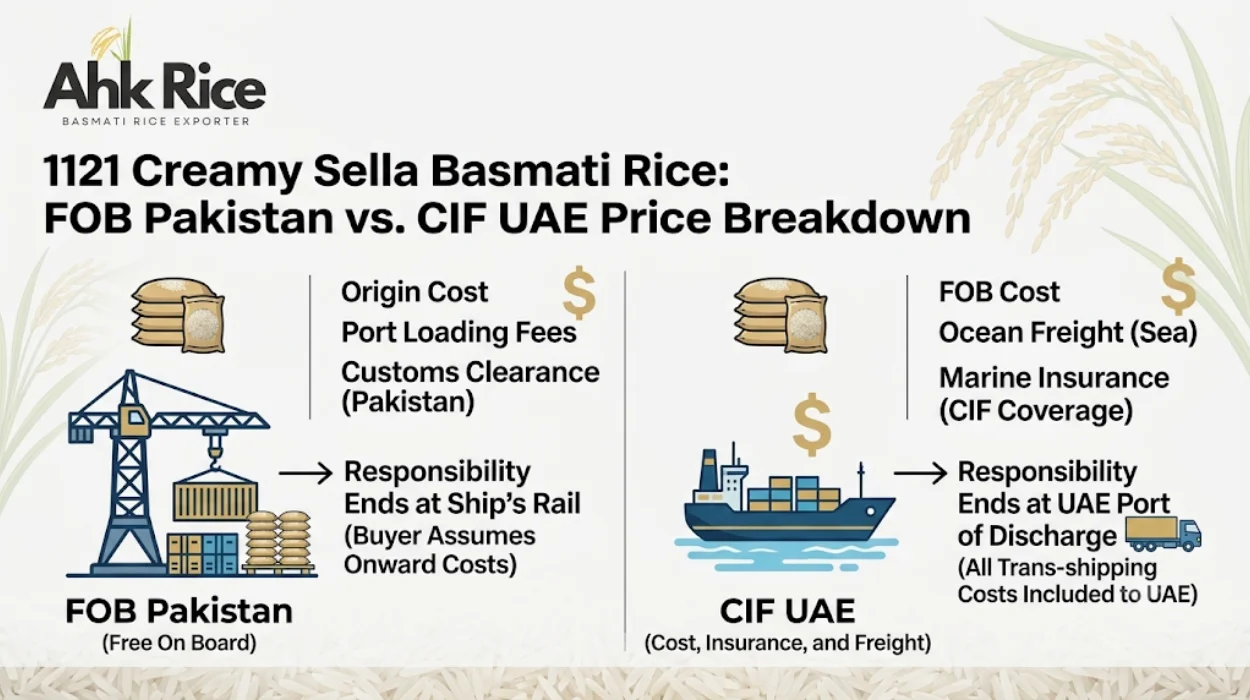
FOB pricing includes the rice cost and export handling up to the Pakistani port, while CIF pricing includes product value, ocean freight, and marine insurance until the destination port in the UAE. The difference directly impacts procurement planning, logistics management, and total import cost calculations.
FOB stands for Free On Board. Under this arrangement, the seller is responsible for processing, packing, customs clearance, documentation, and loading the cargo onto the vessel at the designated Pakistani port.
After loading, responsibility transfers to the buyer. The importer arranges ocean freight, insurance coverage, and destination logistics.
CIF stands for Cost, Insurance, and Freight. In this model, the exporter handles freight booking and insurance coverage while providing a delivered cost up to the destination port.
For UAE importers, CIF quotations simplify budgeting because most major transportation costs are already included within the offered price.
FOB vs CIF Specification Comparison
| Attribute | FOB Pakistan | CIF UAE |
|---|---|---|
| Product Cost | Included | Included |
| Export Documentation | Included | Included |
| Customs Clearance at Origin | Included | Included |
| Ocean Freight | Buyer Pays | Seller Pays |
| Marine Insurance | Buyer Pays | Included |
| Freight Negotiation | Buyer Controls | Seller Controls |
| Cost Visibility | Partial | More Complete |
What Cost Components Influence 1121 Creamy Sella Rice Prices?
Rice pricing depends on raw paddy rates, milling costs, grading standards, packaging specifications, freight rates, insurance expenses, exchange rates, and destination requirements. Every component contributes to the final price per metric ton and affects wholesale profitability.
1121 Creamy Sella Basmati Rice undergoes several processing stages before export.
The process begins with paddy procurement from Punjab’s rice-growing regions. The rice is cleaned, steamed, parboiled, dried, milled, sorted, color-separated, graded, and packed according to buyer specifications.
Each stage adds measurable value and cost.
Typical pricing components include:
- Raw paddy procurement
- Milling and processing
- Color sorting
- Quality grading
- Packaging materials
- Export documentation
- Inland transportation
- Port handling charges
- Freight costs
- Insurance premiums
Changes in any of these variables influence export quotations.
For example, a rise in global container freight rates can increase CIF quotations significantly while leaving FOB quotations relatively unchanged.
How Do UAE Importers Calculate Landed Cost From FOB Pricing?
Importers convert FOB prices into landed costs by adding freight charges, marine insurance, customs duties, destination handling fees, warehousing expenses, and inland transportation costs. This approach provides an accurate profitability assessment before placing wholesale purchase orders.
Consider a practical example.
Assume a buyer receives a FOB Karachi quotation of USD 1,250 per metric ton for 1121 Creamy Sella Basmati Rice.
The importer then adds:
| Cost Component | Example Cost (USD/MT) |
|---|---|
| FOB Rice Price | 1,250 |
| Ocean Freight | 65 |
| Marine Insurance | 5 |
| Destination Charges | 15 |
| Inland Delivery | 20 |
| Total Estimated Cost | 1,355 |
The actual figures vary according to shipping line availability, fuel surcharges, destination port conditions, and shipment size.
However, this framework helps buyers compare supplier offers consistently.
Which Grades Of 1121 Creamy Sella Rice Are Preferred In Different Markets?
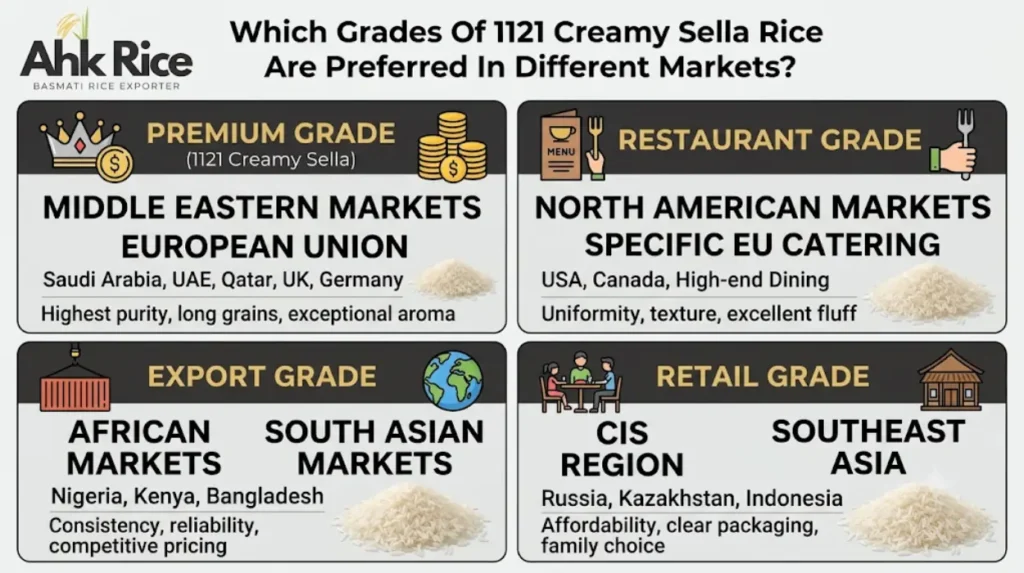
Different importing regions prioritize different quality grades based on consumer preferences, retail positioning, and price sensitivity. Understanding market-specific demand helps wholesalers select the most suitable grade and maximize inventory turnover.
UAE Market Preferences
The UAE market typically favors premium-grade 1121 Creamy Sella rice with:
- High grain length
- Low broken percentage
- Strong cooking performance
- Consistent color
- Premium packaging
Restaurants, hotels, catering businesses, and retail brands generally purchase superior export grades because consumers expect long-grain presentation and premium texture.
African Market Preferences
Many African importers prioritize value-focused grades.
These buyers often seek:
- Competitive pricing
- Acceptable grain length
- Moderate broken percentages
- Bulk packaging options
- High volume availability
While premium grades remain popular in select segments, price competitiveness frequently plays a larger role than luxury positioning.
How Do UAE And African Markets Compare On Price Per Metric Ton?
UAE buyers generally purchase premium specifications with higher average prices, while African markets often prioritize cost efficiency. The resulting difference creates distinct pricing ranges, packaging choices, and procurement strategies for exporters and wholesalers.
Market Comparison
| Factor | UAE Market | African Market |
|---|---|---|
| Preferred Grade | Premium | Mid-Premium |
| Grain Length Demand | Very High | High |
| Packaging Preference | Retail & Branded | Bulk & Wholesale |
| Typical Price Level | Higher | Moderate |
| Quality Tolerance | Strict | Moderate |
| Premium Demand | Strong | Market Specific |
The UAE market often rewards higher-grade rice through stronger retail positioning and premium consumer demand.
African importers may focus on balancing quality and affordability for broader distribution.
What Are The Advantages And Disadvantages Of FOB Pricing?
FOB purchasing provides greater control over logistics and freight negotiations, but it requires expertise in international shipping management. Buyers benefit from flexibility while accepting additional operational responsibilities and cost-management requirements.
Advantages
Greater freight control allows buyers to negotiate directly with shipping lines.
Importers can consolidate shipments from multiple suppliers.
Freight contracts may generate cost savings for large-volume buyers.
The buyer gains visibility into every transportation expense.
Disadvantages
Freight coordination requires expertise.
Unexpected shipping costs may arise.
Insurance arrangements become the buyer’s responsibility.
Operational complexity increases.
Example
A UAE distributor importing multiple containers monthly may secure favorable freight contracts independently and benefit from FOB purchasing.
What Are The Advantages And Disadvantages Of CIF Pricing?
CIF pricing simplifies procurement by combining product, freight, and insurance into one quotation. The model reduces operational complexity but limits buyer control over transportation arrangements and carrier selection decisions.
Advantages
Single quotation structure.
Simplified budgeting process.
Reduced logistics workload.
Lower administrative burden.
Improved predictability.
Disadvantages
Less freight negotiation control.
Limited carrier selection.
Reduced visibility into freight breakdowns.
Potentially higher bundled costs.
Example
A first-time importer entering the UAE market may prefer CIF pricing because logistics management remains largely handled by the exporter.
Which Pricing Method Works Best For Different Types Of Buyers?
The best pricing method depends on shipment volume, logistics capability, purchasing frequency, and procurement objectives. Different buyer profiles benefit from different approaches based on operational requirements and cost-control priorities.
Decision Framework
| Buyer Situation | Recommended Method | Reason |
|---|---|---|
| First Import Order | CIF | Easier management |
| Small Volume Buyer | CIF | Lower complexity |
| Large Distributor | FOB | Freight leverage |
| Multi-Origin Importer | FOB | Shipment consolidation |
| Retail Brand Expansion | CIF Initially | Faster execution |
This framework helps buyers align purchasing strategy with operational capabilities.
What Decision Factors Should Wholesale Buyers Evaluate Before Choosing?
Successful rice procurement depends on evaluating quality specifications, shipment volume, logistics expertise, market requirements, supplier reliability, and long-term purchasing goals. These factors determine whether FOB or CIF pricing delivers better commercial results.
Buyers should examine grain length specifications carefully.
Broken percentage directly affects market positioning.
Packaging requirements influence export costs.
Container utilization impacts freight efficiency.
Supplier quality controls affect consistency.
Shipping schedules influence inventory planning.
Documentation capabilities affect customs clearance performance.
These variables collectively determine purchasing success.
Rather than focusing exclusively on price, wholesalers should compare total value delivered per metric ton.
A slightly higher quotation often produces better profitability when quality consistency and supply reliability remain strong throughout the contract period.
For most UAE wholesale buyers, CIF pricing provides the clearest view of total import costs and simplifies procurement. FOB pricing becomes increasingly attractive as shipment volumes grow and buyers gain logistics expertise.
The optimal decision depends on operational capabilities, sourcing strategy, and market objectives. Wholesale importers should compare identical specifications, evaluate all cost components, and calculate landed costs before selecting a supplier. A structured comparison of FOB and CIF quotations leads to more accurate budgeting, stronger margins, and improved supply chain efficiency.
Frequently Asked Questions
Is FOB cheaper than CIF for 1121 Creamy Sella Basmati Rice?
Not always. FOB prices appear lower because freight and insurance are excluded. After adding shipping and destination costs, the final landed cost may be similar to a CIF quotation.
What is included in a CIF UAE rice quotation?
A CIF quotation generally includes rice value, export documentation, customs clearance at origin, ocean freight, and marine insurance up to the UAE destination port.
Which option is better for first-time rice importers?
CIF pricing is usually better for first-time importers because it reduces logistics complexity and provides clearer budgeting.
How is rice price per metric ton determined?
The price depends on paddy costs, processing expenses, grade quality, packaging specifications, freight rates, insurance charges, and market demand.
Why do freight rates affect CIF prices more than FOB prices?
Freight is included in CIF quotations but excluded from FOB quotations. Any increase in shipping costs directly impacts CIF pricing.
Does grain quality influence wholesale export pricing?
Yes. Longer grain length, lower broken percentages, better color consistency, and stronger cooking performance generally command higher prices per metric ton.