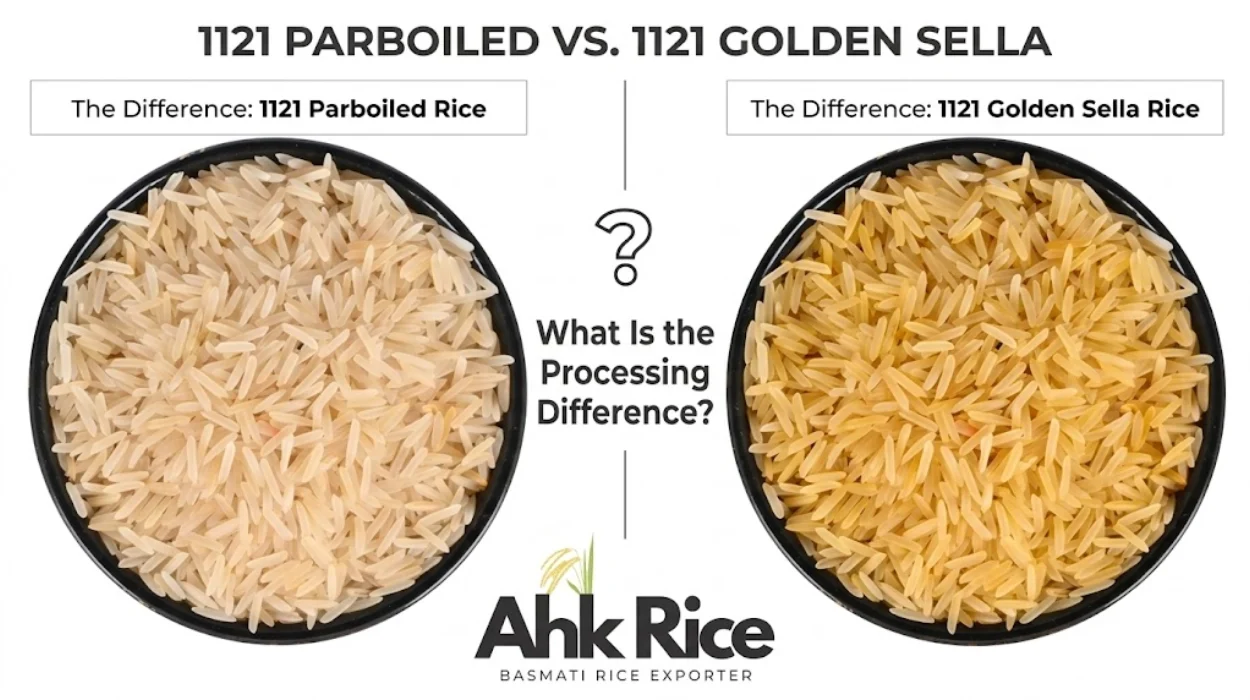
1121 Parboiled vs 1121 Golden Sella: What Is the Processing Difference?
1121 Golden Sella and 1121 Parboiled use the same parboiling method, but Golden Sella applies controlled heat to achieve a yellow-golden color and firmer grain structure. Here is why: heat intensity, drying control, and starch gelatinization levels differ, creating distinct cooking performance and shelf life outcomes.
1121 Basmati processing determines grain strength, elongation, and export suitability. Buyers do not choose between varieties. Buyers choose between processing outcomes. 1121 Parboiled and 1121 Golden Sella represent two optimized solutions within the same processing method.
1121 Basmati rice dominates premium long-grain exports from Pakistan. Exporters like AHK Rice mill, parboil, dry, and grade rice to meet market-specific specifications. Understanding processing differences improves procurement decisions. For foundational knowledge on Basmati characteristics, refer to this contextual guide on 1121 parboiled basmati rice catering buyers benefits.
What is the processing difference between 1121 Parboiled and 1121 Golden Sella?
1121 Parboiled uses standard soaking and steaming, while 1121 Golden Sella applies higher temperature drying and extended steaming to create a golden hue and stronger grain. Both processes gelatinize starch, but Golden Sella achieves deeper structural transformation.
Step-by-step processing comparison
Processing defines the product. Each step changes grain chemistry and physical strength.
Standardized processing stages (both types)
| Step | Process Action | Purpose |
|---|---|---|
| Cleaning | Remove impurities | Ensure purity |
| Soaking | Absorb water | Prepare starch |
| Steaming | Apply heat pressure | Gelatinize starch |
| Drying | Reduce moisture | Stabilize grain |
| Dehusking | Remove husk | Produce brown rice |
| Polishing | Remove bran (optional) | Improve appearance |
| Grading | Sort by size | Export classification |
Key variation in execution
- Apply moderate steaming for Parboiled
- Apply high-pressure steaming for Golden Sella
- Use standard drying cycles for Parboiled
- Use controlled high-temperature drying for Golden Sella
- Achieve light yellow color in Parboiled
- Achieve deep golden color in Golden Sella
1121 Golden Sella creates stronger grain integrity because higher heat locks nutrients deeper into the kernel. This structural change reduces breakage during milling and cooking.
With the processing difference defined, the next step is evaluating available solution types in global rice procurement.
What are the available solutions in 1121 Basmati processing?
1121 Basmati offers three main processing solutions: Steam, Parboiled, and Golden Sella, each designed for different cooking behavior, storage conditions, and market preferences. Golden Sella targets durability, while Parboiled balances nutrition and softness.
Processing solution categories
Processing types comparison
| Type | Processing Method | Color | Grain Strength | Cooking Texture |
|---|---|---|---|---|
| Steam | Direct steaming without soaking | White | Medium | Soft |
| Parboiled | Soak + steam | Light yellow | Strong | Firm |
| Golden Sella | Intensive parboiling | Golden | Very strong | Extra firm |
Functional role of each solution
- Steam rice serves quick cooking retail markets
- Parboiled rice serves balanced retail and foodservice demand
- Golden Sella serves bulk catering and high-temperature storage markets
1121 Golden Sella dominates exports to Gulf and African regions because it resists breakage during long storage and transport (source: REAP export data, December 2025).
With solution types clarified, the next step is direct comparison across measurable specifications.
How do 1121 Parboiled and Golden Sella compare in specifications?
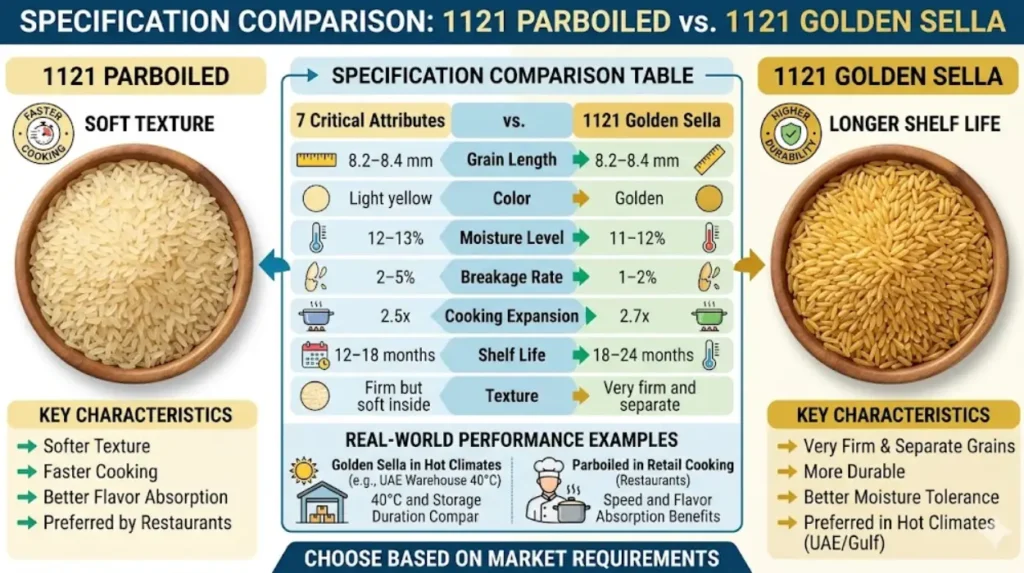
1121 Golden Sella delivers higher durability and longer shelf life, while 1121 Parboiled offers softer texture and faster cooking. Both share similar grain length but differ in moisture tolerance and storage performance.
Specification comparison table
7 critical attributes
| Attribute | 1121 Parboiled | 1121 Golden Sella |
|---|---|---|
| Grain Length | 8.2–8.4 mm | 8.2–8.4 mm |
| Color | Light yellow | Golden |
| Moisture Level | 12–13% | 11–12% |
| Breakage Rate | 2–5% | 1–2% |
| Cooking Expansion | 2.5x | 2.7x |
| Shelf Life | 12–18 months | 18–24 months |
| Texture | Firm but soft inside | Very firm and separate |
Real-world performance example
Golden Sella performs better in hot climates. In a 40°C warehouse in UAE, Golden Sella maintains quality for 18–24 months, while Parboiled requires consumption within 12–18 months. Gulf importers prefer Golden Sella for this reason.
Parboiled performs better in retail cooking environments. Restaurants prefer Parboiled because it cooks faster and absorbs flavors more effectively.
With specifications compared, the next step is identifying which method fits specific market requirements.
Which method works best for different market regions?
Golden Sella works best in Gulf and African markets due to heat resistance, while Parboiled suits European and Asian markets where cooking quality and texture take priority over long storage durability.
Regional demand comparison
Market preference table
| Region | Preferred Type | Reason |
|---|---|---|
| Gulf (UAE, Saudi Arabia) | Golden Sella | Heat resistance |
| Africa (Nigeria, Senegal) | Golden Sella | Long storage |
| Europe (UK, Germany) | Parboiled | Cooking quality |
| Asia (Malaysia, Indonesia) | Parboiled | Flavor absorption |
Price per metric ton comparison
- 1121 Parboiled: $950–$1,050 per MT
- 1121 Golden Sella: $1,050–$1,150 per MT
Golden Sella commands a premium because processing requires more energy and time.
With regional suitability explained, the next step is evaluating advantages and disadvantages in practical use.
What are the pros and cons of each processing method?
Golden Sella offers maximum durability and shelf life, while Parboiled offers better cooking flexibility and softer texture. The choice depends on storage conditions, cooking method, and target consumer segment.
Pros and cons breakdown
Golden Sella
Pros
- Higher grain strength
- Longer shelf life
- Lower breakage during transport
Cons
- Longer cooking time
- Firmer texture limits softness
- Higher cost per MT
Parboiled
Pros
- Faster cooking
- Better flavor absorption
- Lower cost
Cons
- Shorter shelf life
- Slightly higher breakage risk
- Less suitable for extreme climates
Example-based evaluation
Golden Sella suits institutional buyers. Large catering operations benefit from durability and consistency.
Parboiled suits retail brands. Consumers prefer softer texture and faster cooking time.
With pros and cons clarified, the next step is building a structured decision framework.
What factors should buyers use to decide between Parboiled and Golden Sella?
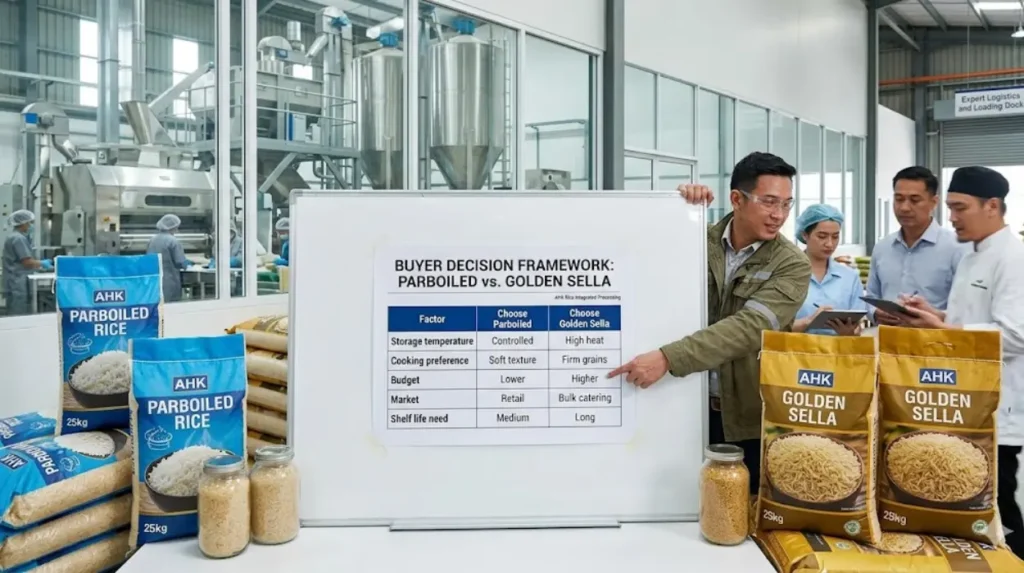
Buyers should evaluate storage conditions, cooking requirements, target market, price sensitivity, and shelf life expectations. Golden Sella fits durability-focused supply chains, while Parboiled fits quality-focused retail distribution.
Decision framework
5-factor decision table
| Factor | Choose Parboiled | Choose Golden Sella |
|---|---|---|
| Storage temperature | Controlled | High heat |
| Cooking preference | Soft texture | Firm grains |
| Budget | Lower | Higher |
| Market | Retail | Bulk catering |
| Shelf life need | Medium | Long |
Practical decision logic
Select Golden Sella for export to hot regions with long storage cycles. Select Parboiled for markets where cooking experience defines product value.
AHK Rice processes both variants using controlled milling, parboiling, drying, grading, and export handling. The company supplies customized specifications based on buyer requirements through its integrated processing and export services.
With decision factors established, the final step is guiding buyers toward procurement readiness.
Final Recommendation
1121 Golden Sella and 1121 Parboiled are not competing products. They are optimized solutions for different supply chains. Golden Sella delivers durability and export resilience. Parboiled delivers cooking quality and consumer satisfaction.
Buyers should align processing choice with logistics conditions, not just price.
For buyers evaluating shipment readiness, sampling, and container-level procurement, the next step is reviewing supplier execution capability and specifications in detail.
Frequently Asked Question
What is the main difference between 1121 Parboiled and Golden Sella?
1121 Golden Sella uses higher heat during parboiling, creating stronger grains and a golden color, while Parboiled uses moderate heat for a softer texture.
Which rice type has a longer shelf life?
1121 Golden Sella lasts 18–24 months, while Parboiled typically lasts 12–18 months under standard storage conditions.
Which rice is better for Gulf markets?
Golden Sella performs better in Gulf markets because it withstands high temperatures and long storage periods without quality loss.
Does Golden Sella take longer to cook than Parboiled?
Golden Sella requires more cooking time due to its firmer grain structure, while Parboiled cooks faster and absorbs flavors better.
Is there a price difference between Parboiled and Golden Sella?
Golden Sella costs $100–$150 more per MT because of extended processing and higher energy usage.