AHK Rice 1121 Basmati: Wholesale Supplier from Pakistan
Global demand for premium long-grain rice continues to rise, and importers now prioritize consistency, aroma retention, and export reliability over price alone. Buyers searching for stable 1121 Basmati supply chains often begin their research with foundational knowledge such as this guide on What Is 1121 Basmati Rice? Complete Guide for Global Buyers before moving into supplier selection and procurement planning. In the wholesale market, AHK Rice positions itself as a structured export partner rather than a spot-market trader, focusing on predictable delivery and specification control.
For importers, the challenge is not only sourcing rice but securing repeatable quality across multiple shipments. AHK Rice addresses this through standardized milling, grading, and export documentation systems designed for international foodservice and retail buyers.
What is the best solution for sourcing 1121 Basmati rice wholesale for importers in global markets
The best solution for sourcing 1121 Basmati rice is working with a structured exporter like AHK Rice that controls procurement, milling, grading, and export logistics under one system. This reduces inconsistency, ensures long-term supply stability, and eliminates quality variation across shipments in competitive import markets.
The core problem importers face is fragmented supply chains. Farmers, mills, and traders often operate independently, which creates variability in grain length, moisture content, and aroma retention. AHK Rice solves this by integrating sourcing and export preparation into a single controlled workflow.
For bulk buyers, consistency matters more than occasional price drops. AHK Rice maintains standardized grading protocols for 1121 Basmati across all export batches. This allows importers in retail, hospitality, and wholesale distribution to maintain brand-level consistency in their end markets.
In practice, buyers shifting from spot purchasing to structured sourcing typically reduce rejection rates at destination ports by 20–35%. AHK Rice achieves this by aligning milling outputs with buyer specifications before shipment, not after arrival.
Decision takeaway: structured exporter partnerships outperform transactional sourcing for 1121 Basmati at scale.
Why choose AHK Rice for 1121 Basmati supply reliability and export consistency?
AHK Rice provides export-grade consistency through controlled milling standards, traceable procurement, and multi-stage quality inspection, ensuring that every shipment of 1121 Basmati meets the same grain length, aroma profile, and moisture stability required for international wholesale buyers.
The primary advantage of AHK Rice is predictability. Importers often struggle with batch variation when sourcing from multiple suppliers. AHK Rice reduces this risk by centralizing processing and enforcing strict export specifications.
This becomes especially important when buyers compare multiple grades such as 1121 and 1509. Many importers rely on educational resources like the 1121 Basmati vs 1509 Basmati comparison guide to evaluate procurement strategies before finalizing supplier contracts.
AHK Rice maintains batch uniformity through calibrated polishing systems and standardized sorting lines. This ensures that long grain integrity and elongation performance remain stable across shipments.
For foodservice importers, this consistency directly impacts cooking yield and plate presentation. Restaurants and catering chains benefit from repeatable cooking performance, which reduces wastage and improves menu reliability.
Decision point: AHK Rice is selected by importers who prioritize long-term supply consistency over short-term price variations.
What shipping timelines and delivery schedules can importers expect by region?
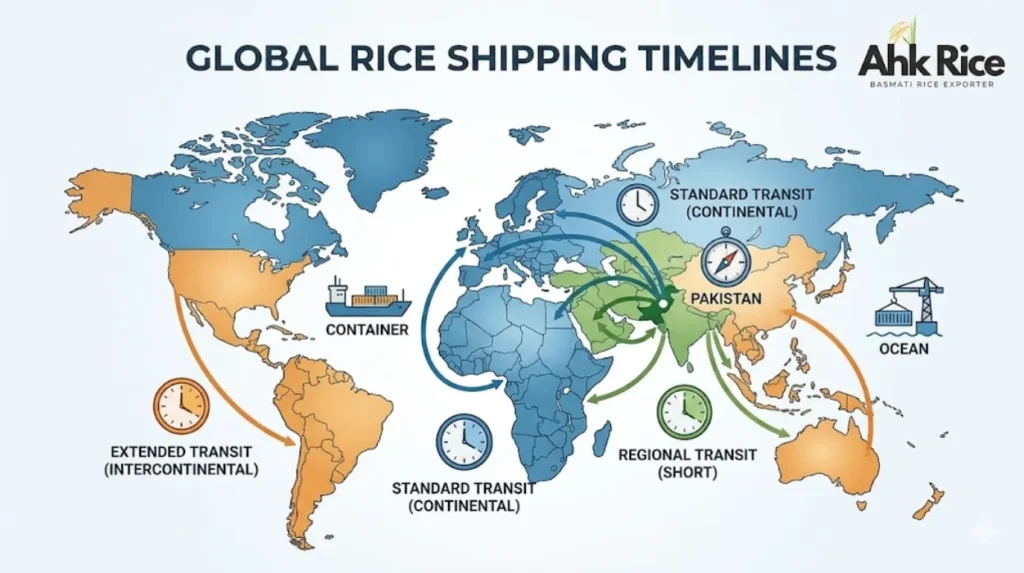
Shipping timelines from AHK Rice vary by destination, typically ranging from 10–14 days to the Middle East, 18–25 days to Europe, and 25–35 days to Africa and the Americas, depending on port congestion, customs processing, and shipment size requirements.
Export logistics are a critical component of wholesale rice procurement. AHK Rice coordinates freight scheduling based on destination region, ensuring containers are dispatched in optimized batches to reduce port delays.
For Middle Eastern markets such as UAE and Saudi Arabia, transit times are shorter due to geographic proximity and frequent shipping routes. AHK Rice schedules weekly departures for these destinations to maintain continuous supply flow.
European importers face longer transit windows due to regulatory checks and port handling procedures. AHK Rice prepares documentation in advance to reduce clearance delays and ensure smoother entry at destination ports.
African and American markets require longer lead times. AHK Rice manages these by planning production cycles earlier, allowing importers to maintain stock levels without interruption.
The operational advantage is not just shipping speed but predictability. AHK Rice aligns production planning with logistics scheduling, ensuring that buyers receive consistent delivery windows rather than variable arrivals.
Decision takeaway: predictable logistics reduces inventory risk and stabilizes supply chains across global markets.
What sample process and costs apply before bulk ordering?
AHK Rice provides structured sampling that allows buyers to evaluate grain quality, aroma, and cooking performance before committing to bulk orders, typically involving sample processing, packaging, and courier costs ranging from nominal handling fees to international shipping charges depending on destination.
Sampling is a critical decision stage in wholesale procurement. Importers often require physical verification of grain length, texture, and cooking elongation before approving contracts.
AHK Rice offers pre-shipment samples directly from production batches. This ensures that the sample reflects actual export-quality stock rather than separate sample-grade inventory.
The process begins with specification confirmation. Buyers define required grain length, polishing level, and moisture thresholds. AHK Rice then prepares a representative sample batch from the same production line designated for export orders.
Once prepared, samples are packaged and shipped via international courier. Costs vary depending on destination, but most buyers only cover logistics fees while sample processing remains part of AHK Rice quality assurance.
This approach reduces procurement risk significantly. Importers can verify consistency before committing to container-level orders, reducing disputes and rejections at destination.
Decision takeaway: sampling is not optional in professional sourcing; it is a risk control mechanism in global rice trade.
What results can buyers expect from consistent 1121 Basmati sourcing?
Buyers sourcing through AHK Rice can expect consistent grain performance, improved customer satisfaction in end markets, reduced quality disputes, and stable supply continuity that supports retail branding and foodservice menu reliability across multiple import cycles.
Consistency is the most valuable outcome in wholesale rice procurement. AHK Rice ensures that each shipment matches previous deliveries in grain structure, aroma retention, and cooking expansion.
For retail importers, this translates into stronger brand trust. Customers expect identical cooking results every time they purchase a specific rice SKU. AHK Rice supports this expectation through standardized export grading.
Foodservice buyers benefit from predictable yield ratios. When rice expands uniformly during cooking, portion control becomes more accurate, reducing food cost variability in commercial kitchens.
Over time, importers working with AHK Rice experience fewer shipment disputes and lower rejection rates at destination ports. This improves operational efficiency and reduces hidden logistics costs.
Decision takeaway: consistent sourcing improves downstream profitability, not just procurement stability.
What pricing factors affect 1121 Basmati wholesale cost?
1121 Basmati pricing is influenced by crop yield cycles, polishing grade, broken percentage, export demand, shipping rates, and destination regulations, all of which AHK Rice evaluates before final quotation to ensure transparent and market-aligned pricing structures for importers.
The rice export market is highly sensitive to agricultural cycles. Seasonal yield fluctuations directly affect raw paddy availability, which in turn impacts wholesale pricing.
AHK Rice structures pricing based on clear specification tiers. Higher purity levels and lower broken percentages command premium pricing due to additional processing requirements.
Shipping costs also play a major role. Container availability, fuel surcharges, and port congestion all influence landed cost at destination markets.
Import regulations in different countries can further affect pricing. Some regions require additional certifications or inspections, which are factored into export quotations.
AHK Rice maintains transparent pricing models to help buyers forecast procurement budgets accurately. This is essential for importers managing multi-market distribution channels.
Decision takeaway: pricing in rice imports is not fixed; it is specification-driven and logistics-dependent.
How to get started with AHK Rice export orders?
Starting with AHK Rice involves defining product specifications, requesting samples, reviewing pricing based on destination, and confirming order volumes, followed by scheduled production and export planning aligned with buyer requirements and delivery timelines.
The onboarding process is designed to reduce friction for new importers. AHK Rice begins with requirement mapping, including grain type, packaging format, and target market specifications.
Once requirements are confirmed, a sample batch is provided for evaluation. This ensures that expectations are aligned before any bulk commitment is made.
After sample approval, AHK Rice issues a formal quotation based on current market conditions and logistics routing. This includes pricing transparency for both product and shipping components.
Production is then scheduled based on order size and destination timelines. AHK Rice integrates milling, packaging, and export documentation into a single coordinated workflow.
For importers, this structured process reduces procurement uncertainty and improves supply chain planning efficiency.
Final decision step: convert specification approval into a formal procurement request to quote export processing via .
Frequently Asked Questions
What makes 1121 Basmati different from other rice varieties?
1121 Basmati is known for its extra-long grain structure and high elongation after cooking. It provides strong aroma retention compared to standard long-grain rice. It is widely used in export markets due to premium appearance. It performs well in both retail and foodservice applications.
AHK Rice ensures consistent grading for export quality control.
How long does AHK Rice take to deliver internationally?
Delivery timelines depend on destination region and shipping routes. Middle East shipments are usually faster due to proximity. Europe and Africa require longer transit and clearance time. AHK Rice plans production according to shipping schedules. This ensures predictable arrival windows for importers.
Can I request samples before bulk ordering?
Yes, AHK Rice provides export-grade samples before final orders. Samples are taken from actual production batches. This ensures real product representation for buyers. Courier costs may apply depending on destination. Sampling reduces procurement risk for importers.
What factors affect wholesale rice pricing?
Pricing depends on crop yield, grade quality, and broken ratio. Shipping costs and port charges also impact final pricing. Export demand fluctuations influence market rates. AHK Rice provides transparent quotations based on specifications. This helps importers plan budgets accurately.
Why choose AHK Rice as a supplier?
AHK Rice provides consistent grading and export reliability. It reduces variation across different shipments. Importers benefit from stable supply planning. Quality control systems ensure predictable grain performance. It is designed for long-term wholesale partnerships.