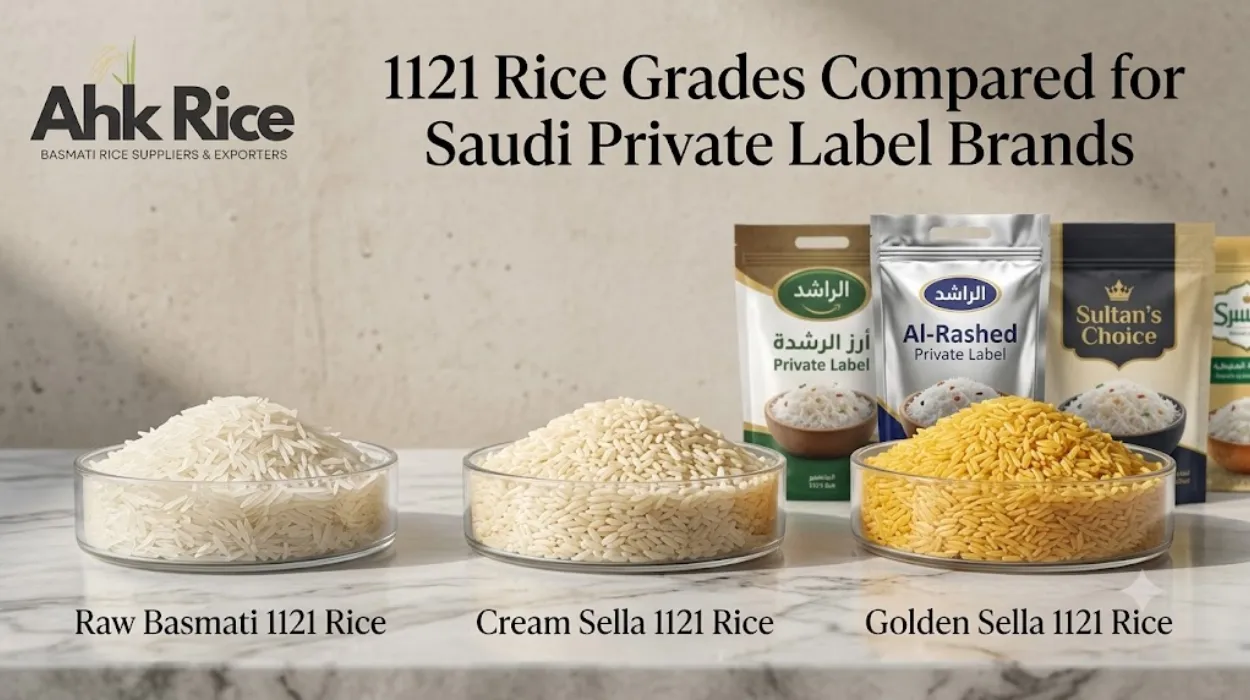
1121 Rice Grades Compared for Saudi Private Label Brands
1121 Basmati grades are not interchangeable for Saudi private label brands. 1121 Extra Long Grain White Rice and 1121 Golden Sella Rice remain the preferred specifications for retail and foodservice channels because they deliver the grain length, cooking performance, shelf life, and consumer acceptance Saudi buyers expect. Here is why: Saudi importers serve different customer segments, and each segment requires a specific grade, processing method, and packaging format.
Saudi Arabia remains one of the largest import destinations for Pakistani Basmati rice. Importers, distributors, and supermarket brands source multiple 1121 grades to serve retail consumers, catering companies, restaurants, and institutional buyers. Buyers entering the market often begin by understanding the sourcing process and supply chain requirements through resources that explain how Pakistani rice reaches Saudi private label shelves.
Private label buyers evaluating suppliers often compare processing specifications before moving toward packaging decisions. AHK Rice supplies multiple 1121 Basmati grades through its custom export programs and works with importers that require different grain lengths, processing standards, and private label requirements.
What 1121 rice grades are available for Saudi private label brands?
Saudi private label brands typically choose from White Rice, Steam Rice, Golden Sella Rice, Creamy Sella Rice, and Premium Sortex Grades, each serving different price points and consumer segments.
1121 Basmati rice is a long-grain aromatic rice cultivated in Punjab, Pakistan. The variety is known for exceptional grain elongation after cooking and consistent aroma. Processors mill, sort, grade, inspect, and package the rice according to export specifications.
1121 White Rice
1121 White Rice undergoes dehusking, whitening, polishing, grading, and color sorting. The grain remains bright in appearance and cooks quickly. Saudi supermarkets commonly stock this grade because consumers prefer its clean white appearance.
Specification Table
| Attribute | 1121 White Rice |
|---|---|
| Grain Length | 8.20–8.40 mm |
| Broken Rice | 2–5% |
| Moisture | 12–13% |
| Purity | 95–100% |
| Aroma | High |
| Cooking Expansion | 2.0–2.5x |
| Shelf Life | 12–18 months |
1121 Steam Rice
1121 Steam Rice undergoes controlled steaming before milling. The process improves grain strength while preserving color. Saudi distributors often select Steam Rice for mid-market retail products.
1121 Golden Sella Rice
1121 Golden Sella Rice undergoes parboiling before milling. The process pushes nutrients into the grain and improves storage performance. Saudi catering companies frequently select Golden Sella because the grain remains separate after cooking.
1121 Creamy Sella Rice
1121 Creamy Sella Rice uses a lighter parboiling process than Golden Sella. The grain appears cream-colored and offers a softer texture.
Premium Sortex Grades
Premium Sortex Grades undergo advanced optical sorting. Color sorters remove defective grains, foreign matter, and discoloration. Premium private label programs usually require these specifications.
The available grades establish the options. The next question is how these grades compare against each other in measurable specifications.
How do different 1121 rice grades compare for Saudi brands?
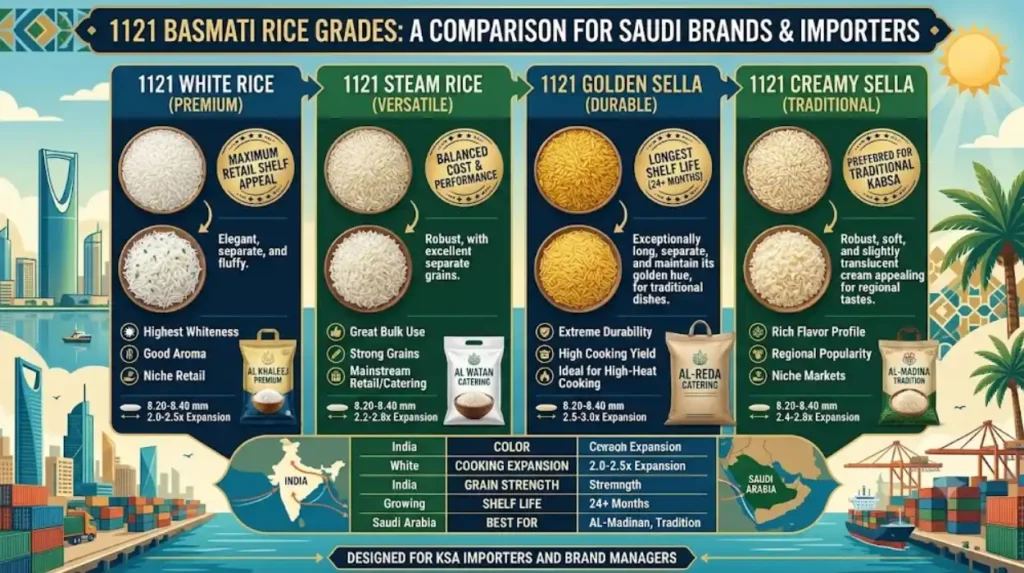
1121 Golden Sella offers the longest shelf life, Premium White Rice provides the brightest appearance, and Steam Rice balances cost and performance for mainstream retail brands.
Grade Comparison Table
| Attribute | White Rice | Steam Rice | Golden Sella | Creamy Sella |
| Grain Length | 8.20–8.40 mm | 8.20–8.40 mm | 8.20–8.40 mm | 8.20–8.40 mm |
| Color | Bright White | Off White | Golden | Cream |
| Cooking Expansion | 2.0–2.5x | 2.2–2.8x | 2.5–3.0x | 2.4–2.8x |
| Grain Strength | Medium | High | Very High | High |
| Shelf Life | 12–18 Months | 18–24 Months | 24 Months+ | 18–24 Months |
| Retail Preference | High | Medium | Medium | Niche |
| Catering Preference | Medium | High | Very High | Medium |
Golden Sella lasts longer than Steam Rice. In Saudi warehouses operating under high summer temperatures, Golden Sella maintains grain stability for up to 24 months. Steam Rice typically performs best within 18 to 24 months. Catering buyers storing large inventories benefit from Golden Sella specifications.
White Rice delivers stronger retail shelf appeal than Sella grades. Saudi supermarket consumers often associate bright white grains with premium quality. Retail-focused brands therefore allocate a larger share of shelf space to premium white specifications.
Steam Rice occupies the middle position. Importers seeking balance between price and quality often choose this specification because it satisfies both retail and foodservice demand.
The grade comparison clarifies performance differences. The next step is understanding which Saudi market segments prefer each specification.
Which 1121 rice grades work best in different Saudi market segments?
Retail supermarkets prefer Premium White Rice, catering distributors prefer Golden Sella Rice, and value-focused wholesalers frequently choose Steam Rice.
Saudi Retail Chains
Saudi retail chains prioritize visual appearance. White Rice grades with 2% broken content and high purity attract stronger consumer demand. Premium packaging programs commonly select these specifications.
Saudi Foodservice and Catering
Saudi catering companies focus on consistency and yield. Golden Sella delivers higher grain elongation and lower breakage during cooking. Large-scale kitchens benefit from this performance advantage.
Saudi Wholesale Distribution
Wholesale distributors serve multiple customer categories. Steam Rice provides flexibility because it balances appearance, shelf life, and procurement cost.
Premium Private Label Programs
Premium private label brands often specify Sortex-cleaned rice with strict purity standards. These programs target higher-income consumers seeking restaurant-quality rice at home.
Regional Preference Comparison
| Market Region | Preferred Grade | Main Reason |
| Riyadh | Premium White Rice | Retail demand |
| Jeddah | Golden Sella Rice | Catering demand |
| Dammam | Steam Rice | Distribution flexibility |
| Makkah Catering Sector | Golden Sella Rice | Bulk consumption |
| Premium Grocery Chains | Sortex White Rice | Brand positioning |
Market preferences help narrow grade selection. The next comparison examines pricing and commercial considerations.
How do 1121 rice grades compare in price per metric ton?
Steam Rice usually occupies the middle price range, White Rice commands premium retail pricing, and Golden Sella often achieves higher value through storage and cooking performance.
Export pricing changes with harvest conditions, freight rates, exchange rates, and destination requirements. Pakistani Basmati exports exceeded historical averages during recent seasons because of strong Gulf demand (source: REAP export data, 2025).
Indicative Export Comparison 2026
| Grade | Typical Export Position |
| Steam Rice | Lower-Mid Range |
| Creamy Sella | Mid Range |
| White Rice | Mid-High Range |
| Golden Sella | High Range |
| Premium Sortex White | Premium Range |
Golden Sella commands higher pricing because processors parboil, dry, mill, grade, and inspect the rice through additional production stages. The additional processing improves grain durability and shelf life.
Premium White Rice can also achieve premium pricing because supermarket brands require stricter sorting specifications and lower defect tolerances.
Steam Rice remains attractive because buyers receive strong performance without the highest procurement cost.
Price comparison alone does not determine the best choice. The next section evaluates practical advantages and disadvantages.
What are the pros and cons of each 1121 rice grade?
Golden Sella provides maximum durability, White Rice offers superior shelf appearance, and Steam Rice delivers the strongest balance between quality and cost.
1121 White Rice
Advantages
- Bright appearance
- Strong retail acceptance
- Fast cooking performance
- Premium consumer perception
Limitations
- Shorter storage life
- More vulnerable to grain breakage
1121 Steam Rice
Advantages
- Balanced pricing
- Strong grain structure
- Good shelf life
- Broad market suitability
Limitations
- Lower visual appeal than White Rice
- Less storage durability than Golden Sella
1121 Golden Sella
Advantages
- Long shelf life
- High cooking yield
- Strong grain integrity
- Excellent catering performance
Limitations
- Higher procurement cost
- Golden color may not suit all retail brands
1121 Creamy Sella
Advantages
- Distinctive appearance
- Good cooking performance
- Competitive pricing
Limitations
- Smaller consumer segment
- Lower recognition than Golden Sella
The strengths and weaknesses establish trade-offs. The next section provides a framework for making the final specification decision.
How should Saudi private label brands choose the right 1121 rice grade?
The correct choice depends on retail positioning, storage duration, customer expectations, packaging strategy, and distribution channel requirements.
Decision Framework
| Decision Factor | Best Grade |
| Premium Retail Brand | White Rice |
| Catering Program | Golden Sella |
| Mixed Distribution | Steam Rice |
| Long Storage Requirement | Golden Sella |
| Cost-Control Strategy | Steam Rice |
Brands targeting supermarket shelves should prioritize visual quality and consumer appeal. Premium White Rice aligns with this objective.
Foodservice distributors should prioritize cooking yield and grain stability. Golden Sella supports these requirements.
Regional wholesalers serving multiple channels should prioritize flexibility. Steam Rice provides the broadest commercial fit.
Private label programs should also evaluate packaging requirements, branding objectives, and export documentation before finalizing procurement specifications. Buyers comparing supplier capabilities often review packaging customization and export support options before selecting a long-term sourcing partner.
Conclusion
1121 White Rice, Steam Rice, and Golden Sella Rice dominate Saudi private label sourcing because each grade solves a different commercial requirement. White Rice serves premium retail channels. Steam Rice supports balanced distribution strategies. Golden Sella delivers maximum durability and foodservice performance. Saudi brands achieve stronger results when grade selection aligns with consumer expectations, storage conditions, and market positioning rather than price alone.
Frequently Asked Questions
Which 1121 rice grade is most popular among Saudi private label brands?
1121 White Rice and 1121 Golden Sella Rice are the most popular grades among Saudi private label brands. White Rice performs well in supermarkets because consumers prefer its bright appearance. Golden Sella is widely used in catering and foodservice because it offers strong grain integrity and a longer shelf life.
What is the difference between 1121 White Rice and 1121 Golden Sella Rice?
1121 White Rice is milled and polished without parboiling, which gives it a bright white appearance and quick cooking time. 1121 Golden Sella Rice is parboiled before milling, which improves grain strength, cooking yield, and storage performance. White Rice suits retail shelves, while Golden Sella suits catering operations.
How long can 1121 Basmati rice be stored?
Storage life depends on the processing grade and storage conditions. 1121 White Rice generally maintains quality for 12–18 months. 1121 Steam Rice can remain stable for 18–24 months. 1121 Golden Sella Rice often exceeds 24 months when stored in dry and ventilated warehouses.
Which 1121 rice grade offers the best value for wholesalers?
1121 Steam Rice offers the best balance between cost and performance for wholesalers. The grade provides good grain strength, reliable cooking results, and competitive pricing. Distributors serving multiple customer segments often choose Steam Rice because it fits both retail and foodservice channels.
What specifications should Saudi importers check before purchasing 1121 rice?
Saudi importers should verify grain length, broken percentage, moisture content, purity level, crop year, shelf life, and sorting standards. Buyers should also inspect packaging specifications and quality certifications to ensure the rice meets retail or foodservice requirements.