1121 Steam Basmati for Airline Catering and Hotel Supply Chains Compared
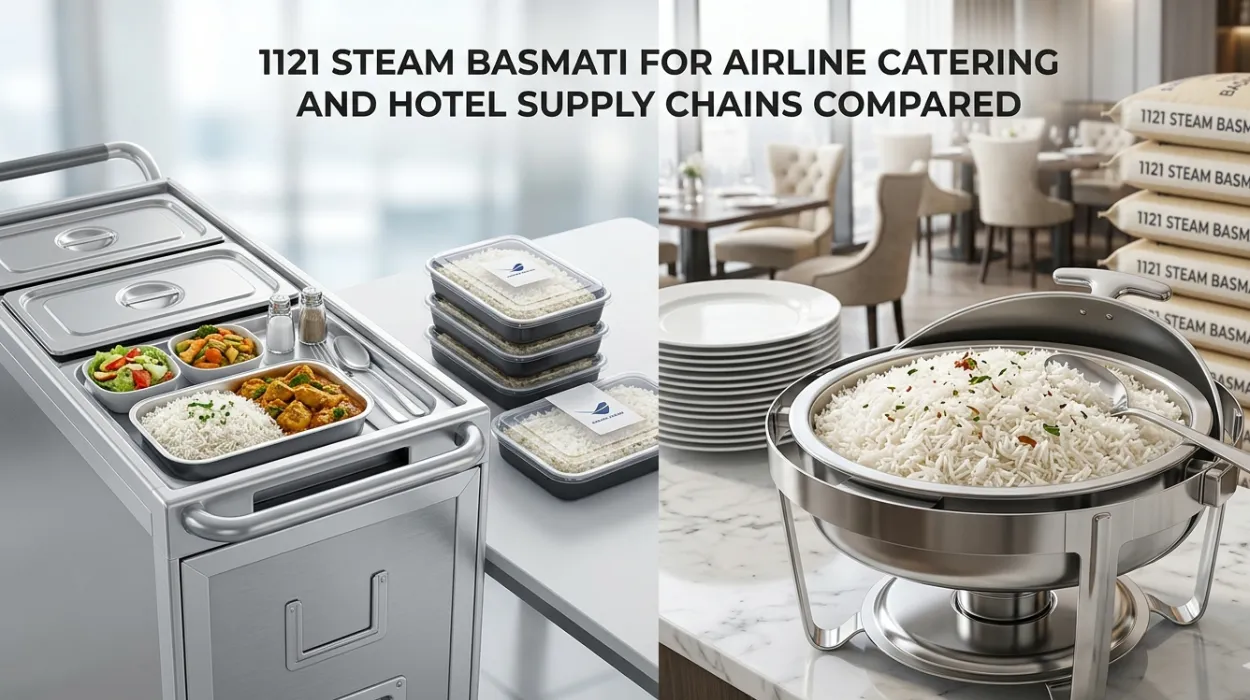
1121 Steam Basmati is the stronger choice for airline catering and hotel supply chains when the buyer prioritises cooking consistency, grain resilience, and service stability. Raw commercial alternatives and lower-grade long grain rice only compete when cost pressure outweighs presentation, but 1121 Steam delivers the most balanced HORECA performance.
For first product mention, the service route belongs here because buyers need export-ready specification, packing control, and predictable CIF handling before they commit.
What are the available solutions?
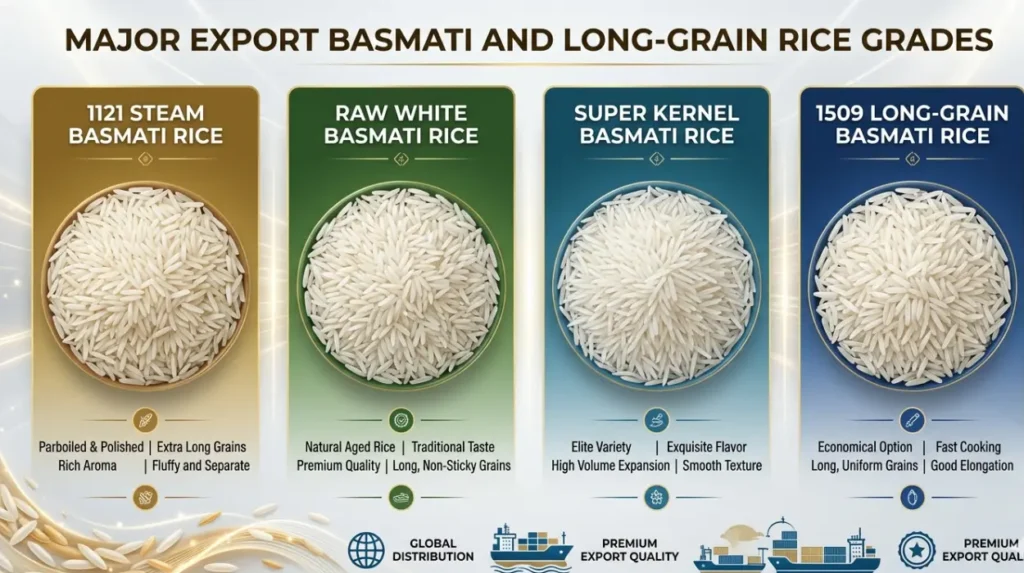
The main solutions are 1121 Steam Basmati, raw white Basmati, and other export long-grain grades such as Super Kernel and 1509. In airline catering and hotel supply, 1121 Steam sits between premium presentation and operational stability, which makes it the most practical HORECA option.
Airline catering and hotel supply chains do not buy rice as a commodity alone. They buy a repeatable service outcome. The meal must hold texture, stay visually clean, and survive batch production, holding time, and reheat cycles. That changes the evaluation. The right product is not the cheapest rice. The right product is the rice that protects service quality.
1121 Steam Basmati is a processed premium long-grain rice made from the 1121 variety. It is steam-treated after milling, which improves grain stability and reduces handling damage. In HORECA supply, that matters because kitchens and caterers move rice through multiple steps before service. Air transport, cold storage, hot holding, and tray service all affect the final result. A stable grain reduces risk at each stage.
AHK Rice operates from Punjab, which places it in the core Basmati production zone. That gives buyers access to an export structure built around 1121, Super Kernel, and 1509 varieties with end-to-end processing and custom packaging. In this category, the first product mention naturally connects to the service page because the buyer needs specification control as much as variety choice.
How do different approaches compare?
1121 Steam Basmati outperforms raw white Basmati and most bulk long-grain alternatives on consistency, grain separation, and plating quality. The comparison matters because airline catering and hotel kitchens require a product that survives scale, not just a product that cooks well in theory.
The first comparison point is texture stability. 1121 Steam holds grain integrity well in batch cooking and tray service. Raw white Basmati often gives a lighter finish, but it needs tighter process control to avoid breakage and collapse. In a hotel kitchen, that difference appears in buffet output. In airline catering, it appears in the meal tray after reheating. The rice has to look acceptable after all those stages.
The second comparison point is plate presentation. Airline meals depend on compact visual quality. Hotel banquets depend on consistency across hundreds of portions. 1121 Steam supports both because it elongates well and separates cleanly. That visual separation matters in premium service settings. A product that clumps or splits unevenly weakens the entire meal impression.
The third comparison point is operational tolerance. HORECA kitchens rarely operate under perfect conditions. They face time pressure, temperature changes, and volume spikes. Steam-treated rice reduces the sensitivity of the system. The grain withstands handling better than raw alternatives. That is why many procurement teams prefer steam grade when the service chain is long.
The fourth comparison point is supplier reliability. Airline and hotel supply chains rely on exact specification repeatability. A supplier must deliver the same grain profile across shipments, not a rough approximation. AHK Rice strengthens that process because the rice moves through controlled milling, grading, and packing. That improves consistency. It also supports larger order planning, which matters when the buyer needs uninterrupted supply.
Specification comparison table
| Attribute | 1121 Steam Basmati | Raw White Basmati | Super Kernel / 1509 |
|---|---|---|---|
| Grain length | Extra-long | Long | Long to extra-long depending on grade |
| Cooking stability | High | Medium | Medium to high |
| Texture after reheating | Strong and separated | Softer, more delicate | Varies by processing |
| Aroma | Strong Basmati aroma | Strong Basmati aroma | Moderate to strong |
| Plate appearance | Premium and clean | Traditional and lighter | Functional and market-specific |
| Breakage tolerance | High | Lower | Medium |
| HORECA suitability | Very high | Medium | Medium to high |
Which method works best for different cases?
1121 Steam Basmati works best for airline trays, hotel buffets, banquets, and institutional catering where consistency and presentation matter. Raw white Basmati works better only when the kitchen controls volume tightly and prioritises a lighter, more traditional finish over processing resilience.
For airline catering, steam grade is the more logical choice. A tray meal passes through cooking, chilling, packaging, transport, and reheating. Every stage adds stress. 1121 Steam keeps its structure through those stages better than raw white rice. That reduces service variation. It also protects the visual standard passengers expect in premium and mid-premium cabins. Airlines do not buy rice for aroma alone. They buy a stable in-flight result.
For hotel supply chains, the decision depends on service type. A breakfast buffet, wedding banquet, and all-day dining operation all require different output behaviour. Steam grade fits large-volume cooking because it preserves grain separation under pressure. It also works well in banquet service where the kitchen prepares rice in repeated batches. The product remains presentable even when staff hold it for service over time.
For institutional foodservice, 1121 Steam gives procurement teams a cleaner operating margin because the rice performs predictably. That helps reduce waste and service complaints. It also supports standardised recipe control, which matters when kitchens serve large guest counts. If the kitchen wants premium presentation at scale, steam grade is the safer route. If the kitchen wants a lower-cost option and accepts more handling sensitivity, raw white becomes the fallback.
Use-case decision matrix
| Buyer case | Better grade | Reason |
|---|---|---|
| Airline catering | 1121 Steam Basmati | Strong reheating and tray stability |
| Premium hotel buffet | 1121 Steam Basmati | Better presentation and separation |
| Banquet service | 1121 Steam Basmati | Handles batch cooking more reliably |
| Budget hotel kitchen | Raw white Basmati | Lower cost and traditional finish |
| Mixed HORECA procurement | Both grades | Segment by service level and budget |
What are the pros and cons?
1121 Steam Basmati offers the strongest balance of premium appearance and operational resilience. Its only clear disadvantage is price, while raw white Basmati offers a lower-cost route but loses the same level of tolerance in transport, holding, and reheating.
The main advantage of 1121 Steam is predictability. The grain behaves consistently across large-volume preparation. That matters because airline catering and hotel kitchens cannot afford batch variation. One poor pan can affect guest perception. One poor tray can trigger complaints. Steam grade reduces that risk and improves service control.
The second advantage is visual quality. The grain separates cleanly and keeps its shape. In HORECA, that translates into a better plate result. Guests notice rice more than procurement teams often expect. If the product looks sloppy, the whole meal feels cheaper. Steam grade protects the meal’s visual standard.
The main disadvantage is cost. Steam grade usually sits above raw white in price per MT because the processing adds value. That extra cost is justified when the buyer needs stability and presentation. It is not justified when the buyer only needs a low-cost starch component. That is why the use case must be clear before purchase.
Raw white Basmati has its own advantage. It offers a familiar flavour and a more traditional cooked profile. Some kitchens prefer that lighter finish, especially in simpler menus. Its limitation is lower tolerance. It needs tighter control in cooking and handling. For busy supply chains, that increases risk. The cheaper grade becomes more expensive if it causes waste or complaints.
Pros and cons summary
- Use 1121 Steam when you need grain separation, reheating tolerance, and premium presentation.
- Use raw white when you need a lower-cost rice with a traditional finish and stricter kitchen control.
- Avoid raw white in tray-based airline service where grain stability drives customer perception.
- Avoid steam grade only if the kitchen has a strict price ceiling and a simple service model.
- Match the grade to the service chain, not just the purchase price.
What do airline and hotel buyers prioritise?
Airline and hotel buyers prioritise consistent yield, visual appeal, supply continuity, and controlled cooking behaviour. They compare price per MT, storage behaviour, and service performance before they approve a rice specification for repeated procurement.
Airline catering buyers focus on tray reliability. The rice must withstand chill-and-reheat conditions without collapsing into a soft mass. Hotels focus on banquet consistency and buffet appeal. In both cases, the service chain matters more than the raw grain story. The rice must perform after cooking, not just before it.
The second priority is storage and logistics. HORECA supply chains often keep stock in controlled stores, but delays still happen. A product with stronger physical tolerance reduces the risk of quality loss during handling. Steam grade performs better in that regard. That is one reason it fits large service systems.
The third priority is supplier predictability. Buyers want one specification across repeated orders. AHK Rice supports this through controlled processing and export packaging. That matters because the buyer needs confidence that next month’s lot will match this month’s lot. In foodservice procurement, consistency protects both brand and margin.
The fourth priority is landed cost. Buyers still compare MT pricing even when quality matters. Steam grade usually costs more, but its higher service performance often offsets that cost through lower waste and better guest satisfaction. Raw white costs less at the invoice stage, but it can create hidden losses in handling and presentation. Procurement teams evaluate both sides of the equation.
How do shelf life and storage compare?
1121 Steam Basmati generally offers better practical storage tolerance in HORECA supply chains, while raw white Basmati needs more careful control of humidity, packaging, and rotation. Shelf life depends on storage discipline, but steam treatment adds resilience in real operating conditions.
Shelf life in a rice supply chain is not only a calendar figure. It depends on moisture, packaging, warehouse temperature, and turnover speed. Steam grade holds up better when the supply chain includes multiple touchpoints. That is common in airline catering and hotel distribution. The product passes through origin storage, export transport, receiving docks, kitchen stores, and service areas before use.
Raw white Basmati can also store well, but it rewards better control. If humidity rises or packaging weakens, quality changes faster. That matters in hotel stores and airline kitchens where stock rotation is not always perfect. The safer choice is the grade that tolerates the system the buyer actually runs, not the ideal system on paper.
For most HORECA buyers, 1121 Steam gives more comfort over a 9 to 12 month commercial stock cycle when stored correctly. Raw white can also remain usable in that range, but it demands closer attention. The difference is practical, not theoretical. The better storage grade is the one that protects service quality after the grain leaves the mill.
What are the price differences by market?
1121 Steam Basmati usually commands a higher price per MT than raw white Basmati because the processing adds value and improves HORECA performance. The premium is justified in airline catering and hotel supply because the service outcome is more stable and more presentable.

In Gulf markets, buyers often accept a higher MT price when the rice supports premium plating and reliable buffet service. That is especially true for hotel groups and catering contractors. In those cases, the extra cost is absorbed by the service model. The buyer is not paying for rice alone. The buyer is paying for reduced failure risk.
In Iraq and broader regional foodservice markets, price sensitivity is stronger, but the same logic applies. Steam grade works best when the customer values presentation and consistency. Raw white only wins when the buyer’s budget is tight and the service chain remains short. That is why the price difference must be read alongside the operational use case.
A commercial buyer should compare price against waste, guest satisfaction, and service complaints. If steam grade reduces one complaint cycle, the extra MT cost can already be justified. If raw white creates more waste or produces weaker tray appearance, the lower purchase price loses its value quickly. The real comparison is total service cost.
What is the final decision?
1121 Steam Basmati is the stronger HORECA choice when the buyer needs stable grain behaviour, premium appearance, and reliable service across airline and hotel operations. Raw white Basmati remains useful for tighter budgets and simpler kitchen models, but it does not deliver the same operational resilience.
For airline catering, steam grade leads. For hotel buffet and banquet chains, steam grade also leads. For budget-controlled kitchens, raw white stays relevant. The comparison is not about prestige. It is about whether the rice supports the service model without creating unnecessary risk. In that sense, 1121 Steam Basmati is the more dependable supply-chain choice for professional foodservice procurement.