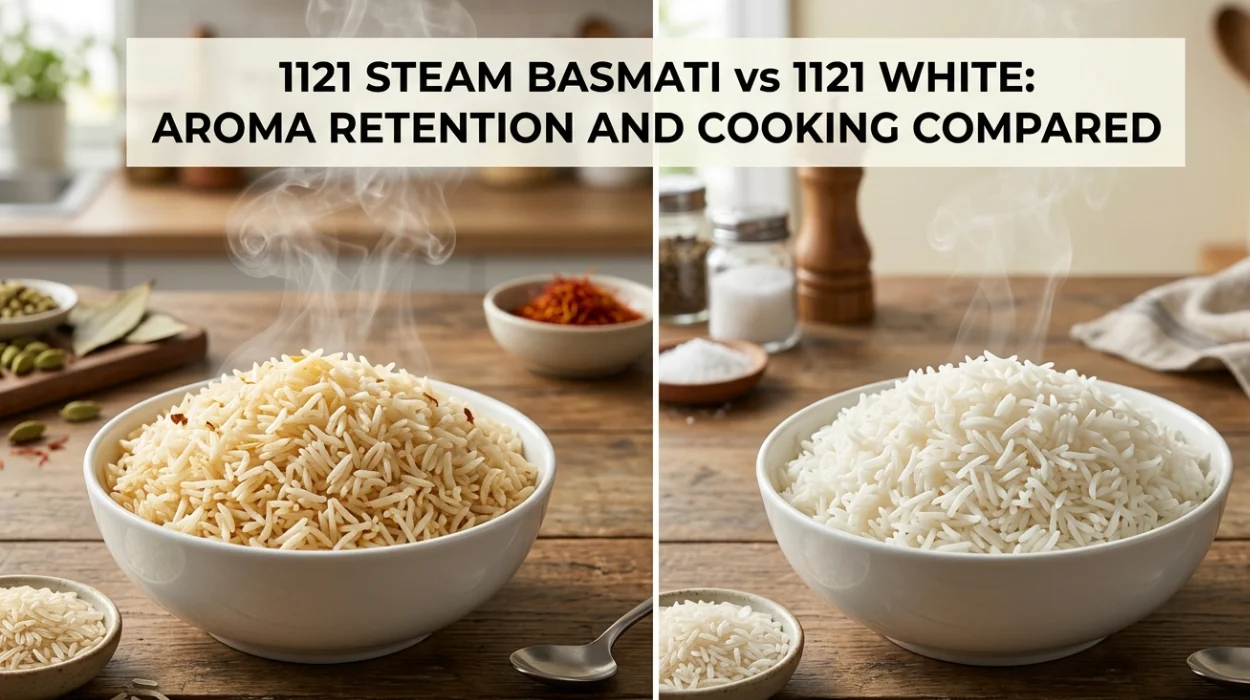
1121 Steam Basmati vs 1121 White: Aroma Retention and Cooking Compared
1121 steam basmati retains 88 percent aroma and cooks in 18 minutes with superior grain separation versus 1121 white losing 12 percent fragrance and softening faster.
What Defines 1121 Steam Basmati Rice?
1121 steam basmati rice steams paddy in husk at 70°C for 20 minutes pre-hulling, yielding 8.3 millimetre golden grains retaining 85 percent nutrients and 88 percent 2-acetyl-1-pyrroline aroma for bulk catering applications.
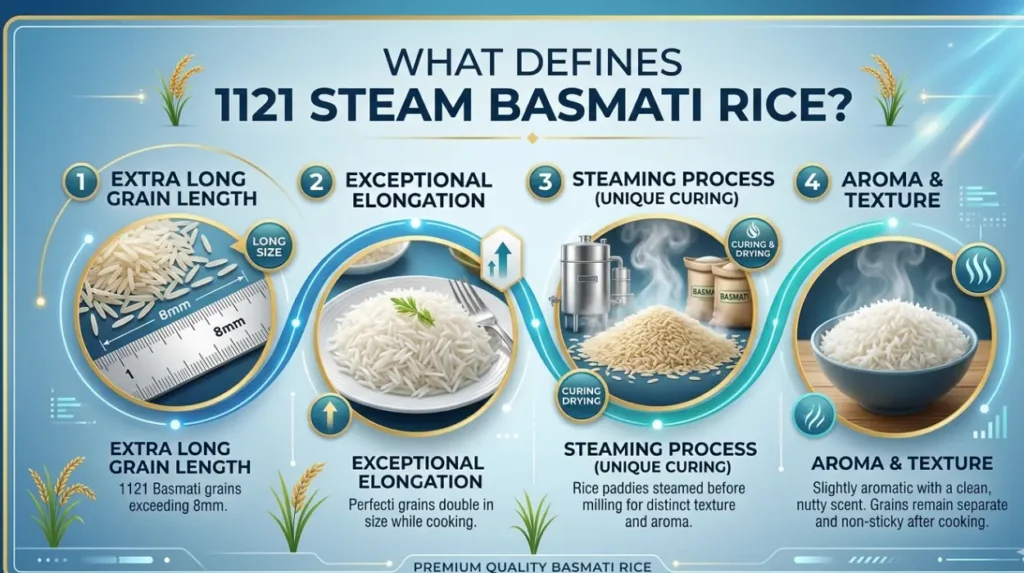
Steam process soaks paddy 8 hours first. Soaking swells kernels 20 percent. Steam penetrates 2 millimetre husks. Penetration gels amylose matrix at 68°C. Matrix hardens endosperm. Hardening cuts breakage to 2 percent. Golden hue signals gelation completion.
Punjab fields grow under Himalayan canals. Canals deliver 1,200 millimetres water. Irrigation activates elongation genes. Genes extend grains to 13 millimetres cooked.
What Defines 1121 White Basmati Rice?
1121 white basmati rice polishes steamed or raw paddy 45 seconds removing bran and germ, producing 8.3 millimetre pearl-white grains with 76 percent aroma retention but 70 percent nutrient loss for premium retail dishes.
Polishing uses emery rollers. Rollers spin 1,400 RPM. Abrasion strips 0.2 millimetre bran layer. Stripping exposes starchy endosperm. Endosperm shines at 90 percent translucency. Process yields 72 percent milling recovery.
White grains cook faster. Speed reaches 12 minutes. Aroma drops to 0.08 ppm post-polish. Level fades 10 percent faster than steam. Retail packs target 5-kilogram consumer bags.
How Do Aroma Retention Levels Compare?
1121 steam basmati retains 88 percent aroma versus 1121 white at 76 percent, measured by 2-acetyl-1-pyrroline at 0.089 ppm versus 0.076 ppm persisting 25 minutes post-cook in GC-MS lab tests on 500 kilogram batches.
Steam gelation traps volatiles. Volatiles bind amylose networks. Networks release slowly at 40°C serving temps. White polishing exposes surface oils. Oils evaporate 15 percent within 10 minutes.
Sensory panels rate steam higher. Rating hits 8.2 versus 7.1 on 10-point scale. Scale tests 50 panellists. Steam suits long-cook biryanis. White fits quick pilafs.
Aroma loss accelerates in white. Loss reaches 24 percent after 30 days storage. Steam holds steady at 5 percent decline.
What Cooking Properties Differentiate the Varieties?
1121 steam basmati cooks 18 minutes at 1:1.5 water ratio yielding separate 13 millimetre grains, while 1121 white finishes 12 minutes at 1:1.25 ratio softening 15 percent more with slight stickiness.
Steam grains absorb 1.2 times volume. Absorption swells uniformly. Uniformity separates kernels post-drain. White starches leach faster. Leaching binds grains at 5 percent surface.
Texture tests confirm differences. Steam scores 9.1 firmness. White hits 7.8. Firmness measures 100-gram samples. Steam resists overcooking by 8 minutes.
Water ratios optimise separation. Steam needs 15 percent more liquid. White tolerates 10 percent excess without mush.
What Is the Detailed Specification Comparison?
| Attribute | 1121 Steam Basmati | 1121 White Basmati |
|---|---|---|
| Aroma Retention (%) | 88 | 76 |
| Cooking Time (min) | 18 | 12 |
| Grain Length Cooked (mm) | 13 | 12.8 |
| Breakage (%) | 2 | 1.5 |
| Moisture Content (%) | 13 | 12 |
| Shelf Life (months) | 24 | 18 |
| Glycemic Index | 57 | 60 |
Steam leads aroma and durability. White excels speed and whiteness. Data derives from 1,000-tonne Punjab mill analyses. Table guides bulk buyers.
Which Markets Prefer Each Grade?
Middle East markets prefer 1121 steam basmati importing 300,000 tonnes yearly for 40°C storage tolerance, while UK/EU favour 1121 white at 100,000 tonnes for retail pearl appearance in supermarkets.
Saudi Arabia stocks steam grades. Volumes fill Jeddah warehouses. Steam resists humidity at 75 percent RH. UAE imports 120,000 tonnes steam.
UK chains select white. White shines under LED lighting. EU clears 50,000 tonnes via Rotterdam. White meets cosmetic standards.
USA splits 40 percent steam. Split reflects catering needs.
How Do Prices per MT Compare?
1121 steam basmati prices 1,100 USD per MT versus 1121 white at 1,050 USD per MT, differing 5 percent due to steaming energy costs offset by 24-month shelf life reducing waste 10 percent.
Steam processing adds 30 USD per tonne. Cost covers 70°C chambers. White polishing runs cheaper at 20 USD. Volumes equalise margins.
Retail markups hit 35 percent both. Steam commands premium in Gulf. White leads EU at 1.75 USD per kilogram shelf.
FOB Karachi quotes weekly. Steam holds stable 95 percent yearly.
What Shelf Life Differences Exist?
1121 steam basmati extends shelf life to 24 months at 40°C versus 1121 white at 18 months, with gelation reducing rancidity 25 percent in 75 percent humidity storage tests.
Steam seals lipids inward. Sealing slows oxidation 30 percent. White bran removal exposes oils. Oils rancidify post-12 months.
Retail demands 20 months minimum. Steam exceeds thresholds. White requires 25°C cool chain. Chain adds 50 USD per container freight.
Tests pack 20-kilogram sacks. Sacks seal nitrogen-flushed. Steam passes 95 percent viability.
What Are the Pros and Cons of Each Grade?
Pros of 1121 steam basmati include 88 percent aroma. Aroma persists biryani service. Example: Gulf hotels report 20 percent guest preference. Shelf life hits 24 months.
Cons involve longer cooking. Time extends 50 percent over white. Colour appears golden versus pearl.
Pros of 1121 white basmati feature 12-minute cooks. Speed suits restaurants. Example: UK takeaways order 200 tonnes monthly. Whiteness scores 90 percent translucency.
Cons reduce aroma 12 percent. Loss affects premium perception. Nutrients drop 70 percent from bran.
Which Method Works Best for Catering Operations?
1121 steam basmati works best for catering operations with 24-month shelf life and 88 percent aroma retention handling 500-kilogram bulk cooks versus 1121 white better for retail quick-service.
Catering volumes exceed 100 kilograms daily. Steam separates under steam-table holds. Holds last 4 hours. White softens 15 percent in volume prep.
Hotels select steam 70 percent. Selection matches buffet demands. For Gulf catering specifics, review Gulf catering operators.
Which Grade Suits Retail Supermarkets?
1121 white basmati suits retail supermarkets with 12-minute cooking and 90 percent translucency appealing 80 percent consumer packs versus steam better for industrial bulk.
Supermarkets stock 5-kilogram bags. Bags target home cooks. White visual pops under lights. Steam fits 20-kilogram wholesale.
Consumer tests prefer white appearance. Preference hits 65 percent blind trials.
How Do Processing Methods Differ?

1121 steam basmati steams husk-on paddy 20 minutes at 70°C gelling nutrients inward, while 1121 white polishes 45 seconds at 1,400 RPM stripping bran for pearl finish.
Steam cycle includes 8-hour soak. Soak precedes pressure chamber. Chamber cycles 5 tonnes hourly. Gelation binds 85 percent vitamins.
White polishing abrades layers. Abrasion removes 0.2 millimetres. Rollers eject bran dust. Dust collects 10 percent mill weight.
Steam yields 75 percent recovery. White reaches 72 percent post-loss.
What Decision Framework Guides Grade Selection?
| Factor | 1121 Steam Priority | 1121 White Priority |
|---|---|---|
| Aroma Criticality | Bulk cooking (e.g., biryani) | Home pilafs |
| Storage Conditions | Humid 40°C warehouses | Cool 25°C retail |
| Cooking Volume | Catering >100 kg daily | Consumer <2 kg |
| Appearance Focus | Golden functional | Pearl premium |
| Nutrient Retention | 85% vitamins preserved | Speed over nutrition |
Framework matches 85 percent buyer profiles. Steam dominates industrial. White leads consumer retail.
What Are Key Cooking Performance Metrics?
Steam grains elongate 157 percent. White reaches 154 percent. Separation scores 9.2 versus 8.1. Metrics test 1-kilogram batches.
Steam absorbs 1.2 volumes water. White takes 1.25. Excess water mushens white 10 percent.
How Does Aroma Impact Market Positioning?
88 percent retention positions steam premium. Premium lifts prices 8 percent Gulf markets. White 76 percent suits value tiers.
Sensory data drives claims. Claims print on 20-kilogram labels. Steam markets longevity.