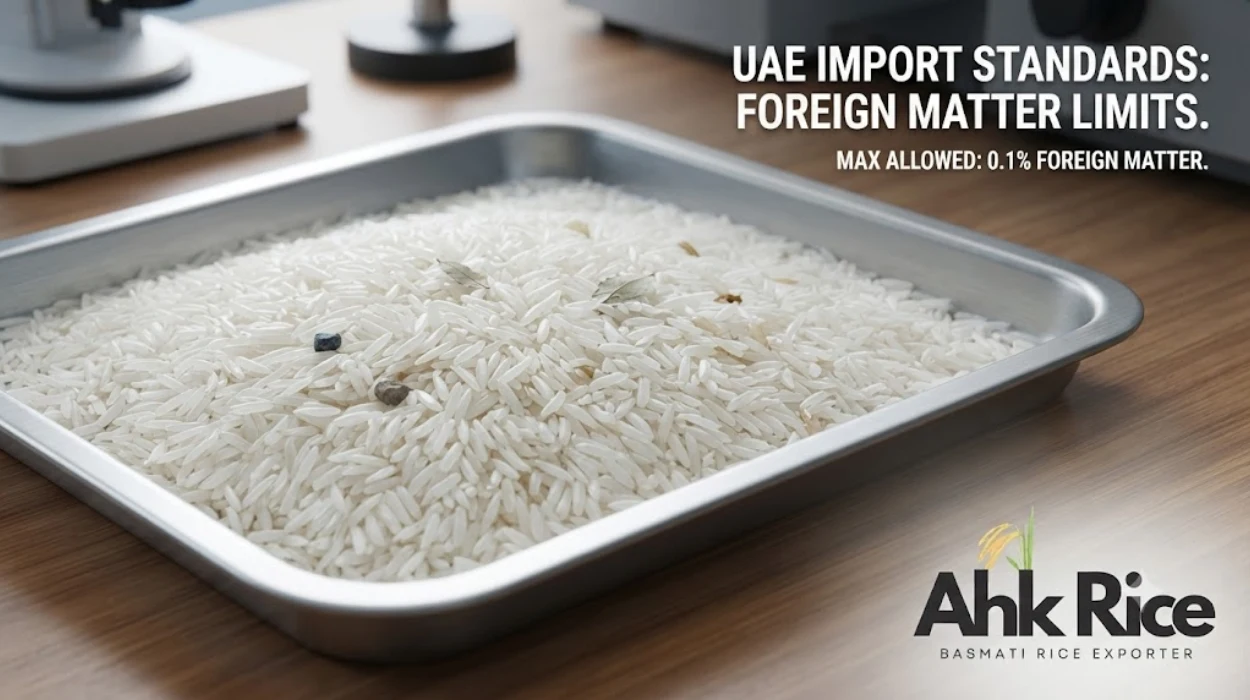
What Foreign Matter Limits Do UAE Rice Importers Require from Pakistan Suppliers?
UAE rice importers generally require foreign matter levels between 0.1% and 0.3%, depending on the buyer segment, product grade, and intended application. Premium retail buyers typically specify 0.1% maximum, while food service and wholesale distributors may accept 0.2–0.3%. Here is why: lower foreign matter improves food safety, customer satisfaction, shelf stability, and compliance with UAE food import regulations.
Rice quality begins long before shipment. Foreign matter affects every stage of the supply chain, from customs inspections to supermarket shelves. UAE buyers evaluate imported Basmati rice against detailed product specifications because contamination increases cleaning costs, customer complaints, and rejected consignments.
Understanding how Pakistani exporters control impurities helps buyers compare suppliers more effectively. Learn more about the complete inspection process in our guide on how foreign matter is removed during Pakistani Basmati rice processing.
AHK Rice supplies export-quality 1121 Basmati Rice through its complete milling and grading service, including colour sorting, metal detection, laboratory testing, and customized export specifications.
What Is Foreign Matter in Exported Basmati Rice?
Foreign matter includes stones, husk particles, dust, straw fragments, damaged seeds, plastic particles, insects, and other materials that are not edible rice kernels. UAE importers specify strict maximum limits because cleaner rice improves food safety, processing efficiency, and retail value.
Foreign matter refers to every unwanted material present inside a rice shipment after milling. International buyers evaluate this parameter because contaminants reduce product quality and increase processing costs after import.
Pakistani rice mills remove foreign matter through several processing stages before packaging. Each stage improves product purity and reduces contamination.
Typical foreign matter includes:
- Stone particles
- Paddy husk
- Straw pieces
- Dust
- Weed seeds
- Broken plant material
- Plastic contamination
- Metal fragments
- Dead insects
Premium UAE supermarkets usually request almost invisible contamination levels because consumers expect clean rice that requires minimal washing before cooking.
Hotels and catering companies also prefer cleaner rice because kitchen preparation becomes faster.
Foreign matter differs from broken rice.
Broken rice remains edible because it consists of fractured rice kernels. Foreign matter consists of materials that should not be present in food.
International laboratories measure foreign matter as a percentage of the total sample weight.
For example:
- 1000 g sample
- 1 g impurities
- Foreign matter = 0.10%
This standardized measurement allows buyers to compare suppliers objectively.
With foreign matter defined, the next question becomes how much contamination UAE buyers actually permit.
What Foreign Matter Limits Do UAE Importers Normally Specify
Premium UAE retailers usually require 0.10%, food service buyers commonly specify 0.20%, and wholesale importers often accept 0.30% when purchasing commercial grades. Each specification depends on customer expectations, processing quality, and intended market segment.
The United Arab Emirates imports large volumes of Pakistani Basmati rice every year. Most professional buyers issue detailed purchase specifications before placing contracts.
These specifications commonly include:
- Moisture
- Broken percentage
- Grain length
- Chalkiness
- Damaged kernels
- Foreign matter
- Packaging requirements
Foreign matter remains one of the most important quality indicators.
Premium supermarket brands generally require:
| Buyer Type | Maximum Foreign Matter |
|---|---|
| Premium Retail | 0.10% |
| Supermarkets | 0.10–0.15% |
| Hotels | 0.20% |
| Catering Companies | 0.20% |
| Wholesale Importers | 0.30% |
Lower contamination creates several commercial advantages.
Clean rice improves consumer confidence.
Clean rice reduces product returns.
Clean rice passes inspections more efficiently.
Clean rice supports premium branding.
Pakistan supplies significant quantities of Basmati rice to Gulf countries every year, making quality consistency essential for exporters (Source: Pakistan Bureau of Statistics, FY2024–25).
Some UAE buyers request laboratory certificates before shipment.
Others perform independent inspections at origin.
Large retail chains often require both.
Supplier capability therefore becomes more important than price alone.
Understanding buyer limits naturally leads to comparing the available processing solutions.
What Solutions Help Pakistani Exporters Meet UAE Foreign Matter Standards?
Advanced cleaning combines multiple processing technologies. Destoning, aspiration, grading, colour sorting, polishing, metal detection, and laboratory inspection together reduce foreign matter to premium export specifications. No single machine achieves export quality independently.
Modern rice processing relies on multiple quality control stages rather than one cleaning operation.
Each processing stage removes different contaminants.
Cleaning Solution 1: Pre-cleaning
Pre-cleaning removes large impurities immediately after harvesting.
Machines separate:
- Straw
- Leaves
- Large stones
- Soil clumps
Removing coarse contamination protects later equipment.
Cleaning Solution 2: Destoning
Destoners separate stones using density differences.
Rice kernels move differently than mineral particles.
Heavy contaminants fall away while rice continues through processing.
This stage significantly reduces physical contamination.
Cleaning Solution 3: Paddy Separation
Paddy separators remove unhulled grains.
Uniform grain quality improves later grading accuracy.
Consistent milling also reduces contamination during polishing.
Cleaning Solution 4: Colour Sorting
Optical colour sorters inspect every grain using high-speed cameras.
The machines automatically reject:
- Black grains
- Yellow kernels
- Foreign seeds
- Plastic fragments
- Discoloured material
Premium exporters depend heavily on colour sorting because manual inspection cannot match modern accuracy.
Cleaning Solution 5: Metal Detection
Metal detectors identify tiny metallic particles before packaging.
This inspection protects consumers and complies with international food safety systems.
Cleaning Solution 6: Laboratory Verification
Laboratory technicians inspect representative samples from each production batch.
Typical tests include:
- Foreign matter
- Moisture
- Broken kernels
- Grain length
- Purity
- Damage
- Milling quality
Testing confirms that production matches contractual specifications before shipment.
Comparison of Available Processing Solutions
| Processing Method | Removes | Accuracy | Best Application |
|---|---|---|---|
| Pre-cleaning | Large debris | Medium | Initial cleaning |
| Destoning | Stones | High | Export quality |
| Paddy Separation | Unhulled rice | High | Uniform milling |
| Colour Sorting | Discoloured grains and foreign particles | Very High | Premium retail |
| Metal Detection | Metal fragments | Very High | Food safety |
| Laboratory Testing | Specification verification | Maximum | Final approval |
| Manual Inspection | Visible defects | Moderate | Additional quality check |
Combining these technologies consistently produces cleaner export rice than relying on manual inspection alone.
Which Approach Works Best for Different UAE Buyers?

Premium retail importers achieve the best results with 0.10% foreign matter, advanced colour sorting, and laboratory-certified quality. Food service buyers balance quality and cost with 0.20%, while wholesale distributors often select 0.30% commercial specifications for price-sensitive markets.
Different UAE buyers purchase rice for different purposes. Their foreign matter requirements reflect their customers’ expectations, storage conditions, and pricing strategies.
Premium Retail
Premium supermarket brands prioritize appearance and consumer satisfaction.
Retail packs are sold directly to families. Consumers expect rice that looks clean immediately after opening the package.
Typical specification:
- Foreign matter: 0.10% maximum
- Broken kernels: 2–5%
- Double colour sorting
- Metal detection
- Laboratory inspection
- Premium packaging
Higher processing costs create stronger brand value and fewer customer complaints.
Food Service and Hospitality
Hotels, restaurants, and catering companies purchase rice in large volumes.
Kitchen staff usually wash rice before cooking. Buyers therefore focus on consistency rather than perfect visual appearance.
Typical specification:
- Foreign matter: 0.20%
- Broken kernels: 5–10%
- Standard colour sorting
- Food-safe packaging
This specification offers an excellent balance between quality and procurement cost.
Wholesale Distribution
Wholesale traders often repackage rice under local brands.
Competitive pricing becomes more important than premium presentation.
Typical specification:
- Foreign matter: 0.30%
- Commercial milling
- Standard inspection
- Bulk packaging
Commercial-grade rice remains suitable for many export markets while reducing processing expenses.
Understanding buyer requirements makes supplier comparison much easier.
How Do UAE and Other Gulf Markets Compare?
The UAE generally demands cleaner retail specifications, while Saudi Arabia purchases larger volumes across both premium and commercial grades. Both markets prioritize food safety, but buying preferences differ according to retail structure and end users.
The Gulf region imports substantial quantities of Pakistani Basmati rice every year because local rice production remains limited (Source: REAP Export Data, 2025).
Market Comparison
| Specification | UAE | Saudi Arabia |
|---|---|---|
| Premium Retail Demand | Very High | High |
| Catering Demand | High | Very High |
| Preferred Foreign Matter | 0.10–0.20% | 0.20–0.30% |
| Preferred Variety | 1121 Basmati | 1121 & Super Kernel |
| Common Pack Sizes | 5kg, 10kg, 20kg | 20kg, 35kg, 40kg |
| Brand Focus | Retail Quality | Retail & Bulk |
| Price Sensitivity | Moderate | Moderate to High |
UAE buyers often prioritize premium presentation because supermarket competition is intense.
Saudi Arabian buyers frequently source larger volumes for catering, hospitality, and wholesale distribution.
These market differences influence the processing specifications exporters provide.
How Do Price and Shelf Life Compare Across Different Quality Levels?
Lower foreign matter increases processing costs but improves shelf stability, customer satisfaction, and retail positioning. Premium specifications command higher export prices because additional cleaning, sorting, and inspection require advanced equipment and stricter quality control.
Price and Shelf Life Comparison
| Quality Level | Foreign Matter | Typical Export Price (USD/MT)* | Shelf Life |
|---|---|---|---|
| Premium Retail | 0.10% | Higher | 18–24 months |
| Food Service | 0.20% | Medium | 18 months |
| Commercial Wholesale | 0.30% | Lower | 12–18 months |
*Prices vary according to crop year, variety, freight rates, packaging, and international market conditions.
Premium rice undergoes additional cleaning stages before packaging.
Reduced contamination minimizes biological activity and protects product quality during long-distance shipping.
For UAE distributors storing rice in climate-controlled warehouses, premium specifications maintain appearance and consumer acceptance throughout the product’s shelf life.
With pricing differences explained, buyers can evaluate the advantages and disadvantages of each specification.
What Are the Pros and Cons of Different Foreign Matter Specifications?
Each specification delivers different commercial benefits. Premium grades maximize customer satisfaction, while commercial grades reduce procurement costs. Buyers should match the specification to their sales channel instead of selecting the lowest price alone.
| Specification | Advantages | Limitations |
|---|---|---|
| 0.10% | Premium appearance, easier customs inspections, fewer complaints, stronger retail branding | Higher processing cost |
| 0.20% | Balanced quality and price, suitable for hospitality | Less attractive for premium supermarkets |
| 0.30% | Competitive pricing, suitable for bulk distribution | More cleaning may be required before cooking |
For example, a UAE supermarket chain benefits from 0.10% because attractive packaging and clean rice improve repeat purchases.
A catering company preparing thousands of meals daily may prefer 0.20% because the specification balances quality and operating costs.
A wholesale trader supplying multiple regional markets may select 0.30% because competitive pricing becomes the primary purchasing factor.
The correct specification always depends on the buyer’s business model.
Which Decision Factors Should UAE Importers Evaluate Before Selecting a Pakistani Supplier?
Supplier capability matters more than the advertised specification. Buyers should evaluate processing technology, laboratory testing, certifications, packaging flexibility, and export experience before approving a supplier.
Decision Framework
| Buying Situation | Recommended Specification | Why It Works |
|---|---|---|
| Premium supermarket brand | 0.10% | Supports premium retail positioning |
| Private label retail | 0.10–0.15% | Delivers consistent consumer quality |
| Hotel and restaurant supply | 0.20% | Balances quality and operational cost |
| Catering contracts | 0.20% | Reliable for high-volume kitchens |
| Wholesale distribution | 0.30% | Maximizes price competitiveness |
Professional buyers should also verify:
- Processing technology
- Colour sorting capability
- Laboratory testing procedures
- Food safety certifications
- Packaging options
- Batch traceability
- Export documentation
- Shipment consistency
Evaluating these factors reduces supply risk and improves long-term procurement performance.
Foreign matter remains one of the most important quality specifications in Pakistani Basmati rice exports to the UAE. Premium retail buyers generally require 0.10%, while hospitality and food service buyers commonly accept 0.20%. Commercial wholesalers often purchase rice with 0.30% foreign matter when price competitiveness is the primary objective.
Modern processing technologies, including pre-cleaning, destoning, colour sorting, metal detection, and laboratory verification, enable Pakistani exporters to meet these demanding specifications consistently.
For buyers ready to compare qualified exporters and procurement requirements, continue with our guide on how to source Pakistani Basmati rice that meets UAE foreign matter standards.
Frequently Asked Questions
What is foreign matter in Basmati rice?
Foreign matter includes stones, husk, dust, straw, weed seeds, plastic fragments, metal particles, and other materials that are not edible rice kernels.
What foreign matter level do UAE importers usually require?
Most premium UAE buyers require 0.10%, while hospitality buyers commonly accept 0.20% and wholesale distributors may specify 0.30%.
Why is low foreign matter important?
Lower foreign matter improves food safety, enhances product appearance, reduces customer complaints, and helps shipments pass quality inspections more efficiently.
How is foreign matter measured?
Quality inspectors collect representative rice samples, separate impurities, weigh them, and calculate the percentage against the total sample weight.
Which machines remove foreign matter?
Modern rice mills use pre-cleaners, destoners, paddy separators, colour sorters, metal detectors, and laboratory inspection systems.