1509 Steam Basmati Rice Delivery Commitments for UAE Buyers
The most reliable delivery commitment for UAE buyers comes from exporters who combine ready inventory, documented production planning, quality-controlled processing, and direct shipping schedules instead of relying on spot-market procurement after orders are confirmed.
Delivery reliability has become one of the primary purchasing criteria for rice importers in the UAE. Importers no longer evaluate suppliers only by price per metric ton. They also compare shipment consistency, transit predictability, production capacity, export documentation, and contingency planning.
Businesses that first understand:
How much volume they should import based on market demand can make more accurate delivery schedules before signing annual supply contracts.
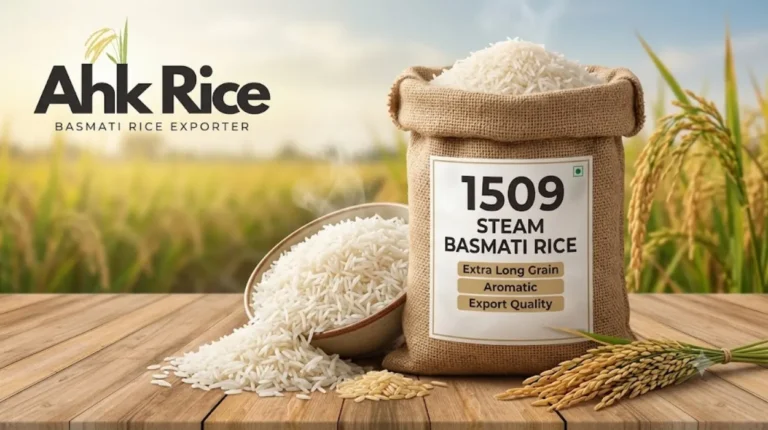
AHK Rice is a Pakistani Basmati exporter based in Punjab that supplies 1509 Steam Basmati Rice alongside 1121 and Super Kernel varieties to buyers in more than fifteen countries. Through integrated milling, grading, packaging, documentation, and export operations, the company supports importers requiring scheduled deliveries throughout the year.
What delivery commitment should UAE buyers expect from a 1509 Steam Basmati Rice exporter?
A dependable delivery commitment includes confirmed production allocation, fixed shipment windows, documented quality inspection, export documentation prepared before vessel booking, and transparent logistics communication. UAE buyers should expect predictable lead times rather than uncertain promises, especially when importing commercial quantities under annual or quarterly purchasing contracts.
A delivery commitment is a documented agreement describing when rice will be produced, packed, loaded, shipped, and delivered.
Instead of focusing only on the estimated arrival date, experienced UAE importers evaluate every milestone in the export process.
These milestones include:
- Production scheduling
- Paddy procurement
- Milling
- Color sorting
- Grading
- Packaging
- Laboratory inspection
- Container loading
- Customs clearance
- Vessel departure
- Transit tracking
A supplier capable of managing every stage internally generally delivers with greater consistency than one outsourcing multiple operations.
Typical shipment planning for Pakistani 1509 Steam Basmati Rice exported to the UAE in 2026 follows this sequence:
| Export Stage | Typical Duration |
|---|---|
| Order confirmation | 1–2 days |
| Production scheduling | 3–7 days |
| Milling & processing | 5–8 days |
| Packaging & palletizing | 2–4 days |
| Quality inspection | 1–2 days |
| Export documentation | 2–4 days |
| Container loading | 1–3 days |
| Karachi Port departure | Based on vessel schedule |
| Transit to Jebel Ali | Approximately 8–14 days |
Actual timelines vary depending on vessel availability, order size, and seasonal demand.
How do different delivery approaches compare?
Not every exporter follows the same fulfillment model. Some maintain ready inventory, others produce after receiving orders, while trading companies purchase from third-party mills. Understanding these differences helps UAE buyers reduce delays, improve inventory planning, and maintain uninterrupted retail or foodservice operations throughout the year.
Three common supply approaches dominate international rice exports.
Delivery Strategy Comparison
| Attribute | Ready Stock Exporter | Production-on-Order Exporter | Trading Company |
| Production control | High | High | Low |
| Inventory availability | Immediate | Planned | Variable |
| Lead time | Short | Medium | Unpredictable |
| Quality consistency | Excellent | Excellent | Moderate |
| Price stability | High | Moderate | Variable |
| Supply continuity | Strong | Strong | Lower |
| Documentation accuracy | High | Moderate | Depends on supplier |
Exporters operating integrated mills generally maintain better delivery performance because production planning remains under their control.
Trading companies often depend on market availability after contracts have already been signed.
Which delivery model works best for different UAE buyers?
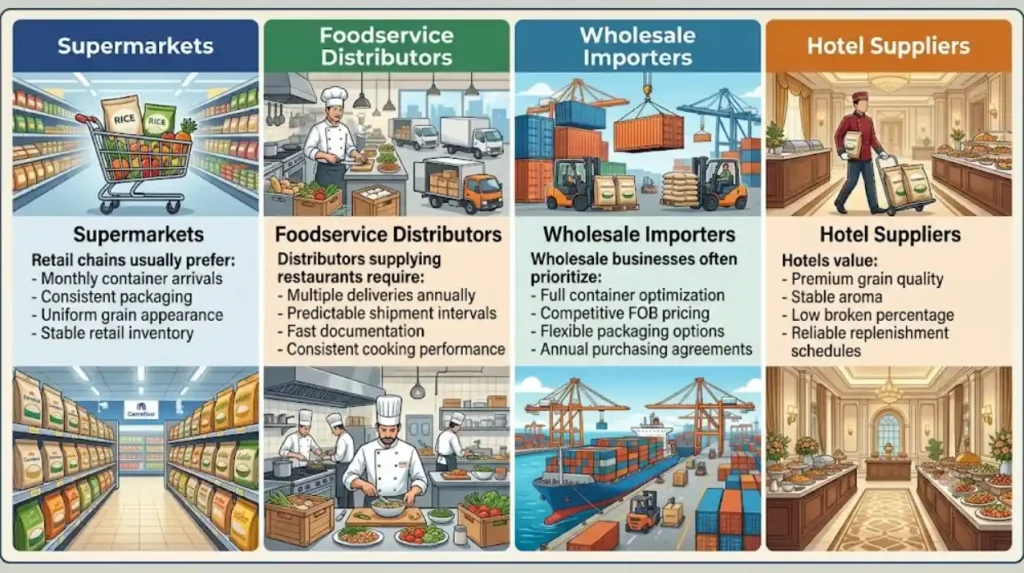
Different businesses require different delivery schedules. Supermarkets prioritize consistent monthly shipments, wholesalers value competitive container pricing, distributors require predictable inventory replenishment, while hospitality buyers often prefer flexible batch deliveries aligned with seasonal tourism demand and procurement cycles.
Different industries purchase rice differently.
Supermarkets
Retail chains usually prefer:
- Monthly container arrivals
- Consistent packaging
- Uniform grain appearance
- Stable retail inventory
Foodservice Distributors
Distributors supplying restaurants require:
- Multiple deliveries annually
- Predictable shipment intervals
- Fast documentation
- Consistent cooking performance
Hotel Suppliers
Hotels value:
- Premium grain quality
- Stable aroma
- Low broken percentage
- Reliable replenishment schedules
Wholesale Importers
Wholesale businesses often prioritize:
- Full container optimization
- Competitive FOB pricing
- Flexible packaging options
- Annual purchasing agreements
The best delivery model depends on inventory turnover rather than simply choosing the fastest shipment.
How do UAE and African markets differ in delivery expectations?
Regional demand influences delivery planning. UAE buyers generally prioritize premium grades with shorter replenishment cycles, whereas many African importers emphasize container optimization, larger purchasing volumes, and competitive pricing while accepting slightly longer delivery schedules for annual procurement programs.
Export planning differs considerably between destinations.
Market Comparison
| Factor | UAE Market | East & West African Markets |
| Preferred Grade | Premium 1509 Steam | Standard Steam & Economy Grades |
| Average Purchase Frequency | Monthly or Quarterly | Quarterly or Annual |
| Packaging Preference | 5 kg, 10 kg, 20 kg | 25 kg and 50 kg |
| Price Sensitivity | Medium | High |
| Delivery Priority | Speed & Consistency | Cost Efficiency |
| Documentation Requirements | Extensive | Moderate |
| Brand Importance | High | Moderate |
Because UAE buyers often supply organized retail and hospitality sectors, delivery precision becomes a stronger purchasing factor.
How does 1509 Steam Basmati Rice compare with other export varieties?
1509 Steam Basmati offers an effective balance between affordability, grain length, cooking performance, and shipment availability. Compared with premium varieties, it delivers competitive export pricing while maintaining quality standards preferred by many commercial UAE buyers across wholesale and retail sectors.
Specification Comparison
| Specification | 1509 Steam | 1121 Steam | Super Kernel Steam |
| Average Grain Length | 8.2–8.4 mm | 8.3–8.5 mm | 7.2–7.4 mm |
| Cooked Length | Up to 17 mm | Up to 18 mm | Moderate |
| Broken % | 1–5% (grade dependent) | 1–5% | 2–5% |
| Moisture | ≤13% | ≤13% | ≤13% |
| Shelf Life | Up to 24 months | Up to 24 months | Up to 24 months |
| Typical FOB Price (2026) | USD 950–1,080/MT | USD 1,080–1,250/MT | USD 830–950/MT |
| Primary Buyers | UAE, GCC, Europe | Premium Retail | Africa, Middle East |
Prices fluctuate with harvest conditions, freight costs, exchange rates, and contract volumes.
What factors influence delivery reliability?
Delivery reliability depends on production capacity, seasonal procurement, milling efficiency, container availability, shipping schedules, export documentation, and quality inspection. Buyers evaluating these operational factors usually experience fewer shipment delays and stronger long-term supply consistency throughout annual purchasing programs.
Several operational factors determine whether delivery dates are achieved.
Production planning is the first.
Exporters that reserve paddy early maintain stable production even during periods of increased demand.
The second factor is integrated processing.
Internal milling, polishing, grading, color sorting, and packaging reduce coordination delays.
Shipping availability is equally important.
Container shortages occasionally influence export schedules despite production being completed on time.
Documentation also affects shipment timing.
Incomplete certificates frequently delay customs clearance more than production itself.
Finally, communication remains essential.
Importers receiving regular production updates can better coordinate warehouse planning and retail distribution.
What are the advantages and disadvantages of different delivery strategies?
Every fulfillment strategy offers benefits and trade-offs. Buyers should compare cost, flexibility, production certainty, inventory requirements, and shipment predictability before selecting an exporter capable of supporting their commercial objectives over multiple purchasing cycles rather than a single transaction.
| Strategy | Advantages | Limitations |
| Ready Inventory | Fast shipment, reduced waiting | Higher storage costs |
| Production on Order | Fresh processing, flexible specifications | Longer preparation time |
| Annual Supply Agreement | Stable pricing and scheduling | Requires forecasting |
| Spot Purchasing | Immediate market opportunities | Greater price volatility |
| Mixed Supply Model | Balance between flexibility and continuity | More planning required |
For example, a UAE supermarket importing twelve containers annually usually benefits more from scheduled quarterly production than repeated spot purchases.
How should UAE buyers decide which exporter is the right choice?
Choosing an exporter requires evaluating operational capability rather than marketing claims. Buyers should compare documented certifications, production capacity, quality systems, shipment history, communication standards, and logistics performance before committing to medium-term or annual purchasing agreements with any supplier.
The following framework simplifies supplier evaluation.
Decision Framework
| Decision Factor | Low Priority | Medium Priority | High Priority |
| Delivery Consistency | ✓ | ✓ | |
| Production Capacity | ✓ | ✓ | |
| Quality Certification | ✓ | ✓ | |
| Export Documentation | ✓ | ✓ | |
| Logistics Communication | ✓ | ✓ |
Buyers scoring suppliers across these categories often make better procurement decisions than comparing only FOB prices.
Reliable delivery commitments for UAE buyers depend on operational capability rather than promises alone. Exporters controlling production, quality inspection, documentation, and logistics achieve more predictable shipment performance than suppliers dependent on third-party procurement. Comparing delivery models, understanding regional requirements, and evaluating structured decision factors allows importers to reduce operational risk while maintaining uninterrupted inventory throughout the year.
Businesses that have completed their supplier evaluation and are ready to move toward procurement can review:
Guaranteed supply options for 1509 Steam Basmati Rice from AHK Rice before finalizing their purchasing decision.
Frequently Asked Questions
How long does it take to deliver 1509 Steam Basmati Rice from Pakistan to the UAE?
Most shipments take 18–30 days from order confirmation to arrival, depending on production schedules, container availability, vessel bookings, and customs clearance. Sea transit from Karachi Port to Jebel Ali typically takes 8–14 days.
What is the best delivery model for UAE rice importers?
The best delivery model depends on your business. Retail chains usually benefit from scheduled monthly deliveries, while wholesalers often prefer quarterly container shipments with fixed production schedules and stable pricing.
What factors can delay 1509 Steam Basmati Rice exports?
Common causes include peak harvest demand, container shortages, port congestion, incomplete export documentation, customs inspections, and unexpected shipping schedule changes. Working with an integrated exporter helps minimize these risks.
How can buyers verify an exporter’s delivery reliability?
Buyers should review the exporter’s production capacity, export history, quality certifications, shipment records, documentation process, communication standards, and ability to provide production and shipping updates.
What certifications should a reliable Pakistani rice exporter provide?
Most professional exporters provide certifications such as ISO 22000, HACCP, FSSC 22000, Halal Certification, Phytosanitary Certificate, Certificate of Origin, and SGS or other third-party inspection reports when requested.
Does ordering larger quantities reduce delivery time?
Not necessarily. Larger orders usually require more production planning. However, exporters with sufficient milling capacity and ready inventory can often maintain consistent delivery schedules even for multiple-container orders.
Why is 1509 Steam Basmati Rice popular among UAE importers?
1509 Steam Basmati Rice offers an excellent balance of long grain length, good cooking performance, competitive pricing, and consistent availability, making it suitable for retail, foodservice, hospitality, and wholesale markets across the UAE.
What should be included in a delivery commitment from a rice exporter?
A professional delivery commitment should include production timelines, shipment schedules, packaging specifications, quality standards, inspection procedures, export documentation, Incoterms, and estimated arrival dates to ensure transparency for both parties.