Pakistani Rice Grades and Product Types Most Commonly Imported into Morocco
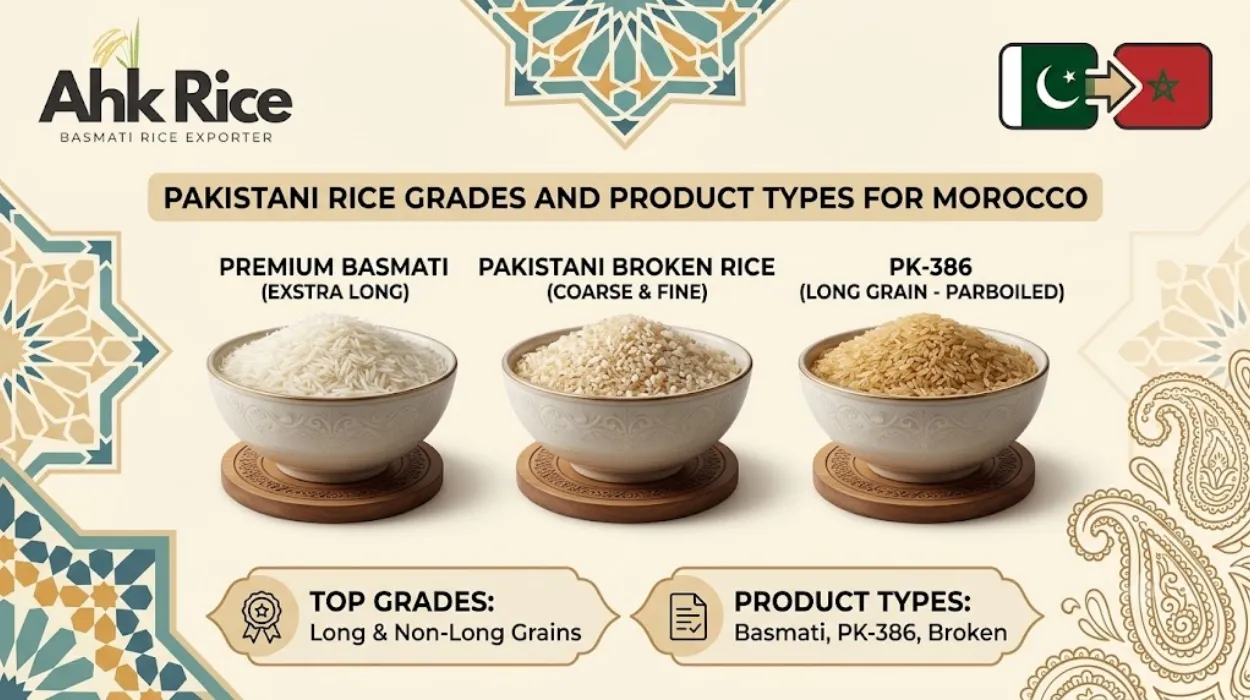
Morocco imports several Pakistani rice varieties, but premium Basmati grades dominate demand because of their aroma, grain length, cooking performance, and suitability for retail, wholesale, and food-service distribution. Understanding rice grades helps importers evaluate quality, pricing, shelf life, and consumer acceptance.
Morocco’s rice market includes retail consumers, restaurants, hotels, catering businesses, and food distributors. Each segment prefers specific rice characteristics. Pakistani exporters supply multiple rice categories that satisfy these requirements through different processing methods, grain specifications, and quality grades.
Understanding the relationship between rice variety, processing standards, and market demand helps explain why Pakistan remains one of the world’s leading rice exporters and why Moroccan buyers continue sourcing Pakistani rice products.
What are the Pakistani rice grades and product types imported into Morocco?
Pakistani rice imports into Morocco primarily include Basmati and non-Basmati varieties. The most common products are 1121 Basmati Rice, Super Kernel Basmati Rice, 1509 Basmati Rice, Long Grain White Rice, and different processing grades based on grain length, purity, and milling specifications.
Rice grade refers to a classification system that evaluates grain quality. The grading process measures physical characteristics such as grain length, broken percentage, purity level, moisture content, chalkiness, and milling quality.
Product type refers to the rice variety itself. Different varieties possess different cooking characteristics, aroma profiles, and grain structures.
The most commonly imported Pakistani rice products into Morocco include:
1121 Basmati Rice
1121 Basmati Rice is known for extra-long grains. Raw grain length often exceeds 8.0 millimeters. After cooking, grains elongate significantly while remaining separate.
Importers select this variety for premium retail packaging, restaurants, wedding catering services, and hospitality businesses.
Super Kernel Basmati Rice
Super Kernel Basmati Rice is one of Pakistan’s traditional aromatic varieties. It offers strong fragrance and excellent cooking characteristics.
Moroccan buyers often choose this variety for consumers seeking authentic Basmati aroma.
1509 Basmati Rice
1509 Basmati Rice matures earlier than traditional Basmati varieties. It produces long grains and attractive cooking results.
The variety balances premium quality and competitive pricing, making it suitable for mass-market retail channels.
Long Grain White Rice
Long Grain White Rice belongs to the non-Basmati category. It provides affordability and broad consumer accessibility.
Importers frequently use this category for institutional supply contracts and price-sensitive markets.
How is Pakistani rice grown before export?
Pakistani rice is cultivated in fertile agricultural regions of Punjab and Sindh using irrigation systems, seasonal planting cycles, controlled harvesting practices, and post-harvest quality management procedures that preserve grain quality before milling and export preparation.
Rice cultivation begins with seed selection.
Farmers prepare nursery beds and transplant seedlings into flooded fields. Irrigation water supports crop growth throughout the cultivation cycle.
Punjab serves as the primary production region for premium Basmati rice. The region’s soil composition, temperature patterns, and water availability contribute to grain quality and aroma development.
The production cycle includes:
- Seed selection
- Nursery preparation
- Transplanting
- Irrigation management
- Crop monitoring
- Harvesting
- Drying
- Storage
Harvesting typically occurs when grain moisture reaches suitable levels for processing.
After harvesting, paddy rice enters drying facilities where moisture is reduced to maintain storage stability.
How does Pakistani rice processing work?
Rice processing transforms harvested paddy into export-ready products through cleaning, husking, polishing, grading, sorting, quality inspection, packaging, and container loading procedures that ensure consistent specifications for international buyers.
Processing begins when harvested paddy arrives at the rice mill.
Cleaning
Machines remove dust, stones, straw fragments, and foreign materials.
Cleaning protects milling equipment and improves final product quality.
Husking
The outer husk is removed from the grain.
The result is brown rice.
Whitening and Polishing
Milling equipment removes bran layers.
Polishing creates a smooth grain appearance preferred by many international markets.
Length Grading
Machines separate grains according to size.
Examples include extra-long grains, long grains, and shorter grains.
Color Sorting
Optical sorting systems remove discolored grains.
Examples include yellow grains, damaged grains, and immature grains.
Quality Inspection
Laboratory testing verifies export specifications.
Parameters include:
- Moisture percentage
- Purity percentage
- Broken percentage
- Grain length
- Foreign matter content
Packaging
Rice is packed into export bags.
Examples include:
- 1 kg retail packs
- 5 kg retail packs
- 10 kg retail packs
- 25 kg bags
- 50 kg bags
What are the key components that determine rice grades?
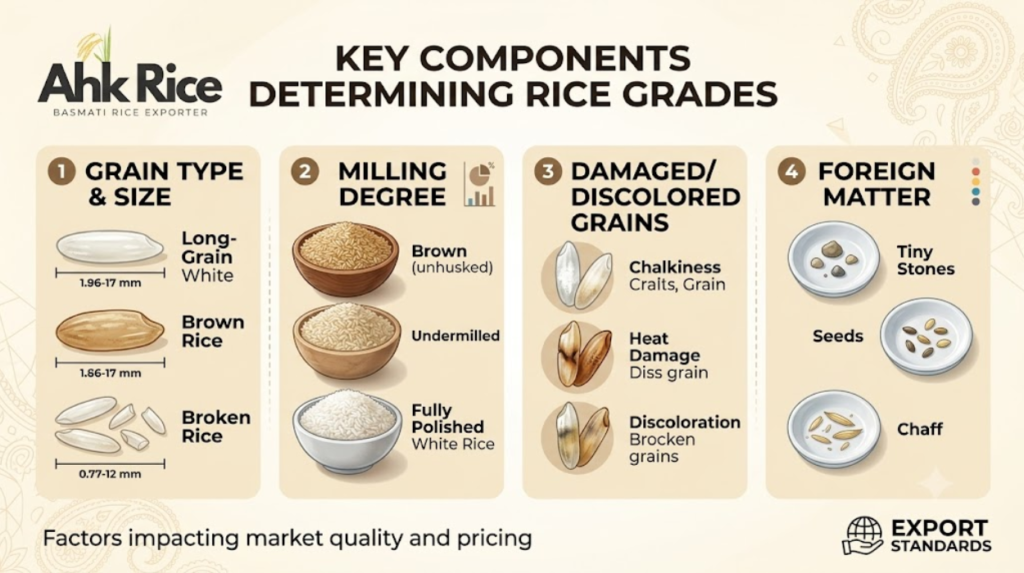
Rice grades are determined by grain length, broken percentage, moisture content, purity level, milling quality, foreign matter content, and visual appearance. These measurable specifications establish product value and suitability for different import markets.
Rice grading relies on objective measurements.
Grain Length
Longer grains generally command higher market value.
Premium Basmati categories require specific length standards.
Broken Percentage
Broken grains reduce visual appeal.
Common export specifications include:
- 0% broken
- 2% broken
- 5% broken
- 10% broken
Purity
Purity measures the percentage of the intended variety present within the shipment.
Higher purity increases product consistency.
Moisture Content
Moisture affects storage stability.
Most export shipments maintain controlled moisture levels to preserve shelf life.
Foreign Matter
Foreign matter includes non-rice materials.
Examples include stones, dust particles, and plant residue.
Milling Quality
Milling quality influences appearance, cooking performance, and consumer perception.
Why do Moroccan importers prefer Pakistani rice?
Moroccan importers prefer Pakistani rice because it offers aromatic characteristics, long grain appearance, reliable cooking performance, multiple grade options, competitive export availability, and suitability for both premium and mass-market distribution channels.
Consumer preferences influence import decisions.
Basmati rice appeals to buyers seeking aroma and grain elongation.
Restaurants value consistency because repeatable cooking results support menu quality.
Retailers prefer products that offer strong shelf presentation and consumer recognition.
Distributors benefit from a wide range of grades that match different customer segments.
Import demand also reflects growing consumer familiarity with Pakistani rice varieties.
Readers interested in broader trade trends and future demand patterns can explore Morocco’s expanding rice market through Morocco’s Rising Rice Import Demand and Pakistan’s Trade Opportunities in 2026.
What benefits do different Pakistani rice grades provide?
Different Pakistani rice grades provide specific advantages including premium presentation, stronger aroma, longer cooked grains, improved affordability, broader consumer accessibility, and flexibility across retail, hospitality, and food-service applications.
Each grade serves a distinct purpose.
Premium Grades
Examples include:
- 1121 Steam Basmati Rice
- 1121 Sella Basmati Rice
- Super Kernel Basmati Rice
Benefits include:
- Extra-long grain appearance
- Premium positioning
- High consumer recognition
Mid-Range Grades
Examples include:
- 1509 Basmati Rice
- Standard Basmati grades
Benefits include:
- Balanced pricing
- Strong cooking performance
- Broad market reach
Economy Grades
Examples include:
- Long Grain White Rice
- Certain non-Basmati products
Benefits include:
- Lower procurement costs
- Institutional suitability
- Volume distribution opportunities
Where are Pakistani rice grades used in Morocco?
Pakistani rice grades are used across retail supermarkets, restaurants, hotels, catering businesses, wholesale distribution networks, and institutional food supply channels throughout Morocco. Different sectors select varieties according to quality requirements and pricing objectives.
Retail stores often prioritize consumer-friendly packaging and recognizable Basmati varieties.
Restaurants frequently select rice grades that deliver grain separation and attractive presentation.
Hotels value consistency and premium appearance.
Catering companies require products capable of maintaining texture during large-scale meal preparation.
Wholesale distributors typically maintain multiple grades to satisfy diverse customer requirements.
Examples include:
- Supermarkets
- Hypermarkets
- Restaurants
- Hotels
- Event caterers
- Food wholesalers
What certifications apply to Pakistani rice exports?
Pakistani rice exports commonly require food safety, quality assurance, phytosanitary, and regulatory compliance certifications that verify product safety, traceability, and suitability for international trade requirements.
Certification requirements vary according to destination market regulations.
Several certification categories frequently apply to rice exports.
Phytosanitary Certification
Government authorities issue phytosanitary certificates.
These documents confirm compliance with plant health requirements.
Certificate of Origin
The certificate identifies the country where the rice was produced.
Import authorities use it for trade verification.
Quality Inspection Reports
Independent inspection agencies evaluate shipment specifications.
Reports document conformity with contractual requirements.
Food Safety Certifications
Examples include:
- ISO standards
- HACCP systems
- Food safety management certifications
These systems help maintain processing consistency and traceability.
Packaging Compliance Documentation
Exporters provide documentation confirming packaging conformity with import regulations.
What misconceptions exist about Pakistani rice grades?
Many buyers incorrectly assume that all Basmati rice grades are identical, longer grains always indicate better quality, and non-Basmati rice lacks value. Rice quality depends on intended application, processing standards, and specification requirements.
One misconception is that every Basmati variety performs identically.
Different varieties produce different aroma levels, grain expansion rates, and cooking textures.
Another misconception is that the most expensive grade suits every market.
Importers achieve better results when product specifications match target consumer preferences.
Some buyers also assume non-Basmati rice is inferior.
Non-Basmati products serve important roles in institutional supply chains, food processing industries, and budget-focused consumer segments.
Understanding these distinctions improves purchasing decisions and supports better market positioning.
Pakistani rice exports to Morocco consist of multiple product categories, processing methods, and quality grades. The most common imports include 1121 Basmati Rice, Super Kernel Basmati Rice, 1509 Basmati Rice, and Long Grain White Rice. Each variety serves different market requirements based on aroma, grain length, cooking characteristics, and price positioning.
Rice grading depends on measurable factors including grain length, broken percentage, purity, moisture content, and milling quality. These specifications determine product suitability for retail distribution, hospitality services, wholesale trade, and institutional supply channels. As Morocco’s rice consumption continues to diversify, understanding rice grades and product types remains essential for importers, distributors, and food businesses evaluating Pakistani rice products.
Frequently Asked Questions
Which Pakistani rice variety is most commonly imported into Morocco?
1121 Basmati Rice is among the most commonly imported varieties because of its extra-long grain length, premium appearance, and strong consumer demand.
What is the difference between 1121 Basmati and Super Kernel Basmati?
1121 Basmati offers longer grain length, while Super Kernel Basmati is widely recognized for its traditional aroma and flavor profile.
What does rice grade mean in export trade?
Rice grade is a quality classification based on factors such as grain length, broken percentage, moisture content, purity, and milling quality.
Does Morocco import non-Basmati rice from Pakistan?
Yes. Morocco imports non-Basmati products such as Long Grain White Rice for institutional, wholesale, and value-focused market segments.
Which certifications are commonly required for Pakistani rice exports?
Common certifications include phytosanitary certificates, certificates of origin, quality inspection reports, and food safety management certifications.