1509 vs 1121 Basmati Rice: Which Is More Profitable?
1509 Basmati is more profitable for cost-sensitive, high-volume distribution, while 1121 Basmati creates stronger margins in premium retail and HORECA channels. Here is why: 1509 offers a lower acquisition cost, while 1121 delivers longer grain, stronger visual appeal, and premium positioning.
The profitability difference starts with procurement cost. 1509 typically enters export contracts below 1121. The gap gives distributors more room for competitive pricing and volume turnover. 1121 requires higher procurement expenditure but supports premium shelf positioning and higher-value foodservice applications.
For a complete foundation on grades, processing, grain specifications, and export quality, read this guide to 1121 and 1509 Basmati rice for export buyers before evaluating commercial profitability.
What are the available solutions for Basmati rice importers?
Importers have two core solutions: 1121 for premium-value positioning and 1509 for cost-efficient volume distribution. The correct solution depends on grain presentation, customer segment, procurement budget, processing type, storage requirements, and achievable selling price.
1121 Basmati is an extra-long-grain Pakistani Basmati variety. Commercial specifications commonly place raw grain length around 8.2–8.5 mm. Its cooked grain can expand dramatically, making it attractive for biryani, pulao, premium retail, and HORECA applications.
1509 Basmati is also a long-grain Basmati variety. It offers a lower-cost route to long-grain presentation. Current market references commonly place 1509 below 1121 in export pricing. Its value proposition centers on procurement efficiency and high-volume distribution.
Both varieties can be processed as White, Steam, or Sella. Steam processing uses controlled steaming and drying. Sella processing uses parboiling before drying. White rice follows milling without parboiling.
AHK Rice supplies 1121, Super Kernel, and 1509 Basmati from Punjab. Its export operation covers processing, grading, packaging, documentation, and shipment coordination for international buyers.
The available solutions therefore extend beyond variety selection. Importers must also select processing type, broken percentage, moisture specification, packaging, order quantity, and Incoterm.
How do 1509 and 1121 compare on specifications?
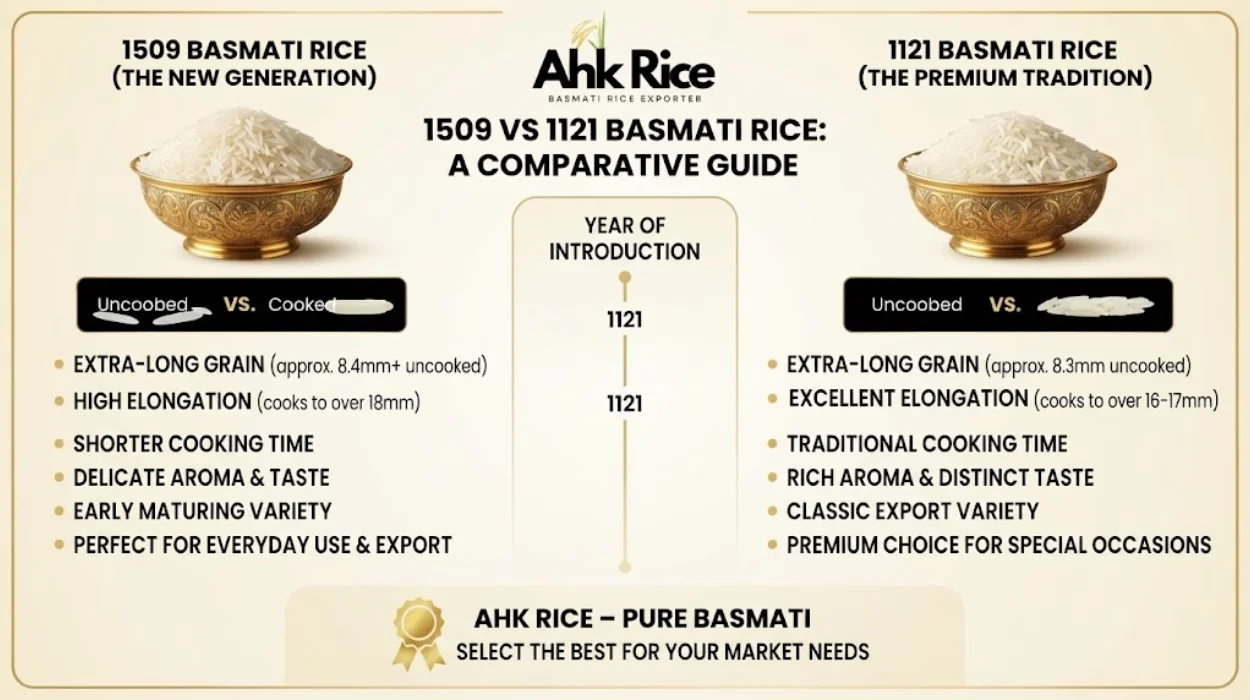
1121 leads on raw grain length and premium visual presentation, while 1509 delivers competitive length with lower procurement cost. The commercial difference becomes clearer through grain dimensions, processing options, pricing, elongation, applications, and buyer positioning.
| Attribute | 1121 Basmati | 1509 Basmati |
|---|---|---|
| Raw grain length | About 8.2–8.5 mm | About 7.4–8.0 mm |
| Cooked elongation | High, often above 20 mm | High, generally below 1121 |
| Price position | Premium | Value-oriented |
| Processing forms | White, Steam, Sella | White, Steam, Sella |
| Main buyers | Premium retail, HORECA | Wholesale, foodservice, value retail |
| Visual positioning | Extra-long premium grain | Long-grain value specification |
| Commercial objective | Higher unit value | Higher cost efficiency |
A current AHK Rice comparison places 1121 around 8.2–8.5 mm and 1509 around 7.4–8.0 mm, depending on specification.
A separate Pakistani exporter reference lists 1121 at approximately 8.30 mm with an indicative FOB range of $1,135–$1,205 per MT.
The specification gap matters because grain appearance influences consumer perception. A longer cooked grain creates a visible premium effect on retail shelves and restaurant plates.
The price gap matters because procurement cost directly affects gross margin. A distributor selling through price-sensitive channels often benefits from purchasing the lower-cost specification.
With the specification difference established, profitability depends on the market where each variety is sold.
Which markets prefer 1121 and 1509 Basmati?
1121 fits premium GCC, European, UK, US, and HORECA channels, while 1509 fits value-focused wholesale and foodservice channels. Market positioning determines whether longer grain or lower procurement cost creates stronger commercial value.
GCC and Middle East
GCC markets provide strong applications for both varieties. UAE and Saudi Arabia have established demand for Pakistani Basmati rice across retail, catering, restaurants, and wholesale distribution.
Pakistan’s FY2024 trade data shows substantial Basmati exports to the UAE, Saudi Arabia, Oman, and other Middle Eastern destinations. UAE Basmati exports reached a reported 149,092 MT across rice categories in the cited trade dataset, while Saudi Arabia recorded 101,909 MT of rice exports from Pakistan. (source: Annual Analytical Report on Trade Statistics of Pakistan, FY2024)
1121 fits premium supermarket packs and restaurants where grain appearance supports a higher selling price. Golden Sella 1121 also suits catering operations requiring cooked grain separation and strong presentation.
1509 fits wholesale distribution and value-focused foodservice. Its lower procurement position helps distributors compete across large-volume channels.
Current Pakistani market references place 1121 around $1,135–$1,205 per MT FOB Karachi. AHK Rice references 1509 around $780–$1,050 per MT, depending on processing and specification.
These figures are indicative export references. Final prices change with crop year, broken percentage, processing, packaging, quantity, and Incoterm.
Europe and United Kingdom
European buyers place greater emphasis on compliance, traceability, pesticide-residue controls, and consistent specifications. Pakistan’s State Bank reported that Basmati exports remained resilient in markets including the UAE and Kazakhstan, while stricter sanitary and phytosanitary requirements affected other rice categories in the EU and UK. (source: State Bank of Pakistan, Annual Report FY2025)
1121 suits premium ethnic retail and specialist foodservice because its grain presentation supports higher-value positioning. 1509 works for distributors targeting competitive retail prices and larger-volume foodservice procurement.
Shelf life depends more on processing, moisture, packaging, storage conditions, and crop age than variety alone. AHK Rice market guidance gives indicative planning ranges of approximately 12–16 months for 1121 and 14–18 months for 1509 under stated specifications.
A controlled warehouse changes the commercial calculation. Climate-controlled storage protects quality more consistently than hot, humid storage. Packaging also protects the product from moisture exposure and handling damage.
With GCC and European positioning defined, the next question is how price and shelf-life differences affect actual margins.
What are the price and shelf-life differences?
1509 generally offers a lower FOB purchase price and longer indicative storage window, while 1121 commands a premium because of grain length and market positioning. Profitability depends on how much selling-price premium the buyer can capture.
Current market references demonstrate a substantial price spread. One AHK Rice comparison places 1121 White at approximately $1,250–$1,600 per MT for a China-oriented specification and 1509 White at approximately $850–$1,050 per MT.
Another Pakistani exporter currently lists 1121 at $1,135–$1,205 per MT FOB Karachi.
These figures should not be treated as universal contract prices. They represent market references under specific specifications. A confirmed export quote requires the exact variety, processing type, grade, packing, quantity, destination, and Incoterm.
Shelf life creates another commercial variable. AHK Rice guidance indicates approximately 12–16 months for 1121 and 14–18 months for 1509 under its stated specifications.
The difference matters for distributors carrying inventory between purchasing and retail sale. Longer planned storage can reduce pressure to clear stock quickly.
Storage conditions still control the outcome. Moisture, warehouse temperature, humidity, packaging integrity, and pest-control procedures affect retained quality.
Price therefore cannot determine profitability alone. A buyer must calculate procurement cost against achievable selling price, inventory duration, logistics, and customer acceptance.
Which method works best for different buyer cases?
1121 works best when customers pay for premium grain presentation, while 1509 works best when procurement efficiency and high-volume turnover drive the business model. The product should match the buyer’s channel before price becomes the deciding variable.
A premium supermarket distributor can monetize 1121 through smaller consumer packs and premium positioning. The higher purchase price becomes part of a higher-value retail proposition.
A wholesale distributor can monetize 1509 through competitive pricing and larger sales volumes. The lower acquisition cost supports aggressive market pricing without removing the entire margin opportunity.
A restaurant group can use either variety. Premium biryani restaurants often value 1121’s cooked appearance. High-volume catering operations can prioritize 1509 when portion economics matter more than maximum grain length.
Private-label buyers can also select either variety. The packaging, declared specification, processing type, and target retail price should match the chosen grain.
The key principle is simple: profitability comes from the relationship between procurement cost and realizable selling price, not from variety name alone.
What are the pros and cons of 1121 and 1509?
1121 provides stronger premium positioning but requires higher procurement investment, while 1509 reduces purchase cost but offers less maximum grain differentiation. Each advantage becomes commercially useful only in the right distribution channel.
1121 Basmati advantages
Premium grain length creates strong visual differentiation. The raw grain commonly reaches approximately 8.3 mm in premium specifications.
Strong cooked presentation supports biryani, pulao, restaurant, and premium retail applications.
Higher price positioning creates room for premium consumer packs and specialist foodservice pricing.
1121 Basmati limitations
Higher procurement cost increases the working capital required for each shipment.
Premium positioning requirements demand consistent grain quality and packaging presentation.
Price-sensitive channels can reduce the commercial advantage when customers focus primarily on affordability.
1509 Basmati advantages
Lower procurement cost supports competitive wholesale pricing.
Strong long-grain appearance provides a Basmati proposition without the full 1121 premium.
Volume suitability makes the variety practical for distributors serving price-sensitive customers.
1509 Basmati limitations
Lower premium differentiation limits the price premium available in luxury retail channels.
Specification consistency remains essential because buyers compare grain length, aroma, cooking performance, and broken percentage.
Market positioning must emphasize value rather than maximum grain length.
These trade-offs show why a simple “higher price equals higher profit” calculation does not work.
What decision factors should importers use?
Importers should compare selling price, procurement cost, customer segment, grain specification, processing type, storage period, and order volume before selecting 1121 or 1509 for commercial distribution.
| Decision factor | Choose 1121 when | Choose 1509 when |
|---|---|---|
| Customer segment | Premium retail or HORECA | Wholesale or value foodservice |
| Selling price | Customers accept premium pricing | Customers prioritize affordability |
| Grain presentation | Maximum elongation matters | Long grain at lower cost matters |
| Inventory model | Premium stock moves at planned velocity | Volume turnover drives revenue |
| Procurement strategy | Unit value matters most | Cost efficiency matters most |
A distributor should start with the customer specification. This prevents procurement teams from buying premium grain that the market will not pay for.
The second factor is landed cost. FOB price alone does not represent final profitability. Freight, insurance, port charges, duties, inspection, inland transport, and financing affect the landed cost.
The third factor is pack size. Retail packs create different economics from 25 kg or 40 kg wholesale bags. Packaging also changes the final product positioning.
The fourth factor is processing. Steam, Sella, and White rice create different cooking characteristics and customer expectations. The importer should compare identical processing types before comparing prices.
The fifth factor is sample performance. Buyers should inspect grain appearance, broken percentage, moisture, aroma, cooking elongation, texture, and packaging before approving bulk procurement.
This framework converts a variety comparison into a practical procurement decision.
How can importers calculate profitability before ordering?
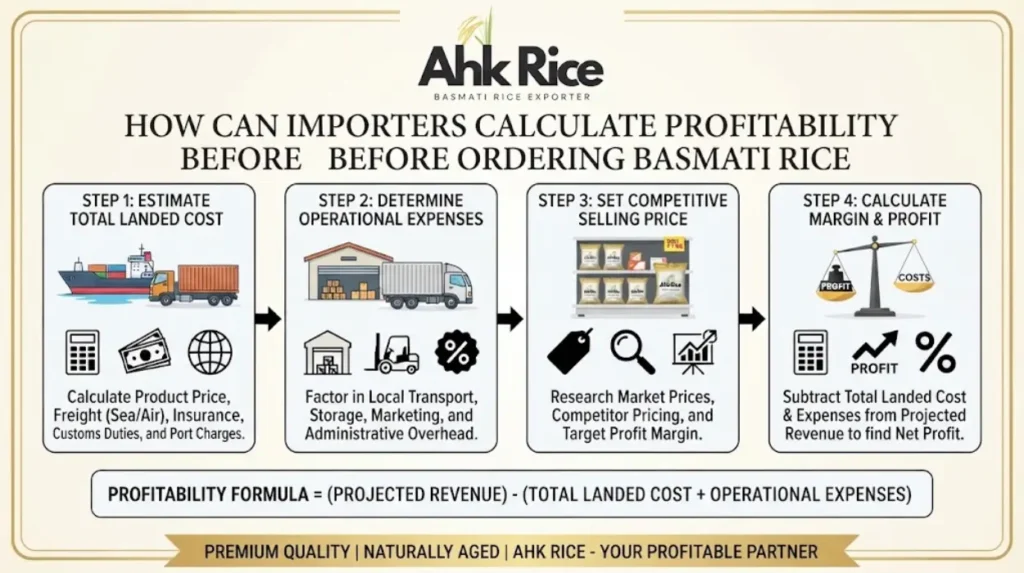
Calculate profitability from landed cost, expected selling price, packaging cost, logistics, wastage, financing, and turnover speed rather than FOB price alone. This approach shows whether 1121’s premium or 1509’s lower cost creates stronger commercial returns.
Consider a simplified example using a $200 per MT procurement difference. A 1,000 MT annual programme creates a $200,000 purchase-cost difference before logistics and financing.
A 1509 buyer can use that difference to maintain a lower retail price or preserve additional gross margin. The result depends on the market’s achievable selling price.
A 1121 buyer can justify higher procurement cost through premium retail positioning. The model works when customers pay enough for longer grain, presentation, and perceived quality.
Inventory turnover adds another variable. A product with a stronger premium but slower movement can produce a weaker annual return than a lower-cost product with faster turnover.
Importers should therefore calculate four numbers before contracting: landed cost per MT, selling price per MT, gross margin per MT, and annual turnover.
A physical sample should validate the commercial assumptions. The same cooking test should be applied to competing lots before final procurement.
What should buyers check before choosing 1509 or 1121?
Buyers should verify grain length, broken percentage, moisture, processing type, cooking performance, packaging, crop year, inspection requirements, and commercial terms before approving a bulk shipment.
Product verification
Inspect the raw grain for length uniformity and appearance. Test moisture against the agreed specification. Check broken grains through a representative sample.
Cooking verification
Cook both samples using the same water ratio and cooking method. Compare elongation, aroma, firmness, separation, and final appearance.
Commercial verification
Compare FOB or CIF pricing using identical quantities and specifications. Separate product price from freight and destination charges.
Documentation verification
Confirm commercial invoice, packing list, certificate of origin, phytosanitary documentation, fumigation documentation, and any destination-specific inspection requirements.
Packaging verification
Confirm bag material, weight, printing, labeling, palletization, and private-label requirements before production.
AHK Rice provides end-to-end processing and export support for buyers sourcing Pakistani Basmati. Its portfolio includes 1121, Super Kernel, and 1509 varieties, with custom packaging available for export programmes.
With product, quality, commercial, and documentation checks completed, buyers can select the variety according to measurable business requirements.
Is 1509 or 1121 more profitable for wholesale export?
1509 generally provides stronger cost efficiency for wholesale distribution, while 1121 provides stronger premium-value potential. Profitability depends on the buyer’s selling channel, achievable price, turnover rate, and required grain specification.
Wholesale distributors competing on price can benefit from 1509’s lower procurement position. The variety creates room for competitive offers while maintaining a long-grain Basmati proposition.
Premium distributors can use 1121 to target customers who value exceptional grain length and cooked presentation. The higher acquisition price becomes commercially relevant through premium positioning.
Neither variety guarantees a specific margin. Export profitability changes with crop conditions, market demand, freight rates, packaging, order volume, exchange rates, and destination costs.
Pakistan’s Basmati export performance remains significant across GCC, European, Asian, and other markets. Recent reporting identified UAE, Saudi Arabia, China, Tanzania, Kenya, and several European destinations among major Pakistani rice markets.
The commercial decision should therefore begin with the target market. Match the customer requirement to the grain specification. Then compare landed cost and achievable selling price.
For buyers moving from comparison to procurement, the next step is evaluating the exact 1509 specification, packaging, quantity, and export terms available for their destination.
What are the key FAQs about 1509 vs 1121 Basmati rice?
The main differences involve grain length, pricing, market positioning, cooking presentation, and procurement economics. 1121 targets premium applications, while 1509 targets competitive pricing and high-volume distribution.
Is 1509 cheaper than 1121 Basmati rice?
1509 generally carries a lower export price than 1121. The exact difference depends on processing, crop year, broken percentage, packaging, quantity, and destination.
Which rice has longer grains, 1509 or 1121?
1121 generally has the longer raw and cooked grain. Premium 1121 specifications commonly reach approximately 8.3 mm raw length and can exceed 20 mm after cooking.
Is 1509 good for wholesale?
Yes. 1509 suits wholesale distribution because its lower procurement position supports competitive pricing and volume-oriented sales.
Is 1121 better for restaurants?
1121 suits premium restaurant applications where cooked grain length, appearance, aroma, and presentation influence menu positioning.
Which has a longer shelf life?
Indicative AHK Rice guidance places 1509 at approximately 14–18 months and 1121 at approximately 12–16 months under stated specifications. Storage conditions and packaging remain important quality controls.
Can 1509 be sold as premium Basmati?
1509 can occupy a premium-quality position within value-oriented Basmati programmes. However, 1121 generally provides stronger maximum-length differentiation.
Which should an importer sample first?
Importers should sample the variety that matches their customer specification. Compare 1121 and 1509 under identical cooking and quality tests before approving the bulk order.
Does processing change profitability?
Yes. Steam, Sella, and White processing create different customer applications and commercial specifications. Buyers should compare the same processing type across both varieties.
1509 and 1121 solve different commercial problems. 1509 reduces procurement pressure and supports high-volume distribution. 1121 creates stronger premium differentiation through longer grain and exceptional cooked presentation.