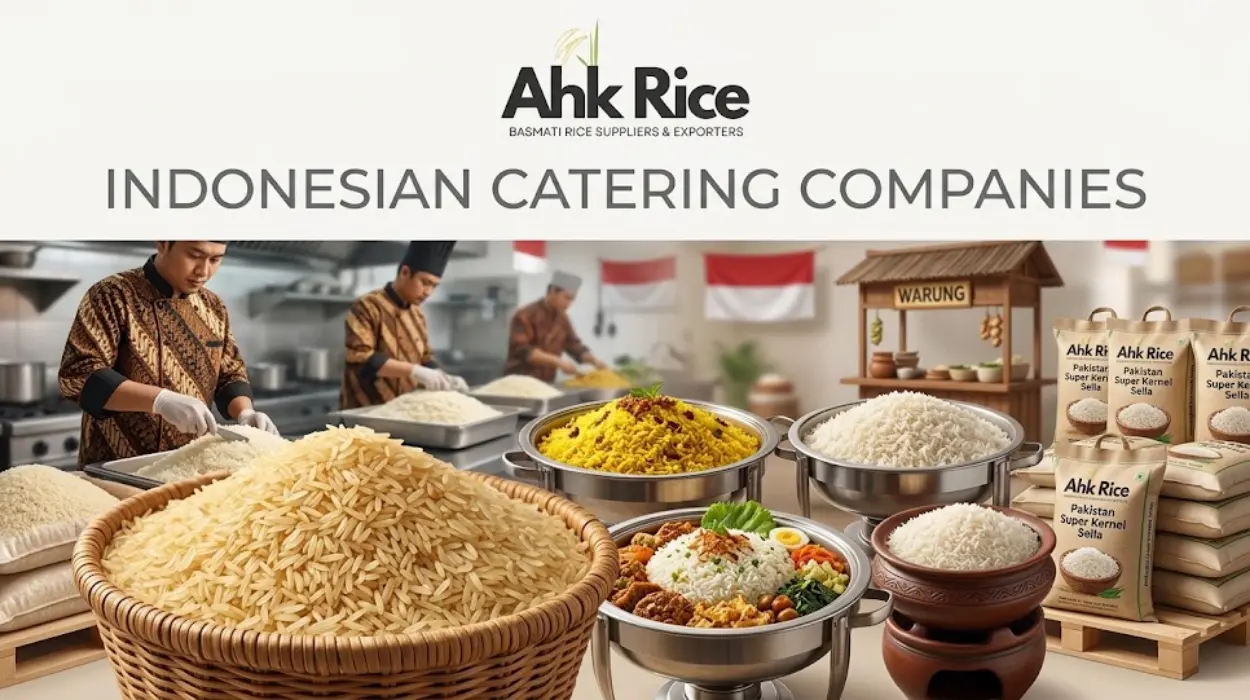
AHK Rice Pakistan Super Kernel Sella Supply for Indonesian Catering Companies
For Indonesian catering companies, the best Pakistan Super Kernel Sella supply is a specification-controlled program that combines approved samples, measurable grain standards, controlled parboiling, quality inspection, suitable packaging, export documentation, and predictable shipment planning rather than selecting a supplier on price per metric ton alone. AHK Rice supplies Super Kernel rice from Punjab for Indonesian buyers, with specifications that can be aligned to bulk catering requirements.
Before placing a commercial order, catering procurement teams should understand why Sella processing matters, which specifications affect cooking performance, how samples should be tested, what the landed cost includes, and how long Pakistan-to-Indonesia delivery can take. For the technical background, review :
Wat makes Pakistan Super Kernel Sella Rice suitable for Indonesian catering, then use the commercial process below to move from product evaluation to shipment.
What is the best solution for Indonesian catering companies buying Super Kernel Sella?
The strongest solution is an approved Super Kernel Sella specification matched with catering cooking tests, controlled processing, pre-shipment inspection, moisture-safe packaging, complete export documents, and a shipment plan that protects restaurant and event inventory from avoidable delays.
Indonesian caterers have a different purchasing requirement from retail buyers. They need rice that performs consistently in larger cooking batches. A product may look attractive in a bag but still create problems if grains break excessively, absorb water inconsistently, become sticky, or lose aroma after bulk cooking.
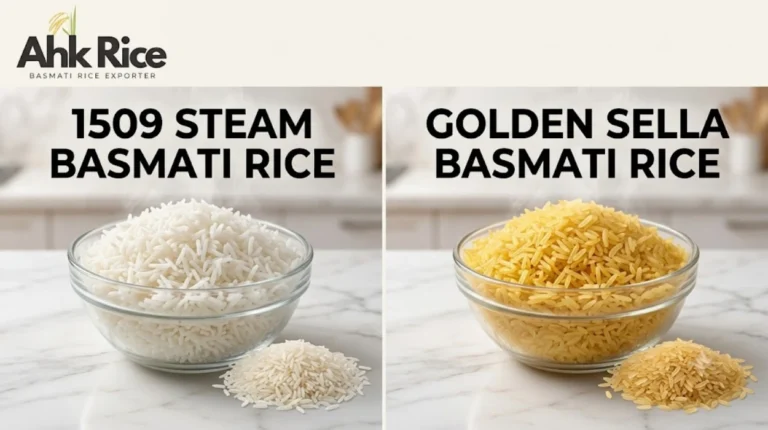
Super Kernel Sella addresses this requirement through parboiling. Sella describes the processing method rather than a separate variety. Paddy is soaked, steamed, dried, milled, sorted, graded, and packed. The resulting kernel is firmer and generally more resistant to breakage during cooking.
Current AHK Rice specifications for Super Kernel parboiled rice list approximately 7.0–7.2 mm average grain length, moisture up to 12.5%, and broken grains up to 2%. The broader Super Kernel export page lists approximately 7.0–7.5 mm and moisture up to 12.5%, demonstrating why the buyer should approve the exact contractual specification rather than rely only on the product name.
For a catering company, the practical target is repeatability. If a kitchen prepares 300, 500, or 1,000 portions, the rice should respond predictably to the same cooking method. This reduces kitchen adjustment, wastage, complaints, and inconsistency between catering events.
AHK Rice therefore positions the supply around specification approval rather than a generic “premium rice” claim.
Why should Indonesian caterers choose AHK Rice for Super Kernel Sella?
AHK Rice is suitable for buyers seeking Pakistan-origin Super Kernel supply because the purchasing process can be organized around measurable specifications, sample approval, controlled processing, packaging selection, export documentation, and direct shipment planning from Karachi to Indonesian ports.
AHK Rice operates from Punjab, Pakistan, where Super Kernel is produced within the country’s Basmati-growing rice belt. The company’s Indonesia supply pages identify Jakarta as a destination port and provide multiple packaging formats, including bulk PP bags and smaller private-label-oriented formats.
The commercial advantage is not simply product origin. It is the ability to define what is being purchased before production.
An Indonesian catering company can specify grain length, broken percentage, moisture, appearance, polishing level, packaging size, quantity, destination port, and Incoterm. The supplier then has a defined benchmark against which the finished shipment can be checked.
This approach is particularly important when the buyer plans repeat containers. A sample that performs well once is not enough. The approved sample and specification should become the reference for subsequent production.
AHK Rice also states that standard Super Kernel export orders can begin from approximately 20 MT, while its published Indonesia process includes inquiry, quotation, sample approval, production, quality control, packing, documentation, and shipment.
For buyers comparing several offers, the useful question is therefore not simply “Who offers the lowest price?” It is “Who can reproduce the specification at the agreed commercial basis?”
What specifications should Indonesian caterers put into the purchase contract?
Indonesian catering buyers should contract grain length, moisture, broken grains, foreign matter, chalky grains, color, polishing level, packing, crop requirements, inspection method, and tolerance limits because these parameters directly affect cooking performance and shipment acceptance.
A practical Super Kernel Sella specification can be structured as follows:
| Specification | Commercial target |
|---|---|
| Variety | Super Kernel Basmati |
| Processing | Sella / parboiled |
| Average raw grain length | About 7.0–7.2 mm |
| Moisture | Maximum about 12.5% |
| Broken grains | Maximum about 2% |
| Chalky grains | Maximum about 3% |
| Polishing | As contractually specified |
| Packaging | 25 kg, 40 kg, 50 kg PP or customized |
| Origin | Pakistan |
| Destination | Jakarta, Surabaya, or agreed Indonesian port |
These are commercial targets, not universal legal grades. The signed specification must control the transaction. AHK Rice’s published Super Kernel parboiled specification gives 7.0–7.2 mm average length, ≤12.5% moisture and ≤2% broken grains.
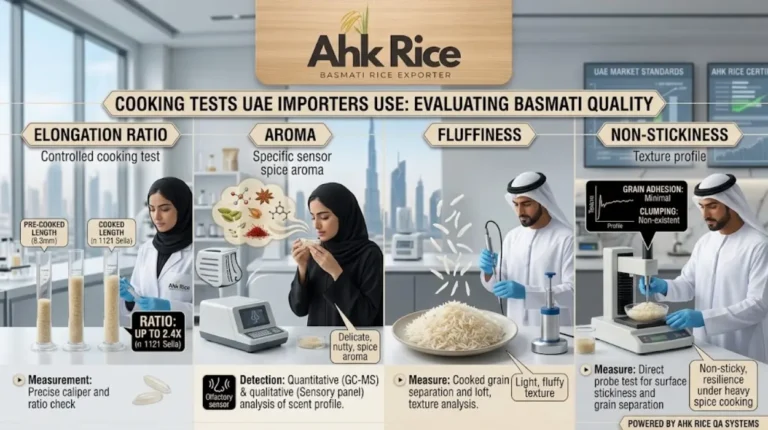
The catering buyer should also define the cooking test. A supplier sample should be cooked using the approximate rice-to-water ratio, soaking period, cooking equipment, holding period, and serving method used by the catering operation.
This matters because cooking performance cannot be judged accurately from raw-grain appearance alone.
For example, a catering company producing biryani may prioritize grain separation and firmness. A company supplying daily meal boxes may place greater weight on yield, aroma, softness, and cost per cooked portion. The same Super Kernel Sella specification can therefore have different commercial value depending on the menu.
How should Indonesian catering companies compare suppliers before ordering?
Caterers should compare suppliers through the same approved specification, controlled cooking test, complete landed-cost calculation, inspection procedure, packaging requirement, and delivery schedule so that competing quotations represent equivalent products and commercial terms.
The comparison should begin with the specification. If Supplier A quotes 2% broken and Supplier B quotes 5% broken, their prices are not directly comparable.
The second stage is sample testing. Both suppliers should provide samples against clearly identified specifications. The catering team should cook them under identical conditions and record grain separation, firmness, aroma, breakage, absorption, appearance, and yield.
The third stage is documentation. The buyer should establish which export and import documents are required for the specific shipment and confirm the Indonesian importer’s obligations before contracting.
Indonesia’s agricultural import framework is regulated and has been updated through 2026. Current Indonesian regulations include changes to agricultural and food import provisions, so importers should verify the applicable requirements for their specific product classification and intended use before shipment.
The fourth stage is commercial comparison. FOB Karachi, CFR/CNF, and CIF quotations should not be treated as identical offers. Freight, insurance, port charges, inspection, customs-related costs, inland transportation, financing, and importer expenses can materially change the final landed cost.
For the detailed product-comparison stage, Indonesian caterers can also use:
How Indonesian caterers compare Pakistan Super Kernel Sella rice specifications as the technical benchmark before moving into a purchase contract.
What sample process should Indonesian caterers follow before placing a bulk order?
The safest sample process moves from specification confirmation to physical sample dispatch, laboratory or supplier testing, controlled kitchen cooking, commercial approval, contract confirmation, and pre-shipment verification before the buyer commits to container-level purchasing.
The first step is the specification request. The buyer sends the required variety, Sella grade, grain length, broken percentage, moisture limit, packaging, quantity, destination port, and Incoterm.
The second step is sample preparation. AHK Rice states that samples can be arranged for Indonesia and that its Super Kernel Indonesia program supports sample requests. Its published process indicates that sample quantities can be provided, while the buyer covers applicable courier or phytosanitary costs.
The third step is shipment of the sample. A published AHK Rice Indonesia page states that 1–2 kg samples can be shipped by air in approximately 5–7 days. Actual courier time varies according to destination, customs processing, weekends, and carrier availability.
The fourth step is kitchen testing. The catering company should prepare the rice using its real production method. Test at least one normal batch and, where possible, a larger batch that represents commercial service.
The fifth step is approval. The buyer should document the accepted sample using photographs, cooking observations, specification values, and a reference sample code.
The sixth step is commercial confirmation. The purchase contract should identify the approved specification, quantity, packaging, price basis, destination, payment terms, inspection requirements, and delivery schedule.
The seventh step is pre-shipment verification. Before container loading, the finished lot should be checked against the agreed specifications. Third-party inspection can also be added when required by the buyer or contract.
This process converts a subjective “rice tasting” into a procurement control system.
How long does Pakistan Super Kernel Sella take to reach Indonesia?
For planning purposes, Indonesian caterers should separate production time, port handling, ocean transit, customs clearance, and inland delivery instead of treating shipping as one fixed number; actual transit depends on vessel schedules, transshipment, destination port, and clearance.
AHK Rice states that direct shipments are arranged from Karachi to Indonesian ports and identifies Jakarta as a destination.
A practical planning framework is:
| Stage | Planning window |
| Quote and specification confirmation | 1–2 days |
| Sample air shipment | About 5–7 days |
| Production and preparation | About 7–10 days where stock is not immediately available |
| Documentation and loading | About 2–4 days |
| Ocean freight | Commonly plan around 20–35 days |
| Indonesian clearance and inland delivery | About 3–10+ days |
| Overall procurement planning | Roughly 5–8 weeks |
The ocean-freight range should be treated as a planning estimate, not a guaranteed transit promise. Vessel schedules, transshipment, port congestion, customs inspection, weather, and documentation can change arrival dates.
For catering businesses, the most useful approach is to build a safety stock period into procurement planning. If the operation has a fixed wedding, hotel, restaurant, or institutional contract, the next shipment should be planned before existing inventory reaches its minimum operating level.
AHK Rice’s published product process also separates production, quality inspection, packing, documentation, and shipment, which is the correct structure for commercial planning.
What affects the price of Super Kernel Sella rice per metric ton?
Super Kernel Sella pricing depends on the exact specification, crop and stock position, broken percentage, processing, polishing, packaging, order volume, inspection, freight, destination, payment terms, and Incoterm, so an online price should be treated as indicative rather than contractual.
A catering buyer should calculate price in two stages.
The first is the product price at origin. The second is the landed cost in Indonesia.
For comparison, current AHK Rice published Indonesia pages show the Super Kernel product with a price placeholder rather than a fixed public quotation, meaning the commercial price must be calculated against the buyer’s actual requirements.
The major price variables are:
- Grade and specification: Lower broken limits and tighter quality tolerances can increase cost.
- Processing: Sella processing, sorting, polishing, and quality control affect the mill cost.
- Packaging: Standard 50 kg PP bags generally differ in cost from customized retail or catering packaging.
- Quantity: A full-container order can have a different unit economics from a small shipment.
- Incoterm: FOB, CFR/CNF, and CIF transfer different freight and risk responsibilities.
- Destination: Jakarta and Surabaya can produce different freight and local handling costs.
- Inspection: Third-party inspection adds a cost but can reduce quality-dispute risk.
- Payment terms: LC, TT, advance payment, and financing requirements influence commercial pricing.
- Freight market: Ocean freight changes according to vessel availability and route conditions.
- Currency: Exchange-rate movements can affect the buyer’s final purchasing cost.
The correct purchasing metric is therefore landed cost per usable kilogram, not simply the quoted FOB price per MT.
What results can Indonesian caterers expect from a controlled Super Kernel Sella program?
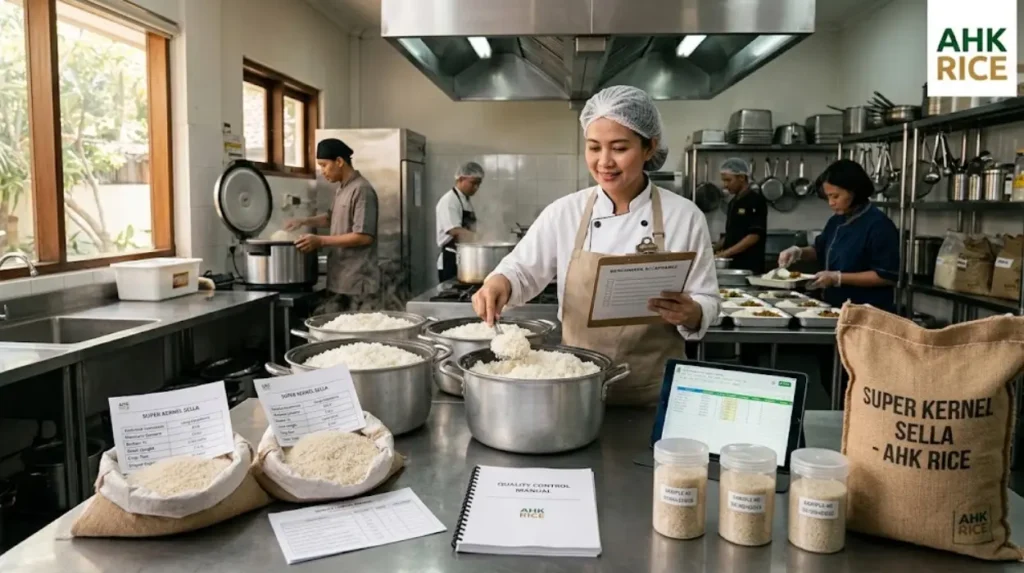
A controlled Super Kernel Sella program can improve cooking consistency, reduce specification disputes, support predictable procurement, simplify repeat ordering, and provide stronger inventory planning when every shipment is matched against an approved technical and commercial benchmark.
The first expected result is more predictable kitchen performance. Parboiled kernels are designed to provide stronger grain integrity and separate cooking characteristics.
The second is lower procurement uncertainty. When moisture, broken percentage, grain length, packaging, and inspection requirements are written into the contract, the buyer has measurable acceptance criteria.
The third is better repeat-order management. Once a sample has been approved, the same specification can be used for future purchase orders.
The fourth is improved cost visibility. The buyer can compare product cost, freight, destination expenses, and expected usable yield rather than making decisions from FOB price alone.
The fifth is stronger inventory planning. A catering business can connect average consumption with container lead time and safety stock, reducing the risk of emergency local purchasing at unfavorable prices.
AHK Rice can support this model by coordinating the product specification, processing, packing, documentation, and shipment requirements around the Indonesian buyer’s order.
How should an Indonesian catering company decide whether to order?
The final purchase decision should be based on five conditions: the sample passes the kitchen test, the written specification matches the sample, the landed cost meets the target margin, the shipment schedule protects inventory, and the supplier can repeat the approved quality.
| Decision criterion | Pass condition |
| Product specification | Contract values match approved sample |
| Cooking test | Required separation, aroma, firmness and yield achieved |
| Commercial price | Landed cost supports target food cost |
| Logistics | Shipment schedule fits minimum inventory requirements |
| Supplier reliability | Repeat production and inspection process is defined |
If all five conditions pass, the buyer can move from sample approval to a commercial purchase order.
AHK Rice is positioned for this type of specification-led procurement because its Indonesia supply process covers Super Kernel product selection, sample handling, processing, quality checks, packaging, documentation, and shipment coordination.
The most important point is that Indonesian catering companies should not purchase Super Kernel Sella simply because it is described as Pakistani Basmati. They should purchase a defined specification that has already passed their own cooking test.
That distinction protects both food quality and commercial margins. To move from specification approval to a commercial Super Kernel Sella supply program, submit the required shipment details through AHK Rice’s request-a-quote process.
Frequently Asked Questions
Is Super Kernel Sella suitable for Indonesian catering companies?
Yes. Super Kernel Sella can suit catering operations that need aromatic rice with firm grain structure and separated cooking performance. The final suitability should be confirmed through a cooking test using the catering company’s actual preparation method.
What is Super Kernel Sella rice?
Super Kernel Sella is Super Kernel Basmati rice processed through parboiling before milling. The Sella process strengthens the kernel and supports firmer, more separate cooked grains.
What grain length does Super Kernel Sella have?
Current AHK Rice specifications list approximately 7.0–7.2 mm average grain length for Super Kernel parboiled rice, while the broader Indonesia product specification lists approximately 7.0–7.5 mm. The buyer should contract the exact required measurement.
What moisture level should Indonesian buyers request?
A current AHK Rice Super Kernel parboiled specification lists maximum moisture of approximately 12.5%. The final moisture requirement should be agreed in the purchase specification and verified before shipment.
What broken percentage is suitable for catering?
A Super Kernel Sella specification can target approximately 2% maximum broken grains. Catering companies should select the limit according to cooking performance, budget, and customer expectations.
Can Indonesian buyers request customized packaging?
Yes. AHK Rice publishes multiple packaging options for Super Kernel rice, including bulk PP bags and smaller customized formats. The buyer should confirm packaging material, size, printing, labeling, and minimum order requirements before contracting.
How much does a Super Kernel Sella sample cost?
AHK Rice states that sample rice can be provided while the buyer covers applicable shipping costs and phytosanitary charges. The exact courier and documentation cost depends on sample weight and destination.
How long does the Super Kernel Sella sample take to reach Indonesia?
The published AHK Rice Indonesia process indicates approximately 5–7 days for a 1–2 kg sample sent by air. Actual delivery can vary according to courier and customs processing.
What should be included in a Super Kernel Sella quotation?
The quotation should state variety, Sella processing, specification, quantity, packaging, price basis, Incoterm, destination port, payment terms, inspection requirements, documentation, production lead time, and estimated shipping schedule.
Should Indonesian caterers compare FOB or landed price?
They should compare landed cost when making the final decision. FOB only represents the origin-side commercial price and does not fully represent freight, insurance, destination charges, customs-related costs, handling, or inland transportation.
How can an Indonesian catering company start the procurement process?
Start by sending the required quantity, Super Kernel Sella specification, packaging size, destination port, preferred Incoterm, and intended use, then request a commercial quotation and sample for controlled kitchen approval before confirming the bulk order.