How Do Indonesian Caterers Compare Pakistan Super Kernel Sella Rice Specifications?
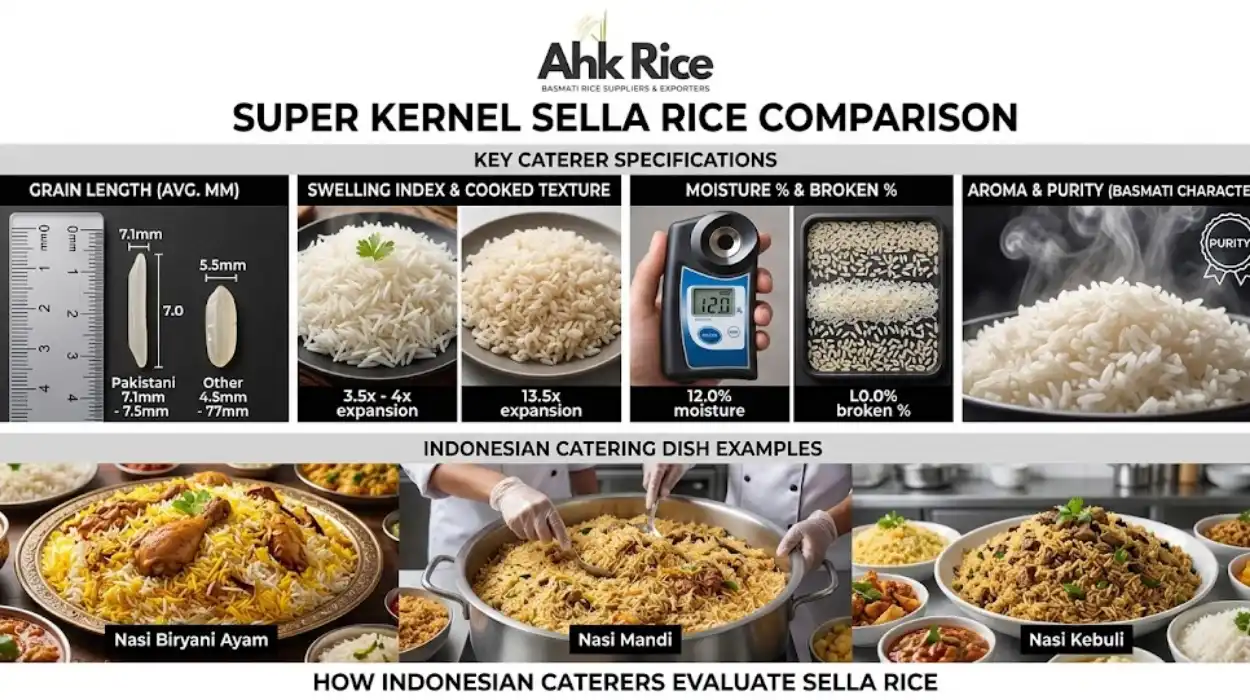
Indonesian caterers should compare Pakistan Super Kernel Sella Rice by grain length, broken percentage, moisture, parboiling quality, cooking performance, price per metric ton, and storage stability because the lowest quotation does not necessarily deliver the best cost per cooked portion.
For buyers who first need to understand the product, cultivation, parboiling process, grading, and catering suitability, the educational guide on:
What makes Pakistan Super Kernel Sella Rice suitable for Indonesian catering provides the production and product background needed before comparing supplier specifications.
Indonesian caterers face a different purchasing requirement from household consumers. A catering company may cook hundreds or thousands of portions in one production cycle. Rice must therefore remain consistent after soaking, cooking, holding, serving, and transport. Super Kernel Sella is relevant because Sella describes parboiled rice, while Super Kernel identifies the Pakistani Basmati variety.
AHK Rice supplies Pakistani Basmati varieties including 1121, Super Kernel, and 1509 from Punjab, with processing, grading, sorting, packaging, inspection, and export coordination. The comparison should therefore focus on measurable specifications rather than generic descriptions such as premium, export quality, or extra-long.
What are the available Super Kernel Sella rice solutions for Indonesian caterers?
Indonesian caterers can choose Super Kernel Sella by broken percentage, grain length, moisture, processing intensity, packaging, and cooking target; the strongest option is the specification that delivers repeatable cooked yield at an acceptable landed cost per metric ton.
The first solution is a low-broken Super Kernel Sella grade. A specification around 0–2% broken grains targets premium catering, banquet service, hotels, restaurants, and events where whole-grain appearance affects presentation.
The second solution is a 3–5% broken grade. It can reduce procurement cost while retaining the main cooking characteristics of Super Kernel Sella. This grade fits catering businesses where rice is served as part of mixed meals rather than as the main visual feature.
The third solution is a higher-broken commercial grade. It can suit institutional kitchens and prepared-food production where the buyer prioritizes cost per portion over whole-kernel presentation.
Super Kernel Sella is a Pakistani Basmati type generally associated with a raw grain length around 7.0–7.6 mm. Current AHK Rice specifications for Super Kernel parboiled rice for Indonesia list an average grain length of 7.0–7.2 mm, moisture up to 12.5%, and broken grains up to 2%.
The specification must be approved before bulk production because different suppliers can use different tolerances for moisture, broken grains, foreign matter, chalkiness, polishing, and grain length.
How do Indonesian caterers compare Super Kernel Sella specifications?
Caterers should compare Super Kernel Sella through seven measurable attributes: grain length, processing, moisture, broken percentage, purity, cooking performance, and price because these factors directly affect yield, appearance, storage, and procurement economics.
| Specification | Premium Super Kernel Sella | Commercial Super Kernel Sella |
|---|---|---|
| Average grain length | About 7.0–7.6 mm | About 7.0–7.4 mm |
| Processing | Controlled Sella/parboiled | Standard Sella/parboiled |
| Moisture | Target around ≤12.5% | Commonly ≤13–14% |
| Broken grains | 0–2% | 3–5% |
| Purity/foreign matter | Tighter buyer-defined tolerance | Standard commercial tolerance |
| Cooking performance | High separation and firm texture | Good separation and stable texture |
| Price per MT | Higher due to tighter specification | Lower due to wider tolerance |
These ranges are commercial procurement references, not a single universal Pakistani legal grade. The final contract should define the exact tolerance. AHK Rice’s Indonesia-facing Super Kernel Parboiled specification lists 7.0–7.2 mm average grain length, ≤12.5% moisture, ≤2% broken grains, ≤3% chalky grains, and a parboiled polishing process.
The distinction matters because two bags labelled Super Kernel Sella can have different commercial value. A 2% broken specification gives the caterer more whole kernels than a 5% broken specification. That difference affects visual presentation and cooked yield.
Moisture also requires measurement. Excessive moisture increases storage risk and can affect grain stability. Lower controlled moisture supports longer storage when the packaging and warehouse environment are also suitable.
Processing is equally important. Sella means the paddy has undergone hydrothermal treatment before milling. Controlled soaking, steaming, drying, dehusking, polishing, grading, and sorting create the final commercial product.
How does Sella processing affect catering performance?
Sella processing strengthens the rice kernel and improves resistance to breakage, making Super Kernel Sella suitable for bulk cooking where caterers need separated grains, stable texture, predictable yield, and better tolerance during holding and service.
Parboiling changes the physical structure of the rice. The paddy is soaked and heated before drying and milling. This produces a harder kernel than many raw-milled rice products.
For catering companies, the practical benefit appears during bulk cooking. Large batches create more mechanical handling, water variation, heat variation, and holding time than household cooking.
A stronger kernel can maintain its structure when prepared in large quantities. This makes Super Kernel Sella suitable for biryani, pulao, banquet rice, buffet service, institutional meals, and other high-volume applications.
The caterer should still test the rice using its own cooking method. A supplier’s laboratory specification cannot replace a real kitchen trial.
For example, a caterer preparing 500 portions should test the approved sample at commercial batch size. The test should record water ratio, soaking time, cooking time, cooked weight, broken grains, separation, firmness, aroma, and holding performance.
The objective is not simply to find rice that looks good before cooking. The objective is to determine how many acceptable portions one metric ton can produce after actual preparation.
How do price per metric ton comparisons work in 2026?
Price per metric ton should be compared on an equivalent FOB, CFR, or CIF basis and against the same Super Kernel Sella specification because broken percentage, moisture, packaging, freight, inspection, and destination charges can materially change the real procurement cost.
Publicly available Pakistani rice quotations in August 2026 place premium Basmati products substantially above standard non-Basmati rice. One current market listing shows Super Kernel Basmati around $1,165–$1,205 per metric ton FOB Karachi, while non-Basmati grades range much lower.
That figure should not be treated as a fixed Super Kernel Sella quotation. Sella processing, exact broken percentage, crop, packaging, order quantity, inspection, and destination can change the final price.
For Indonesian caterers, the correct comparison is:
Landed cost per MT = product price + freight + insurance where applicable + destination charges + applicable import costs + handling.
A $20 per MT saving can look attractive. However, if the cheaper specification creates more broken grains, lower cooked yield, or more rejected portions, the saving can disappear.
Pakistan’s wider 2026 rice market also remains active. USDA’s April 2026 Pakistan Grain and Feed Annual forecasts 2026/27 rice production at approximately 9.8 million metric tons and exports at approximately 5.0 million metric tons.
This supply environment means Indonesian buyers should request current shipment-specific quotations rather than relying on old price lists.
How do Indonesian market regions differ in grade preferences?
Java catering markets generally favor specification consistency and cost control for high-volume foodservice, while Bali’s hospitality and event segment places greater weight on appearance, aroma, cooking performance, packaging, and premium presentation.
| Indonesian market region | Typical catering priority | Preferred Super Kernel Sella positioning | Indicative price approach | Shelf-life priority |
| Java, including Jakarta and Surabaya | High volume and cost control | 2–5% broken depending on menu | Competitive landed $/MT | Stable warehouse stock |
| Bali and hospitality-focused markets | Presentation and cooking quality | 0–2% broken premium grade | Higher $/MT acceptable for premium service | Strong packaging and stock rotation |
Java contains large-scale catering, restaurant, institutional, and event operations. Buyers serving high volumes can prioritize yield and repeatability. A 3–5% broken grade can therefore be commercially efficient where whole-kernel appearance is less important.
Bali has a strong hospitality and event environment. Caterers serving hotels, resorts, weddings, and premium functions may place greater value on whole-grain presentation, aroma, texture, and consistency.
The price difference should be calculated against the customer’s selling price. Premium rice becomes commercially justified when the customer pays for better presentation or when the rice contributes materially to the perceived meal quality.
The same principle applies to packaging. A bulk caterer may prefer 25 kg or 50 kg bags for warehouse efficiency. A distributor supplying smaller kitchens may require 5 kg, 10 kg, or 20 kg formats.
How does shelf life compare between Super Kernel Sella grades?
Properly processed Super Kernel Sella can support long commercial storage, with many Pakistani Basmati suppliers stating shelf-life expectations of up to 24 months; actual performance depends on moisture, packaging, warehouse conditions, pests, heat, and stock rotation.
| Grade | Typical commercial shelf-life planning | Main storage concern |
| Super Kernel Sella 0–2% broken | Up to 24 months | Moisture and packaging integrity |
| Super Kernel Sella 3–5% broken | Up to 24 months | Warehouse humidity and pest control |
| Higher-broken Sella | Up to 24 months under suitable conditions | Faster quality deterioration after poor handling |
Shelf life is not determined by broken percentage alone. A low-broken rice can still lose quality if exposed to humidity, pests, heat, or damaged packaging.
Indonesia’s tropical environment makes warehouse management important. Bags should remain elevated from the floor, protected from direct sunlight, and stored in a dry, clean environment.
Caterers should also use first-in, first-out inventory rotation. Rice purchased for six months of demand should not be treated as an unlimited storage reserve.
Moisture should be checked at receiving. The supplier’s certificate of analysis should be matched with the shipment specification.
Packaging also matters. Moisture-resistant PP bags and properly sealed customized packaging can help protect the product during ocean transport and warehouse storage.
Which Super Kernel Sella method works best for different caterers?
Low-broken Super Kernel Sella works best for premium catering and events, mid-range broken specifications suit high-volume restaurants, while value grades suit institutional kitchens where cost per portion matters more than visual whole-grain presentation.
A premium wedding caterer should prioritize 0–2% broken grains. Guests see the finished rice directly, so whole grains, aroma, separation, and visual uniformity carry commercial value.
A restaurant chain serving hundreds of meals daily can select 2–5% broken rice if the cooking test confirms acceptable texture and yield. The lower purchase price can improve food-cost control.
An institutional caterer supplying schools, factories, or large workforce kitchens can prioritize total cooked yield and cost per serving. A higher broken specification can work where rice is combined with sauces, vegetables, meat, or other ingredients.
A hotel banquet operation may use two grades. Premium events can receive low-broken Super Kernel Sella, while staff meals or high-volume functions can use a more economical specification.
This segmentation is more effective than selecting one grade for every application.
What are the pros and cons of Super Kernel Sella specifications?
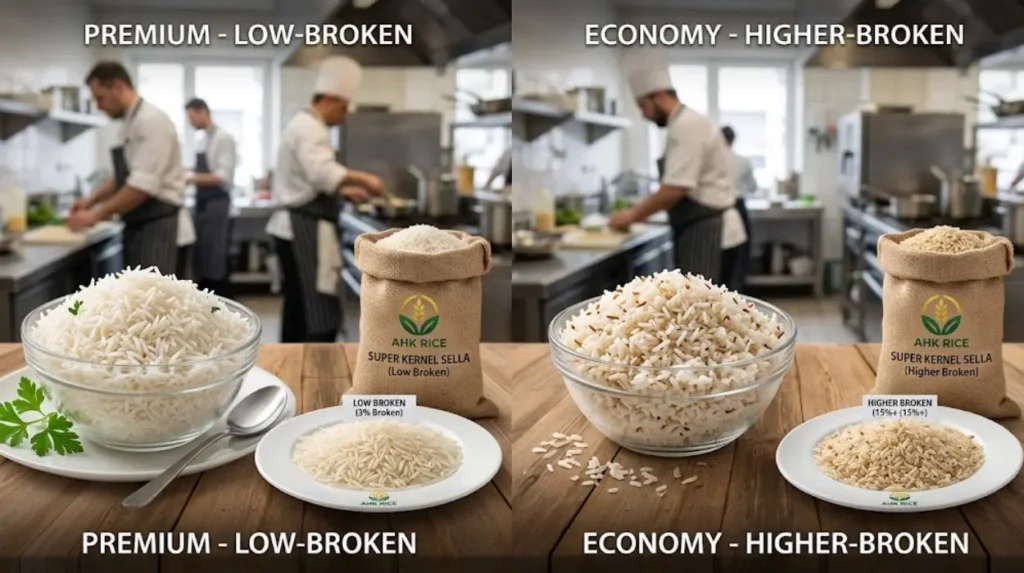
Low-broken Super Kernel Sella provides stronger presentation and premium cooking performance but costs more, while higher-broken grades reduce procurement cost but sacrifice some whole-kernel appearance; the correct choice depends on menu, volume, customer expectations, and margin.
What are the advantages of 0–2% broken Super Kernel Sella?
The main advantage is whole-kernel presentation. The caterer receives a higher proportion of intact grains, which supports premium biryani, pulao, buffet, wedding, and hotel applications.
The main disadvantage is price. Tighter grading and lower breakage generally increase the procurement cost per metric ton.
What are the advantages of 3–5% broken Super Kernel Sella?
The main advantage is cost efficiency. It can provide good cooking performance while reducing the premium paid for extremely low breakage.
The limitation is visual consistency. A larger broken fraction can reduce the appearance of plated rice and affect premium presentation.
What are the advantages of customized Super Kernel Sella?
Customization allows the caterer to define grain length, moisture, broken percentage, packaging, polishing, colour, inspection, and delivery terms.
The limitation is that custom specifications require stronger procurement discipline. The buyer must define and approve the specification before production.
What five decision factors should Indonesian caterers use?
Indonesian caterers should score specification fit, cooking performance, landed cost, storage stability, and supply consistency because these five factors connect the rice specification with food cost, kitchen performance, inventory planning, and customer satisfaction.
| Decision factor | What the caterer should check | Recommended evidence |
| Specification fit | Grain length, moisture, broken percentage, purity | Signed specification sheet |
| Cooking performance | Separation, firmness, aroma, cooked yield | Commercial kitchen test |
| Landed economics | FOB/CFR/CIF plus destination costs | Landed-cost calculation |
| Storage stability | Moisture, packaging, warehouse suitability | COA and packaging specification |
| Supply consistency | Repeat quality and shipment capability | Supplier QC and shipment records |
Specification fit should be the first filter. A low price cannot compensate for rice that fails the required grain or moisture standard.
Cooking performance should be tested before contracting. Caterers should calculate cooked output from a known quantity of dry rice.
Landed economics should use the same commercial basis. FOB Karachi should not be compared directly with CIF Indonesia.
Storage stability should include both shelf life and actual warehouse conditions.
Supply consistency should be assessed through repeat samples, documented quality controls, and the supplier’s ability to reproduce the approved specification.
How should Indonesian caterers make the final purchasing decision?
The best purchasing decision is the Super Kernel Sella specification that passes the physical sample test, meets the written quality limits, produces the required cooked yield, fits the landed-cost target, and can be supplied repeatedly under controlled export conditions.
The decision process should begin with the menu.
If the menu requires premium biryani or banquet presentation, start with 0–2% broken Super Kernel Sella.
If the operation is a high-volume restaurant, compare 2–5% broken against the premium grade using actual cooked yield.
If the business supplies institutional meals, calculate cost per cooked kilogram and cost per serving rather than comparing the rice price alone.
Next, approve a physical sample. The sample should be tested for raw appearance, aroma, grain uniformity, cooking behavior, separation, firmness, and holding performance.
Then establish the written specification. The purchase order should include grain length, moisture, broken percentage, purity, foreign matter, packaging, quantity, crop requirements, inspection method, Incoterm, and destination.
Finally, compare suppliers on repeatability. A supplier that produces the approved sample once but cannot reproduce it is not equivalent to a supplier with a controlled processing and inspection system.
AHK Rice’s Pakistan-origin supply model covers Super Kernel alongside 1121 and 1509 Basmati, with processing, grading, sorting, customized packaging, quality checks, documentation, and export coordination. The relevant Super Kernel export specification for Indonesia currently lists 7.0–7.2 mm average grain length, ≤12.5% moisture, and ≤2% broken grains for its parboiled format.
Pakistan also remains a major global rice exporter. USDA data placed Pakistan among the world’s leading rice-exporting countries, reinforcing the availability of export-oriented rice supply while also highlighting the need to compare individual specifications rather than country-level reputation alone.
For Indonesian caterers ready to evaluate commercial specifications, packaging, shipment terms, and supplier options, see:
Pakistan Super Kernel Sella supply options for Indonesian catering companies.
Frequently Asked Questions
What is Pakistan Super Kernel Sella Rice?
Pakistan Super Kernel Sella Rice is a parboiled Basmati rice made from Super Kernel paddy grown primarily in Pakistan’s Punjab rice-growing region. Sella processing strengthens the grain and supports better separation, lower breakage during cooking, and consistent performance in bulk catering.
What grain length does Super Kernel Sella Rice have?
Super Kernel Sella Rice commonly has an average grain length of around 7.0–7.6 mm, depending on the supplier specification and grade. AHK Rice’s Indonesia-facing specification lists an average grain length of 7.0–7.2 mm.
What is the broken percentage of Super Kernel Sella Rice?
Broken percentage depends on the contracted grade. Premium Super Kernel Sella can be specified at 0–2% broken, while commercial grades may allow approximately 3–5%. Indonesian caterers should select the tolerance according to presentation and cost requirements.
What moisture level should Indonesian caterers request?
A controlled moisture specification is important for storage and shipment stability. AHK Rice’s Indonesia-facing Super Kernel Parboiled specification lists moisture at a maximum of 12.5%. Buyers should include the agreed moisture limit in the purchase specification and certificate of analysis.
Why is Sella Rice suitable for Indonesian catering?
Sella processing produces a stronger kernel that can withstand bulk cooking and handling. Super Kernel Sella can provide separated grains, firm texture, and consistent cooked performance, making it suitable for restaurants, catering companies, banquets, hotels, and institutional kitchens.
Is Super Kernel Sella Rice suitable for biryani and pulao?
Yes. Its long grain, parboiled structure, and separation after cooking make Super Kernel Sella suitable for biryani and pulao. Caterers should conduct a commercial-size cooking test because water ratios, soaking, cooking equipment, and holding conditions affect the final result.