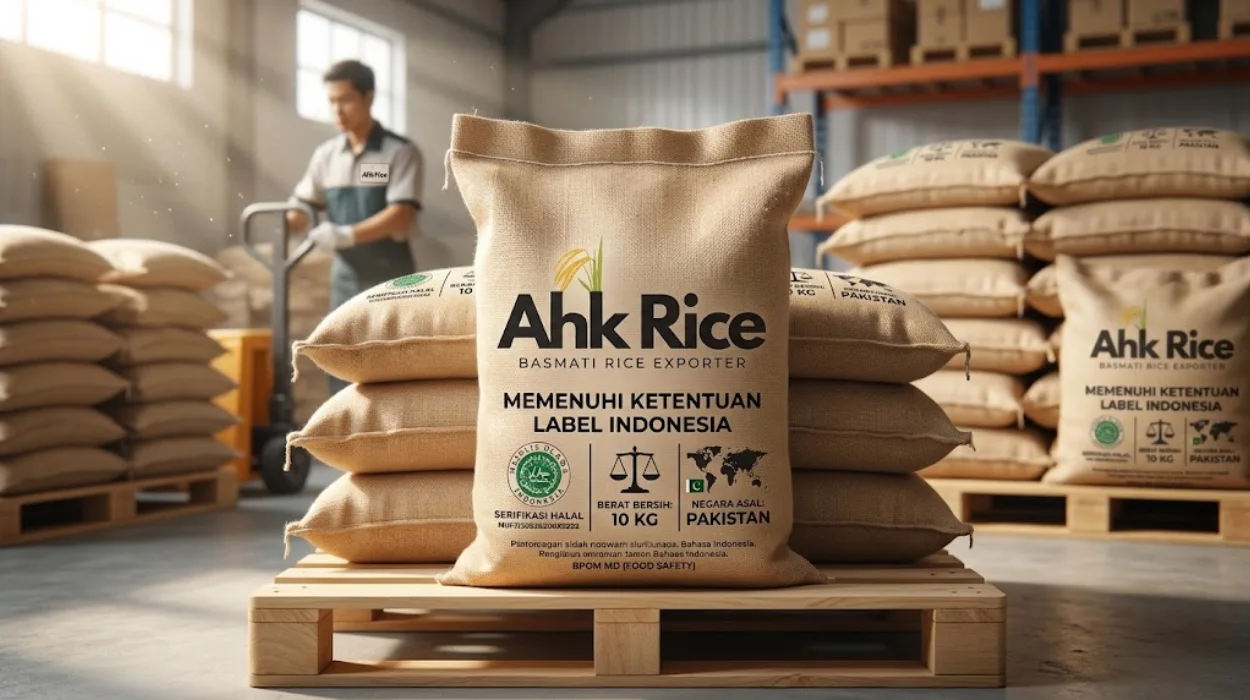
Bahasa Indonesia Labels, Halal Logo, Net Weight and Origin Requirements on Rice Bags
For Indonesian rice imports, the strongest packaging approach is a market-specific bag with Bahasa Indonesia information, accurate net weight, clear Pakistani origin, and the correct halal presentation supported by the applicable compliance documents; generic export bags create more correction risk.
Indonesian rice buyers need packaging that communicates product identity before the bag reaches retail shelves. A rice bag is not only a transport container. It carries the product name, rice variety, net quantity, origin, importer information, production details, and other applicable declarations. For a detailed overview of Indonesia’s rice import and packaging framework, buyers can also review the Indonesia rice import and packaging requirements. Indonesian food-label guidance requires Bahasa Indonesia and specifies information such as product name, ingredients where applicable, net weight, producer or importer details, halal information where required, production information, expiry information, and relevant permit details.
The practical comparison is between generic export packaging, bilingual packaging adapted from another market, and dedicated Indonesia-compliant packaging. Generic bags have the lowest preparation burden but create more label corrections. Adapted bilingual bags improve usability but still require regulatory review. Dedicated Indonesian artwork provides the clearest control because the rice specification, net weight, origin statement, importer details, and applicable halal information are established before printing.
What are the available solutions for Indonesian rice bag labels?
Three practical solutions are available: generic international packaging, adapted bilingual packaging, and dedicated Indonesia-market packaging. Dedicated artwork provides the strongest control because every declaration is designed around Indonesian requirements, the actual rice specification, and the importer’s approved commercial information.
Generic international export packaging
Generic packaging uses a standard rice bag already produced for multiple markets. The bag can carry the product name, rice variety, net weight, exporter information, and country of origin.
This method reduces artwork preparation. It also suits bulk shipments where the buyer does not need retail-ready presentation.
The weakness is regulatory adaptation. Information required for Indonesian retail distribution can require additional stickers, over-labels, or artwork revisions. That creates another control point between the rice specification and the final package.
Bilingual or adapted packaging
The second solution combines English with Bahasa Indonesia. This format works when the importer wants international product presentation while ensuring important consumer information is available in Indonesian.
Bahasa Indonesia remains important because Indonesian food-label guidance requires food labels to use Bahasa Indonesia. Foreign terminology can be used when there is no suitable Indonesian equivalent. Labels must also remain clear, accurate, readable, and durable on the package.
This approach provides stronger retail usability than a generic export bag, but the artwork still needs checking against the Indonesian product category and registration requirements.
Dedicated Indonesia-market packaging
Dedicated packaging is designed specifically for Indonesian distribution. The artwork can establish the Indonesian product name, rice variety, net weight, country of origin, importer details, applicable halal information, and other required declarations before production.
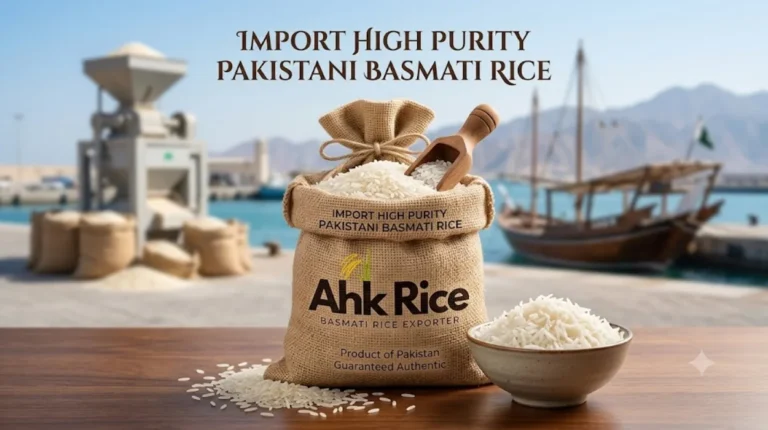
For a Pakistani Basmati exporter, this method also allows the product specification to remain aligned with the printed bag. A 1121 Steam bag should identify the correct variety and processing type. A 1509 White bag should not use artwork created for 1121 or Super Kernel.
AHK Rice supplies Pakistani Basmati varieties including 1121, Super Kernel, and 1509 Basmati rice and coordinates packaging specifications with export requirements. AHK Rice
How do different Indonesian rice packaging approaches compare?
Dedicated Indonesia packaging provides the highest regulatory control, while generic bags provide the lowest preparation cost. Bilingual packaging sits between both options. The correct choice depends on whether the shipment is bulk, wholesale, private label, or retail-ready and on how quickly the importer needs production.
| Attribute | Generic Export Bag | Bilingual Adapted Bag | Indonesia-Dedicated Bag |
|---|---|---|---|
| Bahasa Indonesia | Added separately | Included in artwork | Built into final artwork |
| Halal presentation | Requires review | Integrated where applicable | Integrated with approved format |
| Net weight | Standard declaration | Market-specific | Indonesia-specific |
| Country of origin | General export marking | Adapted for Indonesia | Designed for Indonesian market |
| Importer information | Often added later | Included | Included in approved artwork |
| Retail suitability | Medium | High | Highest |
| Artwork control | Low | Medium | High |
The table shows why packaging should be treated as part of the commercial specification rather than as a final printing task. Indonesian food-label requirements identify the net weight, producer or importer information, halal information where applicable, and other product details as core label elements. Siripo
Which method works best for different Indonesian rice buyers?
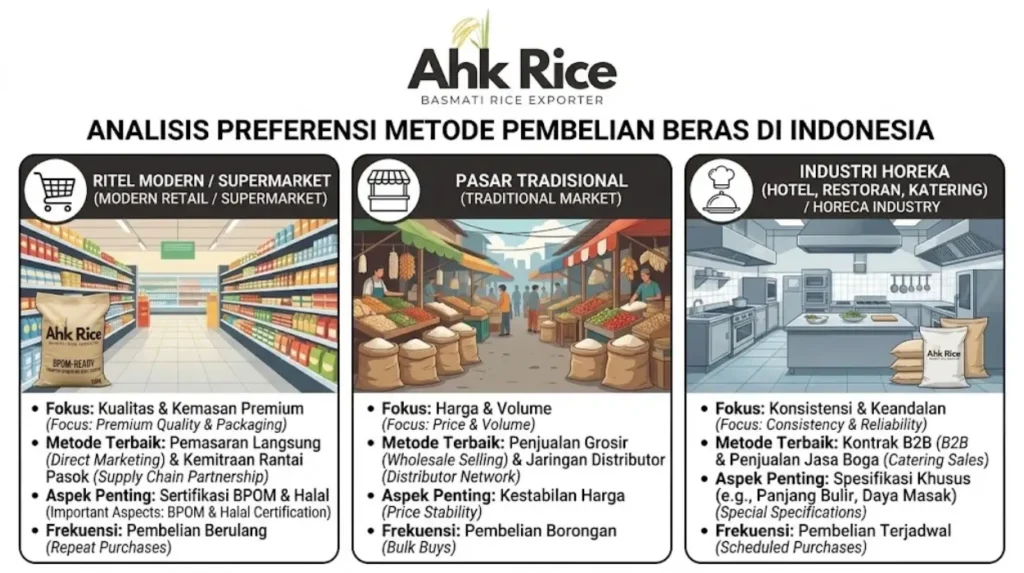
Bulk wholesalers usually benefit from simpler compliant export packaging, while retail brands and private-label importers benefit from dedicated Indonesian artwork. Foodservice buyers prioritize product identification and handling efficiency, whereas consumer brands need stronger front-of-pack information and presentation.
Bulk wholesalers
A bulk importer purchasing 25 kg or 50 kg sacks can prioritize product identification, net weight, origin, importer information, and shipment traceability. A fully customized retail design is less important when bags move directly into wholesale distribution.
Supermarket and retail distributors
Retail buyers need clearer consumer-facing information. A 5 kg or 10 kg Basmati bag should communicate the product identity quickly.
The front panel should be designed around the actual product name, brand, variety, net weight, and applicable halal presentation. The remaining label area can carry the required supporting information.
Private-label brands
Private-label buyers need the highest artwork control. Their brand name, rice variety, processing type, pack size, origin declaration, importer information, and halal information must work as one approved specification.
A private-label shipment therefore benefits from dedicated packaging rather than applying stickers after production.
Restaurants and foodservice distributors
Foodservice buyers generally prioritize larger pack sizes and consistent product specifications. Packaging can focus on variety, processing grade, net weight, origin, batch identification, and storage information.
For example, a caterer purchasing 25 kg 1121 Sella rice needs the bag to clearly identify the product specification without requiring a consumer-oriented retail design.
What are the Bahasa Indonesia label requirements on rice bags?
Bahasa Indonesia should be used for applicable consumer-facing food information, with the wording checked against the approved Indonesian product classification and label requirements. Product identity, net weight, producer or importer details, and other applicable declarations should remain accurate and readable.
The key principle is that translated text must describe the actual product. Translation should not change the rice variety, processing description, quantity, origin, or commercial identity.
For example, an importer selling Pakistani Basmati rice can establish an Indonesian product name and supporting descriptions while retaining the correct technical identity of the rice.
The label should also be durable. BPOM guidance states that food-label information should appear where it can be easily seen and read and should not easily detach, fade, or become damaged. Siripo
This makes printed packaging preferable to temporary labels for long-term retail distribution when the final artwork has already been approved.
How should the halal logo be handled on Indonesian rice bags?
The halal logo should never be treated as decorative artwork. Its use depends on the product’s halal status and applicable BPJPH rules. For natural rice, BPJPH identifies an exemption from product-level halal certification, while direct-contact packaging, storage, transport, and contamination controls remain relevant.
BPJPH specifically identifies natural products such as rice as exempt from product-level halal certification. However, BPJPH also states that packaging that directly contacts the product must meet halal requirements and that transportation, packaging, and storage must be protected against contamination.
This distinction matters for Pakistani Basmati rice.
Plain natural rice should not automatically be treated in the same way as a formulated rice product containing additional ingredients. Steam, Golden Sella, flavored rice, seasoned rice, and ready-to-eat products require classification based on their processing and formulation.
Where a halal label is applicable, the Indonesian Halal Label must follow BPJPH requirements. BPJPH stated in its 2025 guidance that, after 17 October 2026, the Indonesian Halal Label becomes mandatory for products within the applicable certified category instead of the older MUI label.
Foreign halal certificates also require specific recognition and registration arrangements. BPJPH’s rules provide formats for products carrying recognized foreign halal certification, including the Indonesian Halal Label and applicable foreign certificate registration information. cmsbl.halal.go.id
How should net weight and country of origin appear on Indonesian rice bags?
Net weight should match the actual declared commercial pack quantity, while country-of-origin information should accurately identify Pakistan as the rice origin. Both declarations must remain consistent across the packaging, commercial documents, packing list, and approved product specification.
Net weight is a commercial and labeling control point. A bag marked 5 kg must correspond to the declared quantity used in the purchase order and shipment documentation.
Common retail configurations include 1 kg, 2 kg, 5 kg, and 10 kg. Wholesale formats commonly extend to 25 kg, 40 kg, and 50 kg. The selected size should match the Indonesian buyer’s distribution channel.
Country of origin should clearly identify Pakistan when the rice is Pakistani-origin Basmati. The statement should not create confusion between the country where the rice was grown, processed, packed, or imported.
This is especially important for Pakistani Basmati because origin is part of the product identity. A commercial specification can identify Punjab origin, variety, processing type, grade, net weight, and packaging format as one controlled data set.
Which packaging strategy works best for Indonesia?
The best strategy is to build the Indonesian label around the exact rice specification before printing. This approach controls Bahasa Indonesia wording, halal presentation, net weight, origin, importer information, and packaging format while reducing artwork changes after production.
The decision can be simplified through five factors:
| Decision factor | Generic Bag | Adapted Bilingual | Dedicated Indonesia Bag |
|---|---|---|---|
| Bulk shipment | Excellent | Good | Good |
| Retail launch | Fair | Good | Excellent |
| Private label | Weak | Good | Excellent |
| Artwork control | Low | Medium | High |
| Long-term Indonesian program | Fair | Good | Excellent |
The first decision is distribution channel. A bulk shipment does not need the same artwork investment as a private-label supermarket product.
The second decision is product classification. Plain rice, processed rice, and formulated rice products should not be assigned identical compliance assumptions.
The third decision is packaging contact. Direct-contact packaging requires attention to halal assurance and food-contact requirements. BPJPH specifically highlights packaging, storage, transportation, and contamination controls for natural rice.
The fourth decision is consistency. The product name, variety, processing grade, net weight, origin, and commercial documentation should describe the same product.
The fifth decision is production timing. A dedicated printed bag requires artwork approval before printing. This makes early compliance review more efficient than correcting thousands of finished bags.
What are the advantages and disadvantages of each solution?
Generic bags minimize initial artwork work but provide less market-specific control. Bilingual bags improve Indonesian usability without fully redesigning the packaging. Dedicated bags provide the strongest retail presentation and compliance control but require earlier artwork approval and production planning.
A generic bag works well for bulk trade because the buyer can prioritize shipment efficiency. Its disadvantage appears when the importer needs retail distribution and must add Indonesian information after production.
A bilingual bag provides a practical middle position. English and Indonesian information can share the same artwork. The disadvantage is that the design becomes more crowded and still requires market-specific regulatory review.
Dedicated Indonesian packaging has the strongest long-term value for recurring retail orders. The importer can approve one specification and repeat the same controlled artwork across future production batches.
The disadvantage is planning. Printing cannot start until the product specification, translation, pack size, origin statement, importer information, and applicable halal presentation have been reviewed.
What should buyers check before printing Indonesian rice bags?
Before printing, buyers should verify the rice identity, Bahasa Indonesia wording, net weight, country of origin, importer information, halal status, packaging material, artwork version, and documentation. The final bag should match the commercial product specification exactly.
A practical approval checklist includes:
- Rice identity: 1121, Super Kernel, or 1509.
- Processing: White, Steam, Sella, Golden Sella, or another agreed grade.
- Net weight: Confirm the exact retail or wholesale pack size.
- Origin: State Pakistani origin accurately.
- Importer: Confirm Indonesian importer or distributor information.
- Language: Review Bahasa Indonesia wording.
- Halal: Confirm whether the product requires a halal label and whether packaging controls apply.
- Artwork: Approve one final artwork version before printing.
- Documentation: Match the printed information with commercial and import documents.
AHK Rice’s Indonesia packaging guidance also recommends specifying variety, processing grade, bag weight, material, net weight tolerance, label artwork, and shipment documentation in the purchase order. AHK Rice
For buyers planning recurring shipments, this specification becomes a repeatable packaging standard. It prevents each new shipment from starting the artwork process from zero.
What is the final solution for compliant Indonesian Basmati rice packaging?
For Indonesian retail and private-label distribution, the strongest solution is dedicated packaging approved against the exact rice specification before printing. The bag should combine Bahasa Indonesia labeling, correct net weight, Pakistani origin, applicable halal information, importer details, and controlled artwork.
Packaging compliance begins before the bag reaches the printer. The importer first identifies the rice variety and processing grade. Next, the pack size and material are selected. Then the Indonesian label content is developed and checked.
The halal decision follows product classification. Plain natural rice receives different treatment from formulated or processed food products, while direct-contact packaging and supply-chain controls remain important under BPJPH guidance.
The final artwork should then be compared with the purchase order and product specification. This step ensures that a 5 kg retail bag, 25 kg wholesale sack, or 50 kg commercial bag describes the actual product being shipped.
AHK Rice can coordinate Pakistani Basmati specifications, custom packaging, and export preparation for Indonesian buyers. Its Indonesia export service covers sampling and packaging arrangements alongside commercial shipment planning.
The result is a packaging system designed around the Indonesian market rather than a generic export bag modified after production.
Frequently Asked Questions
Does rice packaging in Indonesia need Bahasa Indonesia?
Yes. Indonesian food-label guidance requires food labels to use Bahasa Indonesia. Foreign terminology can be used when an appropriate Indonesian equivalent does not exist.
Does plain Basmati rice need a halal logo in Indonesia?
Plain natural rice is identified by BPJPH as exempt from product-level halal certification. However, direct-contact packaging, storage, transportation, and contamination controls remain subject to applicable halal requirements.
What net weight should Pakistani Basmati rice bags use?
The pack size should match the Indonesian buyer’s distribution channel and commercial specification. Common formats include 1 kg, 2 kg, 5 kg, 10 kg, 25 kg, 40 kg, and 50 kg.
Must the rice bag show Pakistan as the origin?
The packaging should accurately communicate the rice’s country of origin. For Pakistani Basmati, the origin should identify Pakistan consistently with the commercial and import documentation.
Can Pakistani halal certification be used directly on an Indonesian rice bag?
Foreign halal certification requires recognition and registration arrangements where applicable. The Indonesian Halal Label and foreign certificate information must follow BPJPH requirements for recognized foreign halal products.
Is a generic export rice bag suitable for Indonesia?
It can suit certain bulk shipments, but retail and private-label buyers benefit from dedicated Indonesian artwork. Market-specific packaging provides stronger control over language, net weight, origin, importer details, and applicable halal presentation.
What information should an Indonesian rice label contain?
Applicable labeling can include the product name, ingredients where relevant, net weight, producer or importer details, halal information where required, production information, expiry information, registration information, and origin information for specified food materials.
What is the best packaging option for Indonesian private-label Basmati rice?
Dedicated printed packaging is the strongest option because the brand, rice variety, processing grade, net weight, Pakistani origin, Indonesian-language information, and importer details can be approved as one specification before production.