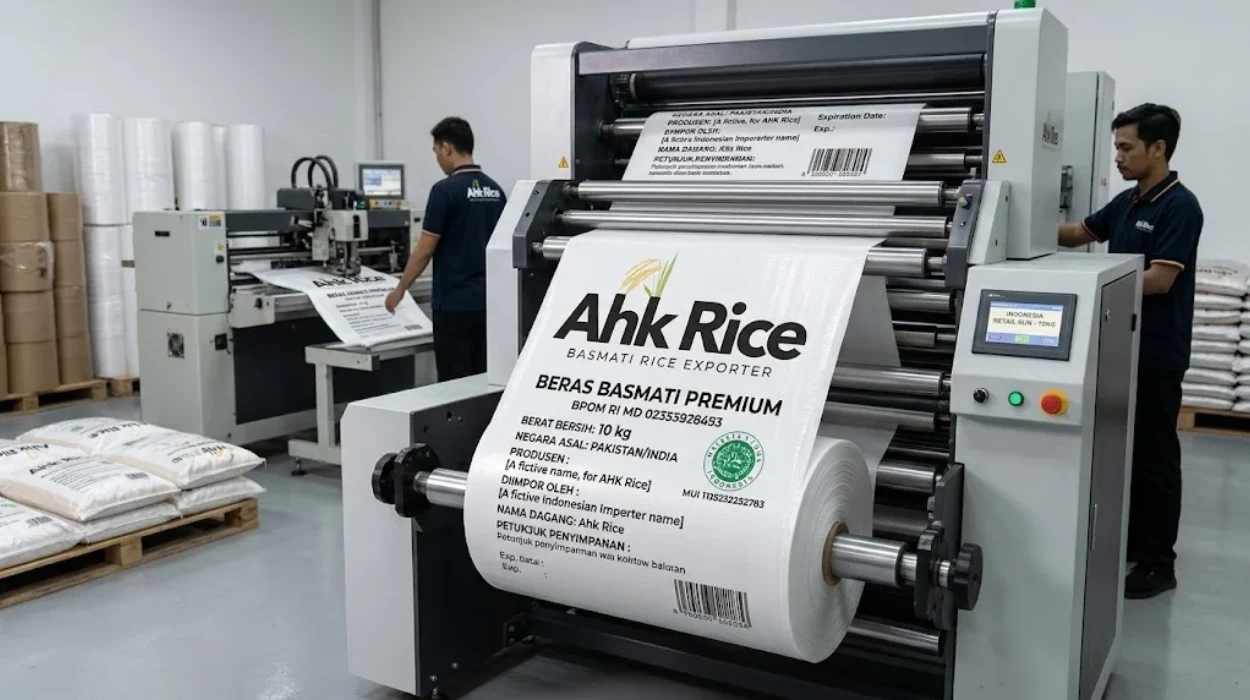
Get Indonesia Label-Compliant Basmati Rice Packaging Printed by AHK Rice
Importing Pakistani Basmati rice into Indonesia requires more than selecting the right grain and arranging container loading. The rice bag itself must communicate the required product information clearly for the Indonesian market. Language, product identity, net weight, origin, importer information, halal status, and other applicable details must be coordinated before commercial packaging is printed.
For buyers comparing suppliers, the practical solution is to connect rice processing, packaging, documentation, and label preparation in one export workflow. AHK Rice provides Pakistani Basmati rice sourcing and packaging support for buyers who need export-ready bags prepared around destination-market requirements.
Before making a packaging decision, buyers should understand the regulatory background explained in What Labelling Rules Apply to Rice Sold in Indonesia?. That educational foundation helps importers identify the information that must be reviewed before artwork is approved and production begins.
What is the best solution for Indonesia-compliant Basmati rice packaging?
The best solution is to prepare Indonesia-specific packaging artwork before production, verify mandatory information, match the label with shipping documents, and print the approved design on rice bags before container loading to prevent costly relabelling after arrival.
A common problem occurs when exporters use one generic international rice bag for several countries. Indonesia can require market-specific information, while the importer may also need product and company details that differ from packaging used in the UAE, USA, Europe, or other markets.
The better approach is to treat packaging as part of the import documentation workflow.
The buyer first confirms the intended rice variety, grade, packing size, product description, origin, importer details, and commercial requirements. The packaging artwork is then prepared around the confirmed information.
For Pakistani Basmati rice, the product identity should remain consistent across the bag, commercial invoice, packing list, certificate of origin, and other shipment documents. This consistency reduces avoidable questions during customs clearance and receiving.
The packing format can also be selected according to the Indonesian distribution channel. A wholesale importer may require larger commercial bags, while a retail distributor can need smaller consumer-facing packs with more prominent product information.
The key decision is simple: do not print final packaging before the importer and exporter agree on the required information.
Why choose AHK Rice for Indonesia-ready packaging?
AHK Rice combines Pakistani Basmati rice sourcing, processing, grading, packaging, and export coordination so buyers can develop destination-specific rice bags without managing every production step through separate suppliers.
The first advantage is product consistency. AHK Rice supplies Pakistani Basmati varieties including 1121, Super Kernel, and 1509. The selected variety can be matched with the buyer’s target market, customer segment, and packaging format.
For example, a distributor selling premium Basmati rice may select 1121 or Super Kernel because long grain appearance and aroma support premium positioning. A bulk-oriented buyer may select 1509 where yield efficiency and competitive pricing are more important.
The second advantage is packaging coordination. AHK Rice can align the selected product with the agreed bag size, packaging artwork, packing specifications, and export shipment requirements.
This is particularly useful when the buyer wants a private-label product. Instead of purchasing generic rice and arranging separate repacking after import, the buyer can establish the packaging specification before shipment.
The third advantage is export-process coordination. A commercial rice shipment involves more than bags. Product specifications, quantity, documentation, inspection requirements, loading, and shipping arrangements must remain aligned.
That makes a coordinated supplier valuable for importers placing their first order or building a repeat supply program.
What information should be checked before printing Indonesian rice bags?
Before printing, buyers should verify the product name, rice variety, net weight, country of origin, importer or responsible business information, Indonesian-language requirements, halal-related information, and any additional mandatory details applicable to the specific product and market channel.
The exact artwork should be confirmed against current Indonesian requirements before mass printing. Regulatory responsibility can involve the Indonesian importer, product category, distribution channel, and applicable authorities.
Language is an important consideration. Consumer-facing information intended for Indonesia should be prepared for the Indonesian market rather than simply translating an English export label after the bags have been produced.
Net weight also needs attention. The printed weight must correspond with the actual packed product and commercial documentation.
Country of origin should also be consistent. For Pakistani Basmati rice, the packaging should clearly identify Pakistan as the origin where required.
Halal information requires particular attention because halal requirements and logo use are regulated separately from general food labelling. Buyers should confirm the applicable halal status and logo requirements before placing a packaging print order.
The practical rule is to create a destination-specific packaging checklist and approve it before printing.
How does AHK Rice handle custom packaging for Indonesian buyers?
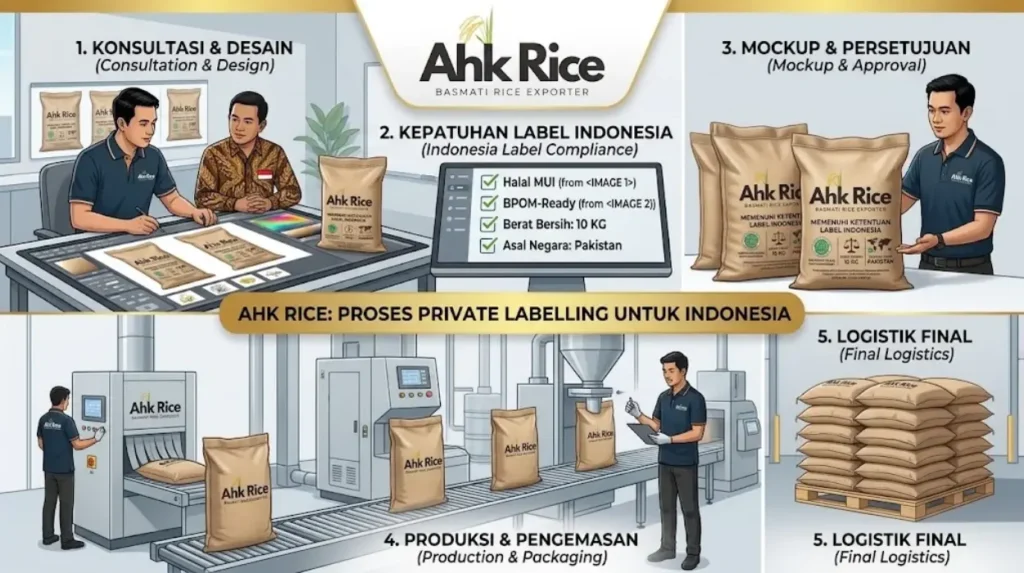
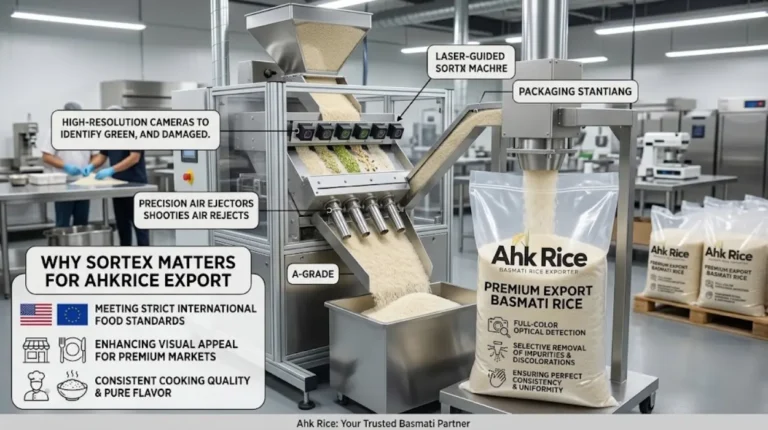
AHK Rice starts with the buyer’s product and packaging specification, confirms the required bag information, prepares or coordinates the packaging artwork, aligns the printed details with the rice specification, and proceeds to packing after the commercial requirements are approved.
The process begins with the product selection.
The buyer identifies the required Basmati variety, grade, processing type, quantity, packing size, and target customer. AHK Rice then works around the agreed specification for sourcing and processing.
The next stage is packaging preparation. The buyer provides brand details, logo assets, required importer information, and preferred bag design. Destination-specific information is incorporated into the artwork.
The importer should review the information before printing. This is an important control point because changing thousands of printed bags after production creates unnecessary cost and delays.
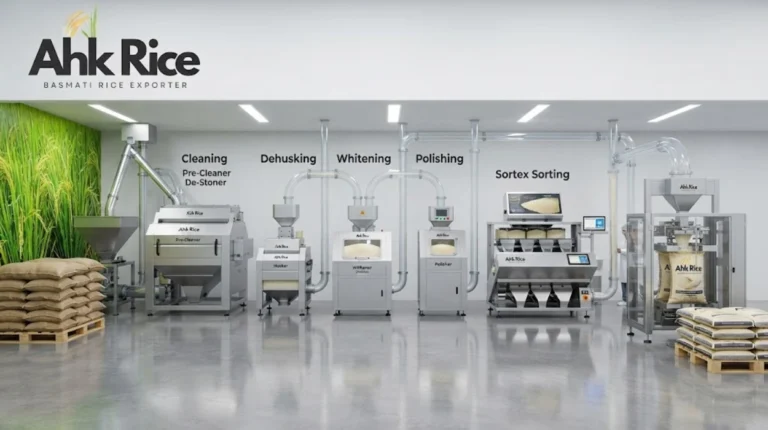
After artwork approval, the packaging material is produced or arranged according to the agreed specification. The rice is then processed, graded, packed, and prepared for export.
A pre-shipment review can compare the packed product with the approved commercial specification. The buyer can also request samples before committing to the full commercial order, depending on the agreed workflow.
This creates a clear chain from sample approval → product specification → packaging approval → production → loading → export shipment.
What results can Indonesian rice importers expect?
A properly coordinated packaging process gives Indonesian buyers a consistent commercial product, clearer brand presentation, fewer packaging discrepancies, stronger shipment-document consistency, and a repeatable specification for future Basmati rice orders.
The commercial benefit is consistency.
Suppose an Indonesian distributor orders 1121 Basmati rice in 5 kg retail bags. If the first shipment uses one approved artwork and the next shipment changes the product description, origin statement, weight presentation, or branding, the distributor must manage unnecessary variation.
A controlled specification solves this problem.
The approved packaging design becomes part of the buyer’s purchasing specification. Future orders can use the same artwork while changing only agreed fields such as crop year, batch information, or other variable details where applicable.
Packaging also supports brand positioning. A premium Basmati product should not look like an undifferentiated bulk commodity if the buyer is selling it through premium retail channels.
The bag becomes part of the product experience.
For wholesalers and foodservice distributors, packaging can instead prioritize handling efficiency, clear product identification, and suitable commercial pack sizes.
This is why AHK Rice treats packaging as part of the supply specification rather than an afterthought.
What affects the cost of Indonesia-compliant Basmati rice packaging?
Packaging cost depends on rice variety, grade, order quantity, bag material, bag size, printing method, artwork requirements, packaging configuration, product processing, and destination-shipment specifications rather than one fixed packaging price.
Rice itself is the largest commercial cost component, but packaging decisions influence the final quotation.
A 25 kg commercial bag has different material and printing requirements from a 5 kg retail pack. A custom private-label design can also require different setup and production arrangements from standard packaging.
The quantity matters because larger orders generally provide better production efficiency than small custom runs. However, the final commercial price depends on the complete specification.
The rice grade also affects pricing. 1121, Super Kernel, and 1509 have different market positioning and processing specifications.
Shipping terms are another major factor. FOB pricing and delivered pricing represent different cost structures. Freight, destination charges, insurance where applicable, and import-side expenses need to be evaluated separately.
For an accurate quotation, buyers should provide:
- Basmati variety and grade
- Steam, Sella, or other required processing
- Packing size
- Number of bags or total MT
- Private-label requirements
- Destination port in Indonesia
- Required Incoterm
- Target delivery schedule
- Required documentation
- Any buyer-specific quality specifications
AHK Rice can then evaluate the complete specification rather than providing an unrealistic packaging-only estimate.
How long does shipping to Indonesia take?
Shipping time depends on the Pakistani loading port, Indonesian destination port, vessel schedule, transshipment requirements, customs clearance, and seasonal congestion, so buyers should confirm the current sailing schedule when requesting a commercial quotation.
For planning purposes, buyers should separate production time from ocean transit time.
Packaging artwork approval and bag production must happen before final packing. Rice processing, quality checks, packing, documentation, and container loading then follow the approved production schedule.
Ocean freight is separate. A shipment from Pakistan to Indonesia can require several weeks depending on the selected route and vessel schedule.
Jakarta/Tanjung Priok, Surabaya/Tanjung Perak, and other Indonesian destinations can have different logistics schedules. Transshipment can also affect the total transit period.
For this reason, AHK Rice should quote shipping timelines against the actual destination and shipment date rather than publishing one fixed number for every Indonesian order.
What is the sample process before a full Indonesia order?
The sample process normally begins with product selection, buyer specification confirmation, sample preparation, courier dispatch, cooking or quality evaluation, commercial approval, and then final production against the approved specification and packaging requirements.
A buyer can first select the required Basmati variety and grade.
For example, an importer comparing 1121 and Super Kernel can request samples for visual inspection and cooking tests. The buyer can evaluate grain appearance, aroma, elongation, texture, and cooking performance.
Once the preferred specification is selected, the commercial order can be prepared.
Sample courier charges are normally paid by the buyer, while any applicable inspection, phytosanitary, or destination-specific costs depend on the agreed shipment arrangement. AHK Rice should confirm the exact sample cost before dispatch because courier charges vary by destination, package weight, and service level.
The important point is that the approved sample should become the reference for the commercial order.
The buyer should not approve one quality and receive another. The commercial specification, processing requirements, packing format, and approved product reference should remain connected throughout production.
How do Indonesian buyers get started with AHK Rice?
Start by sending the required Basmati variety, quantity, packing size, private-label requirements, Indonesian destination port, and target shipment schedule to AHK Rice so the product, packaging, documentation, and shipping specification can be evaluated together.
A first order does not need to begin with a large commercial commitment.
The buyer can start by defining the intended market position. A premium retail distributor may need small branded bags, while a foodservice importer may prefer larger commercial packs.
Next, confirm the rice variety and grade.
Then provide the brand artwork or packaging concept. The importer should also provide the information required for the Indonesian label review.
After the specification is confirmed, AHK Rice can prepare the commercial quotation around the complete order rather than treating rice, packaging, and freight as unrelated purchases.
The final decision should be based on more than price per metric ton. Compare rice specification, packaging quality, documentation support, sample process, production control, shipment planning, and repeat-order consistency.
That is the advantage of using one coordinated export supplier.
For Indonesian importers seeking Pakistani Basmati rice with destination-specific packaging, AHK Rice provides a practical route from product selection to printed bags and export shipment.
To request the current product, packaging, and shipping quotation, request an Indonesia Basmati rice quote from AHK Rice.
Frequently Asked Questions
Can AHK Rice print custom Basmati rice packaging for Indonesia?
Yes, AHK Rice supports custom packaging for export buyers.
The buyer provides the brand and packaging requirements.
Product and label information is aligned before printing.
Bag size and packaging specifications are confirmed before production.
Final artwork should be approved before mass printing.
What Basmati rice varieties can be packed for Indonesia?
AHK Rice supplies Pakistani Basmati rice varieties including 1121, Super Kernel, and 1509.
The suitable variety depends on the buyer’s market position.
Premium retail buyers can select long-grain premium specifications.
Bulk buyers can prioritize yield and commercial pricing.
The final variety and grade are confirmed before quotation.
Can buyers request samples before placing an order?
Yes, buyers can request samples before a commercial order.
The buyer selects the required rice specification first.
AHK Rice prepares the agreed sample for evaluation.
Courier charges are normally paid by the buyer.
The approved sample becomes the reference for commercial production.
What affects the price of custom rice packaging?
Packaging cost depends on bag size, material, printing, quantity, and design requirements.
Rice variety and grade also affect the complete order price.
Private-label packaging can require additional production arrangements.
Freight and destination charges are calculated separately.
AHK Rice quotes according to the complete commercial specification.
How long does delivery to Indonesia take?
Delivery time depends on the selected Indonesian destination port and vessel schedule.
Production and packaging time must be completed before loading.
Ocean transit can take several weeks depending on the route.
Transshipment and port congestion can affect the final schedule.
AHK Rice confirms the current shipping timeline during quotation.