How Are Broken Rice Grades Classified in International Basmati Trade?
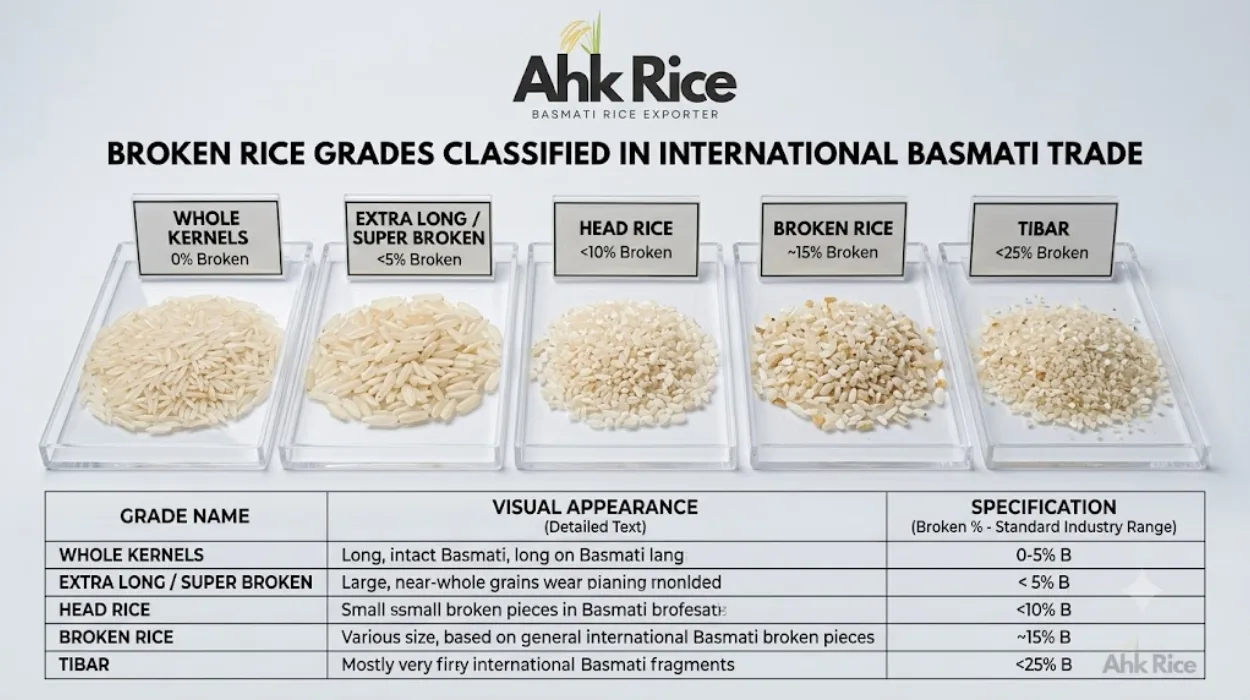
Broken rice grades are classified by the percentage of fractured grains present after milling and sorting. Here is why: international buyers use broken percentage, grain length retention, purity level, moisture content, and destination-market requirements to determine commercial value, pricing, and end-use suitability in wholesale Basmati trade.
International Basmati trade depends on precise grading standards. Importers, wholesalers, food manufacturers, and catering suppliers purchase rice according to measurable specifications rather than general quality descriptions. Broken rice classification creates a common language between exporters and buyers. Pakistani Basmati exporters mill, sort, inspect, and grade rice according to broken grain percentages before shipment. Buyers evaluating different rice grades can first understand how Basmati quality parameters work through our guide on understanding Basmati rice specifications and export grading standards.
AHK Rice is a trusted Pakistani Basmati rice exporter based in Punjab. The company supplies 1121, Super Kernel, and 1509 Basmati rice export solutions to more than 15 countries through end-to-end processing, custom packaging, and complete export support. Understanding broken rice classifications helps buyers compare available grades, evaluate costs, and select suitable specifications for their target market.
What Are Broken Rice Grades in International Basmati Trade?
Broken rice grades range from 0% to 100% broken content, with export categories commonly including 2%, 5%, 10%, 15%, 25%, and 100% broken specifications.
Broken rice refers to grains fractured during milling, polishing, handling, or transportation. The grain remains edible and nutritionally comparable to whole rice. The difference lies in physical appearance, cooking presentation, and market value.
International trade standards classify broken rice according to the percentage of broken kernels present in a shipment. A 5% broken grade contains a maximum of five percent fractured grains. A 25% broken grade contains up to twenty-five percent fractured grains.
Common Export Broken Rice Grades
| Grade | Maximum Broken Content | Typical Buyer Segment | Market Position |
|---|---|---|---|
| Premium Whole Grain | 0–2% | Retail brands | Highest value |
| Extra Fine | 5% | Importers | Premium |
| Standard Export | 10% | Wholesale distributors | Mid-premium |
| Commercial | 15% | Foodservice | Value |
| Economy | 25% | Catering suppliers | Cost-focused |
| Industrial | 50% | Food processors | Manufacturing |
| Broken Rice | 100% | Industrial users | Lowest cost |
Broken rice grading influences export pricing, packaging strategy, and market acceptance. Understanding available classifications leads directly to evaluating the solutions buyers can source.
What Are the Available Solutions for Buyers Seeking Broken Rice Grades?
Buyers can source premium low-broken grades, standard wholesale grades, catering grades, industrial grades, and fully broken rice depending on application requirements.
Different industries require different rice specifications. Retail markets prioritize appearance. Food processors prioritize cost efficiency. Catering operations balance presentation and budget considerations.
Premium Low-Broken Grades
Premium grades contain 0–5% broken kernels. These grades suit retail packaging, supermarkets, gourmet restaurants, and premium food brands.
Premium grades maintain visual consistency after cooking. Grain elongation remains attractive. Consumer perception remains strong.
Standard Wholesale Grades
Standard grades contain 5–10% broken kernels. Importers use these grades for mainstream wholesale distribution.
Wholesale buyers often select this category because it balances quality and procurement cost. Market acceptance remains high across many destinations.
Catering and Foodservice Grades
Foodservice grades contain 10–25% broken kernels. Hotels, institutional kitchens, and catering companies frequently procure these specifications.
Large-volume operations prioritize cost control while maintaining acceptable cooking performance.
Industrial Grades
Industrial grades contain 50–100% broken kernels. Manufacturers use these grades for rice flour, rice starch, brewing, snacks, cereals, and processed foods.
Industrial buyers focus on functionality rather than grain appearance.
With the available solutions established, the next question is how these classifications compare in practice.
How Do Different Broken Rice Approaches Compare?
Premium grades deliver stronger presentation, while higher broken grades provide lower procurement costs and broader industrial applications.
Specification Comparison Table
| Attribute | 2% Broken | 5% Broken | 10% Broken | 25% Broken |
|---|---|---|---|---|
| Broken Content | ≤2% | ≤5% | ≤10% | ≤25% |
| Visual Appearance | Excellent | Very Good | Good | Moderate |
| Retail Suitability | Excellent | Excellent | Limited | Low |
| Catering Suitability | Good | Excellent | Excellent | Excellent |
| Industrial Suitability | Low | Low | Moderate | High |
| Price Level | Highest | High | Medium | Lower |
| Export Demand | Strong | Strong | High Volume | Cost Driven |
A 2% broken specification commands premium pricing because appearance remains nearly identical to whole-grain rice.
A 10% broken specification reduces procurement costs while preserving acceptable cooking performance.
A 25% broken specification supports large-scale catering programs where presentation standards are less strict.
Price Per Metric Ton Comparison
| Grade | Typical Relative Price Level |
|---|---|
| 2% Broken | 100% benchmark |
| 5% Broken | 95–98% of benchmark |
| 10% Broken | 90–95% of benchmark |
| 25% Broken | 75–90% of benchmark |
| 100% Broken | 50–70% of benchmark |
Actual market pricing varies by crop year, variety, freight conditions, and destination market.
The comparison becomes clearer when examining how different regions purchase these grades.
Which Broken Rice Grades Do Different Markets Prefer?
The UK favors low-broken retail grades, while African and Middle Eastern bulk markets often purchase higher broken specifications for value-focused distribution.
UK Market Preferences
The United Kingdom primarily imports 2%, 5%, and 10% broken Basmati rice for retail distribution.
British consumers prioritize grain appearance, cooking performance, and package presentation. Retail brands therefore prefer lower broken percentages.
Supermarkets commonly specify premium Basmati grades because shelf presentation directly affects consumer purchasing behavior.
Middle East Market Preferences
The Gulf region imports both premium and commercial grades depending on end users.
Restaurants often select 5–10% broken grades. Catering companies frequently source 10–25% broken grades for large-volume operations.
High-temperature storage environments also influence purchasing decisions.
African Market Preferences
Many African importers focus on affordability and food security requirements.
Commercial buyers often procure 15–25% broken grades because lower acquisition costs improve market competitiveness.
Volume frequently outweighs appearance requirements in value-driven segments.
Market preferences highlight another important buying factor: shelf life and storage performance.
How Does Shelf Life Compare Across Different Broken Rice Grades?
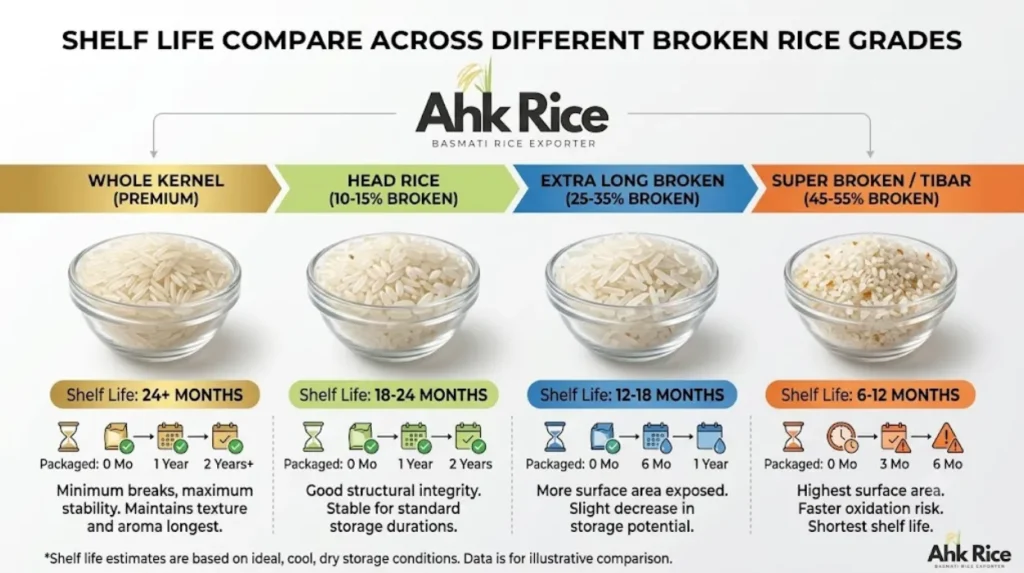
Lower broken percentages generally maintain appearance longer, while higher broken percentages require stricter storage controls to preserve quality.
Broken kernels expose larger surface areas. Increased exposure can affect appearance during extended storage.
Premium grades with 2–5% broken content typically maintain stronger visual consistency throughout storage periods.
Commercial grades with 15–25% broken content remain safe and usable but may show greater fragmentation after handling.
Shelf Life Comparison
| Grade Category | Recommended Shelf Life |
|---|---|
| 2–5% Broken Basmati | 18–24 months |
| 10% Broken Basmati | 18–24 months |
| 15–25% Broken Basmati | 12–24 months |
| 100% Broken Rice | 12–18 months |
Proper storage requires controlled moisture levels, clean warehouses, pest management, and suitable packaging.
Storage considerations naturally lead to evaluating advantages and disadvantages.
What Are the Pros and Cons of Different Broken Rice Grades?
Lower broken grades maximize presentation, while higher broken grades maximize cost efficiency and processing flexibility.
Advantages of Low-Broken Grades
- Strong visual appeal
- Higher retail acceptance
- Better brand positioning
- Premium pricing potential
- Improved consumer perception
A UK retail importer benefits from 2% broken rice because shelf appearance supports premium product positioning.
Disadvantages of Low-Broken Grades
- Higher procurement costs
- Stricter specification requirements
- Reduced sourcing flexibility
Premium specifications become harder to source during tight crop seasons.
Advantages of Higher Broken Grades
- Lower acquisition costs
- Strong industrial suitability
- Better catering economics
- Higher supply availability
A catering distributor serving large events benefits from 25% broken rice because presentation requirements remain secondary.
Disadvantages of Higher Broken Grades
- Reduced retail appeal
- Lower premium positioning
- Greater visual inconsistency
A premium supermarket brand may struggle to maintain customer expectations using higher broken specifications.
Understanding strengths and weaknesses helps buyers make objective sourcing decisions.
Which Broken Rice Grade Works Best for Different Cases?
The best grade depends on retail goals, catering requirements, industrial use, budget constraints, and customer expectations.
Decision Framework
| Buying Situation | Recommended Grade | Primary Reason |
|---|---|---|
| Retail Brand | 2–5% Broken | Appearance |
| Supermarket Supply | 5% Broken | Consistency |
| Wholesale Distribution | 5–10% Broken | Balance |
| Catering Operations | 10–25% Broken | Cost Efficiency |
| Food Processing | 50–100% Broken | Functionality |
Retail buyers prioritize presentation.
Wholesale distributors prioritize balanced economics.
Foodservice operators prioritize operational efficiency.
Industrial manufacturers prioritize ingredient functionality.
This framework demonstrates that no single broken rice grade suits every buyer.
What Decision Factors Should Importers Evaluate Before Purchasing?
Broken percentage, destination market, packaging format, shelf-life requirements, and budget determine the correct procurement specification.
Importers should inspect broken content specifications before confirming purchases.
Importers should verify moisture levels before shipment because moisture directly affects storage performance.
Importers should test cooking characteristics because end-user expectations vary by region.
Importers should evaluate packaging requirements because retail and wholesale channels require different formats.
Importers should compare landed costs rather than FOB prices alone because freight costs significantly affect profitability.
Careful specification matching reduces procurement risks and improves long-term buyer satisfaction.
FAQs
What percentage defines broken rice in export trade?
Broken rice is classified according to the percentage of fractured kernels present after milling and sorting. Common export grades include 2%, 5%, 10%, 15%, and 25% broken rice.
Is broken Basmati rice lower quality?
Broken Basmati rice remains edible and nutritious. The primary difference is grain appearance, not food safety or nutritional value.
Which broken rice grade is best for UK retail markets?
UK retailers commonly prefer 2% and 5% broken grades because these specifications provide strong shelf presentation and consumer acceptance.
Why do catering companies buy higher broken grades?
Catering buyers prioritize cost efficiency and cooking performance. Higher broken grades often deliver better procurement economics.
Can broken rice be exported internationally?
Yes. International trade includes both premium low-broken Basmati rice and fully broken rice for industrial processing applications.
Does broken rice affect shelf life?
Higher broken percentages may increase fragmentation during storage. Proper packaging and moisture control remain the most important shelf-life factors.