Can Indonesia Import Basmati Rice?
Yes, Indonesia can import Basmati rice as a specialty rice product, subject to government authorization, import controls and applicable food regulations. Indonesia distinguishes specialty rice from ordinary consumption rice. Basmati serves specialist food markets, including restaurants, hotels, catering businesses and international cuisine retailers.
Indonesia produces several domestic rice varieties, but its agricultural sector does not fully meet demand for every specialty rice category. Basmati is an example of a specialty product used by businesses serving South Asian and international cuisines.
According to India’s Agricultural and Processed Food Products Export Development Authority (APEDA), Indonesia continues to require specialty rice varieties that cannot be cultivated domestically in sufficient quantities. These include Basmati, Ponni, Sona Masoori, Idli rice and other specialty varieties.
The Indonesian government controls rice imports through a regulatory framework involving import approvals and national food supply planning. Therefore, permission to export Basmati from Pakistan does not automatically authorize its entry into Indonesia.
Understanding the difference between specialty rice and ordinary rice is the first step for exporters, distributors and Indonesian importers.
What Is Specialty Basmati Rice in Indonesia’s Import System?
Specialty Basmati rice is a distinct imported rice category used for specific culinary and commercial requirements. Indonesia separates specialty rice from ordinary consumption rice because domestic production, consumer demand and approved import purposes differ across these categories.
Basmati rice is a long-grain aromatic rice traditionally cultivated in the Punjab regions of Pakistan and India. Pakistani Basmati comes from agricultural areas such as Hafizabad, Gujranwala, Sheikhupura, Narowal and Sialkot.
Its commercial characteristics include:
- Long, slender grains.
- Distinctive natural aroma.
- Firm texture after cooking.
- Grain elongation during cooking.
- Applications in biryani, pulao and other specialty dishes.
Main Basmati varieties
1121 Basmati
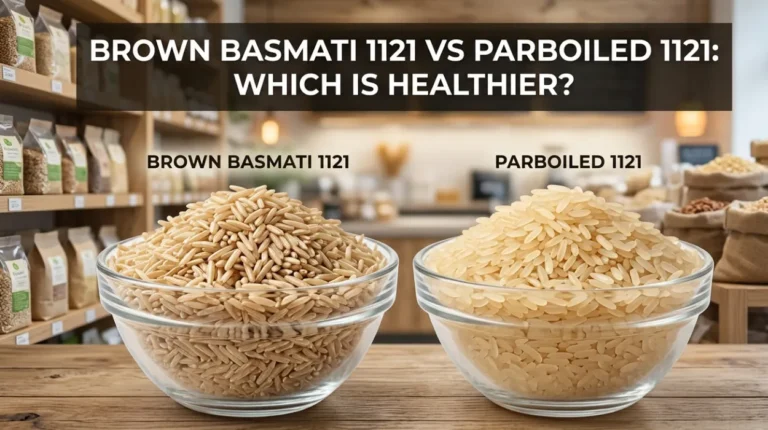
1121 Basmati is a premium long-grain variety. Its raw grain length generally measures approximately 8.0–8.4 mm. Steam, Golden Sella, Creamy Sella and Brown are important commercial processing forms.
Super Kernel Basmati
Super Kernel is an aromatic Pakistani variety with a characteristic grain length of approximately 7.0–7.5 mm. It serves ethnic grocery retailers, restaurants and wholesale distributors.
1509 Basmati
1509 is an early-maturing Basmati variety with high agricultural yield. Its raw grain length generally measures approximately 8.1–8.4 mm. It provides a commercial option for bulk rice distribution and foodservice.
The Indonesian classification of Basmati depends on its official tariff description and import authorization, not simply its variety name or country of origin.
How Does Basmati Rice Importation Work in Indonesia?
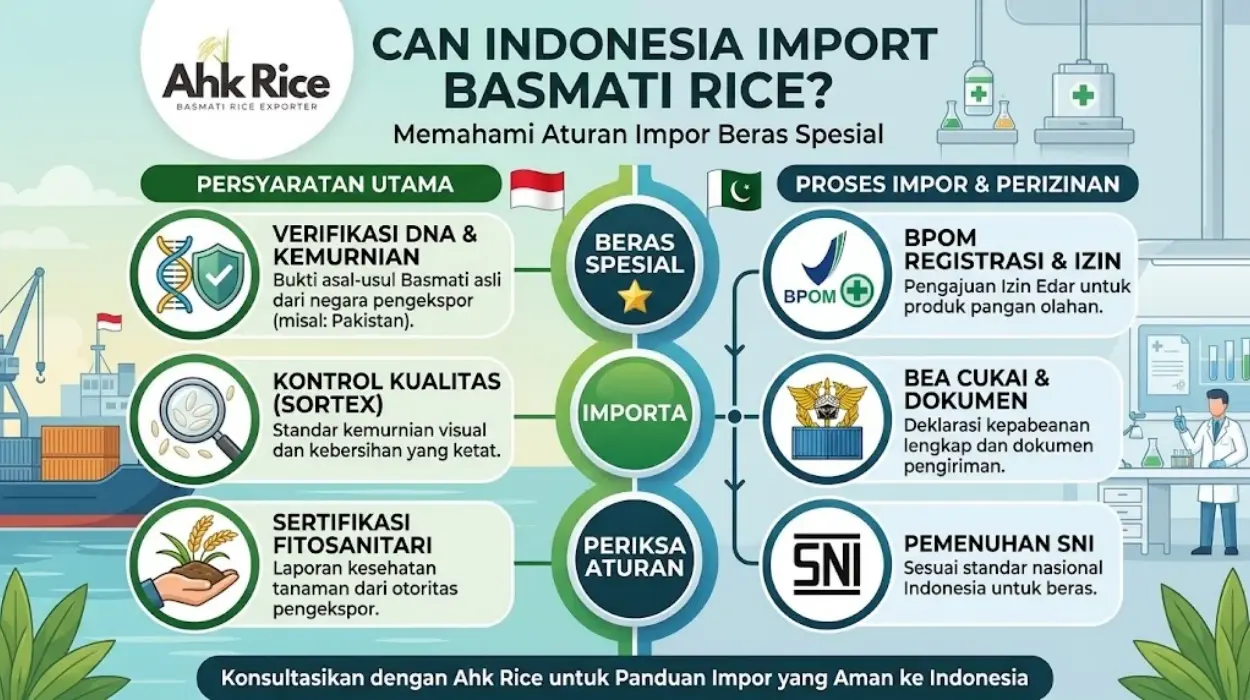
Basmati rice importation follows a controlled process involving product classification, eligible importer identification, government authorization, shipment documentation and customs clearance. Importers must establish regulatory eligibility before exporters arrange commercial shipments or dispatch containers to Indonesian ports.
The process follows these stages:
1. Identify the rice classification
The importer confirms the correct Indonesian Harmonized System classification. The 2026 Indonesian import framework identifies Basmati under HS 1006.30.50.
The applicable classification determines the import requirements, product description and authorization route. JDIH BPK+1
2. Establish importer eligibility
The Indonesian buyer must hold the appropriate business and importer identification. The distinction between API-U and API-P is important because they serve different importing purposes.
- API-U: General Importer Identification Number.
- API-P: Producer Importer Identification Number.
Under the 2026 framework, Basmati under the relevant specialty-rice category follows the state-owned enterprise route with API-U. An API-P industrial importer follows a separate route for qualifying rice imported as industrial raw material. CRPG Law Database+1
3. Obtain government authorization
The eligible importer obtains Persetujuan Impor (PI), which means Import Approval. The application follows the applicable national commodity balance and supporting requirements.
4. Arrange export documentation
The exporter prepares the commercial invoice, packing list, certificate of origin, bill of lading and applicable phytosanitary documentation.
5. Complete customs clearance
The importer submits the required documents, completes applicable customs procedures and meets inspection requirements before releasing the cargo.
A shipment must match the approved product description, quantity, origin and destination details.
What Are the Key Components of Indonesia’s Basmati Import Regulations?
Indonesia’s Basmati import framework involves importer identification, government recommendations, Persetujuan Impor, national commodity planning and product-specific requirements. Each component controls a different stage of the transaction, from importer eligibility to authorized shipment quantities and final customs entry.
1. Persetujuan Impor (PI)
Persetujuan Impor is the formal import approval issued under Indonesia’s Ministry of Trade framework. It authorizes qualifying imports according to the applicable product category and approved conditions.
The regulatory framework includes Permendag No. 18 of 2025, amended by Permendag No. 31 of 2025 and Permendag No. 11 of 2026. The latest amendment became effective on 8 May 2026. JDIH BPK+2
2. Importer identification
Importer identification establishes the legal status and permitted business activity of the Indonesian buyer.
API-U identifies a general importer. API-P identifies a producer importer that brings in qualifying materials for its own industrial production.
These registrations are not interchangeable. The importer must use the category applicable to the product and its intended use.
3. National Commodity Balance (Neraca Komoditas)
Neraca Komoditas is Indonesia’s national commodity balance system. It helps the government assess domestic production, consumption, supply requirements and import needs.
Where the applicable commodity balance has been established, it forms part of the import approval requirements. Where it has not been established, alternative supporting documents specified in the regulation apply. CRPG Law Database+1
4. Government recommendation and import allocation
The National Food Agency, known as Badan Pangan Nasional (Bapanas), participates in national food supply planning and import recommendations.
An importer’s recommendation and approved allocation are important because rice imports operate under government controls. An exporter cannot independently create an Indonesian import quota.
5. Product quality and documentation
The product must meet its approved specification and applicable Indonesian requirements.
Important quality parameters include:
- Grain variety and product description.
- Broken grain percentage.
- Moisture content.
- Foreign matter.
- Crop year and country of origin.
- Packaging and net weight.
For Basmati classified under HS 1006.30.50, the 2026 framework specifies a maximum broken-grain level of 5% for the relevant Basmati category. CRPG Law Database
What Are the Benefits of Importing Basmati Rice into Indonesia?
Basmati imports give Indonesian food businesses access to an aromatic long-grain product that serves specialized culinary demand. Its grain length, cooking characteristics and established international recognition make it suitable for premium restaurants, hotels, catering operations and specialty grocery distribution.
The main commercial benefits include:
- Specialty restaurant supply: Basmati supports biryani, pulao and Middle Eastern rice dishes.
- Product differentiation: Retailers offer an imported aromatic rice category alongside locally produced varieties.
- Premium foodservice: Hotels and restaurants use long-grain rice for international menus and banquet services.
- Wholesale distribution: Importers supply specialty food distributors, supermarkets and ethnic grocery stores.
- Consistent product specifications: Importers can specify grain length, broken percentage, moisture and processing method before shipment.
These benefits depend on legal import authorization, product quality and actual market demand. Specialty classification does not automatically guarantee permission to import a particular quantity.
Which Indonesian Businesses Use Imported Basmati Rice?
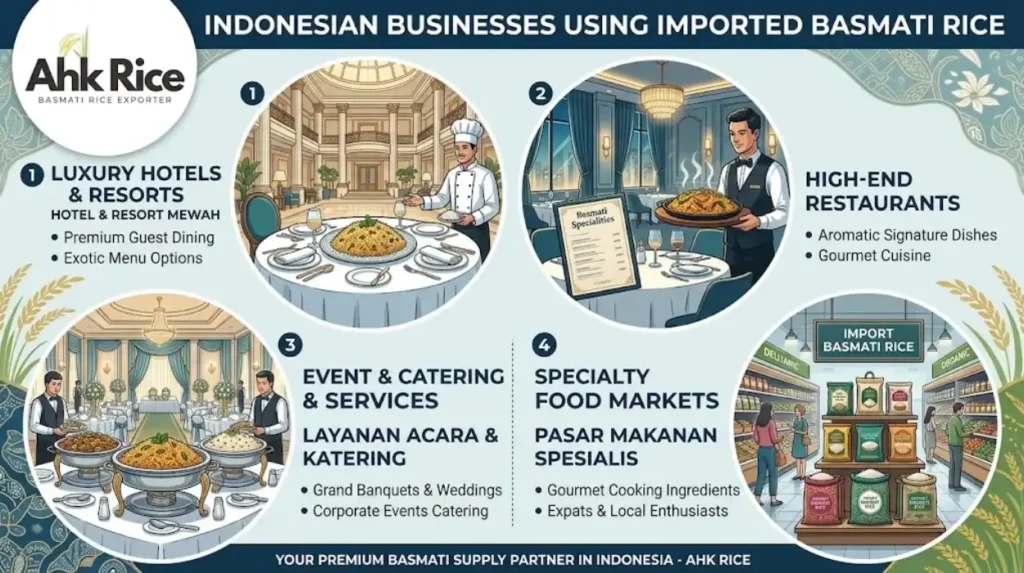
Imported Basmati serves Indonesian businesses that require aromatic long-grain rice for specialized menus and retail customers. Its principal commercial applications include South Asian restaurants, international hotels, catering companies, specialty food distributors and modern retail outlets serving diverse consumer preferences.
Restaurants and foodservice
Indian, Pakistani and Middle Eastern restaurants use Basmati for biryani, pulao and traditional rice dishes. Separate grain characteristics support different cooking techniques and menu requirements.
Hotels and hospitality businesses
Hotels use specialty rice in international restaurants, buffet services and banquet menus. Their procurement teams specify grain quality, cooking performance and packaging requirements.
Catering companies
Large catering operations require consistent rice quality across multiple servings. Golden Sella and Steam Basmati serve different preparation preferences.
Supermarkets and specialty retailers
Retailers distribute imported rice in consumer packaging, including 1 kg, 2 kg, 5 kg and 10 kg bags. Packaging and product descriptions must comply with Indonesian requirements.
Food distributors
Importers and wholesalers supply restaurants, institutional buyers and specialty grocery retailers. Their purchasing decisions depend on approved import quantities, customer demand and distribution capacity.
Which Certifications and Documents Apply to Basmati Rice Imports?
Basmati rice shipments require commercial, origin, plant-health and food-compliance documentation according to Indonesian import requirements. The precise documents depend on the product classification, applicable regulations, country of origin, shipment arrangement and destination port.
The main documents and compliance areas include:
| Document or requirement | Purpose |
|---|---|
| Certificate of Origin | Establishes Pakistani origin |
| Phytosanitary Certificate | Confirms applicable plant-health requirements |
| Commercial Invoice | Records product value and transaction details |
| Packing List | Identifies package quantities and weights |
| Bill of Lading | Confirms shipping and cargo details |
| Import Approval (PI) | Authorizes the approved import |
| Quality Certificate / COA | Records agreed product specifications |
| Customs documentation | Supports Indonesian customs clearance |
Food safety and quality standards
Importers must check applicable Indonesian food safety and quality requirements before shipment. These include relevant limits for pesticide residues, contaminants, moisture and other regulated parameters.
A Certificate of Analysis (COA) records measurable product characteristics. It can include moisture, broken grains, foreign matter and other agreed quality parameters.
Packaging and labelling
Commercial packaging must provide accurate product information and comply with Indonesian labelling requirements.
Important information includes:
- Product name and rice variety.
- Country of origin.
- Net weight.
- Importer identification where required.
- Applicable Indonesian-language information.
- Production and expiry details where required.
Halal certification, BPOM requirements and other food-related registrations must be assessed according to the product, intended use and applicable Indonesian rules. They should not be treated as universally identical requirements for every raw rice shipment.
What Are the Common Problems and Misconceptions About Basmati Imports?
The biggest import problems arise from incorrect product classification, missing authorization, unsuitable importer registration and shipment-document discrepancies. Exporters and Indonesian buyers must resolve these issues before loading cargo because commercial contracts alone do not replace regulatory approval.
Misconception 1: Indonesia completely prohibits Basmati imports
Indonesia distinguishes ordinary rice imports from specialty rice imports. The National Food Agency has specifically identified Basmati and Hom Mali as specialty rice categories.
Its December 2025 announcement explained that specialty and industrial rice imports were treated separately from ordinary consumption rice. pustaka.badanpangan.go.id+1
Misconception 2: Every Indonesian company can import Basmati
Importer eligibility depends on the applicable authorization category. The 2026 framework identifies the Basmati specialty-rice route under the relevant BUMN/API-U provisions.
An ordinary trading company cannot assume that its existing business registration automatically qualifies it to import Basmati.
Misconception 3: An exporter’s certificate guarantees Indonesian entry
A Pakistani Certificate of Origin or phytosanitary certificate does not replace Indonesian import approval. These documents serve different regulatory purposes.
Misconception 4: All Basmati varieties have identical specifications
1121, Super Kernel and 1509 have different grain characteristics. Steam and Sella processing also produce different cooking properties.
Importers must specify the exact variety and grade in their purchase contracts and quality documents.
Misconception 5: Import approval and customs clearance are the same
Import approval authorizes the relevant import transaction. Customs clearance is a separate procedure involving declaration, document verification, applicable duties and taxes, and release of goods.
How Can Exporters Prepare for Indonesia’s Specialty Rice Market?
Exporters should confirm the Indonesian importer’s eligibility, approved product category, available allocation and shipment requirements before accepting a shipment order. This sequence reduces documentation errors and prevents cargo from departing before the buyer establishes the necessary import authorization.
A practical preparation process includes:
- Confirm the Indonesian buyer’s legal importer status.
- Verify the applicable Basmati HS classification.
- Confirm the current import approval and government allocation.
- Agree on variety, grade and broken-grain percentage.
- Prepare a COA and commercial sample for quality evaluation.
- Confirm packaging, labelling and plant-health documentation.
- Match the invoice, packing list and shipping documents with the approved import details.
For a deeper explanation of the Indonesian buyer’s regulatory responsibilities, the next stage is understanding [Import Approval (Persetujuan Impor), Ministry Recommendations and Importer ID for Specialty Rice].
This subject explains how government recommendations, importer identification and import approvals work together before a specialty rice shipment enters Indonesia.
Frequently Asked Questions
Can Pakistan export Basmati rice to Indonesia?
Yes. Pakistan-origin Basmati can enter Indonesia when the Indonesian importer meets the applicable eligibility requirements and obtains the required government authorization. Export documentation and plant-health compliance must also be completed.
What is Persetujuan Impor (PI) in Indonesia?
Persetujuan Impor is Indonesia’s formal Import Approval. It authorizes eligible businesses to import specified products under applicable government conditions, including product classification and approved quantities.
What is the role of Bapanas in Basmati imports?
Badan Pangan Nasional (Bapanas) manages national food supply planning and participates in rice import allocation and recommendation processes. Its decisions consider domestic supply and demand.
Can private companies import Basmati rice into Indonesia?
The applicable 2026 framework identifies Basmati under the specialty-rice import route for BUMN (state-owned enterprises) holding API-U. Private industrial importers have a separate API-P route for qualifying rice used as industrial raw material.
What is the HS code for Basmati rice in Indonesia?
The 2026 Indonesian import regulation identifies Basmati under HS code 1006.30.50. Importers must confirm the classification against the current Indonesian tariff schedule and product description.