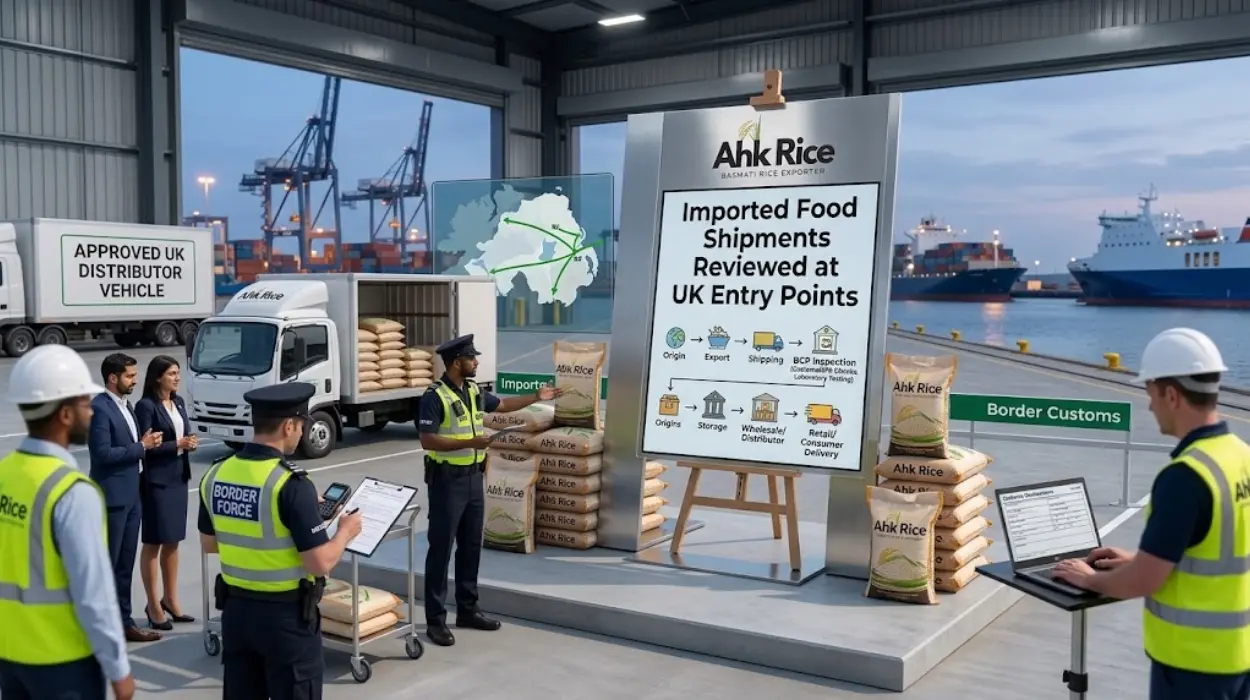
How Are Imported Food Shipments Reviewed at UK Entry Points?
Imported food shipments are reviewed through documentary, identity, and physical checks, with the exact controls determined by commodity risk, origin, destination, and applicable UK or Northern Ireland rules. Here is why: Border Control Posts (BCPs) verify documentation, shipment identity, food safety, and regulatory compliance before controlled consignments enter the market.
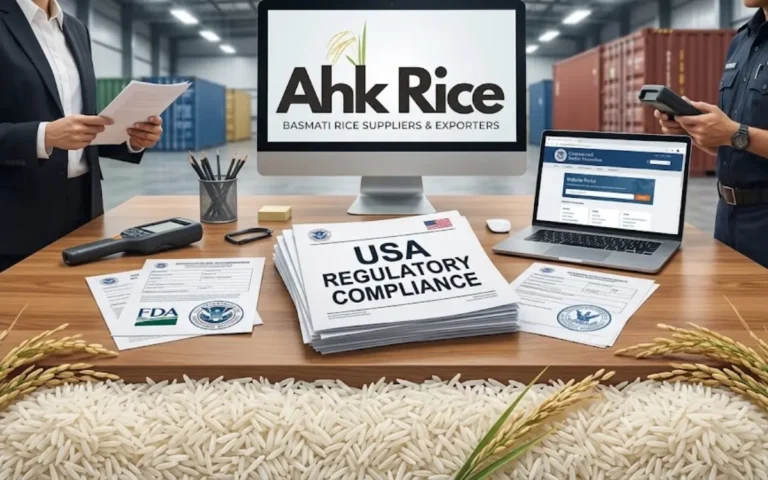
For rice importers, the most important distinction is between Great Britain and Northern Ireland. Great Britain uses UK import controls, while Northern Ireland remains aligned with EU sanitary and phytosanitary requirements for relevant goods. Importers should understand these differences before selecting a supplier or shipping route. For a broader explanation of documentation and compliance, see UK rice import requirements for Pakistani suppliers.
What are the available solutions for reviewing imported food shipments?
The main review methods are documentary checks, identity checks, physical inspections, laboratory testing, and risk-based controls. Each method examines a different compliance layer, from paperwork accuracy to the actual condition and safety of the food shipment.
Documentary checks
Documentary checks examine the information submitted for the consignment. Authorities can review commercial documents, certificates, declarations, product descriptions, commodity codes, and import notifications.
For controlled food imports, pre-notification through IPAFFS provides authorities with shipment information before arrival. The system supports risk-based sampling and traceability for relevant imports.
A rice shipment can therefore face delays before physical inspection starts when its documents contain inconsistent product descriptions, quantities, origins, or certification details.
Identity checks
Identity checks confirm that the shipment matches its declared documentation. Officers compare package markings, identification information, seals, quantities, and product descriptions.
A container declared as 1121 Basmati should therefore contain packaging and product information consistent with that declaration. Identity verification connects the physical consignment to its import record.
Physical checks
Physical checks involve opening, examining, and sampling the consignment. Authorities assess whether the product complies with applicable food safety and import requirements.
The exact frequency depends on the commodity and risk classification. Certain high-risk food products require official controls at authorised BCPs.
Laboratory testing
Laboratory testing provides analytical evidence for specific risks. Rice and cereal products can be subject to controls involving contaminants, pesticide residues, mycotoxins, or other specified hazards.
UK guidance identifies retained controls for contaminants including aflatoxins and Fusarium toxins in cereals and cereal products.
With the review methods established, the next question is how Great Britain and Northern Ireland apply these controls differently.
How do Great Britain and Northern Ireland approaches compare?
Great Britain applies UK import procedures, while Northern Ireland follows separate arrangements involving EU SPS requirements for relevant agri-food goods. The difference affects entry points, notifications, documentation, inspections, and the compliance strategy used by importers.
Great Britain
Great Britain means England, Scotland, and Wales for food import control purposes. Controlled consignments can require entry through an authorised Border Control Post capable of handling the relevant commodity.
BCPs perform sanitary and phytosanitary checks on goods subject to official controls. Each BCP has approved commodity categories, so route planning must match the product with the correct inspection facility.
Rice classification also matters. UK tariff guidance places milled, semi-milled, husked, broken, and parboiled rice within heading 1006, subject to the precise product characteristics.
Northern Ireland
Northern Ireland operates a distinct SPS framework because relevant agri-food goods entering Northern Ireland are subject to EU-aligned controls.
DAERA identifies Belfast Port, Larne Harbour, Warrenpoint Port, and Foyle Port as designated Northern Ireland Points of Entry for SPS checks. Belfast International Airport’s designation is currently suspended.
Northern Ireland therefore requires closer route planning for controlled food shipments. A supplier and importer must confirm the correct Point of Entry and applicable documentation before dispatch.
Specification comparison
| Attribute | Great Britain | Northern Ireland |
|---|---|---|
| Regulatory framework | UK import controls | EU-aligned SPS controls for relevant goods |
| Main inspection location | Authorised BCP | Designated Northern Ireland Point of Entry |
| Documentary review | Required for controlled consignments | Required under applicable SPS procedures |
| Risk assessment | UK risk-based controls | EU-aligned risk controls |
| Notification | IPAFFS for applicable imports | Applicable Northern Ireland notification system |
| Commodity classification | UK tariff and food rules | EU tariff/SPS framework where applicable |
| Route planning | Match commodity to authorised BCP | Match commodity to approved NI Point of Entry |
The comparison shows why the same Pakistani rice shipment can require different entry planning. The next issue is the commercial effect of those differences.
How do rice grade, price, and shelf life compare between the two markets?
Both markets can source 1121, Super Kernel, and 1509 Basmati, but buyers should match processing grade with retail positioning, storage conditions, and landed-cost targets. Price should be compared on the same Incoterm and specification.
Great Britain market preferences
Great Britain has established demand for Pakistani Basmati in retail, wholesale, foodservice, and ethnic grocery channels. Premium buyers commonly evaluate 1121 White, 1121 Steam, 1121 Sella, Golden Sella, and Super Kernel.
Current indicative Pakistani export pricing places 1121 Basmati around $1,135–$1,205 per MT FOB Karachi, depending on processing grade and specification. These figures are origin prices rather than final UK landed prices.
Northern Ireland market preferences
Northern Ireland buyers also evaluate long-grain Basmati according to retail, catering, and wholesale requirements. The principal difference is the regulatory route rather than the basic identity of the rice varieties.
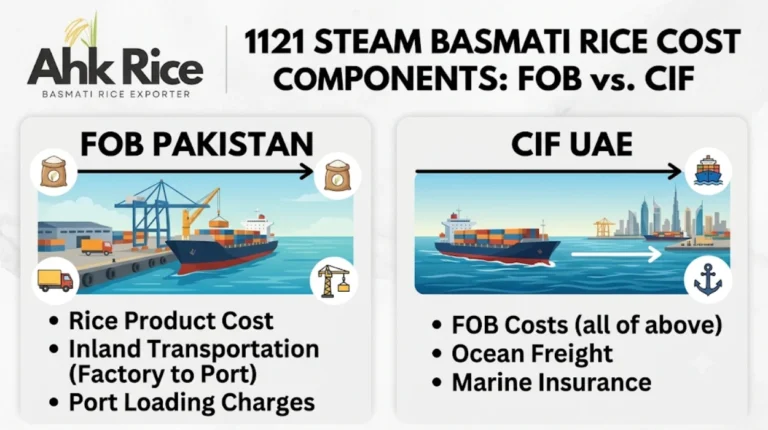
A buyer comparing Northern Ireland and Great Britain should therefore avoid treating FOB price as the complete procurement cost. Freight, customs treatment, inspection charges, port handling, storage, and inland delivery can change the final cost per MT.
Shelf-life comparison
Golden Sella generally provides stronger structural durability than raw white rice because parboiling changes the starch structure of the grain. Steam and white grades serve different texture and appearance requirements.
For commercial procurement, the buyer should specify the required shelf-life period in the purchase specification rather than relying on the generic term “long shelf life.” Storage temperature, humidity, packaging, crop year, and warehouse hygiene affect actual product stability.
The market comparison establishes the commercial variables. The next question is which preparation strategy best controls them.
Which method works best for different imported food cases?

The best method depends on the shipment’s regulatory risk, product type, destination, and inspection requirements. Low-risk food benefits from accurate documentation, while controlled commodities require stronger pre-shipment testing and entry-point coordination.
Standard documentary preparation
Standard documentary preparation works for routine food shipments that do not require enhanced controls. The importer verifies the commercial invoice, packing list, bill of lading, origin information, product classification, and applicable certificates.
This approach reduces administrative errors. It also gives customs and food authorities consistent information before the shipment arrives.
Pre-shipment inspection
Pre-shipment inspection works better for buyers purchasing large commercial quantities. An independent inspection company can examine product specifications before container loading.
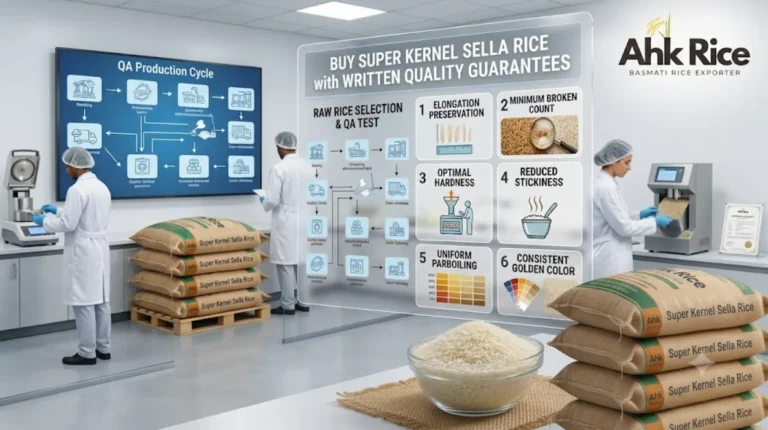
Inspection can verify grain quality, broken percentage, moisture, packaging, container condition, and other contract specifications.
Laboratory testing
Laboratory testing works best when the buyer faces defined chemical or microbiological risks. A certificate or laboratory report can support the compliance file.
The testing plan should match the destination requirements. Testing unrelated parameters adds cost without improving regulatory protection.
Supplier-controlled preparation
Supplier-controlled preparation combines processing, grading, sorting, testing, packaging, documentation, and dispatch under one coordinated export workflow. AHK Rice operates from Punjab and supplies 1121, Super Kernel, and 1509 Basmati varieties to international buyers. Its Pakistan rice export service covers processing, grading, packaging, documentation, and export logistics.
This approach is particularly useful for importers seeking repeat shipments. Specification consistency becomes easier to maintain when the same export process controls each production batch.
With the solution types compared, the next step is evaluating their advantages and limitations.
What are the pros and cons of each shipment preparation approach?
Document preparation provides administrative control, laboratory testing provides analytical evidence, and pre-shipment inspection provides physical verification. A coordinated supplier process combines these controls but requires stronger specification management.
| Approach | Main advantage | Main limitation | Best example |
|---|---|---|---|
| Documentary preparation | Reduces paperwork errors | Cannot prove physical quality alone | Routine rice shipment |
| Identity verification | Confirms shipment matches declaration | Does not test food safety | Sealed container with defined packs |
| Physical inspection | Examines actual product | May delay release | Risk-based official inspection |
| Laboratory testing | Produces analytical evidence | Adds testing cost and time | Residue or contaminant concern |
| Supplier-controlled preparation | Connects production and export controls | Requires capable exporter | Repeat commercial contracts |
A practical example is a 25 MT Basmati shipment destined for wholesale distribution. Documentation confirms the commercial transaction, identity checks confirm the cargo, physical checks assess the product, and laboratory tests address specified risks.
The strength of the system comes from combining the correct controls rather than using every control for every shipment.
What decision factors should importers use before selecting a shipment strategy?
Importers should evaluate destination, product risk, grade, documentation, testing, packaging, supplier capability, and total landed cost before dispatch. These factors determine whether a shipment clears efficiently and remains commercially useful after arrival.
| Decision factor | Buyer question | Practical decision |
|---|---|---|
| Destination | Is the cargo entering GB or Northern Ireland? | Select the correct regulatory route |
| Product risk | Does the commodity face enhanced controls? | Confirm current official requirements |
| Rice grade | Does the buyer need White, Steam, or Sella? | Match processing to end use |
| Documentation | Are declarations and certificates consistent? | Complete verification before loading |
| Testing | Which hazards require evidence? | Use destination-specific laboratory testing |
| Packaging | Does the pack match the sales channel? | Select retail or bulk packaging |
| Cost | What is the final landed cost per MT? | Compare identical Incoterms |
| Supplier | Can the exporter manage the full process? | Evaluate processing and documentation capability |
Cost comparison deserves particular attention. A $1,150 FOB offer cannot be compared directly with a $1,300 delivered quotation. The two prices include different logistics responsibilities.
Grade comparison also requires consistency. A 1121 Golden Sella quotation should not be compared with 1509 White without adjusting for grain specification, processing, packaging, broken percentage, and intended market.
For Northern Ireland shipments, entry-point planning adds another decision layer. DAERA’s designated Points of Entry handle SPS controls, making route selection part of the procurement strategy.
These decision factors convert border compliance from a reactive problem into a procurement specification.
How should an importer prepare a Basmati shipment before UK entry?
Prepare the product specification, verify classification, complete required notifications, assemble certificates, inspect the shipment, confirm packaging, and coordinate the correct entry point before dispatch. This sequence reduces avoidable documentation and routing problems.
Product preparation
Define the Basmati variety, processing grade, broken percentage, moisture specification, packaging format, crop year, and quantity.
Documentation preparation
Prepare the commercial invoice, packing list, bill of lading, certificate of origin, applicable phytosanitary documentation, inspection reports, and other destination-specific records.
Quality preparation
Test agreed quality parameters before container loading. Confirm the results against the purchase specification rather than relying on generic descriptions such as “premium quality.”
Route preparation
Confirm whether the shipment enters Great Britain or Northern Ireland. For controlled goods, select an approved BCP or Point of Entry capable of handling the commodity.
Arrival preparation
Ensure the importer or agent can respond quickly to authority requests. Missing information can extend the clearance process even when the physical product meets specification.
For rice products, classification must also match the actual processing method. UK guidance separates paddy, husked, milled, broken, and parboiled rice classifications under heading 1006.
This preparation sequence connects product quality with border compliance. The final decision is therefore not simply which rice costs less, but which shipment arrives with the correct specification and evidence.
What is the most effective strategy for UK and Northern Ireland rice importers?
The strongest strategy is specification-led procurement supported by accurate documents, destination-specific testing, pre-shipment verification, and coordinated entry-point planning. This approach connects product quality with regulatory clearance and commercial usability.
Great Britain buyers should focus on UK import requirements and the correct authorised BCP where controls apply. Northern Ireland buyers should separately verify the applicable EU-aligned SPS requirements and approved Point of Entry.
For Pakistani Basmati, the procurement specification should identify the exact variety and processing grade. AHK Rice supplies 1121, Super Kernel, and 1509 varieties and manages processing, grading, custom packaging, and export documentation from Punjab.
The commercial objective is straightforward. The buyer needs rice that matches the contract, documentation that matches the cargo, testing that matches the risk, and a route that matches the destination.
That combination provides stronger value than selecting a supplier on FOB price alone.
Frequently Asked Questions
How are imported food shipments checked at UK entry points?
Imported food shipments can undergo documentary, identity, and physical checks. Authorities review declarations, certificates, shipment details, product identity, packaging, and physical condition. Risk-based controls determine whether additional inspection or laboratory testing applies.
Does all imported rice require a physical inspection?
No. Physical inspection depends on the applicable commodity controls and risk framework. Documentary review and other regulatory requirements still apply where relevant. Controlled high-risk products must use appropriate authorised entry points.
What is the difference between a BCP and a Point of Entry?
A Border Control Post is an authorised inspection facility for goods subject to official controls. Northern Ireland uses designated Points of Entry for applicable SPS checks. DAERA currently identifies Belfast Port, Larne Harbour, Warrenpoint Port, and Foyle Port among its designated facilities.
Which Pakistani Basmati grades suit UK importers?
UK buyers can source 1121, Super Kernel, and 1509 according to their target segment. 1121 suits premium retail and foodservice, Super Kernel provides a balanced premium option, and 1509 supports buyers prioritising cost efficiency.
What documents should a Basmati importer prepare?
Typical commercial documentation includes the invoice, packing list, bill of lading, origin documentation, applicable certificates, import notification, and inspection or laboratory evidence where required. Exact requirements depend on the product, origin, destination, and current controls.
How much does Pakistani Basmati cost per metric ton?
Indicative July 2026 FOB Karachi prices for Pakistani Basmati range around $1,135–$1,205 per MT for major 1121 and Super Kernel specifications. Final UK or Northern Ireland landed costs depend on freight, handling, inspection, duties, and the agreed Incoterm.
How should buyers compare Great Britain and Northern Ireland shipments?
Buyers should compare the same variety, processing grade, packaging, quantity, Incoterm, freight basis, inspection requirements, and destination charges. Comparing only the FOB price can produce an inaccurate landed-cost decision.
Does Northern Ireland use the same food import route as Great Britain?
No. Northern Ireland has distinct SPS arrangements for relevant agri-food goods. DAERA designates specific Points of Entry for these controls, while Great Britain operates under its own UK border control framework.