Creamy Sella Basmati Rice: Grain Colour Texture and Cooking Properties
Creamy sella basmati rice grain cooking properties define a lightly parboiled basmati rice that shows a creamy ivory grain, higher structural firmness, and controlled starch release during cooking. Here is why: the parboiling stage partially gelatinizes starch inside the grain before milling, which stabilizes texture, improves elongation, and reduces breakage during boiling and steaming.
Creamy sella basmati rice is cultivated in Pakistan’s Punjab rice belt, where long grain basmati varieties such as 1121, Super Kernel, and 1509 are harvested, milled, parboiled, and graded for export markets that demand consistent cooking performance and uniform grain appearance.
What is creamy sella basmati rice grain cooking properties?
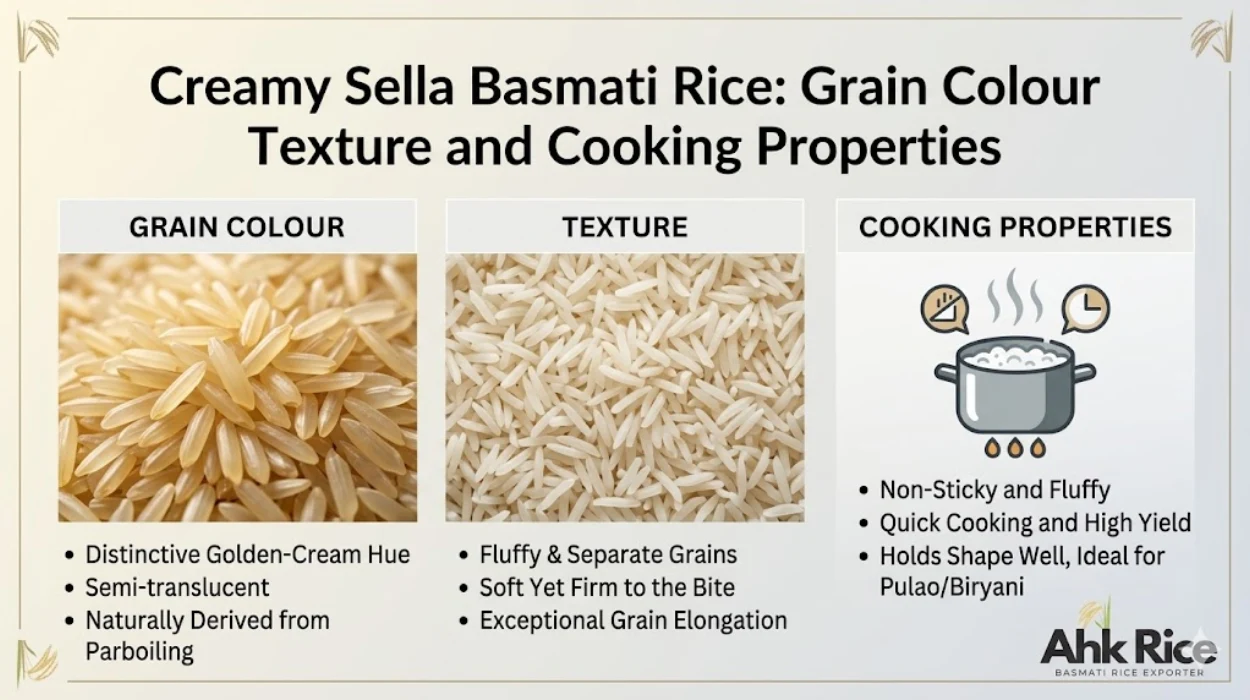
Creamy sella basmati rice grain cooking properties describe a parboiled basmati rice type that produces firm, separate, non-sticky grains with a creamy off-white color and stable elongation after cooking. The grain retains shape due to controlled starch gelatinization during parboiling before milling.
Creamy sella basmati rice originates from long grain basmati harvested in Punjab, Pakistan, where farmers cultivate basmati under controlled irrigation conditions. The harvested paddy is not directly milled. It is first processed through parboiling, which modifies internal starch behavior.
Creamy sella refers to the color outcome after parboiling. The grain turns ivory or creamy instead of golden because steaming intensity is lower compared to golden sella processing. This controlled heat treatment preserves a softer visual profile while maintaining structural firmness.
The grain cooking property is defined by three measurable outputs: elongation ratio after cooking, firmness under pressure, and starch leakage during boiling. Creamy sella maintains low surface starch release, which ensures separation of grains in bulk cooking systems.
This category is widely used in institutional cooking where texture consistency matters more than aroma intensity alone.
With the definition of creamy sella basmati rice established, the next step is understanding how the processing system creates these cooking properties.
How does creamy sella basmati rice work in processing?
Creamy sella basmati rice works through a controlled parboiling system that involves soaking, steaming, drying, milling, polishing, and grading. This sequence stabilizes starch inside the grain and locks structure before final cooking use.
Processing follows a fixed industrial flow in export mills across Punjab.
Clean paddy is first inspected and cleared of impurities such as dust, stones, and immature grains. Mechanical graders separate uniform kernels.
Soak paddy in warm water until moisture penetrates the husk layer. This prepares starch for gelatinization.
Steam paddy under controlled pressure to partially gelatinize starch without fully cooking the grain. This step defines creamy coloration.
Dry parboiled paddy using low-temperature airflow until moisture stabilizes at export-safe levels.
De-husk grain using rubber rollers to remove husk while preserving kernel integrity.
Mill brown rice lightly to remove bran layers without breaking grain structure.
Polish rice minimally to achieve creamy ivory surface instead of high gloss finish.
Grade rice using length separators to isolate 6.8–7.3 mm average kernel length categories for export lots.
Sort grains through optical color sorters to remove discolored or broken kernels.
Test moisture, elongation, and purity in laboratory quality control units before packaging.
With processing mechanics established, the next focus is the internal structure that defines creamy sella grain behavior.
What are key components of creamy sella grain profile?
Creamy sella grain profile consists of starch stability, controlled moisture retention, protein structure, and elongated kernel geometry that determines firmness, texture separation, and post-cooking expansion behavior.
Starch stability defines how the grain reacts to boiling water. Parboiling converts raw starch into a semi-gelatinized form, which prevents rapid breakdown during cooking.
Moisture retention remains at controlled export levels between 12% and 14%, which stabilizes shelf life during shipping and storage.
Protein structure in basmati rice supports elongation without fragmentation, especially in 1121 and Super Kernel varieties.
Kernel geometry in creamy sella basmati remains long and slender, maintaining a length-to-width ratio that supports expansion without collapse.
Grain hardness increases due to parboiling, which improves resistance to breakage during transport and bulk handling.
These components interact to produce consistent cooking output in both household and industrial kitchens.
With structural components defined, the next section explains why these properties matter in real-world applications.
What benefits define creamy sella basmati rice?
Creamy sella basmati rice delivers firm texture, low stickiness, long shelf stability, high elongation ratio, and uniform cooking output across large-scale catering and retail systems.
Firm texture ensures grains remain separate after boiling, which is critical for buffet and institutional food service systems.
Low stickiness reduces starch surface leakage, which improves visual presentation in plated meals.
Long shelf stability reaches up to 18 months in controlled warehouse conditions, supporting export logistics across Gulf and African markets.
High elongation ratio increases grain length after cooking, improving perceived quality in commercial rice dishes.
Uniform cooking output ensures identical texture across batches, reducing preparation variability in kitchens.
Creamy sella also absorbs sauces evenly without collapsing structure, making it suitable for mixed rice dishes.
These benefits align with export-grade specifications demanded by importers in high-volume food markets.
With benefits clarified, the next section focuses on where creamy sella basmati rice is consumed globally.
Where is creamy sella basmati rice used globally?
Creamy sella basmati rice is used in Middle Eastern catering, African food distribution, European ethnic retail, and South Asian wholesale markets due to its firmness, storage stability, and predictable cooking performance.
Gulf markets such as UAE, Saudi Arabia, and Qatar use creamy sella in large-scale catering systems where rice must remain stable in heat-holding containers.
African markets such as Nigeria and Senegal prefer creamy sella due to its resistance to spoilage in non-climate-controlled storage environments.
European ethnic retail imports creamy sella for packaged basmati segments targeting South Asian and Middle Eastern consumers.
South Asian wholesale markets use creamy sella for bulk distribution in restaurants and institutional kitchens.
Importers often compare creamy sella with steam and golden sella variants depending on cooking texture requirements and storage conditions.
A comparative evaluation such as 1121 vs 1509 creamy sella margins importers explains pricing structure differences and yield performance.
With application areas defined, the next section examines common misconceptions about creamy sella rice.
What problems or misconceptions exist about creamy sella rice?
Common misconceptions include confusion between creamy sella and golden sella, misunderstanding of parboiling effects on nutrition, and incorrect assumptions about cooking softness and aroma intensity.
One misconception states that creamy sella is under-processed compared to golden sella. In reality, creamy sella uses controlled steaming intensity to preserve color while stabilizing starch.
Another misconception assumes parboiled rice loses nutritional value. Parboiling actually transfers micronutrients from bran into the kernel, improving retention of minerals during milling.
A third misconception assumes creamy sella becomes soft like raw white rice. Instead, it remains firm due to starch restructuring during steaming.
Some buyers assume all basmati variants behave similarly in cooking. In practice, 1121 shows higher elongation, while 1509 offers faster cooking hydration response.
Another misunderstanding relates to storage life. Creamy sella maintains longer shelf stability than raw milled rice due to reduced enzymatic activity.
With misconceptions clarified, the next logical focus is specification-driven comparison for trade decisions.
Creamy sella basmati rice remains a structured parboiled rice category defined by controlled processing, stable grain morphology, and consistent cooking output across global markets. It connects agricultural cultivation in Punjab with industrial milling, grading, and export systems that supply over 15 international destinations through standardized quality control frameworks.
Frequently Asked Questions
What makes creamy sella basmati rice different from white rice?
Creamy sella basmati rice is parboiled before milling, which partially gelatinizes starch inside the grain. This creates firmer texture, lower stickiness, and better grain separation after cooking compared to raw white rice, which remains softer and more fragile.
Does creamy sella basmati rice expand after cooking?
Yes, creamy sella basmati rice expands significantly after cooking due to starch stabilization during parboiling. The grain elongates while maintaining structure, which results in long, separate grains instead of breaking or becoming sticky.
What is the ideal cooking method for creamy sella basmati rice?
The ideal method is boiling or absorption cooking with controlled water ratio. Rice should be rinsed, soaked briefly, and cooked on medium heat until moisture is fully absorbed. This preserves grain integrity and enhances elongation.
Which countries import creamy sella basmati rice the most?
Major importers include UAE, Saudi Arabia, Qatar, Iraq, Nigeria, and Senegal. These markets prefer creamy sella for catering, retail packaging, and bulk distribution due to its long shelf life and stable cooking performance in large batches.
Is creamy sella basmati rice healthier than raw rice?
Creamy sella basmati rice retains more micronutrients than fully milled white rice because parboiling transfers nutrients from bran into the kernel. It also has a lower glycemic impact compared to standard polished rice.