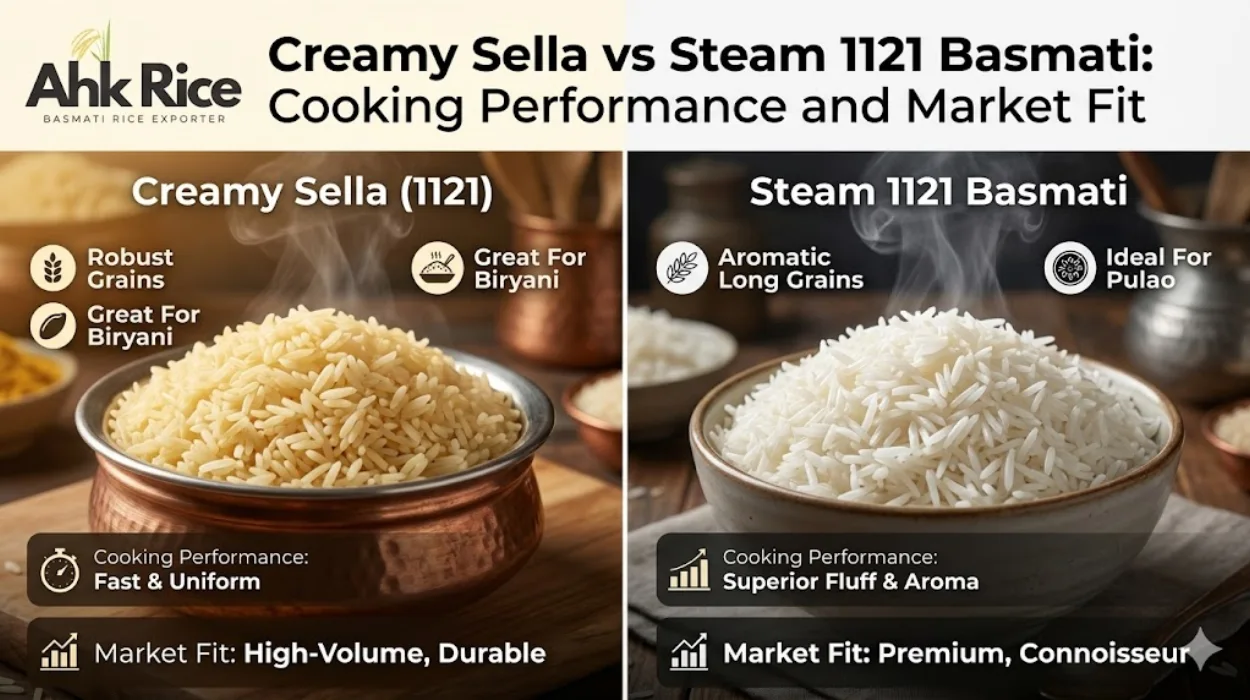
Creamy Sella vs Steam 1121 Basmati: Cooking Performance and Market Fit
Creamy Sella 1121 outperforms Steam 1121 in durability and bulk cooking stability, while Steam 1121 delivers superior softness and aroma for premium dining. Here is why: parboiling strengthens grain structure in Sella, whereas direct milling preserves fragrance in Steam, creating distinct cooking and market outcomes.
Buyers evaluating creamy sella vs steam 1121 basmati cooking market fit need clarity on performance, not just appearance. Both variants originate from 1121 Basmati paddy cultivated in Punjab. Both undergo milling, grading, and export processing. Yet their processing method defines their final behavior.
For foundational understanding of basmati processing differences, review this contextual guide on parboiled and raw rice systems before comparing outcomes.
The first commercial benchmark begins with sourcing. AHK Rice mills, grades, and exports both Creamy Sella and Steam 1121 through controlled processing lines, ensuring consistent specifications across shipments.
What are the available solutions?
Creamy Sella and Steam 1121 represent two processing solutions: parboiled durability versus raw softness, each optimized for distinct cooking systems and supply chains across export markets.
Creamy Sella 1121 Basmati
Creamy Sella 1121 undergoes parboiling before milling. Parboiling means soaking, steaming, and drying paddy before dehusking. This process hardens the grain and locks nutrients inside.
Processors follow nine controlled steps:
- Clean the paddy
- Soak in water tanks
- Steam under pressure
- Dry to target moisture
- Dehusk the grain
- Polish the rice
- Sort by length
- Grade by thickness
- Pack for export
Creamy Sella grains appear off-white or cream-toned. Grain length averages 8.20–8.40 mm. After cooking, elongation reaches 2.0–2.2x.
Steam 1121 Basmati
Steam 1121 skips soaking and directly steams raw paddy lightly before milling. This preserves aroma but reduces structural strength.
Processors follow seven steps:
- Clean the paddy
- Steam lightly
- Dry the grain
- Dehusk the rice
- Polish the kernels
- Sort by size
- Pack for shipment
Steam rice appears bright white. Grain length averages 8.30–8.50 mm. Cooked elongation reaches 2.2–2.5x.
Creamy Sella offers resilience in cooking systems, while Steam offers sensory appeal. With both solutions defined, the next question is how their performance compares in measurable terms.
How do different approaches compare?
Steam 1121 leads in aroma and softness, while Creamy Sella leads in breakage resistance, shelf life, and bulk cooking efficiency across high-temperature and high-volume conditions.
Specification Comparison Table
Core Attribute Comparison
| Attribute | Creamy Sella 1121 | Steam 1121 |
|---|---|---|
| Grain Length | 8.20–8.40 mm | 8.30–8.50 mm |
| Cooking Elongation | 2.0–2.2x | 2.2–2.5x |
| Texture After Cooking | Firm, separate | Soft, fluffy |
| Aroma Retention | Moderate | High |
| Breakage Resistance | High | Medium |
| Water Absorption | Controlled | Rapid |
| Shelf Life | 18–24 months | 10–12 months |
Cooking Performance Comparison
Creamy Sella absorbs water gradually because parboiling gelatinizes starch. This prevents overcooking in large batches. In UAE catering kitchens operating above 35°C ambient temperature, Sella maintains grain separation after 2 hours holding time.
Steam 1121 absorbs water quickly. This produces soft, aromatic rice ideal for plated meals. However, grains break under prolonged heat. In restaurant buffets, Steam rice loses structure after 60–90 minutes.
Market Price Comparison (Per MT)
- Creamy Sella 1121: $950–$1,150/MT CIF Gulf
- Steam 1121: $1,050–$1,300/MT CIF Gulf
(source: REAP export data, December 2025)
Steam commands higher prices due to premium dining demand. Sella maintains stable pricing due to bulk utility.
Buyers comparing shipment-level costs can review detailed CIF breakdowns for Gulf ports in this guide to 1121 creamy sella export pricing.
Shelf Life Comparison
- Creamy Sella: 18–24 months in non-climate storage
- Steam: 10–12 months in controlled storage
In Saudi warehouses without humidity control, Sella retains quality longer. Steam requires faster turnover.
With measurable differences established, the next step is identifying which method suits specific use cases.
Which method works best for different cases?
Creamy Sella suits bulk catering and hot climates, while Steam 1121 fits premium restaurants and retail consumers seeking aroma and softness in controlled cooking environments.
Market Fit by Region
Gulf Cooperation Council (GCC)
GCC buyers prioritize durability and storage stability. Climate conditions exceed 40°C, and storage often lacks full climate control.
- Preferred grade: Creamy Sella 1121
- Use case: Catering, labor camps, bulk kitchens
- Reason: Heat resistance and longer shelf life
In Dubai catering supply chains, Sella maintains quality across long logistics cycles.
European Union (EU)
EU buyers prioritize sensory quality and packaging presentation.
- Preferred grade: Steam 1121
- Use case: Retail packs, premium restaurants
- Reason: Aroma, whiteness, softness
In UK supermarkets, Steam rice sells as premium basmati due to consumer preference for fragrance.
Application-Based Fit
- Choose Creamy Sella for large-scale cooking systems
- Choose Steam for plated dining experiences
- Choose Sella for long storage cycles
- Choose Steam for fast retail turnover
This alignment between cooking behavior and market demand defines the correct specification. With use cases clear, evaluating advantages and limitations provides deeper clarity.
What are the pros and cons?
Creamy Sella offers durability and consistency, while Steam 1121 delivers superior taste and visual appeal, creating a trade-off between operational efficiency and sensory quality.
Creamy Sella Pros
- High resistance to breakage during cooking
- Long shelf life in varied climates
- Stable performance in bulk cooking
Creamy Sella Cons
- Lower aroma intensity
- Slightly firmer texture
- Less visual whiteness
Example: In Iraqi institutional kitchens, Sella prevents clumping during mass cooking, ensuring consistent servings.
Steam 1121 Pros
- Strong natural basmati aroma
- Soft and fluffy texture
- Bright white grain appearance
Steam 1121 Cons
- Shorter shelf life
- Higher breakage risk
- Sensitive to overcooking
Example: In London fine dining restaurants, Steam enhances dish presentation but requires precise cooking control.
Performance Variation Examples
- Creamy Sella lasts longer than Steam. In UAE storage, Sella lasts 18 months, Steam lasts 12 months.
- Steam cooks softer than Sella. In restaurant plating, Steam delivers higher customer satisfaction scores.
- Sella resists breakage better than Steam. In catering kitchens, Sella reduces waste by 15–20%.
These trade-offs clarify operational decisions. The next step is structured decision-making.
What decision factors should buyers consider?
Buyers should prioritize cooking method, storage conditions, target market, pricing tolerance, and supply chain length to select between Creamy Sella and Steam 1121 effectively.
Decision Framework Table
| Factor | Choose Creamy Sella | Choose Steam 1121 |
|---|---|---|
| Cooking Scale | Large batch | Small batch |
| Storage Duration | Long-term | Short-term |
| Climate | Hot, humid | Controlled |
| Customer Preference | Utility | Premium taste |
| Price Sensitivity | Moderate | Higher tolerance |
Practical Decision Logic
Select Creamy Sella when cooking involves industrial-scale kitchens. Select Steam when presentation defines value.
Select Sella when storage exceeds six months. Select Steam when turnover remains fast.
Select Sella for export markets like Saudi Arabia and Iraq. Select Steam for UK and European retail chains.
Supply Chain Impact
Sella reduces logistical risk. Steam increases market positioning value.
Sella supports cost control. Steam supports brand differentiation.
With decision factors defined, buyers can align specification with business goals.
Conclusion: Cooking Performance Defines Market Fit
Creamy Sella and Steam 1121 serve different commercial objectives. Sella delivers reliability, efficiency, and durability. Steam delivers aroma, softness, and premium appeal.
The correct choice depends on operational context, not preference alone.
For pricing benchmarks and shipment-level specifications, refer to the detailed breakdown in the decision-stage guide on 1121 creamy sella export pricing for Gulf markets.
Frequently Asked Questions
What is the main difference between Creamy Sella and Steam 1121 Basmati?
Creamy Sella 1121 is parboiled before milling, which strengthens the grain and increases shelf life. Steam 1121 is lightly steamed and milled directly, preserving aroma and softness. This processing difference defines cooking performance and market suitability.
Which type of basmati rice is better for bulk cooking?
Creamy Sella 1121 performs better in bulk cooking because it resists breakage and maintains grain separation under prolonged heat. Large catering operations prefer it for consistent results and lower waste during high-volume preparation.
Why does Steam 1121 have a stronger aroma than Sella rice?
Steam 1121 retains more natural aromatic compounds because it avoids full parboiling. The lighter processing preserves the basmati fragrance, making it ideal for restaurants and premium retail markets focused on sensory quality.
How does shelf life impact the choice between Sella and Steam?
Creamy Sella lasts up to 24 months in non-climate-controlled storage, while Steam typically lasts 12 months. Buyers in hot regions select Sella to reduce spoilage risk and maintain quality during longer storage periods.
Which markets prefer Creamy Sella vs Steam 1121?
Gulf and Middle Eastern markets prefer Creamy Sella due to climate and bulk usage. European markets prefer Steam 1121 because consumers value aroma, whiteness, and soft texture in packaged retail rice.