Super Kernel Brown vs Super Kernel White Basmati: Which to Import for Europe?
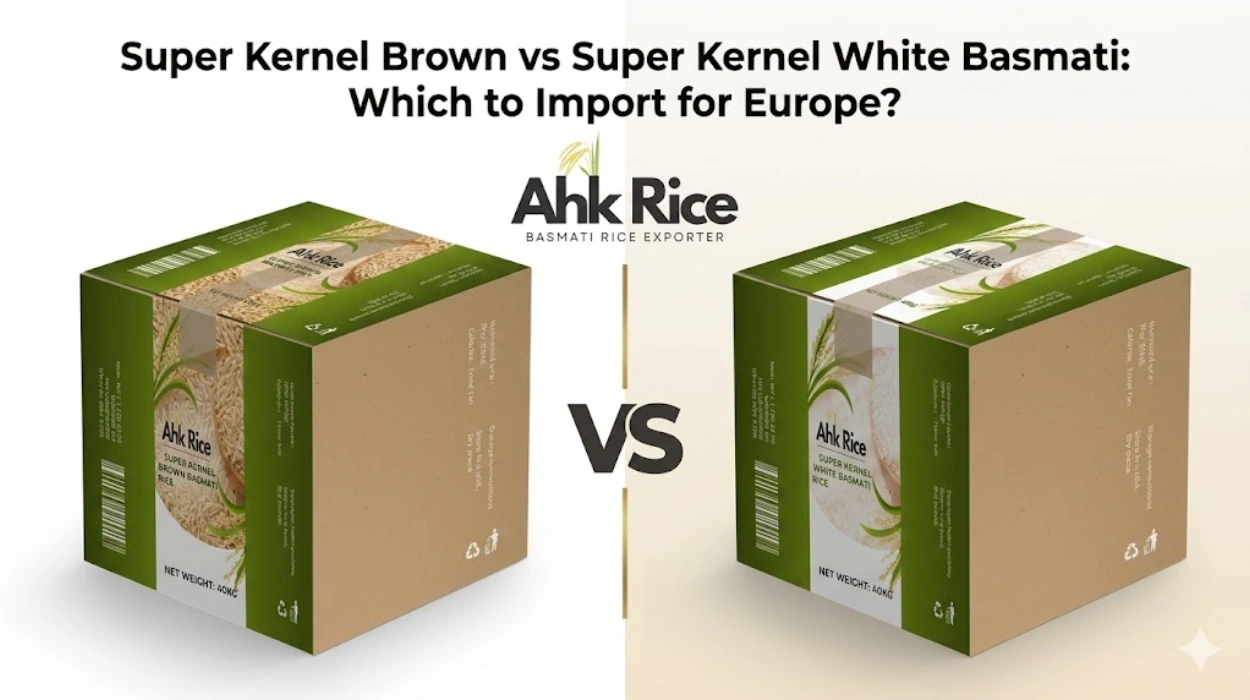
Super Kernel White Basmati fits mainstream European retail and foodservice demand, while Super Kernel Brown Basmati fits health-focused and wholegrain segments. Here is why: white basmati delivers higher consumer familiarity and volume turnover, while brown basmati delivers fibre value and premium positioning in EU health markets.
European buyers evaluate basmati rice based on consumption trends, compliance, and shelf performance. Super Kernel Basmati, cultivated in Punjab’s irrigated plains, meets EU expectations for aroma, grain length, and cooking elongation. The import decision depends on whether the buyer targets volume retail channels or niche health segments.
For foundational understanding of basmati varieties, cultivation zones, and processing methods, refer to our educational guide on super kernel brown basmati rice nutrition EU demand.
What are the available solutions for importing Super Kernel Basmati to Europe?
Two primary solutions exist: import Super Kernel White Basmati for mainstream demand or import Super Kernel Brown Basmati for wholegrain health positioning. Both originate from the same paddy but differ at the milling stage.
Super Kernel Basmati begins as harvested paddy cultivated in Punjab. Farmers irrigate fields using canal systems fed by Himalayan rivers. Harvested paddy enters controlled milling facilities for transformation into export-grade rice.
Super Kernel White Basmati (Fully Milled)
Super Kernel White Basmati undergoes full milling and polishing. The process removes husk and bran layers.
Processing steps:
- Clean the paddy to remove impurities
- Dehusk the grain using rubber roll shellers
- Polish the rice to remove bran layers
- Sort by length using graders
- Colour sort to remove defective grains
- Test moisture and purity levels
- Pack in export-grade materials
White basmati delivers:
- Grain length: 6.8–7.2 mm
- Cooked elongation: up to 2x
- Moisture: 12–13%
- Shelf life: 24 months
European supermarkets prefer white basmati because consumers associate it with traditional basmati cooking.
Super Kernel Brown Basmati (Wholegrain)
Super Kernel Brown Basmati retains the bran layer. Milling stops after dehusking.
Processing steps:
- Clean the paddy thoroughly
- Dehusk without polishing
- Sort by grain uniformity
- Inspect for bran integrity
- Test fibre and moisture levels
- Pack with oxygen barrier materials
Brown basmati delivers:
- Grain length: 6.6–7.0 mm
- Higher fibre content: 3–4%
- Lower glycaemic index
- Shelf life: 12–18 months
European health retailers and organic chains prefer brown basmati for its nutritional profile.
With both solutions defined, the next step is to compare their specifications directly.
How do Super Kernel Brown and White Basmati compare in specifications?
White basmati offers longer shelf life and higher polish, while brown basmati offers higher fibre and natural grain integrity. The difference lies entirely in processing depth and market positioning.
Specification Comparison Table
| Attribute | Super Kernel White Basmati | Super Kernel Brown Basmati |
|---|---|---|
| Processing Level | Fully milled and polished | Dehusked only |
| Grain Length | 6.8–7.2 mm | 6.6–7.0 mm |
| Colour | Bright white | Light brown |
| Nutritional Value | Lower fibre | Higher fibre (3–4%) |
| Shelf Life | 24 months | 12–18 months |
| Cooking Time | 12–15 minutes | 25–30 minutes |
| Market Demand | High volume retail | Health-focused niche |
White basmati performs better in logistics because it resists spoilage under long transit conditions. Brown basmati requires controlled storage because bran oils oxidize faster.
Price comparison reinforces this difference.
Price per Metric Ton (Indicative)
| Market | White Basmati | Brown Basmati |
|---|---|---|
| Germany | $900–$1,050/MT | $1,050–$1,200/MT |
| UK | $950–$1,100/MT | $1,100–$1,250/MT |
(source: REAP export data, December 2025)
Brown basmati commands a premium due to lower yield and higher niche demand. White basmati dominates due to scalability.
With specification differences clear, the next question is how European regions actually choose between them.
Which type works best for different European markets?
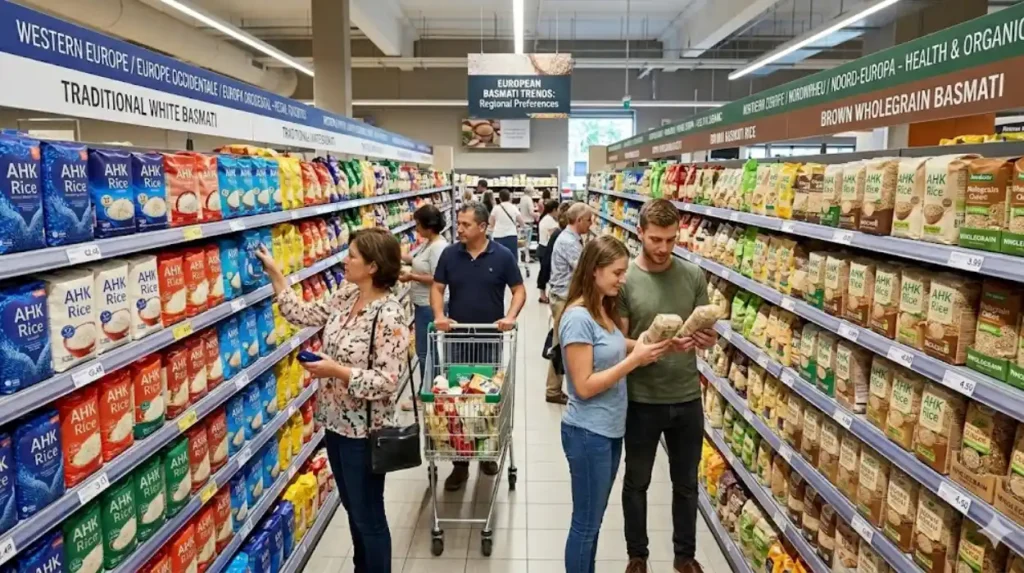
Western Europe prefers white basmati for retail volume, while Northern and Central Europe show increasing demand for brown basmati in organic and health segments.
Western Europe (UK, France, Spain)
White basmati dominates imports.
Reasons:
- Established consumer familiarity
- Faster cooking time
- Lower retail price
- Compatibility with ethnic cuisine
Example:
UK supermarkets stock primarily white basmati because South Asian cuisine drives demand.
Northern Europe (Germany, Netherlands, Scandinavia)
Brown basmati demand is rising.
Reasons:
- Health-conscious consumers
- Organic food retail growth
- Wholegrain dietary trends
Example:
German organic chains stock brown basmati alongside quinoa and wholegrain rice.
Central & Eastern Europe
White basmati remains dominant.
Reasons:
- Price sensitivity
- Lower awareness of brown basmati
- Preference for polished grains
European importers align product selection with consumer awareness levels. Market maturity determines whether brown basmati is viable.
With regional preferences established, evaluating pros and cons clarifies trade-offs.
What are the pros and cons of brown vs white basmati for importers?
White basmati offers stability and volume efficiency, while brown basmati offers differentiation and higher margins. The choice depends on turnover strategy versus niche positioning.
White Basmati – Pros
- Longer shelf life (24 months)
- Faster cooking time
- Lower logistics risk
- High consumer acceptance
Example:
A Spanish distributor importing 5,000 MT annually benefits from predictable turnover using white basmati.
White Basmati – Cons
- Lower nutritional value
- High competition
- Price pressure
Brown Basmati – Pros
- Higher retail margin potential
- Health positioning
- Growing EU demand
Example:
A German organic retailer sells brown basmati at a 20–30% premium compared to white rice.
Brown Basmati – Cons
- Shorter shelf life
- Slower cooking time
- Limited consumer awareness
Brown basmati suits specialized channels, while white basmati suits mass distribution.
With pros and cons clear, decision factors help importers choose accurately.
What factors should importers consider before choosing?
Key decision factors include target market, storage capability, pricing strategy, and consumer demand alignment. Each factor directly affects profitability and inventory risk.
Decision Framework Table
| Factor | Choose White Basmati | Choose Brown Basmati |
|---|---|---|
| Market Type | Mass retail | Health/organic niche |
| Shelf Life Needs | Long storage required | Fast turnover possible |
| Consumer Awareness | Low awareness markets | High awareness markets |
| Pricing Strategy | Competitive pricing | Premium pricing |
| Logistics Risk | Low tolerance | Managed storage systems |
Importers reduce risk by aligning product choice with infrastructure and demand.
Example:
A distributor with ambient storage facilities should select white basmati because it withstands temperature variation better.
Example:
A premium retailer with controlled storage can select brown basmati to capture higher margins.
With decision criteria established, selecting a supplier becomes the next operational step.
How should European importers source Super Kernel Basmati efficiently?
Importers should source from certified exporters who control cultivation, milling, and packaging under EU compliance standards. For buyers specifically targeting wholegrain demand, this guide on sourcing EU-compliant Super Kernel brown basmati explains supplier capabilities and quality benchmarks in detail.
Super Kernel Basmati export requires strict compliance with EU regulations.
Key export steps:
- Inspect paddy quality before milling
- Mill under controlled temperature conditions
- Test pesticide residue levels
- Certify under ISO and HACCP standards
- Load in fumigated containers
- Dispatch with full documentation
Required export documents:
- Phytosanitary certificate
- Certificate of origin
- Fumigation certificate
- Quality inspection report
- Packing list and invoice
(source: Pakistan Bureau of Statistics, FY2024-25)
AHK Rice operates as a Punjab-based exporter supplying 1121, Super Kernel, and 1509 varieties to 15+ countries, with full processing and export control. This integrated model ensures consistent grain quality and compliance with EU import standards.
With sourcing clarified, the final decision depends on aligning product type with business goals.
Conclusion: Which option delivers better value for Europe?
White basmati delivers volume efficiency and stability, while brown basmati delivers niche growth and premium margins. Importers should align choice with target segment and operational capability.
White basmati dominates European imports due to familiarity and shelf stability. Brown basmati grows steadily within health-conscious segments.
Balanced import strategies often include both:
- White basmati for volume turnover
- Brown basmati for margin expansion
This dual approach reduces risk while capturing diverse market demand.
Frequently Asked Questions
What is the main difference between Super Kernel brown and white basmati?
Super Kernel White Basmati is fully milled and polished, while Super Kernel Brown Basmati is only dehusked and retains its bran layer. This difference affects fibre content, shelf life, cooking time, and market positioning in Europe.
Which type of basmati rice has better demand in Europe?
White basmati has higher demand across Europe because it suits mainstream retail and foodservice markets. Brown basmati demand is growing in health-focused segments, especially in Germany and Northern Europe.
Does brown basmati require special storage conditions?
Brown basmati requires controlled storage because the bran layer contains natural oils that can oxidize. Importers should maintain low humidity and stable temperatures to preserve quality during storage and distribution.
Why is brown basmati more expensive than white basmati?
Brown basmati costs more because it has lower milling yield and targets niche health markets. The retained bran layer also requires stricter quality control and packaging, increasing overall export cost.
Which basmati type is better for long-distance shipping to Europe?
White basmati is better for long-distance shipping because it has a longer shelf life and lower risk of spoilage. Brown basmati can be shipped successfully but requires faster turnover and better storage management.