Difference Between Parboiled Basmati and Raw Basmati Rice for Importers
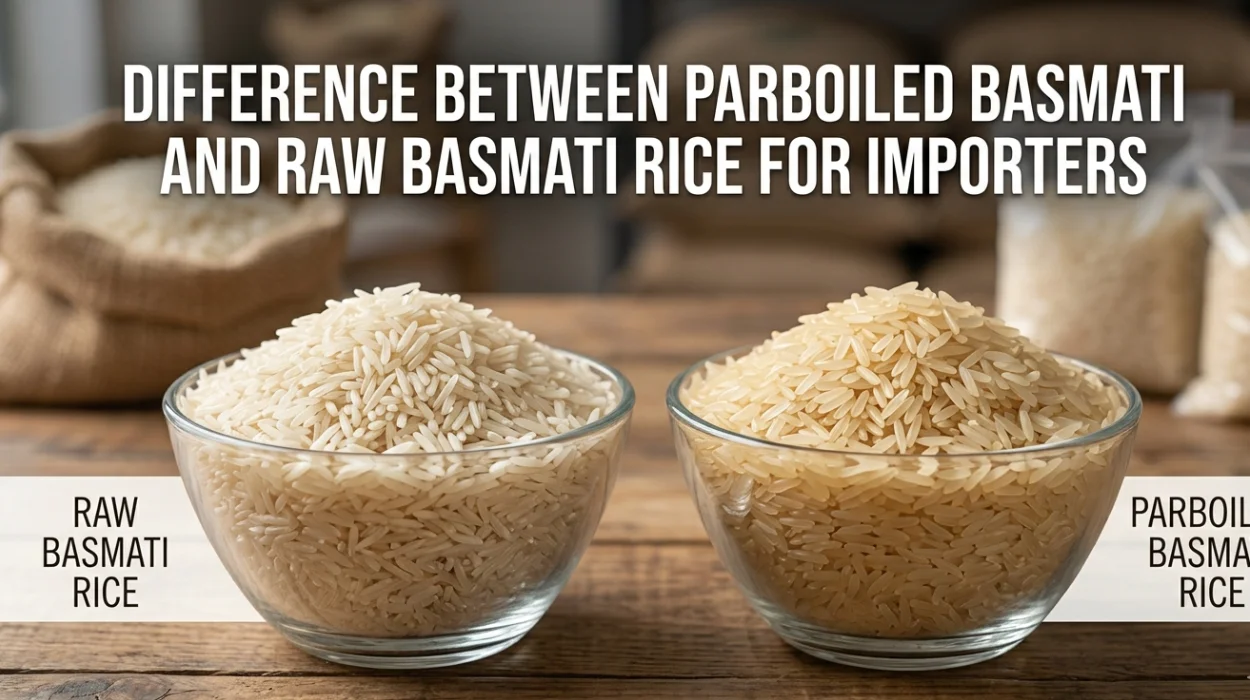
Parboiled basmati and raw basmati are the same botanical variety but differ in processing, which changes the grain’s structure, cooking behaviour, and storage performance. For importers, the choice between parboiled and raw basmati is a commercial decision about shelf life, cooking stability, and market positioning rather than a simple quality choice.
What is the difference between parboiled and raw basmati?
Parboiled basmati is a paddy‑based product that is soaked, steamed, dried, and milled before export, which changes grain hardness, colour, and storage life, while raw basmati is milled directly without parboiling so it keeps a whiter, more aromatic finish.
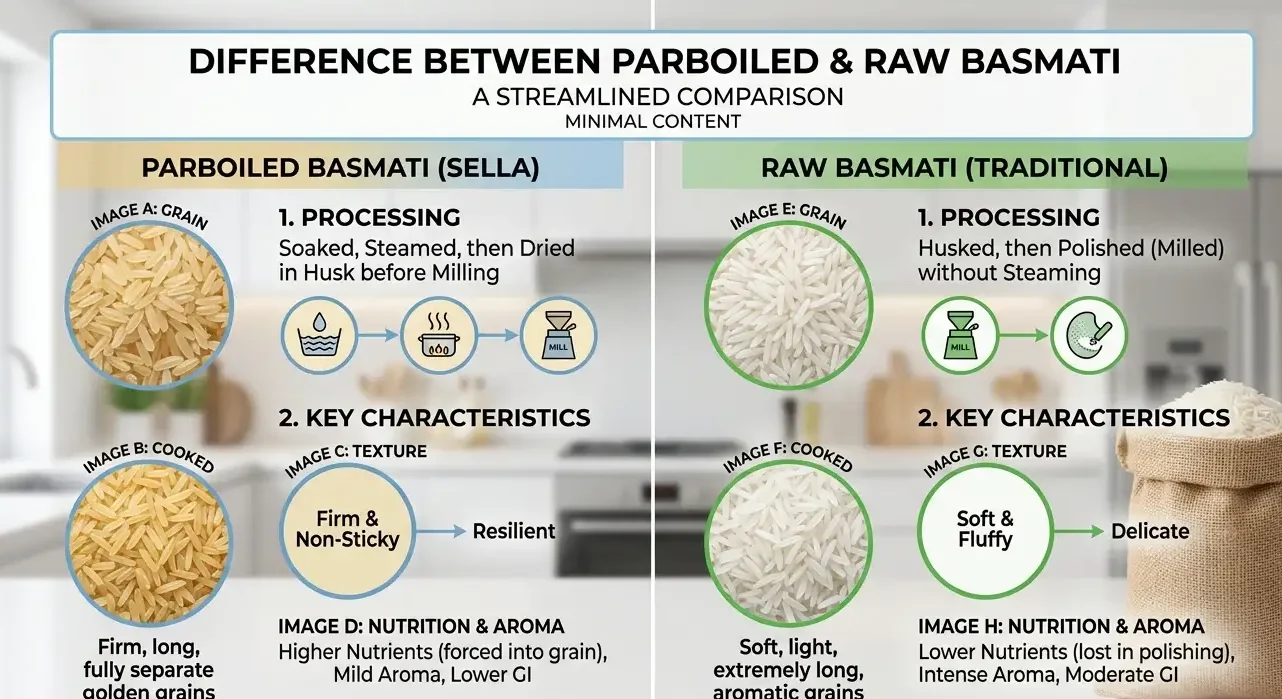
Parboiled basmati and raw basmati both start as Basmati paddy, usually grown in Punjab, Pakistan. The difference appears in the processing route. In parboiled rice, the paddy goes through a heat‑and‑moisture treatment before the bran is removed. In raw basmati, the paddy is cleaned, dried, and milled without that pre‑heat step. That timing change is what creates the distinct end products.
AHK Rice supplies both routes for 1121, Super Kernel, and 1509 varieties. The company uses the same origin base but applies different processing logic to match the market need. That is why the parboiled vs raw basmati decision is not about origin but about finished‑grain behaviour.
For importers, the key is understanding that the variety name does not tell the full story. The same 1121 can appear as white, parboiled, Sella, or brown depending on the processing line. The exporter’s production method decides whether the grain will be more durable, more aromatic, or more shelf‑stable in the final market.
How does parboiled basmati processing work?
Parboiled basmati processing works by moving the paddy through soaking, steaming, drying, husking, and milling so that nutrients move inward, the grain hardens, and the golden colour appears before the final product reaches export packing.
The first step is paddy cleaning. Raw harvest paddy contains dust, straw, broken husks, and field refuse. These are removed mechanically so the grain enters the next stage with a uniform size and moisture level. That uniformity matters because uneven paddy creates uneven colour and breakage later in the line.
The second step is soaking. Clean paddy is placed in water tanks and held until the grain absorbs enough moisture to allow starch gelatinisation. The exact time and water temperature vary by plant design, but the goal is the same: hydrate the kernel so it can accept heat evenly. Without soaking, the next stage produces inconsistent results.
The third step is steaming. The soaked paddy passes through a pressurised steam chamber while still inside the husk. This heat causes the starch molecules in the endosperm to swell, partially set, and lock more nutrients into the grain. The process also triggers the yellow‑gold tint that defines Sella‑style rice. The steaming phase is the core of the parboiled vs raw distinction.
The fourth step is drying. After steaming, the paddy has high moisture and cannot be milled directly. Mechanical or controlled‑air dryers reduce the moisture to a safe storage level. The drying curve is important. Fast drying can crack the grain. Slow, controlled drying keeps head rice yield high and the finish stable.
The fifth step is husking and milling. Once dry, the paddy passes through huskers that remove the outer husk. The brown rice then moves through polishing and grading lines that remove the bran and refine the appearance. The result is parboiled basmati that is ready for export in bulk or consumer packs.
AHK Rice controls this sequence from Punjab‑sourced paddy to export‑ready bag or carton, which keeps the product aligned with international standards. The company can apply the same parboiled logic to 1121, Super Kernel, and 1509 depending on the buyer’s target market.
How does raw basmati processing differ from parboiled?
Raw basmati processing skips the soaking and steaming cycle and moves directly from paddy to cleaning, drying, husking, and polishing, which keeps the grain whiter, more aromatic, and less heat‑treated but more fragile.
In raw basmati, the paddy still undergoes thorough cleaning. Dust, straw, stones, and immature grains are removed so only mature, uniform paddy enters the next stage. Cleaning is the same in both routes. The divergence happens after that point.
The paddy is then dried to a safe milling moisture level. Once the moisture is in range, the grain moves to the husking line. The husk is removed, and the brown rice is polished to remove the bran layer. The result is raw white basmati, which is whiter and more visually bright than parboiled grain. The fragrance also tends to be stronger because the grain has not undergone the same degree of heat exposure.
From an importer’s viewpoint, the un‑stolen state of raw basmati gives a more traditional Basmati experience. The rice cooks softer, clumps more easily, and carries a higher aroma profile. That profile suits buyers who want a sensory‑led product rather than one optimised for storage and breakage control.
What are the key differences in grain structure and behaviour?
The key differences are grain hardness, moisture behaviour, broken‑grain tendency, and shelf life, with parboiled basmati harder and more stable and raw basmati softer and more fragile.
Parboiled basmati is harder because the starch has already undergone partial gelatinisation. The grain keeps its shape better during transport, storage, and cooking. That makes it more suitable for long‑haul shipments, mixed‑channel distribution, and bulk handling. The grain also resists breakage more than raw basmati.
Raw basmati is softer because it has not been steamed. The grain cooks more quickly and becomes more tender. It can also absorb more water and may clump slightly if the cooking ratio is not controlled. That softness is attractive in some markets but creates more risk in long supply chains.
Moisture behaviour differs as well. Parboiled basmati contains less absorbable moisture than raw basmati because part of the hydration happened before milling. That gives the processed grain better storage stability. Raw basmati is more sensitive to humidity and temperature changes, which can increase spoilage or insect risk if the storage environment is not controlled.
Shelf life is longer for parboiled basmati. Under standard export conditions, parboiled 1121 can often maintain quality for 14–18 months. Raw basmati usually performs best within 8–12 months. For importers, that difference changes the way they plan inventory, warehouse rotation, and order frequency.
What benefits does each type offer importers?
Parboiled basmati offers better storage, lower breakage, and more predictable cooking, while raw basmati offers stronger aroma, brighter appearance, and a more traditional Basmati perception.
For importers, parboiled basmati is a logistics‑friendly product. It handles container transit, repeated loading, and long warehouse storage better than raw basmati. This is useful for bulk buyers, distributors, and markets that place rice in slow‑moving channels. The grain also keeps its elongated shape after cooking, which supports consistent plating across large volumes.
Raw basmati is a consumer‑perception‑focused product. The whiter grain and higher aroma appeal to buyers who want a more classic Basmati experience. That is useful in premium retail, ethnic markets, and food‑service settings where the customer sees and smells the rice. The shorter shelf life is acceptable when the turnover is fast and the price supports the product’s sensory profile.
What are the common use cases for each type?
Parboiled basmati is stronger in bulk supply, institutional catering, and long‑haul export, while raw basmati is stronger in premium retail, aroma‑led service, and fresh‑look plating.
Parboiled basmati suits large‑scale importers who supply supermarkets, distributors, and caterers. The grain performs well under volume cooking, buffet service, and hot‑holding conditions. It is also suitable for private‑label and value‑oriented lines where the retailer wants a stable, predictable product without the need for fast stock turnover.
Raw basmati suits buyers who sell on aroma and freshness. Ethnic retailers, gourmet stores, and high‑end restaurants often prefer raw Basmati because the grain carries a stronger fragrance and a whiter plate presence. The format works when the importer can move the product quickly and when the retail environment emphasises freshness over long storage.
Some buyers use both formats. They allocate parboiled basmati to bulk and contract channels and raw basmati to premium SKUs. AHK Rice supports this mixed approach because the company can supply the same variety in both finishes from its Punjab processing line.
What are the common misconceptions about parboiled vs raw basmati?
The most common misconceptions are that parboiled rice is cooked, lower quality, or less nutritious, or that raw basmati is always the premium choice, but none of these statements correctly describes the technical difference.
One misconception is that parboiled rice is already cooked. It is not. The grain is heat‑treated before milling, but it still needs normal boiling before eating. The process changes the internal structure and nutrient distribution, not the cooking requirement. That is why parboiled rice can still be stored as a dry grain.
Another misconception is that parboiling removes nutrients. The opposite is closer to the truth. The process pushes nutrients from the outer layers into the endosperm, which can improve nutrient retention after milling. That is why the parboiled format often delivers a more stable nutrition profile than raw basmati.
A third misconception is that all “Basmati” is the same regardless of processing. It is not. The same variety can emerge as white, parboiled, Sella, cream, or brown depending on the processing line. The market and the buyer’s logistics model should decide which route is right, not the variety name alone.
AHK Rice supplies multiple finishes of 1121, Super Kernel, and 1509 to help buyers match grain type to channel. The company’s end‑to‑end processing in Punjab ensures that the difference between parboiled and raw basmati is controlled, documented, and export‑ready.
How do export standards and certifications apply to both types?
Both parboiled and raw basmati must meet food‑safety standards, phytosanitary rules, moisture limits, and grading specifications, which are enforced through HACCP, ISO‑type quality systems, and export documentation.

Food‑safety systems such as HACCP and ISO‑oriented frameworks control hazards during paddy handling, storage, milling, and packing. These systems help ensure that both parboiled and raw basmati are free from contaminants and processed in a monitored environment. Importers need that proof for customs and retail compliance.
Phytosanitary documentation is also required. The rice must be free from regulated pests and conform to the importing country’s plant‑health requirements. That documentation is part of the standard export process and applies to both processing routes.
Moisture, cleanliness, grain length, and broken‑grain limits form the technical spec sheet. Export mills usually target a safe moisture range, low broken percentage, and a defined grain‑length band. AHK Rice applies these limits across its Basmati lines so both parboiled and raw grains meet international buyer expectations.
How should importers choose between raw and parboiled basmati?
Importers should choose parboiled basmati for long storage, high‑volume handling, and stable cooking, and raw basmati for aroma‑led retail, shorter turnover, and premium perception.
The choice depends on the channel and the logistics model. If the buyer runs a large distribution network, slow‑moving stock, or institutional catering, parboiled basmati is usually the stronger option. The grain survives longer without quality loss and keeps its shape under repeated handling.
If the buyer sells on aroma, whiteness, and freshness, and the product turns over quickly, raw basmati is usually the better fit. The short shelf life is less of a problem when the inventory cycle is tight and the retail price supports the sensory premium.
For buyers in the Asian retail sector, an additional resource on 1121 parboiled vs sella grades gives a regional view of which processing route performs best in specific markets. Insert that MOFU article link in the final section of your page, after the discussion on export markets and before the conclusion, so readers can move from the technical comparison into regional buying behaviour.