Does Packaged Basmati Rice Need BPOM Registration in Indonesia?
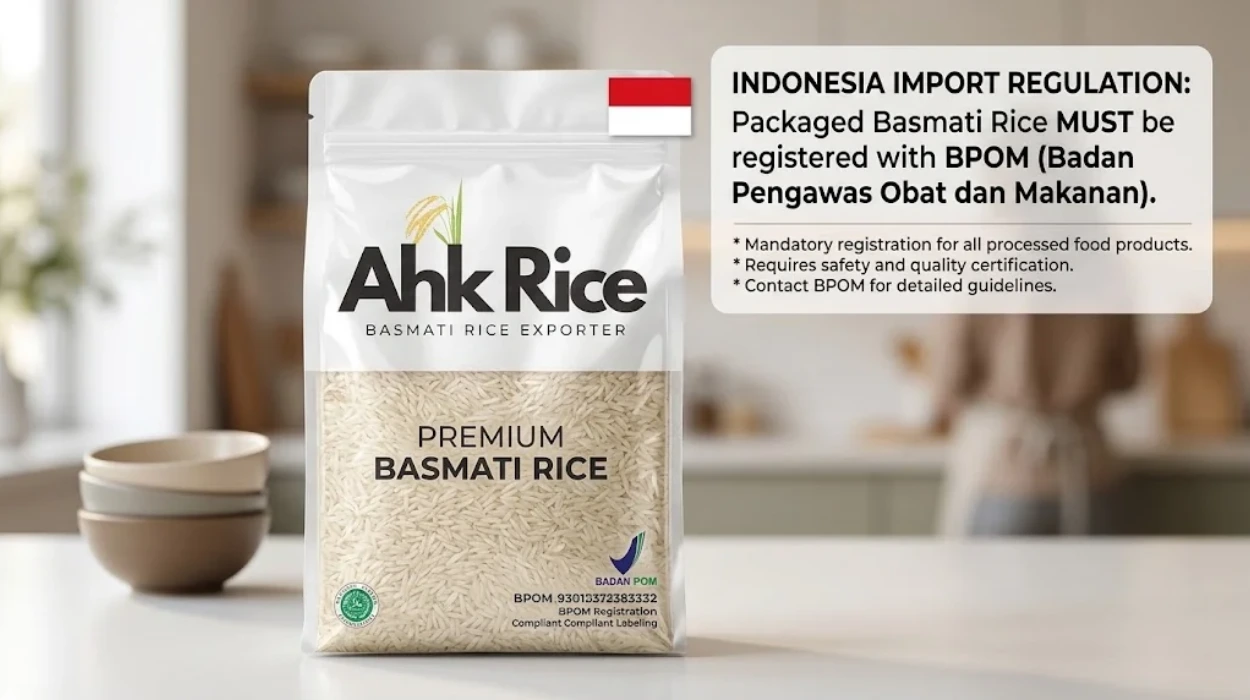
Imported packaged Basmati rice generally needs BPOM registration when it is sold in retail packaging to Indonesian consumers. BPOM treats imported packaged processed food as requiring an authorization for distribution. The imported product receives a BPOM RI ML number.
Basmati rice starts as paddy grown mainly in South Asian rice-producing regions. Pakistan and India are major origins. Pakistani Basmati includes varieties such as 1121, Super Kernel, and 1509 Basmati rice. After milling, grading, sorting, packing, and export, the product enters the Indonesian import and food-control system.
The important distinction is between retail-packed rice and bulk rice used as an ingredient. Indonesian BPOM rules contain exemptions for certain products, including food used further as a raw material and not sold directly to final consumers, bulk-packed food not sold directly to consumers, and small imports for testing, research, or personal consumption. registrasipangan.pom.go.id
What is BPOM registration for packaged Basmati rice?
BPOM registration is the Indonesian food authorization process that allows eligible packaged food to be distributed legally. Imported packaged food receives an ML registration number, while domestically produced food receives an MD registration number.
BPOM stands for Badan Pengawas Obat dan Makanan, Indonesia’s Food and Drug Authority. It controls the safety, quality, labeling, and distribution requirements for regulated food products.
For imported packaged Basmati rice, the relevant approval is generally identified by BPOM RI ML followed by a series of digits. ML indicates food produced outside Indonesia and imported into Indonesia. MD identifies eligible food produced domestically.
The registration is connected to a specific product configuration. Differences in food type, packaging, composition, foreign production facility, importer or distributor, and label design can require separate registration.
Retail-packed versus bulk rice
A 5 kg or 25 kg branded Basmati rice bag intended for Indonesian grocery shelves falls into the retail-packaged category.
A large shipment of rice used as a manufacturing input is treated differently when it is not sold directly to the final consumer.
This distinction is important for importers because the same rice variety can follow different regulatory pathways depending on its intended use, packaging, and distribution model.
How does BPOM registration work for imported Basmati rice?
The Indonesian importer or appointed distributor handles registration for food produced overseas. The process requires company authorization, product information, foreign manufacturer documents, food-safety evidence, labeling materials, and other documents required by BPOM.
The first step is identifying the Indonesian importer responsible for the product. BPOM states that food manufactured abroad and imported into Indonesia is registered by the importer or distributor appointed by the overseas company.
The importer then prepares the required business and product documentation.
For imported products, BPOM’s published requirements include documents such as:
- NPWP
- NIB
- Applicable business permissions
- SMKPO requirements for the distribution facility
- Letter of Appointment from the foreign manufacturer
- GMP, HACCP, ISO 22000, or equivalent evidence
- Product composition
- Production process information
- Shelf-life information
- Production code information
- Product label artwork
- Health Certificate or Free Sale Certificate where required
- Product photographs showing label information
BPOM’s current registration guidance identifies these requirements for imported food registration.
The registration process also checks food safety, quality, nutrition, labeling, production practices, distribution practices, and retail requirements.
What are the key components of packaged Basmati rice registration?
The main components are product identity, composition, manufacturing details, packaging, labeling, safety documentation, foreign manufacturer authorization, importer information, and food-safety certification. Each component connects the imported rice to a specific legal product registration.
Product identity
The importer must define the product accurately.
For example, a product can be identified as Basmati rice with a specified variety, processing type, net weight, and brand.
A 1121 Steam Basmati product and a 1121 Golden Sella product represent different processing descriptions. Their registration details must reflect the actual products being imported.
Composition and production process
Rice appears simple because it generally contains rice as the principal ingredient. The regulatory file still needs accurate product information.
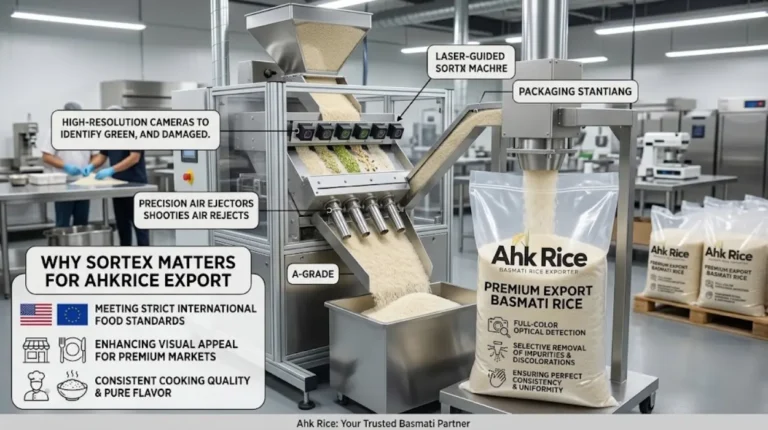
The production process can include paddy cleaning, dehusking, milling, whitening, grading, Sortex sorting, quality inspection, and packaging.
Parboiled Basmati follows a different processing pathway from ordinary white Basmati because steaming or parboiling occurs before final milling.
Packaging
Packaging is a registration component. BPOM requires separate registration when relevant product characteristics differ, including packaging type.
Examples include retail bags, laminated plastic packaging, and different commercial pack formats.
Label
The label connects the registered product to the product sold in Indonesia.
The registration file includes the label design. Differences in label design can trigger separate registration requirements.
For an imported Basmati brand, the importer therefore needs to prepare the actual commercial packaging rather than treating labeling as a separate issue after registration.
What happens to Basmati rice after it is grown and processed?
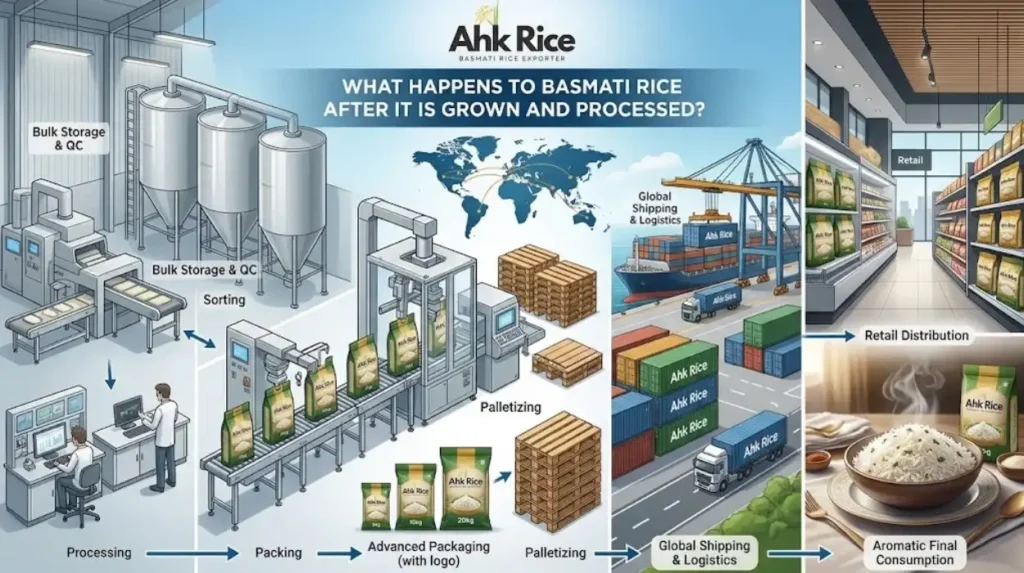
Basmati rice moves through cultivation, harvesting, drying, storage, milling, grading, optical sorting, quality control, packing, and export before reaching an Indonesian importer. Each stage influences the physical specification and documentation of the finished packaged product.
Basmati rice begins as paddy. Pakistani Basmati is cultivated primarily in Punjab, where growing conditions support aromatic long-grain varieties.
After harvesting, paddy is dried to control moisture and preserve storage stability.
The next stage is milling. The outer husk is removed. Further milling produces the desired white rice. Parboiled varieties follow soaking, heating, steaming, and drying stages before milling.
Grading separates kernels according to characteristics such as length, broken percentage, and appearance.
Optical sorting, including Sortex processing, removes unwanted discolored or defective grains.
The finished rice then undergoes quality inspection. Parameters can include moisture, broken percentage, grain dimensions, foreign material, and other specifications defined for the commercial grade.
Finally, the rice enters retail or bulk packaging. The package becomes the physical product that the Indonesian importer distributes.
This processing chain matters for registration because the BPOM file describes the product that enters Indonesia. The registered product must correspond with the actual packaged food.
What grades of Basmati rice can be imported into Indonesia?
Basmati rice is sold in multiple commercial varieties and processing grades, including 1121, Super Kernel, 1509, Steam, Golden Sella, Creamy Sella, Brown, and broken grades. The appropriate grade depends on cooking characteristics, market positioning, and buyer requirements.
1121 Basmati is known for very long grains and strong cooked elongation. It is used for premium rice applications, including biryani and pulao.
Super Kernel Basmati is a premium Pakistani Basmati category with aromatic grains and a long-grain profile. It serves retail and foodservice markets.
1509 Basmati is associated with shorter crop duration and strong yield economics. It serves price-sensitive bulk and foodservice applications.
Steam Basmati provides a white cooked appearance and is commonly used where bright presentation matters.
Golden Sella is parboiled Basmati with a golden appearance. It suits catering, banquet, restaurant, and institutional applications.
Creamy Sella provides another parboiled presentation and is used across foodservice and retail markets.
Brown Basmati retains the bran layer and targets consumers seeking less-refined rice.
Broken Basmati contains broken kernels generated during milling and grading. It serves value-oriented food applications.
The grade itself does not determine whether BPOM registration applies. The distribution model, packaging, intended consumer sale, and regulatory classification determine the registration requirement.
Which markets import packaged Basmati rice?
Packaged Basmati rice serves retail, wholesale, restaurant, catering, institutional, ethnic grocery, private-label, and food manufacturing markets. In Indonesia, the regulatory pathway depends on whether the imported product is sold directly to consumers or enters another production process.
Retailers purchase branded 1 kg, 2 kg, 5 kg, 10 kg, and larger consumer-oriented packages.
Wholesale distributors handle larger quantities and supply restaurants, caterers, hotels, and grocery businesses.
Foodservice buyers select grades according to cooking performance, yield, appearance, and cost.
Private-label brands import rice under their own commercial identity while relying on an overseas producer for manufacturing.
Food manufacturers can use rice as a raw material. When imported rice is used further as a manufacturing input and is not directly sold to final consumers, Indonesian BPOM guidance identifies an exemption from ordinary registration in the stated circumstances.
What are the benefits of BPOM registration for an imported rice brand?
BPOM registration establishes the regulatory identity of an eligible imported packaged rice product. It supports lawful retail distribution, connects the product to an approved importer, and demonstrates that the product has passed the applicable registration requirements.
The biggest benefit is legal market access.
An eligible packaged food cannot simply enter Indonesian retail channels while its BPOM registration remains pending. BPOM states that food undergoing registration cannot be sold or distributed before receiving the relevant authorization.
Registration also creates a clear relationship between the product, foreign manufacturer, Indonesian importer, packaging, and label.
This matters for brands managing several Basmati SKUs. A company selling 1121 Steam, 1121 Golden Sella, and Super Kernel in different packaging formats needs to evaluate each configuration against the registration rules.
What are common BPOM registration problems for imported Basmati rice?
Common problems include treating all rice as exempt, confusing bulk imports with retail products, submitting inconsistent labels, using incomplete manufacturer documents, and changing packaging or importer details without assessing registration consequences.
The first misconception is that rice automatically avoids BPOM because it is a basic agricultural commodity.
That is incorrect for every situation. BPOM distinguishes food that has undergone only minimal post-harvest processing from regulated packaged processed food. Its published exemption includes products receiving minimal processing such as washing, drying, milling, cutting, freezing, mixing, and similar activities without changing form or adding food additives.
The second misconception is that a bulk shipment and retail bag have the same regulatory status.
They do not. Indonesian rules specifically distinguish food packed in bulk and not directly sold to final consumers from food imported for retail sale.
The third problem is inconsistent documentation.
The manufacturer name, product description, packaging, composition, production information, and label should correspond across the registration file.
A fourth problem occurs when an importer changes the commercial configuration after registration. BPOM identifies differences in packaging, composition, foreign production facility, importer or distributor, and label design as factors requiring separate registration assessment.
Frequently Asked Questions
Does packaged Basmati rice need BPOM registration in Indonesia?
Yes, when eligible imported packaged food is intended for retail sale to Indonesian consumers, it generally requires BPOM authorization and receives a BPOM RI ML number.
What does ML mean on a BPOM registration number?
ML identifies food produced outside Indonesia and imported into Indonesia. MD identifies applicable food produced domestically.
Who registers imported Basmati rice in Indonesia?
The Indonesian importer or distributor appointed by the overseas product owner handles registration for food manufactured outside Indonesia.
Is bulk Basmati rice always exempt from BPOM registration?
No. The exemption depends on the product’s use and distribution. BPOM identifies bulk food not directly sold to final consumers as an exemption category.
Can rice imported only as a sample require BPOM registration?
Small imported quantities for product testing, research, or personal consumption are listed among the exemption categories.
How long is an Indonesian BPOM food registration valid?
BPOM’s published guidance states that the food distribution authorization is valid for 5 years and can be renewed through re-registration.
What documents support imported rice registration?
Documents can include the importer’s business documents, Letter of Appointment, GMP/HACCP/ISO 22000 or equivalent evidence, product composition, production information, label artwork, and applicable health or free-sale certificates.
Does changing the rice packaging affect registration?
Yes. Packaging is one of the product characteristics BPOM identifies when determining whether separate registration is required. Label design and importer details also affect this assessment.