Transit Times to East Coast, Gulf Coast and West Coast Ports for Rice Containers
For Pakistani Basmati rice importers, the best US shipping route depends on the destination warehouse, vessel schedule, total landed cost and inventory deadline, not simply the shortest ocean transit time. East Coast, Gulf Coast and West Coast ports serve different distribution networks, so buyers must compare shipping schedules, freight charges and inland transportation before selecting a route.
Understanding how Pakistani Basmati rice shipping times differ between the US East and West Coasts helps importers estimate arrival windows and coordinate purchasing decisions. However, ocean transit is only one part of the supply chain. Production, container booking, export documentation, customs clearance and warehouse delivery also determine when rice becomes available for sale.
What are the main shipping options for rice containers entering the USA?
Importers can route containerised Basmati rice through East Coast gateways such as New York and New Jersey, Gulf Coast gateways such as Houston, or West Coast gateways such as Los Angeles and Long Beach. The best option depends on the final delivery location, available vessel services and total logistics cost.
Containerised shipping moves rice in sealed freight containers aboard ocean vessels. Full container load (FCL) shipping reserves an entire container for one shipment, while less-than-container load (LCL) shipping consolidates smaller consignments with other cargo. FCL generally suits established rice importers purchasing commercial quantities because it simplifies cargo handling and shipment planning.
The three main US port regions serve different commercial purposes.
- East Coast: The Port of New York and New Jersey serves importers distributing rice across the Northeast and nearby eastern markets.
- Gulf Coast: The Port of Houston provides access to Texas and distribution networks across parts of the southern United States.
- West Coast: The Port of Los Angeles and the neighbouring Port of Long Beach serve California and western distribution networks.
The Port of New York and New Jersey is a major gateway for northeastern distribution. Houston suits buyers whose warehouses and customers are concentrated in Texas or nearby states. Los Angeles and Long Beach offer established container-handling infrastructure for importers serving California and other western markets.
Importers should compare the complete route rather than assume that the geographically closest port always provides the lowest delivered cost. A cheaper ocean freight quotation can become more expensive after terminal charges, customs-related expenses, rail transportation and trucking are included.
How do transit times compare between East Coast, Gulf Coast and West Coast ports?
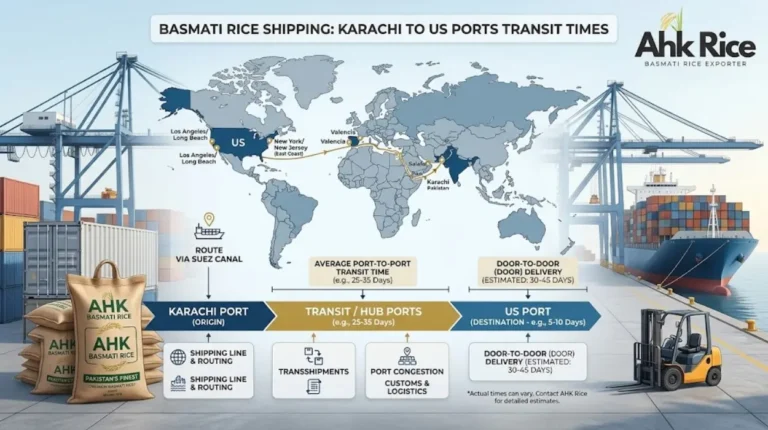
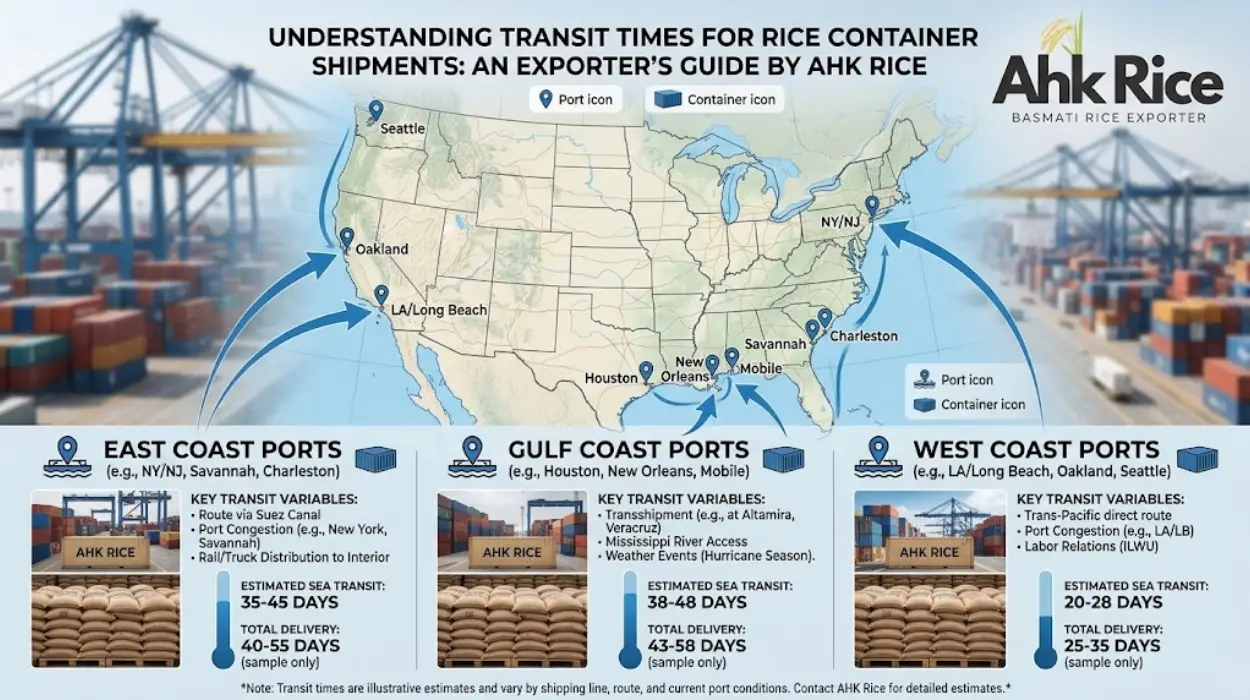
West Coast routes can provide shorter transit on suitable services, while East Coast and Gulf Coast routes depend heavily on vessel routing and transshipment. For preliminary planning from Pakistan, buyers can compare approximately 25–40 days for West Coast, 30–50 days for Gulf Coast and 23–50 days for East Coast services.
The following figures are broad planning ranges, not live carrier schedules or guaranteed delivery commitments. Actual transit depends on the Pakistani loading port, destination terminal, shipping line, vessel availability, transshipment and operating conditions.
| Comparison attribute | East Coast: New York/New Jersey | Gulf Coast: Houston | West Coast: Los Angeles/Long Beach |
|---|---|---|---|
| Indicative ocean transit from Pakistan | Approximately 23–50 days | Approximately 30–50 days | Approximately 25–40 days |
| Main distribution advantage | Northeastern and eastern markets | Texas and southern markets | California and western markets |
| Inland transportation considerations | Truck or rail to eastern warehouses | Truck or rail to Texas and surrounding states | Truck or rail to western distribution centres |
| Freight comparison | Depends on carrier, routing and booking date | Depends on vessel service and destination charges | Depends on vessel service and destination charges |
| Typical commercial fit | Importers serving eastern retail and wholesale networks | Distributors supplying Texas and southern customers | Importers serving California and western markets |
| Inventory planning | Allow for ocean transit and destination release | Allow for ocean transit and onward delivery | Allow for ocean transit and onward delivery |
| Main scheduling risk | Transshipment, congestion and customs delays | Vessel availability, terminal congestion and inland delivery | Vessel availability, congestion and inland delivery |
These ranges provide a starting point for evaluating routes. A current freight quotation and confirmed sailing schedule must determine the actual shipment plan.
Buyers should also distinguish ocean transit time from total order lead time. Ocean transit measures the vessel journey between ports. Total lead time includes stock allocation or production, packaging, inland transport to the Pakistani port, export clearance, vessel waiting time, ocean transport, US customs processing and final delivery.
For example, an importer ordering rice for a supermarket promotion in New York needs more than an estimated vessel arrival date. The importer needs a confirmed shipment window, sufficient customs-processing time and a warehouse delivery appointment. A delay at any stage can affect the retail launch.
Which US port provides the best balance between freight cost and delivery time?
The best port is the gateway that produces the lowest practical landed cost while meeting the buyer’s inventory deadline. Importers serving Texas should evaluate Houston first, northeastern distributors should compare New York and New Jersey, and western distributors should assess Los Angeles and Long Beach against alternative routes.
Freight cost includes the charges required to move cargo between agreed locations. The final logistics bill can include origin handling, ocean freight, insurance where applicable, terminal handling, customs brokerage, port fees, container detention or demurrage, and inland transportation.
A port comparison should use the same rice specification, shipment quantity, container type and quotation date. Otherwise, the comparison mixes different commercial conditions.
Consider three hypothetical buyers purchasing 24 metric tons of Pakistani Basmati rice.
Buyer A: New York distributor. The distributor supplies ethnic grocery stores across the Northeast. An East Coast route may reduce onward transportation and make warehouse replenishment easier. A faster vessel service remains useful only if its additional cost fits the buyer’s margins.
Buyer B: Houston wholesaler. The wholesaler supplies restaurants and independent grocery stores throughout Texas. Houston may provide a practical gateway because it places the container closer to the principal customer base. The buyer must still compare port charges and current ocean freight.
Buyer C: Los Angeles importer. The importer distributes rice across California and neighbouring western markets. Los Angeles or Long Beach may reduce inland transportation. The buyer should compare the actual sailing schedule rather than rely on a general claim that every West Coast service is faster.
The following cost framework helps buyers compare quotations.
| Cost component | What to check |
|---|---|
| Rice price per MT | Grade, variety, crop year and agreed specification |
| Origin charges | Inland movement, handling, documentation and loading |
| Ocean freight | Carrier, container type, route and booking date |
| Insurance | Coverage, insured value and responsible party |
| Destination charges | Terminal handling, release fees and applicable service charges |
| Customs and compliance | Brokerage, entry requirements and any applicable duties or inspections |
| Inland delivery | Trucking, rail, storage and warehouse appointment costs |
A lower freight rate does not automatically produce a lower landed cost. A route with cheaper ocean transport may require expensive inland delivery or additional handling. Buyers should compare the full cost per metric ton delivered to the warehouse.
How do rice grades, prices and shelf life affect the shipping decision?
Rice variety and processing style determine product positioning, while freight and storage conditions affect the final commercial result. Importers should compare 1121, Super Kernel and 1509 against their target selling price, cooking requirements, expected inventory period and destination market before approving a shipment.
AHK Rice supplies Pakistani Basmati varieties, including 1121, Super Kernel, and 1509 Basmati rice, through its rice export and supply services. These varieties serve different market segments, so choosing the correct grade is as important as selecting a port.
How do 1121, Super Kernel and 1509 compare?
1121 Basmati suits buyers seeking extra-long grains, aromatic cooking characteristics and a premium presentation. Retailers, specialist rice distributors and foodservice businesses may select it for products where grain appearance and cooking performance support the selling price.
Super Kernel Basmati offers an aromatic Pakistani Basmati option for retail and wholesale distribution. Its suitability depends on the agreed grain length, broken percentage, moisture level, processing type and buyer’s cooking test.
1509 Basmati provides another option for buyers prioritising procurement economics and high-volume distribution. The selected specification and processing method determine its suitability for retail, catering and institutional foodservice.
Importers should not assume that one variety automatically costs less per metric ton in every market. The quotation depends on grade, crop availability, processing, packaging, order volume and commercial terms.
How should buyers compare prices per metric ton?
Rice prices change with market conditions, specifications, packaging and freight. A reliable comparison uses a current supplier quotation rather than an unverified market average.
For illustration, assume two suppliers offer the same 24 MT shipment. Supplier A quotes US$1,100 per MT FOB, while Supplier B quotes US$1,150 per MT FOB. Supplier A’s rice value is US$26,400, compared with US$27,600 for Supplier B.
The US$1,200 difference does not settle the decision. Buyers must add the relevant freight, insurance, destination charges, customs-related expenses and inland delivery costs. They must also confirm that both quotations cover identical specifications.
FOB (Free on Board) generally places delivery and cost responsibilities on the seller until the goods are loaded aboard the nominated vessel at the named port. The buyer arranges the main carriage and subsequent costs under the agreed contract.
CIF (Cost, Insurance and Freight) requires the seller to arrange and pay for ocean freight and insurance to the named destination port. The buyer remains responsible for relevant destination and import formalities under the contract. Under CIF, risk generally transfers when the goods are loaded aboard the vessel at the port of shipment, not when they arrive at destination.
For meaningful evaluation, compare the same Incoterm, destination port and shipment conditions.
How long does packaged Basmati rice remain usable?
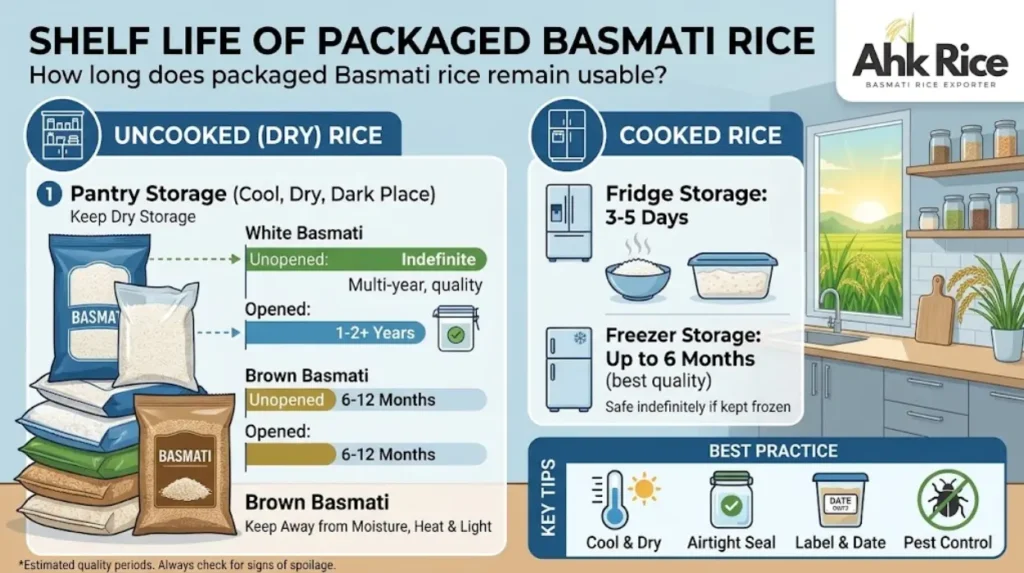
Shelf life is the period during which a food product retains its intended quality under specified storage conditions. Rice shelf life depends on processing, packaging, moisture, storage temperature, humidity, pests and the product’s declared specifications.
Properly processed and packaged white Basmati rice can retain quality for an extended period when stored in a cool, dry and pest-controlled environment. Brown rice generally has a shorter storage life because its bran contains oils that are more susceptible to oxidation. Parboiled rice requires storage conditions appropriate to its packaging and product specification.
Importers should not use one universal shelf-life figure for every rice type. They should obtain the supplier’s declared shelf life, manufacturing or packing date, crop-year information where relevant, and storage instructions before purchase.
Shipping duration also does not directly determine shelf life. A longer voyage reduces the remaining shelf-life window only insofar as time passes between the relevant production or packing date and the customer’s sale or use date. Buyers should calculate remaining shelf life at arrival and establish minimum acceptance requirements in the contract.
Which shipping method works best for different rice importers?
FCL shipping generally suits importers ordering container quantities for regular wholesale, retail or foodservice distribution. LCL can suit smaller trial consignments, while a planned series of FCL shipments works better for buyers who need reliable replenishment without holding excessive inventory.
The correct method depends on order size, demand predictability, handling requirements and cash-flow constraints.
Full container load for established importers
FCL is appropriate when the buyer can use the available container capacity and has enough demand to justify the shipment. It gives the importer more control over the container and reduces the need to coordinate with unrelated cargo owners.
For example, a wholesaler importing 24 MT of Super Kernel Basmati rice can compare 20-foot and 40-foot container options with its freight forwarder. The final payload must comply with container limits, road-weight regulations and carrier requirements.
Less-than-container load for smaller orders
LCL consolidates the buyer’s cargo with shipments from other businesses. It can support smaller commercial trials when purchasing a full container would create excessive inventory.
However, consolidation introduces additional handling and coordination. Rice importers must evaluate moisture protection, packaging integrity, cargo handling and total charges. LCL is not automatically cheaper per metric ton once consolidation, destination handling and other fees are included.
Scheduled FCL shipments for recurring demand
Recurring importers can divide annual demand into planned shipment windows. This approach supports inventory control and reduces dependence on one large arrival.
For example, a distributor selling 24 MT every six weeks can build a replenishment calendar around forecast demand, supplier readiness, vessel departures and warehouse capacity. The actual shipment frequency should reflect sales data and supplier lead times.
Scheduled shipments do not eliminate delays. They make delays easier to manage when the importer maintains adequate safety stock and communicates regularly with the exporter and freight forwarder.
What decision factors should importers use before booking a rice container?
Importers should approve a shipment only after comparing the destination warehouse, required arrival date, rice specification, total landed cost, supplier readiness and import documentation. A written shipment plan should assign responsibility for each stage and define how schedule changes will be communicated.
A five-part decision framework helps buyers choose the most suitable option.
| Decision factor | Question to ask | Recommended action |
|---|---|---|
| Destination | Which port best serves the warehouse and customer base? | Compare the relevant East Coast, Gulf Coast and West Coast gateways. |
| Delivery deadline | When must the rice be available for sale or use? | Work backwards from the warehouse date and add contingency time. |
| Product specification | Which variety, processing type, moisture level and broken percentage are required? | Approve a written specification and representative sample before bulk shipment. |
| Landed cost | What is the complete cost per metric ton after freight and destination expenses? | Compare quotations using the same Incoterm and cost components. |
| Compliance and readiness | Are the shipment documents, packaging and importer requirements prepared? | Confirm document responsibilities and clearance arrangements before vessel departure. |
US food imports may involve Food and Drug Administration (FDA) requirements, including applicable facility registration and Prior Notice obligations. The Foreign Supplier Verification Programs (FSVP) rule also establishes responsibilities for covered US importers. US Customs and Border Protection (CBP) handles customs entry, while other agencies may apply depending on the product and circumstances.
Importers should verify current requirements with their customs broker and compliance advisers before dispatch. A complete commercial document set does not replace the importer’s legal responsibilities.
What are the advantages and disadvantages of each shipping approach?
Direct or low-transshipment services can simplify scheduling, while transshipment services may offer additional routing options. FCL supports container-scale procurement, LCL lowers the initial cargo commitment, and scheduled shipments improve replenishment planning. Each option carries cost, timing and inventory trade-offs.
| Approach | Main advantage | Main disadvantage | Suitable example |
|---|---|---|---|
| East Coast routing | Access to northeastern distribution networks | Transit and inland costs vary by route | A New York-area importer supplying eastern retailers |
| Gulf Coast routing | Access to Texas and southern distribution | Vessel frequency and final delivery costs require checking | A Houston wholesaler serving Texas |
| West Coast routing | Access to California and western markets | Actual transit depends on the selected service | A Los Angeles distributor supplying western customers |
| FCL shipping | Efficient for container-scale orders | Requires sufficient demand and working capital | An importer purchasing 20–24 MT or more, subject to payload limits |
| LCL shipping | Lower initial order commitment | Additional handling and consolidation charges | A buyer conducting a limited commercial trial |
The strongest option is the one that meets the buyer’s operational requirements at an acceptable total cost. Importers should avoid choosing a route solely because it advertises the shortest transit or lowest headline freight rate.
How can importers plan scheduled deliveries to New York, Houston or Los Angeles?
Importers can improve delivery reliability by confirming product specifications, approving samples, booking suitable vessel space and preparing customs documentation before departure. A shipment calendar should separate production, export handling, ocean transit, import clearance and inland delivery so each milestone has a clear owner.
Start with the required warehouse arrival date. Work backwards to establish the latest acceptable port arrival, vessel departure and container loading dates. Include time for production or stock allocation, packaging, inspection, export documents and booking confirmation.
Next, confirm the rice specification and commercial terms. Record the variety, processing type, grain length where relevant, moisture, broken percentage, packaging, quantity, price basis and agreed acceptance criteria. Where a sample is required, complete the cooking and quality evaluation before bulk approval.
Then obtain a current shipping quotation for the actual destination. Ask the freight provider to identify the loading port, destination terminal, scheduled departure, estimated arrival, transshipment points and any important routing limitations. Confirm which party pays each origin and destination charge.
Finally, coordinate customs clearance and final delivery. Share the necessary shipment information with the US customs broker before arrival and arrange transport from the terminal to the receiving warehouse. Track the shipment against the agreed milestones and maintain a contingency plan for delays.
AHK Rice supplies Pakistani Basmati rice to international buyers with end-to-end processing, custom packaging and export coordination. Buyers can assess 1121, Super Kernel and 1509 against their target market and arrange shipment planning around the required product specification and destination.
For buyers evaluating the next step, the decision-focused guide Get Scheduled Basmati Rice Deliveries to New York, Houston or Los Angeles with AHK Rice should be linked here once its dedicated article URL is confirmed. It should help readers move from comparing routes to evaluating a shipment plan for their destination and purchasing requirements.
Selecting a shipping route for Pakistani Basmati rice requires more than comparing the number of days at sea. Importers must evaluate the destination warehouse, total landed cost, rice specification, remaining shelf life, customs requirements and vessel schedule together.
East Coast, Gulf Coast and West Coast ports serve different distribution needs. A route that suits a New York distributor may not suit a Houston wholesaler or a Los Angeles importer. The right choice balances delivery reliability, freight economics and inventory requirements.
By comparing shipping methods and confirming every milestone before dispatch, buyers can build a practical import plan for 1121, Super Kernel and 1509 Basmati rice.
Frequently Asked Questions
How long does Basmati rice take to ship from Pakistan to New York?
Ocean transit depends on the loading port, carrier, route and vessel schedule. Preliminary estimates can range from approximately 23 to 50 days. Buyers should confirm the current sailing and allow additional time for export handling, customs clearance and inland delivery.
How long does it take to ship rice to Houston?
Shipping to Houston can take approximately 30–50 days from Pakistan under broad planning estimates. The actual schedule depends on vessel service, transshipment and port conditions. Customs clearance and delivery to the final warehouse require additional time.
Is Los Angeles the fastest port for Pakistani Basmati rice?
Los Angeles can offer a practical route for California and western US importers, but it is not automatically the fastest option for every shipment. Compare current vessel schedules, ocean freight, destination charges and onward transport before booking.
Which US port is cheapest for importing Basmati rice?
There is no universally cheapest port. The best option depends on the shipment route, freight quotation, terminal charges, customs-related expenses and inland transportation. Importers should compare the complete landed cost for their warehouse destination.
How should importers compare rice prices per metric ton?
Compare quotations with the same variety, grade, crop information, packaging, quantity, Incoterm and destination. Add applicable freight, insurance, customs-related costs and inland delivery to calculate the final landed cost per metric ton.
Does longer shipping time reduce Basmati rice shelf life?
Time in transit reduces the remaining period before the declared shelf-life end date, but it does not by itself determine product quality. Storage conditions, moisture, packaging, processing and the product’s original shelf-life specification also matter.
Should a new US importer choose FCL or LCL?
LCL can suit a small trial shipment when the buyer does not need a full container. FCL is generally more practical for established importers purchasing container quantities. Compare the complete cost per metric ton and handling requirements before choosing.
What documents should US importers confirm before shipment?
Importers should confirm the commercial invoice, packing list, bill of lading, country-of-origin documentation and any applicable phytosanitary or inspection documents. They must also evaluate FDA, CBP and other relevant import requirements for the specific shipment.
How can importers reduce the risk of late rice deliveries?
Importers should confirm stock readiness, agree on a realistic loading window, obtain a current vessel schedule, prepare documents early and coordinate customs clearance before arrival. Maintaining safety stock and allowing contingency time helps manage unavoidable shipping delays.