EPA Tolerances, MRL Testing and Aflatoxin Checks for Pakistani Basmati Exports
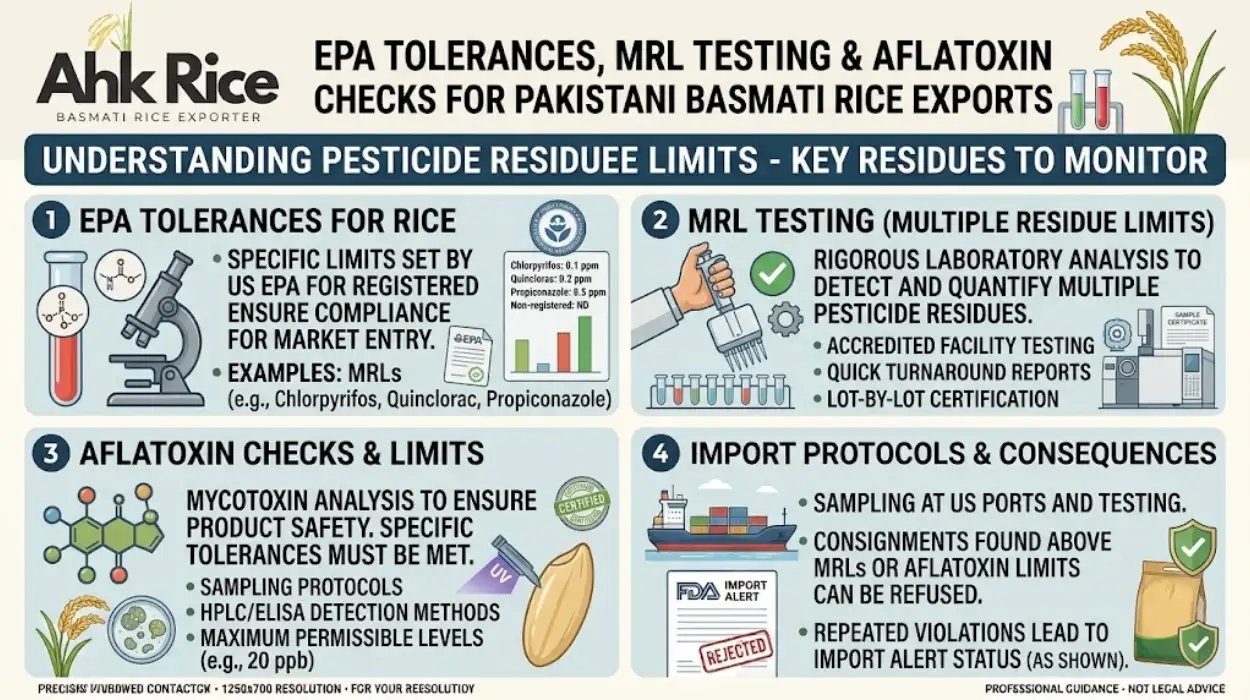
For Pakistani Basmati rice entering the United States, the strongest compliance strategy combines pesticide-residue testing against applicable EPA tolerances, risk-based aflatoxin analysis, and documented supplier verification. These controls address different hazards, so importers need a coordinated testing plan rather than relying on one laboratory certificate.
What do EPA tolerances, MRL testing, and aflatoxin checks mean for US rice importers?
EPA tolerances establish legally permitted pesticide-residue levels for applicable food commodities, MRL testing measures pesticide residues against relevant limits, and aflatoxin analysis detects toxins produced by certain moulds. Importers evaluate each requirement separately because passing one test does not establish compliance with every US food-safety rule.
The US Environmental Protection Agency (EPA) establishes pesticide tolerances under the Federal Food, Drug, and Cosmetic Act. A tolerance specifies the maximum legally permitted residue of a particular pesticide on or in a food commodity. A maximum residue limit (MRL) is the term commonly used internationally for a comparable regulatory limit. The applicable US tolerance, commodity classification, pesticide, and any exemption determine the correct comparison for imported rice.
For a broader overview of the regulatory framework, read what FDA requirements apply to Basmati rice imported into the USA. This educational resource complements residue and mycotoxin checks by explaining the wider import framework, including FDA oversight, facility registration, Prior Notice, and the Foreign Supplier Verification Program (FSVP).
Aflatoxins are toxic compounds produced by certain Aspergillus moulds under suitable environmental conditions. Their presence depends on factors such as crop conditions, moisture, storage, and handling. Aflatoxin testing therefore addresses a different food-safety concern from pesticide-residue analysis. Neither an MRL report nor a general quality certificate replaces an appropriate aflatoxin assessment.
What solutions are available for checking Basmati rice compliance?
US importers can combine accredited laboratory testing, supplier documentation, risk-based sampling, preventive controls, and shipment-specific verification. The appropriate combination depends on the rice’s origin, intended market, supplier history, identified hazards, applicable limits, and the importer’s food-safety responsibilities.
Five practical approaches support compliance:
- Pesticide-residue laboratory testing: A laboratory analyses rice for selected pesticide residues and compares the results with applicable US tolerances. The analytical scope must match the hazards identified through the supplier and product risk assessment.
- Aflatoxin testing: A laboratory analyses representative samples using a suitable validated method. The report identifies the analyte or analytes tested, results, units, detection or quantification limits, and relevant acceptance criteria.
- Supplier and farm-level controls: Buyers review pesticide-use records, approved agricultural practices, harvest controls, drying, storage, and traceability. These records help identify risks before the rice reaches the laboratory.
- Shipment-specific quality verification: Buyers establish sampling plans and acceptance criteria for each relevant lot. A lot is a defined quantity of product produced or handled under sufficiently consistent conditions to support traceability and evaluation.
- Import compliance and preventive controls: US importers determine which FDA requirements apply, maintain appropriate supplier-verification activities, and ensure required entry information is submitted. FSVP obligations are separate from pesticide and aflatoxin test results.
The strongest approach combines prevention with verification. Testing identifies measured conditions in the samples examined. Agricultural and storage controls help prevent hazards from developing in the first place.
How do EPA tolerances, MRL tests, and aflatoxin tests differ?
The three controls differ in the hazards they measure, the regulatory criteria they use, and the decisions they support. Pesticide testing evaluates chemical residues, aflatoxin testing evaluates fungal toxins, and supplier verification evaluates whether the importer’s food-safety controls address identified risks.
| Comparison attribute | EPA tolerance and pesticide-residue testing | Aflatoxin testing | Supplier verification and documentation |
|---|---|---|---|
| Primary purpose | Assess pesticide residues against applicable US tolerances | Detect and quantify specified aflatoxins | Evaluate supplier controls and food-safety risks |
| Hazard category | Agricultural chemical residues | Naturally occurring fungal toxins | Broader biological, chemical, and process risks |
| Main reference | Applicable EPA tolerance or exemption | Applicable legal or buyer acceptance criteria | Applicable FDA requirements and documented risk assessment |
| Testing method | Validated analytical method appropriate to the pesticide and rice matrix | Validated method appropriate to the specified aflatoxins | Record review, risk assessment, audits, and verification activities |
| Typical evidence | Laboratory report listing analytes and results | Laboratory report listing aflatoxin analytes and results | Supplier records, hazard analysis, verification records, and traceability |
| Main limitation | A targeted panel does not cover every pesticide | A negative result applies to the sample and analytes tested | Documents alone do not prove that every shipment is free from hazards |
| Best application | Evaluating pesticide-residue risks before shipment or release | Evaluating mycotoxin risks linked to crop and storage conditions | Maintaining a documented, risk-based import compliance programme |
This comparison shows why a single certificate cannot demonstrate complete compliance. A pesticide report does not establish aflatoxin status, and an aflatoxin report does not verify pesticide residues. Supplier documentation supports the overall assessment but does not replace testing when testing is needed to manage an identified risk.
Which pesticide-residue testing approach works best for Pakistani Basmati?
A risk-based analytical plan works best when it identifies likely pesticide hazards, selects a suitable laboratory panel, uses representative sampling, and compares results with the correct US tolerances. A generic certificate without analyte coverage, methods, units, and lot identification provides weaker evidence.
The first step is to establish which pesticides are relevant to the crop and supply chain. Buyers review agricultural inputs, supplier records, previous analytical findings, and the intended US market. The laboratory then selects an appropriate analytical scope and method for the rice matrix.
A multi-residue screen can assess many pesticide compounds in one analytical workflow. It offers broad screening coverage, but it does not automatically detect every pesticide or metabolite. Some compounds require specialised methods. Buyers must therefore check the laboratory’s analyte list instead of assuming that the term “multi-residue” means universal coverage.
The second step is to confirm the applicable tolerance for each relevant pesticide and commodity. US tolerances are pesticide-specific and commodity-specific. An importer should not apply a limit from another country or assume that a Codex MRL automatically determines the US legal limit. Where no applicable tolerance or exemption exists, the importer must obtain a regulatory assessment before treating the product as compliant.
The third step is to examine the report’s technical details. The report should identify the product, lot or sample reference, analytes, analytical methods, units, results, and relevant detection or quantification limits. The buyer should also confirm laboratory competence for the methods used and the sample matrix.
A result reported as “not detected” does not mean that the substance is absolutely absent. It means the laboratory did not detect it under the stated method and reporting conditions. Buyers should interpret the finding alongside the method’s performance and the applicable legal limit.
How should importers compare aflatoxin testing methods?
Importers should select an aflatoxin method according to the required analytes, expected concentration range, sample characteristics, laboratory capability, and decision being made. Rapid screening supports efficient initial assessment, while confirmatory analysis provides stronger evidence when results require precise quantification or further investigation.
Aflatoxin testing begins with representative sampling. Contamination can be unevenly distributed across a shipment, so a laboratory result is only as reliable as the sampling and sample preparation supporting it. A sample taken from one convenient bag may not represent a full consignment.
Rapid screening methods can help buyers identify samples that require additional investigation. These methods support timely decisions, but their suitability depends on validation, matrix performance, and the acceptance criteria. A screening result near a decision threshold may require confirmatory analysis.
Chromatographic methods, including high-performance liquid chromatography (HPLC) and liquid chromatography coupled with tandem mass spectrometry (LC-MS/MS), can provide targeted analytical measurements when appropriately validated. The selected method must match the analytes required by the buyer or applicable regulatory framework.
Reports must distinguish between aflatoxin B1 and total aflatoxins when the analytical scope or specification requires that distinction. Total aflatoxins commonly refers to the sum of B1, B2, G1, and G2. Buyers should not assume that a result for one aflatoxin represents the total.
Importers must also avoid treating a buyer’s private specification as a universal US legal limit. The applicable legal requirements, contractual limits, laboratory reporting limits, and risk assessment must be evaluated separately. A supplier agreement should specify the analytes, sampling protocol, testing method, reporting format, and action to take when results fail acceptance criteria.
How do US and European market requirements compare?
US and European buyers both require evidence that food meets the rules applicable in their markets, but their regulatory frameworks and commodity-specific residue limits are not interchangeable. Importers must identify the destination’s current requirements before setting laboratory panels, contractual specifications, or shipment-release criteria.
United States: EPA tolerances and FDA import oversight
US buyers importing Pakistani Basmati rice should verify pesticide residues against applicable EPA tolerances and evaluate relevant food-safety risks under the applicable FDA framework. The importer must also determine its obligations under FSVP, including supplier approval, hazard analysis, verification activities, corrective action, and records where required.
The precise controls depend on the product and supply chain. A shipment’s compliance cannot be established by applying one universal pesticide limit to all rice or by relying solely on a supplier’s general statement of compliance.
European Union: commodity-specific MRLs and food-safety controls
European buyers must use the applicable European Union pesticide MRL framework for the relevant commodity and substance. EU limits can differ from US tolerances, including in situations where one market has a specific tolerance and another applies a different limit or default rule.
Both markets benefit from traceability, appropriate sampling, competent laboratories, and documented corrective action. However, a test report prepared for the US market does not automatically demonstrate compliance with EU requirements. The buyer must confirm that the analytes, methods, limits, and reporting format match the destination market.
How should buyers compare price per metric tonne and shelf life?
Price and shelf life are commercial factors, not substitutes for regulatory compliance. A lower quoted price per metric tonne does not establish lower contamination risk, and a longer stated shelf life does not prove that pesticide residues or aflatoxins meet the applicable criteria.
For both US and European buyers, the landed cost depends on grade, crop year, processing, packaging, order volume, freight, insurance, inspection, and the agreed Incoterm. A meaningful comparison uses current supplier quotations for equivalent specifications rather than assumed market prices.
Similarly, shelf life depends on product condition, moisture, packaging, storage, and the manufacturer’s validated specification. Buyers should request documented shelf-life information for the exact product and packaging configuration. There is no universal shelf-life period that proves regulatory compliance or applies to every Basmati shipment.
What are the advantages and limitations of each compliance strategy?
Laboratory testing provides analytical evidence, preventive controls reduce the likelihood of contamination, and supplier verification documents how risks are managed. Combining these approaches creates stronger assurance than relying on any single certificate, test, audit, or supplier declaration.
| Approach | Advantages | Limitations | Example |
|---|---|---|---|
| Multi-residue pesticide screening | Covers many relevant compounds efficiently | Does not necessarily cover every pesticide or metabolite | A buyer screens a new crop lot before shipment |
| Targeted pesticide analysis | Focuses on identified high-priority hazards | Narrow scope can miss untested compounds | A buyer investigates a pesticide flagged by farm records |
| Aflatoxin analysis | Measures specified fungal toxins | Results depend on representative sampling and method capability | A buyer tests rice where storage conditions raise concern |
| Supplier preventive controls | Address risks before testing and shipment | Records require verification and consistent implementation | A processor documents drying and storage controls |
| Integrated verification programme | Connects testing, traceability, records, and corrective action | Requires coordination, documented responsibilities, and ongoing review | An importer reviews supplier records and shipment-specific reports |
Consider a US distributor purchasing 1121 Basmati for retail packs. A pesticide screen supports the chemical-residue assessment, while aflatoxin analysis addresses a separate hazard. Lot traceability connects the results to the product received. If a test fails the agreed acceptance criteria, the buyer should hold the affected lot, investigate the cause, and determine appropriate corrective action before release.
Which factors should buyers use to select a testing programme?
Buyers should select a testing programme based on destination-market rules, product and supplier risk, representative sampling, laboratory capability, traceability, and corrective-action procedures. The programme should define who commissions tests, which results trigger a hold, and how compliance evidence is reviewed before shipment release.
A five-factor decision framework helps buyers compare suppliers consistently.
| Decision factor | Question to ask | Preferred approach |
|---|---|---|
| Destination compliance | Are the correct US or EU limits being applied? | Confirm current rules for the destination and commodity |
| Hazard coverage | Do the tests cover relevant pesticides and aflatoxins? | Use a documented, risk-based analytical scope |
| Sampling quality | Does the sample represent the identified lot? | Establish a written sampling protocol |
| Evidence quality | Can results be linked to the product and laboratory method? | Require traceable reports with analytes, units, and lot identifiers |
| Corrective action | What happens when a result fails? | Define lot holds, investigation, retesting where appropriate, and disposition |
Buyers should also agree on testing frequency. A new supplier, new crop, changed pesticide-use profile, storage incident, or previous non-compliant result can justify additional verification. An established supplier with consistent results may support a different risk-based frequency, but previous success does not remove applicable legal obligations.
How can Pakistani Basmati exporters prepare residue and aflatoxin documentation?
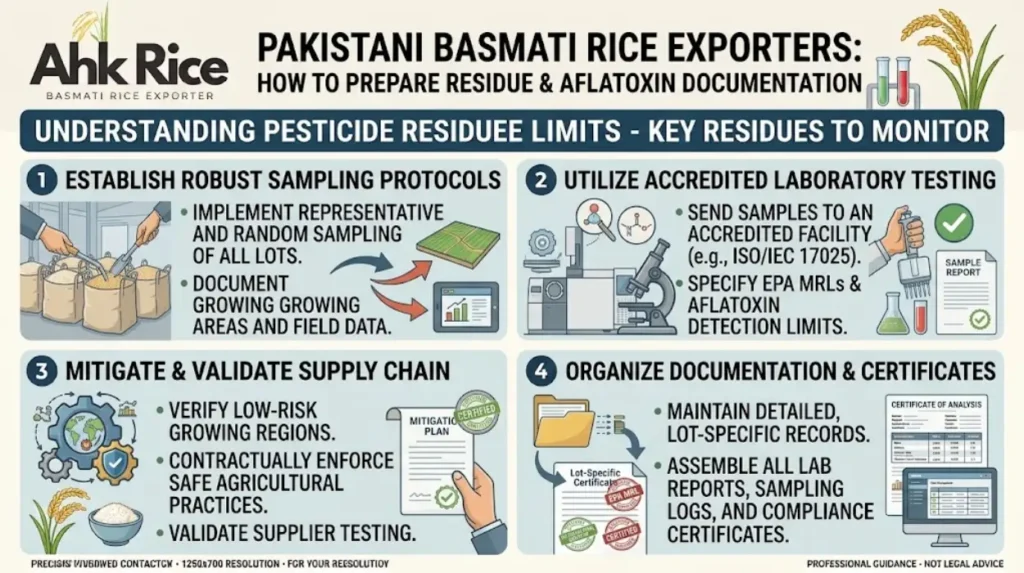
Exporters should connect each shipment to its product specification, lot identity, traceability records, applicable laboratory results, and supporting supplier documentation. This evidence helps importers assess risk and meet their responsibilities, but it does not guarantee entry or replace regulatory obligations imposed on the importer.
A practical export documentation package can include a product specification, lot or batch identification, certificate of analysis, pesticide-residue report, aflatoxin report where required by the risk assessment or contract, processing records, and traceability information. The exact package depends on the buyer’s contract, product risks, and destination requirements.
AHK Rice is a Pakistani Basmati rice exporter based in Punjab, supplying 1121, Super Kernel, and 1509 varieties to more than 15 countries. Buyers evaluating AHK Rice’s Pakistani Basmati rice supply and export services should define the required grade, processing, packaging, testing scope, and documentation before confirming an order. This keeps the product specification and compliance expectations aligned from the beginning.
For every proposed shipment, buyers should request current, lot-relevant evidence rather than assuming that a previous report covers a new consignment. They should also establish how discrepancies will be handled, who approves laboratory reports, and whether independent inspection is required by contract.
The final decision should combine regulatory review, supplier controls, laboratory evidence, and shipment traceability. No single test guarantees that every unit in a shipment is free from contamination, and no certificate replaces compliance with applicable US import law.
Frequently Asked Questions
What are EPA tolerances for imported Basmati rice?
EPA tolerances establish the maximum legally permitted residue of a pesticide on or in a food commodity. US importers must verify the applicable tolerance or exemption for each relevant pesticide and commodity before determining compliance.
Is an MRL certificate mandatory for every Basmati rice shipment to the USA?
There is no universal rule requiring the same MRL certificate for every Basmati rice shipment. Importers must meet applicable legal requirements and assess testing needs according to identified hazards, supplier risks, contractual specifications, and verification obligations.
What is the difference between pesticide-residue testing and aflatoxin testing?
Pesticide-residue testing measures chemical residues associated with agricultural pesticide use. Aflatoxin testing measures toxic compounds produced by certain moulds. Each test targets different hazards, so a negative pesticide-residue result does not establish that aflatoxins are absent.
Does a laboratory report guarantee that Pakistani rice will enter the USA?
No. A laboratory report provides evidence about the sample and analytes tested. US entry also depends on applicable food-safety requirements, import documentation, admissibility decisions, and any other controls relevant to the shipment.
Which laboratory method is best for pesticide-residue testing?
The appropriate method depends on the pesticides being investigated, the rice matrix, required sensitivity, and laboratory capability. A validated multi-residue method offers broad screening, while targeted methods address compounds requiring specialised analysis.