Why Is Production Capacity a Key Rice Procurement Metric?
Production capacity is a key rice procurement metric because it shows whether a supplier can repeatedly produce the required quantity at the required specification. A buyer purchasing rice for wholesale distribution needs more than a supplier with sufficient inventory for one shipment. The supplier needs enough processing capacity, raw-material access, storage, packaging output, and quality-control capacity to support the complete procurement program.
For Pakistani Basmati rice, production capacity connects agricultural supply with commercial export execution. Pakistan produces Basmati rice primarily in Punjab, where climatic conditions, irrigation, soil characteristics, and established rice-growing systems support long-grain aromatic varieties. Common commercial varieties include 1121 Basmati, Super Kernel Basmati, and 1509 Basmati.
Production capacity therefore starts before milling. It begins with access to suitable paddy and continues through drying, cleaning, milling, grading, processing, packaging, storage, and container loading. Importers evaluating suppliers need to understand this complete chain before comparing production figures.
What is rice production capacity?
Production capacity is the quantity of rice a supplier can process, grade, pack, and prepare for export within a defined period. Importers use this metric to test whether supply volume matches contract requirements, shipment schedules, seasonal demand, and repeat-order commitments.
Production capacity is normally expressed in metric tons (MT) per day, month, or year. A rice mill with a stated milling capacity of 10 MT per hour has a theoretical processing rate. That figure does not automatically represent the amount of export-ready rice available to an importer.
Procurement teams should distinguish between installed capacity, processing capacity, effective capacity, and export capacity.
Installed capacity describes the maximum output supported by machinery. Processing capacity describes the quantity that enters and passes through production equipment. Effective capacity represents usable output after operational restrictions. Export capacity describes the quantity that reaches the required specification, packaging format, storage location, and shipment schedule.
For example, a supplier with equipment rated for 5,000 MT per month can have lower effective output when paddy quality, maintenance, product changeovers, grading requirements, packaging schedules, or storage availability restrict production.
The procurement metric is therefore not simply the largest number a supplier reports. It is the repeatable quantity available at the required quality specification.
How does rice production capacity work from paddy to export?
Production capacity works as a supply chain measurement from paddy intake through finished export stock. A supplier records processing throughput, usable recovery, packaging output, storage availability, and loading schedules, then compares those figures with contracted monthly quantities and shipment dates.
The process begins with paddy procurement. Paddy is harvested from rice-growing regions and transported to processing facilities. The supplier needs sufficient access to suitable varieties and quality levels before production begins.
The next stage is drying and moisture control. Paddy enters drying systems that bring moisture into a suitable range for safe storage and efficient milling. Moisture control affects milling performance, storage stability, and finished-rice quality.
The third stage is cleaning and pre-processing. Foreign material, stones, dust, immature grains, and other unwanted materials are removed. This prepares the paddy for milling.
The fourth stage is husking. The outer husk is removed to produce brown rice. Milling then removes bran layers and produces white rice.
The fifth stage is grading and sorting. Rice passes through equipment that separates grains according to length, thickness, broken percentage, and other specifications. Optical sorting systems identify and remove discolored or defective grains.
The sixth stage depends on the product specification. Steam rice, Sella rice, Creamy Sella rice, and white rice follow different processing requirements. Parboiling and steaming require controlled heat and drying processes before final milling and grading.
The seventh stage is polishing and final sorting. The rice receives its required appearance and cleanliness specification. Quality-control checks verify grain length, broken percentage, moisture, purity, foreign matter, and other contractual attributes.
The final stages are packaging, warehousing, and container loading. These stages determine whether processed rice becomes export-ready inventory. A supplier with strong milling capacity but inadequate packaging or storage capacity has lower practical export capacity.
What are the key components of rice production capacity?
Production capacity consists of raw-material access, milling throughput, grading equipment, parboiling or steaming lines, drying systems, packaging capacity, warehouse space, quality-control resources, labor, utilities, and container-loading capability. Each component limits the volume that reaches export-ready status within the procurement period.
Raw-material availability
A supplier requires sufficient paddy of the correct variety. Examples include 1121, Super Kernel, and 1509. Raw-material availability directly affects production continuity because a mill cannot maintain output without suitable paddy stocks.
Milling throughput
Milling throughput determines how much paddy enters and passes through the milling system within a defined period. Higher throughput supports larger procurement programs when downstream operations have equivalent capacity.
Processing lines
Different rice products require different processing stages. White rice follows a different process from steam and Sella products. A supplier serving several product specifications needs sufficient dedicated or scheduled processing capacity.
Grading and sorting
Grading equipment controls commercial specifications. Length sorting, broken-rice separation, thickness grading, and optical sorting determine whether the finished rice meets the buyer’s specification.
Packaging capacity
Packaging becomes a production constraint when large orders require specific bag sizes or private-label formats. Examples include 5 kg, 10 kg, 20 kg, 25 kg, and 50 kg formats.
Storage capacity
Warehouses hold paddy, semi-processed rice, and finished rice. Storage capacity becomes important when production occurs before a scheduled vessel departure.
Quality control
Quality-control capacity determines how much production can be released after inspection. Laboratory testing and production checks cover parameters such as moisture, broken grains, grain length, purity, foreign matter, and appearance.
Utilities and labor
Electricity, water, fuel, maintenance systems, machine operators, packaging workers, and quality personnel all influence actual output. A production line cannot maintain its rated capacity when essential operating resources are unavailable.
Why does production capacity matter in rice procurement?
Measuring production capacity helps importers match purchase volumes with output, reduce supply interruptions, plan inventory, schedule containers, and evaluate supplier scalability. It separates installed machinery capacity from export capacity, which depends on yield, maintenance, quality controls, storage, packaging, and logistics.
The first benefit is volume reliability. A buyer ordering 300 MT every month needs a supplier that can repeat that volume across multiple production cycles.
The second benefit is inventory planning. Production capacity helps an importer estimate how quickly stock can be replenished after a shipment leaves the warehouse.
The third benefit is contract planning. A long-term supply agreement requires a production base that supports repeated orders rather than a single large production run.
The fourth benefit is seasonal planning. Rice procurement often involves harvest cycles, paddy availability, and periods of higher market demand. Importers need production information to plan purchases around these cycles.
The fifth benefit is quality consistency. Production volume has value only when the supplier maintains the same specification. A larger production line does not compensate for inconsistent grain length, broken percentage, moisture, or purity.
Production capacity also supports risk analysis. An importer can compare the required quantity against the supplier’s effective output and identify whether the procurement program consumes a reasonable share of available capacity.
What rice varieties and grades require production capacity planning?
Rice production planning differs by variety and processing grade because 1121, Super Kernel, and 1509 have different grain characteristics, while white, Steam, Sella, Creamy Sella, and Brown products require different processing sequences and equipment schedules.
1121 Basmati is an extra-long-grain Basmati variety widely used in export markets. Commercial forms include 1121 White and 1121 Steam. Parboiled variants require additional steaming and drying stages.
Super Kernel Basmati is another established Pakistani Basmati variety. It is sold in white, steam, and other processed forms depending on the buyer’s specification.
1509 Basmati is an extra-long-grain variety used for export applications. Common commercial forms include 1509 Steam and 1509 Creamy Sella.
Processing grades describe how rice is treated after milling. White rice receives conventional milling. Steam rice receives controlled steaming before drying and milling. Sella rice is parboiled and dried before milling. Creamy Sella follows a parboiling process that produces its characteristic creamy appearance. Brown rice retains the bran layer after husking.
Capacity planning must account for these differences. A supplier with high white-rice milling capacity does not automatically have equal capacity for steam or Sella production. Additional processing stages consume machinery time, energy, labor, drying space, and storage capacity.
Which markets import Pakistani rice and why does capacity matter there?
Pakistani rice enters markets across the Middle East, Europe, North America, Africa, and other regions, where importers purchase different varieties, grades, packaging formats, and shipment volumes. Production capacity helps suppliers coordinate these specifications without compromising scheduled export quantities.
The Middle East is a major destination for Pakistani rice. Saudi Arabia and the UAE have established demand for Basmati products, including long-grain varieties used by households, retailers, foodservice operators, and distributors.
The European market requires close attention to product specifications, food-safety documentation, labeling, packaging, and residue requirements. Production planning must incorporate the time required for testing and compliance checks.
The North American market, including the United States, contains retail, ethnic grocery, foodservice, and wholesale channels. Buyers often require specific grain lengths, packaging formats, private-label designs, and repeat shipment programs.
African markets include countries with demand for different rice varieties, grades, and price points. Procurement requirements vary by destination, customer segment, packaging size, and product specification.
Capacity becomes especially important when one supplier serves multiple destinations. A 1,000 MT production schedule divided across several markets requires production planning by variety, grade, packaging format, quality specification, and shipment date.
What certifications and compliance requirements affect rice production capacity?
Rice production capacity must include the operational time required for quality testing, traceability, food-safety controls, documentation, and destination compliance. Certifications do not replace production capacity; they add controlled processes that help verify whether export-ready rice meets specified commercial and regulatory requirements.
Certification requirements differ by destination, buyer, product, and supply chain. Common frameworks and documents in international rice procurement include HACCP-based food-safety systems, ISO 22000 food-safety management, ISO 9001 quality management, phytosanitary certificates, certificates of origin, laboratory analysis, and destination-specific compliance documentation.
Some buyers also require recognized third-party food-safety certifications or retailer-specific standards. The exact requirement depends on the importing market and buyer specification.
Production planning must reserve time for sampling, laboratory analysis, documentation, inspections, and final release. These activities are part of export execution even when they do not increase physical milling output.
For example, a shipment requiring additional laboratory tests needs those tests completed before final documentation and loading. A supplier therefore needs operational capacity beyond the milling line itself.
What are the main use cases for measuring rice production capacity?
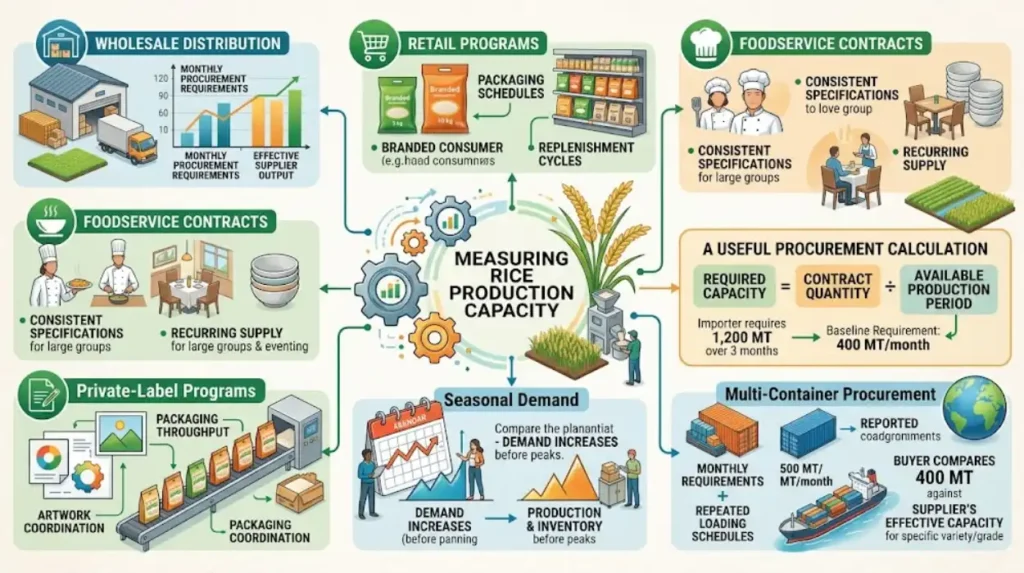
Production capacity is used to evaluate recurring purchase programs, container volumes, private-label orders, retail replenishment, foodservice contracts, seasonal demand, and distributor requirements. Each use case requires comparison between expected purchasing volume and repeatable export-ready output over a defined period.
For wholesale distribution, buyers compare monthly procurement requirements against effective supplier output.
For retail programs, capacity must support packaging schedules and replenishment cycles. Examples include 5 kg and 10 kg consumer bags.
For foodservice, buyers prioritize consistent specifications and recurring supply. Large restaurant groups need predictable availability across multiple orders.
For private-label programs, production capacity includes packaging and artwork coordination. A supplier needs enough packaging throughput to complete the required branded quantity.
For seasonal demand, procurement teams compare expected demand increases with available production and inventory. A supplier must have enough capacity before the demand period begins.
For multi-container procurement, buyers compare monthly requirements with loading schedules. A program requiring 500 MT each month needs production planning that supports repeated container release rather than one isolated shipment.
A useful procurement calculation is:
Required capacity = Contract quantity ÷ Available production period
If an importer requires 1,200 MT over 3 months, the baseline requirement is 400 MT per month. The buyer then compares 400 MT against the supplier’s effective capacity for the specified variety and grade.
What are common misconceptions about rice production capacity?
Production capacity is frequently misunderstood as the number on a mill specification sheet. Installed capacity represents theoretical machine output, while effective capacity reflects actual usable production after yield losses, maintenance, quality checks, packaging, storage constraints, labor availability, and export scheduling.
The first misconception is that installed capacity equals export capacity. It does not. A machine rated at a particular throughput does not prove that the same quantity reaches export-ready status.
The second misconception is that more machinery always means better supply reliability. Reliability depends on raw-material availability, maintenance, quality control, packaging, storage, and operational scheduling.
The third misconception is that production capacity is only a supplier’s concern. It directly affects the importer’s inventory planning, contract structure, delivery schedule, and replenishment cycle.
The fourth misconception is that one large shipment proves high capacity. A supplier can complete one large order from existing inventory without demonstrating the ability to reproduce the same volume every month.
The fifth misconception is that capacity is independent of product grade. It is not. A supplier producing 1121 White does not automatically have equivalent output for 1121 Steam because the processing route differs.
The sixth misconception is that quality controls reduce the value of production capacity. Proper quality control protects usable capacity by preventing large quantities of non-conforming rice from entering the export supply chain.
For importers, the strongest capacity assessment connects four numbers: required purchase volume, effective monthly production, available finished inventory, and scheduled export volume. This creates a practical comparison between demand and supply. For deeper insight explore:
How much production capacity an importer should require from a supplier
For a deeper procurement framework, the next consideration is determining the supplier capacity threshold that matches a specific import program. This requires comparing monthly requirements, shipment frequency, product specifications, safety stock, and supplier allocation.
Frequently Asked Questions
What is rice production capacity?
Rice production capacity is the quantity of rice a supplier can process, grade, package, and prepare for export within a defined period. It is usually measured in metric tons per day, month, or year.
Why is production capacity important in rice procurement?
Production capacity helps importers determine whether a supplier can consistently meet contracted quantities. It supports inventory planning, shipment scheduling, repeat orders, and long-term supply agreements.
How is rice production capacity measured?
Production capacity is measured through processing throughput, effective output, packaging capacity, storage availability, and export-ready production. Buyers should compare actual usable capacity rather than relying only on installed machinery capacity.
What is the difference between installed capacity and effective capacity?
Installed capacity is the maximum theoretical output of production equipment. Effective capacity is the quantity a supplier can realistically produce after accounting for maintenance, raw-material availability, quality controls, labor, storage, packaging, and operational constraints.
Which Pakistani rice varieties require production capacity planning?
Major Pakistani Basmati varieties requiring production planning include 1121 Basmati, Super Kernel Basmati, and 1509 Basmati. Each variety can have different processing, grading, packaging, and quality requirements.
Does production capacity differ between White, Steam, and Sella rice?
Yes. White, Steam, Sella, and Creamy Sella rice follow different processing routes. Steam and Sella products require additional steaming, parboiling, drying, and processing stages, which affect production scheduling and effective capacity.
How does production capacity affect rice shipment schedules?
Production capacity determines how quickly a supplier can process the required quantity before container loading. Higher effective capacity supports larger or more frequent shipments when packaging, storage, documentation, and logistics capacity are also available.