How Do Restaurants Evaluate Rice Quality Before Changing Suppliers?
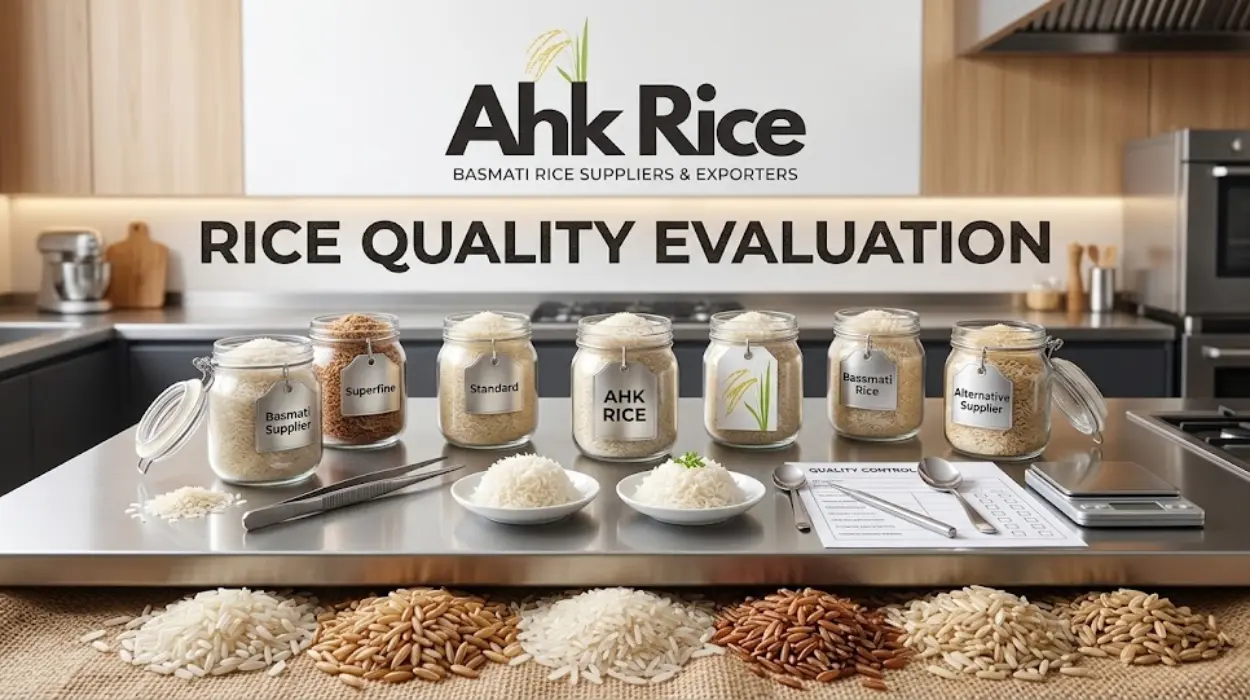
Restaurants should evaluate rice through a controlled supplier trial, not a single tasting. The strongest comparison combines raw-grain inspection, laboratory results, cooking tests, yield, holding performance, packaging, documentation, landed cost, and repeat samples from multiple production lots before final approval.
For New Hampshire operators, supplier evaluation matters because rice quality affects portion consistency, kitchen labor, food waste, customer experience, and menu presentation. Restaurants considering premium Pakistani Basmati can first review:
Why Are New Hampshire Restaurants Switching to Premium Basmati Rice? as the educational context for changing rice specifications. The evaluation should then move from general market demand to measurable product performance.
In 2026, Pakistan remains a major global rice supplier. USDA forecasts Pakistan’s 2026/27 rice production at about 9.8 million metric tons and exports at about 5.0 million metric tons. This gives restaurant buyers a substantial origin market to evaluate, but availability alone does not prove that a supplier can maintain the required specification across repeat shipments.
What are the available solutions for evaluating restaurant rice quality?
Restaurants have four practical evaluation routes: kitchen-only tasting, laboratory and specification review, pre-shipment inspection, and full supplier qualification. Each answers a different question, but the best decision combines them so product quality, safety, value, and supply reliability are evaluated together.
The first approach is a controlled kitchen trial. The restaurant cooks the candidate rice using the same equipment, water ratio, batch size, cooking time, resting period, and holding procedure used for its current supplier. This reveals whether the rice actually works in the kitchen.
The second approach is laboratory and specification testing. A laboratory can evaluate moisture, broken grains, foreign matter, damaged or discoloured grains, chalkiness, and other agreed parameters. These measurements convert the phrase “premium rice” into a defined purchasing specification.
The third approach is pre-shipment inspection. A third-party inspection company such as SGS, Bureau Veritas, or Intertek can inspect a commercial lot before loading. The objective is to verify that the shipment matches the approved specification rather than relying only on an earlier sample.
The fourth approach is supplier qualification. This examines the supplier’s processing controls, milling, grading, colour sorting, packaging, traceability, certificates, documentation, production capacity, sampling process, and shipment history. This is the most useful method for restaurant groups that need repeat supply.
For U.S. imports, the evaluation must also consider the Food and Drug Administration (FDA). Imported food must meet U.S. requirements, and facilities handling food must satisfy applicable FDA registration requirements. U.S. importers also have responsibilities under the Foreign Supplier Verification Program (FSVP), while Prior Notice is required for applicable imported food shipments.
How do different rice evaluation approaches compare?
The four approaches differ mainly in evidence depth, cost, speed, and repeatability. A cooking trial is fastest for menu performance, laboratory testing verifies specifications, inspection checks a shipment, and supplier qualification evaluates the system behind repeated deliveries across production lots.
| Attribute | Kitchen Cooking Trial | Laboratory Testing | Pre-Shipment Inspection | Supplier Qualification |
|---|---|---|---|---|
| Primary purpose | Measure actual cooking performance | Verify measurable product specifications | Confirm commercial shipment quality | Evaluate long-term supplier capability |
| Main evidence | Texture, aroma, expansion, yield | Moisture, broken grains, purity, foreign matter | Lot condition and specification compliance | Process controls, certificates, traceability, capacity |
| Speed | Fast | Fast to moderate | Conducted before shipment | Moderate to extensive |
| Cost | Low | Moderate | Moderate | Higher initial evaluation effort |
| Best use | Single restaurant or menu trial | Specification approval | First commercial order or repeat shipment | Restaurant groups and long-term contracts |
| Main limitation | Cannot prove supplier consistency | Cannot assess complete production system | Only covers the inspected lot | Requires more time and documentation |
| Recommended decision | Approve cooking performance | Approve measurable quality | Approve shipment release | Approve supplier relationship |
A kitchen trial is the best starting point because rice is ultimately judged by what happens after cooking. A sample can look long and clean but still produce inconsistent texture, excessive breakage, poor holding performance, or uneven expansion.
Laboratory testing then gives the cooking result measurable context. For example, a restaurant may prefer rice with low broken percentage because whole grains create stronger plate presentation and can reduce the amount of visibly broken rice served to customers.
Supplier qualification answers a different question: Can this supplier reproduce the approved result? That question becomes more important when a restaurant moves from a 20 kg sample to a container-scale purchase.
Which method works best for different restaurant cases?
Restaurant groups should match evaluation depth to operational risk. A single-location restaurant can begin with samples and a cook test. A multi-unit group needs batch testing, supplier audits, pre-shipment inspection, documentation review, and repeat-lot approval before changing its rice specification.
A single-location New Hampshire restaurant should begin with a controlled sample test. The restaurant should compare its existing rice against one or two candidate grades. The test should record raw grain appearance, cooking time, cooked yield, grain separation, aroma, texture, holding quality, and customer-facing presentation.
A restaurant serving biryani, pulao, or premium rice platters should prioritize grain length, aroma, elongation, separation, and cooked texture. 1121 Steam Basmati is a strong candidate for this type of test because its premium positioning emphasizes long grain, aroma, and fresh-service presentation. 1121 and premium Pakistani Basmati options through AHK Rice’s USA export service.
A high-volume catering kitchen needs a different evaluation. It should test large-batch cooking, holding time, reheating, handling, and resistance to breakage. Sella or parboiled formats can become more relevant when the kitchen prepares large quantities in advance.
A multi-location restaurant group should not change suppliers after one successful sample. Procurement teams should approve the product specification, test more than one lot, review supplier quality controls, and establish a pre-shipment inspection procedure.
A restaurant distributor serving multiple customers should evaluate the supplier at the supply-chain level. The distributor needs consistent packaging, documentation, labeling, shelf-life information, shipment scheduling, and product specifications because one inconsistent shipment can affect several restaurant accounts.
What are the pros and cons of each rice quality evaluation strategy?
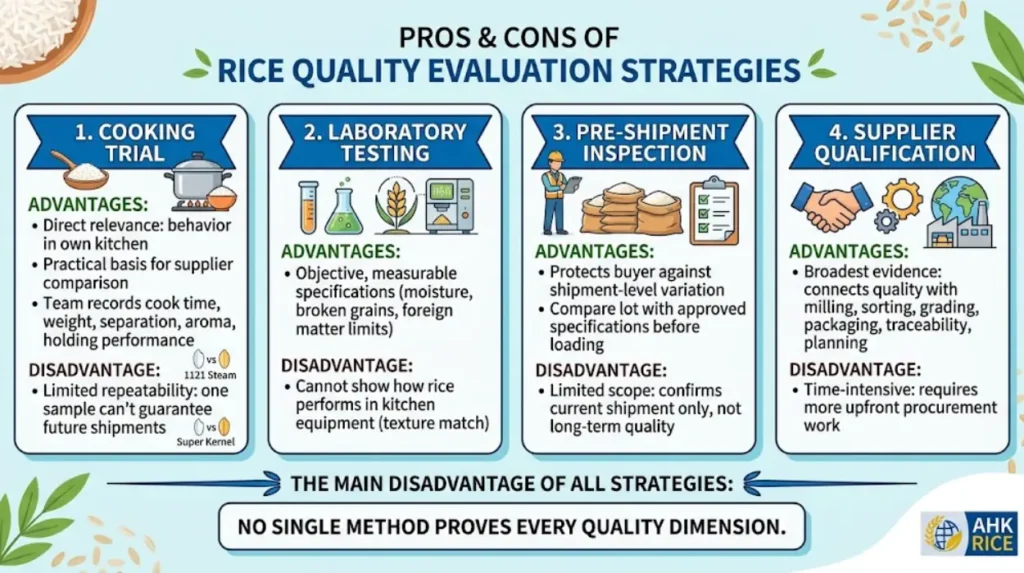
A cooking trial provides the strongest evidence of menu performance, laboratory testing provides measurable specifications, inspection provides shipment-level control, and supplier qualification provides long-term supply evidence; the main disadvantage is that no single method proves every quality dimension.
What are the advantages of a cooking trial?
The main advantage is direct relevance. The restaurant sees exactly how the rice behaves in its own kitchen.
For example, a chef can compare 1121 Steam against Super Kernel using the same 5 kg batch. The team can record cooking time, cooked weight, grain separation, aroma, and holding performance. This creates a practical basis for supplier comparison.
The limitation is repeatability. One sample cannot prove that every future shipment will perform identically.
What are the advantages of laboratory testing?
Laboratory testing creates objective measurements. A specification can state maximum moisture, maximum broken grains, foreign matter limits, and other quality requirements.
The limitation is that a laboratory report cannot show how rice performs in a restaurant’s cooking equipment. A technically compliant sample can still fail a kitchen trial if the texture does not match the menu.
What are the advantages of pre-shipment inspection?
Pre-shipment inspection protects the buyer against shipment-level variation. The inspector can compare the commercial lot with the approved specification before loading.
The limitation is scope. Inspection confirms a particular shipment. It does not automatically prove that the supplier will maintain the same quality six months later.
What are the advantages of supplier qualification?
Supplier qualification provides the broadest evidence. It connects product quality with milling, sorting, grading, packaging, testing, documentation, traceability, and production planning.
The limitation is time. It requires more procurement work before the first commercial shipment.
AHK Rice describes its export operation as covering sourcing, processing, grading, colour sorting, customized packaging, documentation, and container loading. Its published USA service also describes sample approval, processing, packaging, quality inspection, and shipment coordination.
How do New England and Gulf restaurant markets compare when selecting rice?
New England restaurants generally prioritize premium Steam and White Basmati for aroma, long-grain presentation, and fresh service, while Gulf foodservice buyers place stronger emphasis on Sella grades for firm separation, bulk cooking, holding, and dishes such as mandi and kabsa.
| Market region | Common restaurant preference | 2026 price reference | Shelf-life planning | Main quality priority |
| New England, USA | 1121 Steam, 1121 White, Super Kernel | 1121 Steam about $1,160–$1,200/MT FOB Karachi | Up to 24 months under suitable storage | Aroma, elongation, texture, FDA/FSVP compliance |
| Saudi Arabia / GCC | 1121 Sella, Golden Sella, 1509 Sella, 1121 Steam | 1121 Sella about $1,135–$1,175/MT FOB; about $1,313–$1,353/MT CNF Jeddah/Dammam including indicative $178/MT freight | About 18–24 months depending on grade and storage | Separation, bulk cooking, holding, packaging |
The New England price benchmark is an origin price. Current published August 2026 references place 1121 Steam at approximately $1,160–$1,200 per metric ton FOB Karachi. Super Kernel is around $1,165–$1,205/MT. These are indicative origin prices rather than fixed restaurant quotations.
Freight adds a significant destination component. A current Karachi-to-Boston FCL reference shows an estimated 31-day transit and a 40-foot-high-cube ocean rate of approximately $9,652–$10,473. At an illustrative 27 MT load, that represents roughly $357–$388/MT of ocean freight before destination charges. Actual payload, carrier, surcharge, port, customs, and inland costs must be confirmed for the shipment.
Saudi Arabia has a different cost structure. Current August 2026 references show 1121 Sella around $1,135–$1,175/MT FOB Karachi, with an indicative $178/MT freight component and CNF pricing around $1,313–$1,353/MT for Jeddah or Dammam.
Shelf life should not be used as the only reason to select a grade. Published commercial specifications commonly place premium Basmati shelf life around 24 months when stored under suitable cool, dry conditions. Contract specifications should state the actual shelf-life requirement for the product and packaging.
What decision factors should restaurants use before changing rice suppliers?
The best decision factors are cooked performance, grain specification, broken percentage, moisture, purity, food-safety controls, shelf life, packaging, price, freight, documentation, and replenishment reliability. Restaurants should score these factors against their menu, production volume, storage conditions, and acceptable landed cost.
| Decision factor | What the restaurant should verify | Example approval standard |
| Cooking performance | Texture, aroma, expansion, separation and yield | Matches current kitchen recipe or improves it |
| Physical specification | Grain length, broken percentage, moisture and purity | Written specification approved before production |
| Food safety | Facility registration, supplier controls and relevant certificates | Documentation reviewed before commercial order |
| Commercial value | FOB/CNF price, freight, packaging and waste | Lower total cost without sacrificing performance |
| Supply reliability | Production capacity, lead time, inspection and replenishment | Repeatable shipments against the approved specification |
Grain length matters because it affects visual presentation. 1121 Basmati commonly occupies a premium long-grain position, while Super Kernel provides a different balance of grain profile and aroma. 1509 can provide another option when the buyer wants long-grain performance with a different cost position. Current 2026 published benchmarks place 1121 grades broadly around $1,135–$1,205/MT FOB depending on processing, while published 1509 references vary more widely by grade and destination.
Broken percentage should be treated as a commercial specification rather than a marketing phrase. Premium Basmati contracts commonly target around 0–2% broken, but the exact tolerance should be written into the purchase specification.
Moisture affects storage and cooking consistency. The buyer should establish a contractual moisture limit and verify that the supplier measures it consistently.
Purity and foreign matter affect preparation, food safety, and customer confidence. The restaurant should request defined limits instead of accepting a general statement such as “export quality.”
Food-safety documentation is essential for U.S. imports. FDA states that imported food must comply with U.S. legal requirements, while applicable facilities must be registered and importers must follow Prior Notice requirements. FSVP also places verification responsibilities on U.S. food importers.
Packaging should match restaurant storage and handling. Food-grade PP woven bags, laminated bags, and custom formats can serve different procurement models. The specification should state bag weight, material, labeling, batch identification, and protection against moisture exposure.
Landed cost is more important than FOB price alone. A restaurant should compare rice price, ocean freight, insurance where applicable, port charges, customs-related costs, inland transportation, inspection, packaging, and expected product loss.
Replenishment reliability completes the evaluation. A restaurant can accept a slightly higher rice price when the supplier provides consistent specifications, predictable production, clear documentation, and reliable shipment planning.
For New Hampshire restaurants, the strongest supplier-change process therefore follows a sequence: define the specification, test samples in the actual kitchen, verify laboratory results, compare commercial costs, review compliance documentation, inspect the first commercial lot, and monitor repeat shipments.
This process separates rice quality from supplier quality. Rice quality describes what is in the bag. Supplier quality describes the ability to keep putting the same product in the bag.
That distinction is critical when evaluating a long-term Pakistani Basmati supplier. A supplier can offer 1121, Super Kernel, and 1509, but the restaurant should select the grade according to its cooking method, menu, volume, storage conditions, and target cost rather than choosing only by variety name.
The decision-focused next step is to compare the approved specification with an actual commercial supply program for New Hampshire restaurants:
Supply New Hampshire Restaurants with Premium AHK Rice Varieties.
Frequently Asked Questions
What quality factors do restaurants check before changing rice suppliers?
Restaurants typically evaluate grain length, broken-grain percentage, moisture, aroma, purity, cooking performance, color, texture, and consistency between lots. They also compare packaging quality, documentation, delivery reliability, and the supplier’s ability to maintain the agreed specification.
How do restaurants test rice cooking performance?
Restaurants prepare a sample using their normal cooking method and compare water absorption, expansion, cooking time, aroma, texture, separation, and appearance. For Basmati rice, they often assess whether grains elongate properly while remaining separate rather than becoming sticky or excessively soft.
Why is grain length important when evaluating Basmati rice?
Grain length affects visual presentation, portion appearance, cooking behavior, and customer expectations. Restaurants may compare raw and cooked grain length to confirm that the rice matches the specification they require for dishes such as biryani, pulao, and rice platters.
How do restaurants evaluate rice purity?
Buyers review the percentage of foreign matter, damaged grains, discolored grains, stones, husk, and other impurities. They may also request laboratory analysis or quality reports to verify that the delivered rice meets the agreed food-quality and purity specifications.
What moisture level do restaurants look for in rice?
Restaurants generally want rice with controlled moisture because excessive moisture can affect storage stability, milling quality, cooking consistency, and shelf life. The exact acceptable range depends on the rice variety, grade, contract specification, and applicable quality standards.