Why Do UK Importers Review Broken Percentages Before Buying Basmati Rice?
UK importers review broken percentages before buying Basmati rice because broken grains directly affect cooking performance, visual appearance, retail value, and compliance with purchase specifications. Here is why: lower broken percentages deliver better grain uniformity, higher consumer acceptance, and stronger commercial returns across wholesale and retail markets.
Basmati rice remains one of the most imported specialty rice categories in the United Kingdom. Importers evaluate grain length, moisture content, purity, crop year, and broken percentage before placing orders. Among these specifications, broken percentage serves as a measurable quality indicator. It helps buyers compare suppliers, calculate value, and select the correct grade for their target customers.
Pakistan and India supply most of the Basmati rice imported into the UK. Buyers inspect every shipment against predefined specifications before approving contracts. Broken percentage plays a central role in that evaluation process because it directly impacts product consistency.
What Does Broken Percentage Mean in Basmati Rice?
Broken percentage represents the proportion of grains measuring less than three-fourths of the original grain length. Lower percentages indicate higher quality grades and stronger market value.
Broken rice forms during harvesting, milling, handling, transportation, and packaging. Every rice-producing country measures broken grains according to established grading standards.
Basmati rice naturally contains some broken kernels after processing. Rice mills sort and grade rice according to the quantity of broken grains present in each batch. Buyers then purchase the grade that matches their intended use.
For example, a 2% broken specification contains significantly fewer broken grains than a 10% broken specification. Retail supermarkets generally prefer lower percentages. Food manufacturers often accept higher percentages.
Broken percentage functions as a universal quality language between exporters and importers. It creates a measurable standard for international trade.
With broken percentage defined, the next question is why UK buyers place such importance on this specification.
Why Do UK Importers Pay Close Attention to Broken Percentages?
Consumer expectations, retail presentation, and product consistency make broken percentage a critical purchasing factor for UK importers.
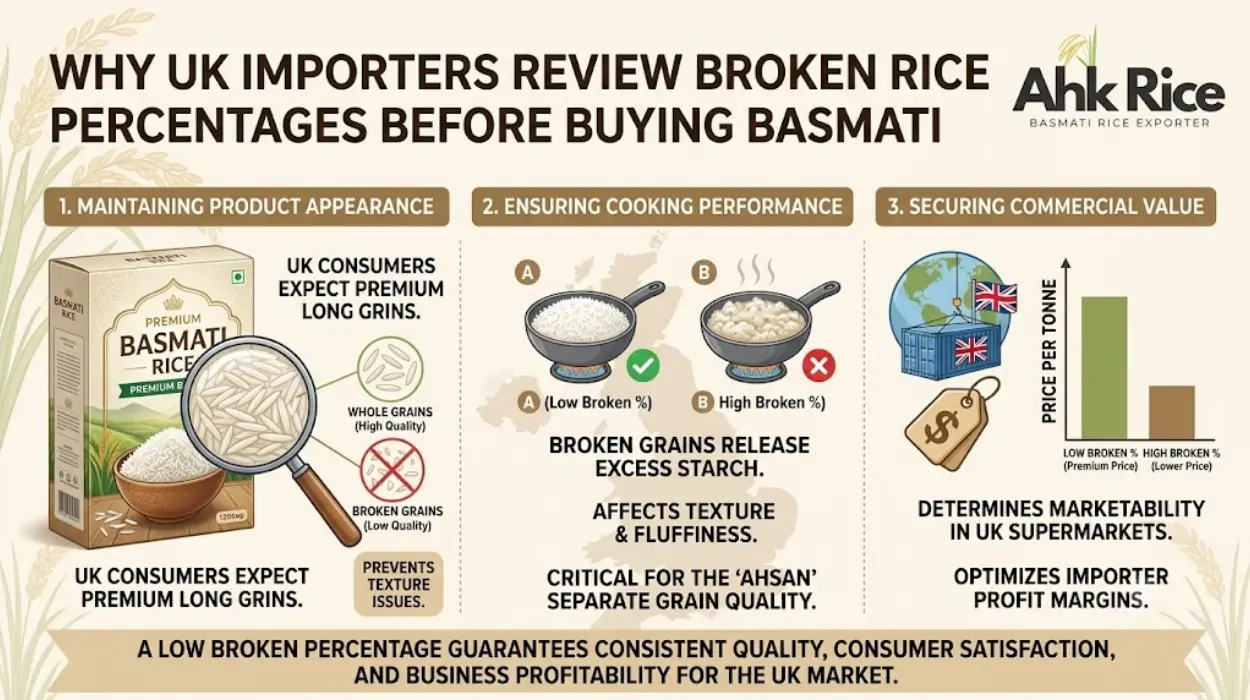
UK consumers associate long grains with premium Basmati quality. Whole grains create a visually attractive product on retail shelves and after cooking.
Retail brands compete through appearance. Uniform grains strengthen consumer confidence and improve repeat purchases. Higher broken percentages reduce visual consistency and weaken product presentation.
Food service distributors also monitor broken percentages. Restaurants serving premium South Asian cuisine prefer long, separate grains after cooking. Lower broken content supports this requirement.
Importers use broken percentages to calculate value. A shipment containing 2% broken rice commands a higher price than a shipment containing 10% broken rice because buyers receive more intact grains.
Import regulations and contractual agreements often include detailed quality specifications. Broken percentage appears alongside moisture, purity, grain length, and damaged grain limits.
Understanding buyer priorities leads directly to the classification system used in international rice trade.
How Are Broken Rice Grades Classified in International Basmati Trade?
International Basmati trade commonly uses specifications ranging from 1% to 25% broken, with lower percentages receiving premium classification.
Importers purchase rice according to agreed quality standards rather than general descriptions. Each grade corresponds to measurable specifications.
Premium Export Grades
Premium grades contain very low broken content.
| Grade | Typical Broken Percentage |
|---|---|
| Extra Premium | 1–2% |
| Premium | 2–5% |
| Standard Premium | 5% |
Premium grades dominate supermarket and retail channels.
Commercial Grades
Commercial grades balance quality and affordability.
| Grade | Typical Broken Percentage |
|---|---|
| Commercial | 5–10% |
| Value Grade | 10–15% |
| Industrial Grade | 15–25% |
Commercial grades serve food manufacturers, catering companies, and institutional buyers.
Readers seeking a detailed explanation of international grading standards can explore our article discussing how exporters classify rice according to grain breakage and trade specifications: [Insert Link to MOFU Article].
With classification established, the next topic is how broken grains develop during processing.
How Does Broken Rice Occur During Basmati Processing?
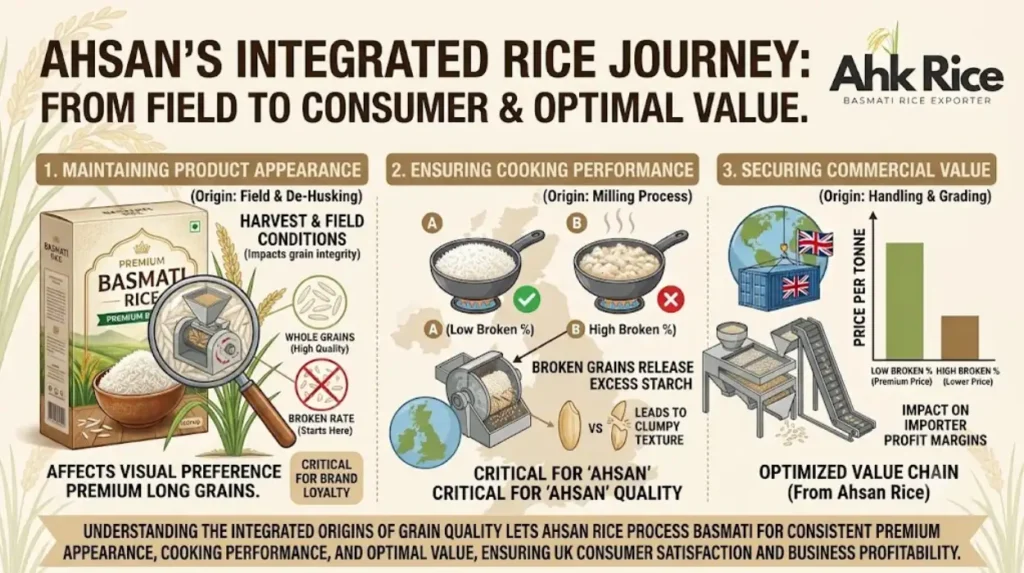
Mechanical stress during harvesting, drying, milling, polishing, and handling creates broken grains within every rice production cycle.
Basmati rice begins as paddy harvested from fields across Punjab and other rice-growing regions. Farmers cultivate and harvest mature crops before transferring paddy to processing facilities.
Rice mills follow a structured process:
- Clean the paddy.
- Dry the grain.
- Dehusk the kernels.
- Separate husk material.
- Polish the rice.
- Grade by size.
- Sort by colour.
- Inspect quality.
- Package the product.
Each stage introduces physical pressure. Excessive drying increases grain brittleness. Aggressive milling creates fractures. Poor handling damages kernels during transportation.
Modern processing facilities reduce breakage through automated equipment and controlled moisture management.
Broken percentage therefore reflects both crop quality and processing efficiency.
Understanding the causes of breakage helps explain the benefits of maintaining lower broken percentages.
What Benefits Do Lower Broken Percentages Provide?
Better appearance, improved cooking performance, higher resale value, and stronger consumer acceptance make lower broken percentages desirable.
Long Basmati grains create a premium visual impression before cooking. Consumers immediately recognize grain uniformity.
Cooking performance also improves. Whole grains expand more consistently and maintain separation after preparation.
Lower broken percentages support stronger retail branding. Packaged rice displaying uniform grain structure attracts quality-conscious consumers.
Commercial value increases as broken percentages decrease. Premium grades generate higher margins across wholesale and retail channels.
Storage performance also benefits. Intact grains experience less dust generation during handling and transportation.
These advantages explain why different industries purchase different broken-grade specifications.
Which Industries Use Different Broken Rice Grades?
Retailers prefer lower broken percentages, while manufacturers and institutional buyers often select higher broken grades for cost efficiency.
Retail Supermarkets
Retail chains generally source rice containing 1–5% broken grains. Consumers expect premium presentation and cooking quality.
Restaurants and Catering Businesses
Food service operators commonly purchase 2–10% broken grades. The chosen specification depends on menu positioning and budget requirements.
Food Manufacturing
Manufacturers producing rice flour, rice snacks, breakfast cereals, and processed foods frequently use 10–25% broken grades.
Institutional Procurement
Schools, hospitals, and large catering contracts often balance quality and cost through commercial-grade specifications.
Each market segment evaluates broken percentage according to its operational goals.
These varying applications create several misconceptions among new buyers.
What Misconceptions Exist About Broken Rice Percentages?
Broken rice does not indicate contamination, spoilage, or unsafe food. It indicates grain size classification within a quality grading system.
Many first-time buyers assume broken rice represents poor-quality rice. This assumption ignores how rice grading works.
Broken grains remain edible and nutritious. Nutritional composition remains largely unchanged because breakage affects physical structure rather than food safety.
Another misconception states that all broken rice cooks poorly. Cooking performance depends on the intended application. Processed foods often perform effectively with higher broken grades.
Some buyers believe every shipment should contain zero broken grains. Commercial rice production does not eliminate breakage entirely. International standards recognize acceptable percentages within every grade category.
Understanding these misconceptions allows buyers to evaluate specifications objectively.
The final consideration involves certifications and quality controls used during export.
Which Certifications and Quality Controls Support Basmati Rice Exports?
Laboratory testing, export inspections, food safety certifications, and documented quality controls verify broken percentages and product compliance.
Exporters inspect rice before shipment. Quality teams test grain length, moisture content, purity, and broken percentage.
Common certifications include:
- ISO 22000
- HACCP
- BRCGS
- FDA Registration
- Phytosanitary Certification
- Fumigation Certification
- Certificate of Origin
Laboratories verify specification compliance before containers are loaded and shipped.
Pakistan remains one of the world’s largest rice exporters, shipping millions of tonnes annually to global markets including the United Kingdom, Europe, the Middle East, and Africa (source: Pakistan Bureau of Statistics, FY2024-25).
Quality verification protects buyers and sellers by ensuring every shipment matches contractual specifications.
Broken percentage therefore functions as both a quality measurement and a commercial decision-making tool throughout the international Basmati trade chain.
UK importers review broken percentages because grain breakage affects product quality, consumer perception, cooking performance, and commercial value. Broken percentage provides a standardized method for comparing rice grades across suppliers and exporting countries. Lower broken percentages support premium retail markets, while higher grades serve manufacturing and institutional applications. Understanding broken rice classification helps buyers select the correct Basmati specification for their intended market.
Frequently Asked Questions
What is an acceptable broken percentage for premium Basmati rice?
Premium Basmati rice generally contains 1% to 5% broken grains, depending on the buyer’s specification.
Does broken rice reduce nutritional value?
No. Broken rice maintains nearly the same nutritional composition as whole rice because only grain size changes.
Why is lower broken rice more expensive?
Lower broken percentages require stricter grading and sorting processes, which increase processing costs and market value.
Do UK supermarkets prefer low broken percentages?
Yes. Most supermarkets prefer 1–5% broken grades because consumers expect uniform grain appearance.
How is broken percentage measured?
Quality inspectors separate broken grains from whole grains and calculate the percentage by weight according to grading standards.
Is broken rice safe to eat?
Yes. Broken rice is completely safe to consume and remains widely used in food manufacturing and commercial cooking.