Which Pakistani Rice Grade Do Chinese Importers Buy Most in 2026?
Pakistani rice grade Chinese importers buy most in 2026 is 1121 Steam Basmati, followed closely by 1509 Steam for cost-sensitive bulk demand. Here is why: China prioritizes long grain elongation, stable cooking texture, and consistent milling recovery under commercial catering and re-export requirements.
China’s import demand is shaped by large-scale food service chains, rice blending factories, and re-export traders. These buyers evaluate grain length, aroma retention, and broken percentage before price.
In parallel, exporters like AHK Rice structure supply using controlled milling, grading, and polishing systems to match these exact expectations.
Explore deeper grading structures in the ToFu guide on Pakistani rice grades and export classification for foundational understanding of basmati segmentation.
For procurement alignment and trade execution, the AHK Rice China 1509 basmati wholesale importers quote service page provides commercial-grade pricing structure for bulk buyers entering China distribution channels.
What are the available Pakistani rice grade solutions for China importers?
Available solutions include 1121 Steam Basmati, 1121 Sella Basmati, 1509 Steam Rice, 1509 Sella Rice, and Super Kernel Basmati, each serving different Chinese industrial and retail consumption tiers with distinct grain length, aroma intensity, and milling recovery behavior.
Chinese importers do not buy rice as a single commodity. They buy structured grade systems.
1121 Basmati (Premium Long Grain Export Grade)
1121 Basmati dominates high-end food service supply. It delivers long grain expansion after cooking.
- Grain length: 8.05–8.30 mm
- Aroma level: High natural basmati fragrance
- Market role: Premium restaurants and branded retail packs
1509 Basmati (High Yield Commercial Grade)
1509 Basmati targets cost-driven importers in China.
- Grain length: 7.2–7.5 mm
- Milling yield: High head rice recovery
- Market role: Bulk catering and institutional kitchens
Super Kernel Basmati (Mid Premium Blend Grade)
Super Kernel balances aroma and cost efficiency.
- Grain profile: Medium-long aromatic grain
- Usage: Mixed retail packs and trading re-export
Processing Types Across All Grades
- Steam processing preserves grain strength and elongation
- Sella (parboiled) processing increases shelf stability
- Raw milling enhances aroma but reduces storage life
With grade options defined, the next step is understanding how these solutions compare under export conditions.
How do different Pakistani rice grades compare for China importers?
1121 Steam leads in premium segmentation, 1509 Steam dominates bulk trade, and Sella variants outperform in storage-heavy supply chains due to higher moisture stability and reduced breakage risk during long shipping cycles.
China evaluates rice using measurable trade parameters, not branding.
Specification Comparison Table (7 Attributes)
| Attribute | 1121 Steam | 1509 Steam | Super Kernel | 1121 Sella | 1509 Sella | White Raw Rice | Parboiled Strength |
|---|---|---|---|---|---|---|---|
| Grain Length | 8.1 mm | 7.4 mm | 7.0 mm | 8.2 mm | 7.5 mm | 6.8–7.2 mm | High |
| Aroma Level | High | Medium | Medium-High | High | Medium | Medium | Medium |
| Broken Ratio | Low | Medium | Medium | Very Low | Low | Medium-High | Controlled |
| Cooking Expansion | Very High | High | Medium | Very High | High | Medium | Stable |
| Shelf Stability | 12 months | 12 months | 14 months | 18 months | 18 months | 9–12 months | High |
| Export Demand (China) | High | Very High | Medium | Medium | High | Low | High |
| Price per MT | High | Medium | Medium | High | Medium | Low | Variable |
Steam processing improves aroma retention, while Sella processing increases durability for logistics-heavy routes.
With these comparisons established, the decision shifts toward market-specific usage patterns.
Which Pakistani rice method works best for different import cases in China and Middle East?
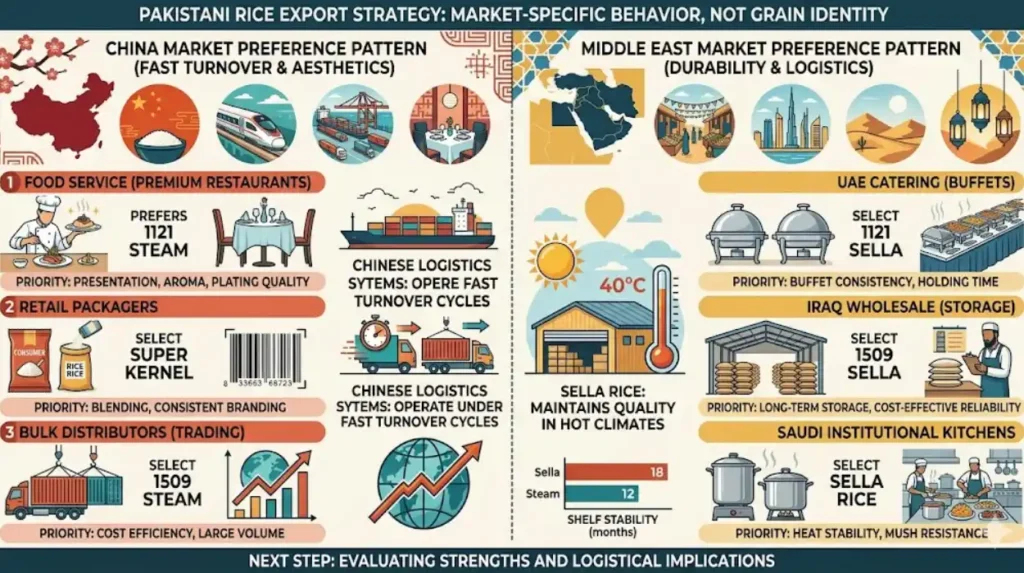
China prefers 1121 Steam for premium restaurants and 1509 Steam for bulk trading, while Middle East markets prefer Sella rice due to longer storage cycles, higher heat resistance, and extended shelf stability in non-refrigerated warehouses.
Market selection depends on consumption structure, not grain identity.
China Market Preference Pattern
China imports focus on three buyer types.
- Food service buyers select 1121 Steam for plating quality
- Retail packagers select Super Kernel for blended SKUs
- Bulk distributors select 1509 Steam for cost efficiency
Chinese logistics systems operate under fast turnover cycles. Steam rice performs well because it retains aroma during short storage.
Middle East Market Preference Pattern
Middle East importers prioritize durability.
- UAE catering buyers select 1121 Sella for buffet consistency
- Iraq wholesale traders select 1509 Sella for warehouse storage
- Saudi institutional kitchens select Sella rice for heat stability
Sella rice maintains quality longer in hot climates. In 40°C warehouse conditions, Sella maintains structure for 18 months, while Steam typically lasts 12 months.
With market-specific behavior defined, the next step is evaluating strengths and weaknesses.
What are the pros and cons of each Pakistani rice grade for China import trade?
1121 Steam delivers premium aroma and export branding strength, while 1509 Steam delivers cost efficiency at scale, and Sella rice provides logistics stability but slightly reduced aroma intensity compared to fresh-milled Steam variants.
Each grade creates a different trade advantage.
1121 Steam Advantages
- High aroma retention during cooking
- Strong branding for premium retail packs
- Excellent grain elongation after boiling
1121 Steam Limitations
- Higher procurement cost per MT
- Sensitive to long warehouse storage
1509 Steam Advantages
- High volume supply stability
- Lower cost per MT for bulk buyers
- Strong milling recovery ratio
1509 Steam Limitations
- Lower aromatic intensity than 1121
- Less suitable for luxury retail branding
Sella Rice Advantages
- Extended shelf life up to 18 months
- Strong resistance to humidity damage
- Stable shipping performance across long routes
Sella Rice Limitations
- Slightly firmer texture after cooking
- Lower fragrance compared to Steam grades
These trade-offs directly influence procurement decisions across China and neighboring export markets.
What decision factors determine Pakistani rice grade selection for China importers?
Decision factors include grain length requirements, target price per MT, storage duration, buyer segment type, and cooking performance expectations, with each factor directly influencing whether importers choose 1121, 1509, or Sella-based rice solutions.
China import decisions are structured, not emotional.
Decision Framework Table (5 Factors)
| Factor | 1121 Steam | 1509 Steam | Sella Variants | Super Kernel | Best Fit Outcome |
|---|---|---|---|---|---|
| Budget Sensitivity | Low | High | Medium | Medium | 1509 Steam |
| Aroma Requirement | Very High | Medium | Medium | High | 1121 Steam |
| Storage Duration | Medium | Medium | High | High | Sella Rice |
| Retail Branding | Very Strong | Moderate | Moderate | Strong | 1121 Steam |
| Bulk Supply Stability | Medium | Very High | High | High | 1509 Steam |
Trade Selection Logic
- Importers choose 1121 Steam when premium branding matters
- Importers choose 1509 Steam when cost efficiency dominates
- Importers choose Sella rice when logistics stability is critical
China’s rice procurement model prioritizes consistency across shipments rather than single-batch quality spikes.
With decision factors clarified, the final selection depends on aligning grade structure with market application.
Final market conclusion for Pakistani rice grade demand in China 2026
1121 Steam Basmati remains the most preferred premium-grade rice in China, while 1509 Steam dominates total volume imports due to its cost efficiency and stable milling yield across industrial supply chains.
China’s rice import structure is divided into premium dining consumption and bulk institutional procurement.
1121 Steam captures high-value restaurant branding and retail positioning.
1509 Steam captures large-scale catering, trading, and repackaging flows.
Sella rice supports climate-heavy storage routes across secondary distribution hubs.
AHK Rice aligns production through milling, grading, polishing, and export dispatch systems tailored to each segment, ensuring consistent compliance with China’s import requirements.
Frequently Asked Questions
Which Pakistani rice grade do Chinese importers buy most in 2026?
Chinese importers primarily buy 1121 Steam Basmati for premium demand and 1509 Steam for bulk commercial supply. 1121 Steam serves high-end restaurants, while 1509 Steam dominates large-volume trading and catering channels due to lower cost and stable milling output.
Why do Chinese buyers prefer 1509 Basmati for bulk imports?
Chinese buyers prefer 1509 Basmati because it offers high yield, lower price per MT, and consistent grain recovery during milling and repacking. It supports large-scale food service operations where cost efficiency matters more than strong aroma intensity.
Is 1121 Steam better than Sella rice for China?
1121 Steam is better for premium aroma and restaurant presentation, while Sella rice is better for long storage and hot climate logistics. Steam performs best in fast-moving supply chains, while Sella performs best in long-term warehouse storage.
What affects Pakistani rice grade pricing in China imports?
Pricing depends on grain length, broken percentage, aroma level, and processing type such as Steam or Sella. Higher grain uniformity and better polishing increase price per MT, while higher broken ratios reduce export value.
Which rice grade is best for long-distance shipping to China?
Sella rice, especially 1509 Sella and 1121 Sella, is best for long-distance shipping because it maintains structure, resists moisture damage, and stays stable for up to 18 months in storage conditions.